PUBLISHER: Mordor Intelligence | PRODUCT CODE: 2116147

PUBLISHER: Mordor Intelligence | PRODUCT CODE: 2116147
Corneal Implants - Market Share Analysis, Industry Trends & Statistics, Growth Forecasts (2026 - 2031)
According to Mordor Intelligence, corneal implants market size in 2026 is estimated at USD 514.69 million, growing from 2025 value of USD 484.74 million with 2031 projections showing USD 694.62 million, growing at 6.18% CAGR over 2026-2031.
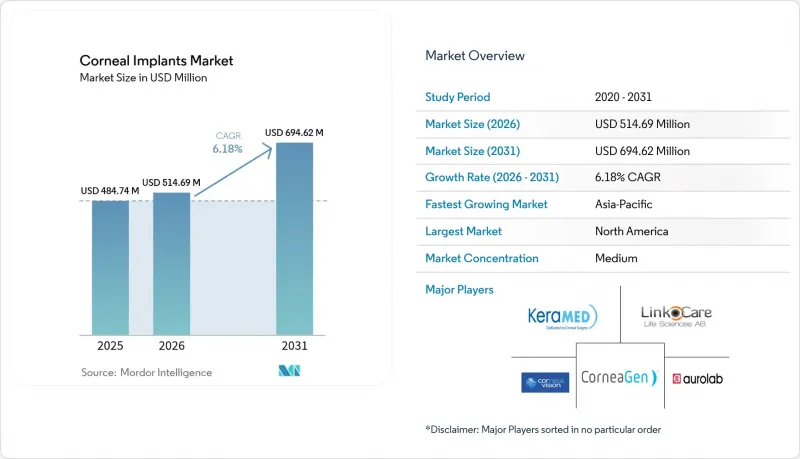
This report Segments the Industry Into by Implant Type (Artificial Corneal Implant, Human Donor Corneal Implant), by Procedure Type (Endothelial Keratoplasty, Penetrating Keratoplasty, and More), by Disease Indication (Keratoconus, Fuschs' Dystrophy, and More), by End User (Hospitals, Ambulatory Surgical Centers, and More), and Geography (North America, Europe, Asia-Pacific, and More).
Global Corneal Implants Market Trends and Insights
Technological Advancements in Corneal Implants
Cross-linked recombinant collagen scaffolds sustained clear corneal regeneration for four years, delivering mean corrected acuity of 20/54 without immunosuppression needs. Patient-specific 3-D-printed lenticules now match individual curvature, solving donor-shortage bottlenecks while lowering rejection risk. Kuragel hydrogel matrices show superior stromal integration versus legacy PMMA designs. Coupling femtosecond lasers with these bio-scaffolds reduces operating time and improves wound integrity. Collectively, these gains broaden the addressable base of the corneal implants market by upgrading clinical outcomes and surgeon confidence.
Growing Incidences of Corneal Disorders & Blindness in Elderly
Fuchs' endothelial dystrophy affects 4% of U.S. adults over 40, with prevalence climbing steeply after age 60. Medicare data links advanced cases to rising treatment spending, underscoring the economic imperative for definitive surgical cures. Longer life expectancy and heavy digital-device use exacerbate dry-eye and accelerates surface degeneration. Improved safety profiles entice older patients who previously deferred surgery, propelling steady procedure growth.
High Cost of Keratoprosthesis & Surgery
A single Boston Keratoprosthesis procedure can exceed USD 30,000 once lifelong follow-up is factored. Reimbursement growth lags inflation, curbing facility investment. Device makers also face 20% of revenue tied to supply-chain expenses, challenging price flexibility. Consequently, cash-strapped health systems delay adoption or choose donor grafts instead.
Other drivers and restraints analyzed in the detailed report include:
- Rising Adoption of Minimally-Invasive Lamellar Keratoplasty
- Advances in Bioengineered Synthetic Endothelial Layers
- Availability of Alternative Treatments
For complete list of drivers and restraints, kindly check the Table Of Contents.
Segment Analysis
Human donor grafts provided 69.15% of corneal implants market revenue in 2025, supported by decades of surgical standardization. Artificial devices, however, are growing 7.12% per year as breakthrough designations speed approvals. EyeYon Medical's EndoArt membrane cut mean central corneal thickness from 759 µm to 613 µm at 12 months, validating synthetic viability. The Boston Keratoprosthesis tops 20,000 implants worldwide. Newer hydrogel-based optics now promote cellular in-growth, a marked upgrade over inert PMMA. Collectively, these trends reposition the artificial slice of the corneal implants market for sustained share capture through 2031.
Continued donor shortages sustain waitlists, prompting surgeons to trial synthetic options even as they refine tissue matching algorithms in eye banks. Manufacturing scale-up keeps average device costs on a gradual downward path, though specialty follow-up still commands premium fees. Convergence of bioprinting and collagen scaffolds is expected to lift the corneal implants market size for artificial devices at the fastest clip within this decade.
Penetrating keratoplasty retained 45.92% of global revenue during 2025, yet endothelial keratoplasty is tracking a 6.9% CAGR on superior visual recovery profiles. A 75% 10-year graft survival rate with minimal rejection propels surgeon preference for DMEK. Laser-assisted incisions lower induced astigmatism, which once deterred adoption. Cell-therapy infusions under development promise to merge pharmacologic convenience with surgical durability.
Rising comfort with partial-thickness grafts is redirecting capital budgets toward lamellar instrumentation. The corneal implants market share held by full-thickness techniques will likely shrink as payers reward quicker rehabilitation and fewer complications. Training programs now prioritize lamellar skills, reinforcing momentum.
Complete Report Scope:
- By Implant Type
- Artificial Corneal Implant
- Human Donor Corneal Implant
- By Procedure Type
- Endothelial Keratoplasty
- Penetrating Keratoplasty
- Anterior Lamellar Keratoplasty
- Intrastromal Corneal Ring Segment Implantation
- By Disease Indication
- Keratoconus
- Fuchs' Dystrophy
- Infectious Keratitis
- Corneal Ulcers
- Corneal Edema
- Other Indications
- By End User
- Hospitals
- Ambulatory Surgical Centers
- Ophthalmic Specialty Clinics
- Others
- By Material
- Collagen-based Biomaterials
- PMMA & Other Polymers
- Hydrogels & Hydrophilic Acrylic
- Others
- Geography
- North America
- United States
- Canada
- Mexico
- Europe
- Germany
- United Kingdom
- France
- Italy
- Spain
- Rest of Europe
- Asia-Pacific
- China
- Japan
- India
- Australia
- South Korea
- Rest of Asia-Pacific
- Middle East and Africa
- GCC
- South Africa
- Rest of Middle East and Africa
- South America
- Brazil
- Argentina
- Rest of South America
- North America
Geography Analysis
North America controlled 50.92% of global revenue in 2025 owing to FDA breakthrough pathways, eye-bank maturity, and Medicare's separate tissue reimbursement. Academic hubs such as Mass Eye and Ear partner with device firms to pilot next-gen implants, sustaining a tight innovation loop. Breakthrough designations for products like EndoArt further shorten time-to-clinic. Even so, supply-chain vigilance around PMMA imports remains on strategic watchlists.
Asia-Pacific is the fastest-advancing territory with an 7.7% CAGR through 2031. India alone carries 6.8 million corneal-blind individuals, adding 25,000-30,000 new cases yearly. Eye-bank deficits and surgeon shortages open space for shelf-stable synthetics. Government blindness-eradication drives plus rising middle-class spending underpin procedure volume growth, cementing the region as a critical demand node for the corneal implants market.
Europe shows steady uptake under the Medical Device Regulation introduced in 2022. Recent CE marks for advanced optics illustrate regulators' receptivity to innovation. Germany's ophthalmic sector booked EUR 2,066.1 million revenue in fiscal 2024, underscoring industrial depth. First-in-region EndoArt implants in elderly patients underscore readiness to adopt artificial solutions when donor tissue proves infeasible. Cost-effectiveness requirements continue to shape purchase decisions but rarely stifle novel, outcome-improving therapies.
- AJL Ophthalmic
- Aurolab
- CorNeat Vision
- CorneaGen
- Cornea Biosciences
- KERAMED
- LinkoCare LifeSciences
- Presbia
- Mediphacos Medical Industries S/A
- DIOPTEX
- Massachusetts Eye and Ear
- Pantheon Vision
- EyeYon Medical
- Pandorum Technologies Pvt. Ltd.
- Gebauer Medizintechnik GmbH
- Kerato Limited
Additional Benefits:
- The market estimate (ME) sheet in Excel format
- 3 months of analyst support
TABLE OF CONTENTS
1 Introduction
- 1.1 Study Assumptions & Market Definition
- 1.2 Scope of the Study
2 Research Methodology
3 Executive Summary
4 Market Landscape
- 4.1 Market Overview
- 4.2 Market Drivers
- 4.2.1 Technological advancements in corneal implants
- 4.2.2 Growing incidences of corneal disorders & blindness in elderly
- 4.2.3 Rising adoption of minimally-invasive lamellar keratoplasty
- 4.2.4 Advances in bioengineered synthetic endothelial layers
- 4.2.5 Expansion of eye-bank public-private partnerships in emerging markets
- 4.2.6 Surge in AI-based pre-operative corneal imaging
- 4.3 Market Restraints
- 4.3.1 High cost of keratoprosthesis & surgery
- 4.3.2 Availability of alternative treatments (CXL, IOLs)
- 4.3.3 Supply-chain bottlenecks for medical-grade PMMA & hydrogels
- 4.3.4 Post-keratoplasty microbial keratitis risk
- 4.4 Value / Supply-Chain Analysis
- 4.5 Regulatory Landscape
- 4.6 Technological Outlook
- 4.7 Porter's Five Forces
- 4.7.1 Threat of New Entrants
- 4.7.2 Bargaining Power of Buyers
- 4.7.3 Bargaining Power of Suppliers
- 4.7.4 Threat of Substitute Products
- 4.7.5 Intensity of Competitive Rivalry
5 Market Size & Growth Forecasts (Value)
- 5.1 By Implant Type
- 5.1.1 Artificial Corneal Implant
- 5.1.2 Human Donor Corneal Implant
- 5.2 By Procedure Type
- 5.2.1 Endothelial Keratoplasty
- 5.2.2 Penetrating Keratoplasty
- 5.2.3 Anterior Lamellar Keratoplasty
- 5.2.4 Intrastromal Corneal Ring Segment Implantation
- 5.3 By Disease Indication
- 5.3.1 Keratoconus
- 5.3.2 Fuchs' Dystrophy
- 5.3.3 Infectious Keratitis
- 5.3.4 Corneal Ulcers
- 5.3.5 Corneal Edema
- 5.3.6 Other Indications
- 5.4 By End User
- 5.4.1 Hospitals
- 5.4.2 Ambulatory Surgical Centers
- 5.4.3 Ophthalmic Specialty Clinics
- 5.4.4 Others
- 5.5 By Material
- 5.5.1 Collagen-based Biomaterials
- 5.5.2 PMMA & Other Polymers
- 5.5.3 Hydrogels & Hydrophilic Acrylic
- 5.5.4 Others
- 5.6 Geography
- 5.6.1 North America
- 5.6.1.1 United States
- 5.6.1.2 Canada
- 5.6.1.3 Mexico
- 5.6.2 Europe
- 5.6.2.1 Germany
- 5.6.2.2 United Kingdom
- 5.6.2.3 France
- 5.6.2.4 Italy
- 5.6.2.5 Spain
- 5.6.2.6 Rest of Europe
- 5.6.3 Asia-Pacific
- 5.6.3.1 China
- 5.6.3.2 Japan
- 5.6.3.3 India
- 5.6.3.4 Australia
- 5.6.3.5 South Korea
- 5.6.3.6 Rest of Asia-Pacific
- 5.6.4 Middle East and Africa
- 5.6.4.1 GCC
- 5.6.4.2 South Africa
- 5.6.4.3 Rest of Middle East and Africa
- 5.6.5 South America
- 5.6.5.1 Brazil
- 5.6.5.2 Argentina
- 5.6.5.3 Rest of South America
- 5.6.1 North America
6 Competitive Landscape
- 6.1 Market Concentration
- 6.2 Market Share Analysis
- 6.3 Company Profiles (includes Global level Overview, Market level overview, Core Segments, Financials as available, Strategic Information, Market Rank/Share for key companies, Products & Services, and Recent Developments)
- 6.3.1 AJL Ophthalmic SA
- 6.3.2 Aurolab
- 6.3.3 CorNeat Vision
- 6.3.4 CorneaGen
- 6.3.5 Cornea Biosciences
- 6.3.6 KERAMED INC.
- 6.3.7 LinkoCare LifeSciences AB
- 6.3.8 Presbia PLC
- 6.3.9 Mediphacos Medical Industries S/A
- 6.3.10 DIOPTEX
- 6.3.11 Massachusetts Eye and Ear
- 6.3.12 Pantheon Vision
- 6.3.13 EyeYon Medical
- 6.3.14 Pandorum Technologies Pvt. Ltd.
- 6.3.15 Gebauer Medizintechnik GmbH
- 6.3.16 Kerato Limited

