PUBLISHER: Mordor Intelligence | PRODUCT CODE: 2116150

PUBLISHER: Mordor Intelligence | PRODUCT CODE: 2116150
US Microwave Oven - Market Share Analysis, Industry Trends & Statistics, Growth Forecasts (2026 - 2031)
According to Mordor Intelligence, the US microwave oven market size is expected to grow from USD 3.66 billion in 2025 to USD 3.79 billion in 2026 and is forecast to reach USD 4.53 billion by 2031 at 3.62% CAGR over 2026-2031.
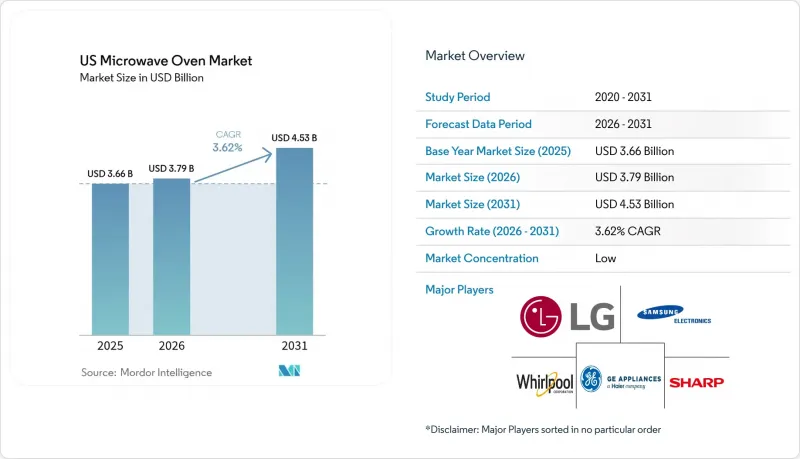
This report is Segmented by Product (Solo, Grill, and More), Structure (Countertop, Built-In, and More), Control Feature (Button Controls, and Dial Controls), Capacity (Up To 19 Litres, 20 To 24 Litres, and More), Application (Residential, and Commercial), Distribution Channel (B2C, and B2B), Geography (Northeast, Southeast, Midwest, and More). The Market Forecasts are Provided in Terms of Value (USD).
US Microwave Oven Market Trends and Insights
Urbanization & Demand For Ready-To-Eat Meals
Accelerating migration toward city centers shortens daily cooking windows, prompting millennials and Gen Z to allocate a higher share of food budgets to prepared items. Consumers who prepare quick meals rely on microwave ovens to reheat premium frozen entrees that replicate restaurant quality. Time-pressed households spend fewer minutes on meal preparation than previous generations, reinforcing sustained demand for multifunction models that combine convection and sensor capabilities. Convenience culture is also filtering into small commercial formats such as coffee shops and coworking pantries, where speed ovens improve order throughput. These patterns bolster unit sales in the US microwave oven market while pushing manufacturers to refine preset programs tailored to frozen and grab-and-go fare.
Rise of Smart/Connected Kitchen Appliances
WiFi-enabled microwaves have evolved from novelty to norm as consumers seek remote control, over-the-air updates, and voice integration. LG's camera-equipped line, launched in January 2025, showcases real-time food monitoring and AI cooking guidance. Platforms such as GE Appliances' SmartHQ suggest recipes, adjust power levels, and coordinate with energy-management panels, aligning appliance usage with off-peak tariffs. Patent filings indicate active development of interference mitigation solutions that allow uninterrupted home-network performance during microwave operation. Commercial kitchens mirror this transition by adopting high-speed ovens that blend inverter microwave technology with true convection, reducing cook times by two-thirds. Collectively, connected features lift the value mix within the US microwave oven market and support price premiums that offset raw-material inflation.
High Power Consumption & Energy-Cost Concerns
Electricity costs vary widely across the United States, making wattage a rising purchase criterion in coastal metros where tariffs exceed the national mean. Commercial units that draw more than 2,000 watts face scrutiny from operators pursuing lower utility bills. Compliance spending tied to the 2026 standard raises bill-of-materials costs that may flow through to retail prices. Although inverter and insulation enhancements improve efficiency, these features add complexity that limits price competitiveness in mass segments. The gap between premium energy-savvy models and basic imports could widen, curbing volume growth if economic conditions tighten.
Other drivers and restraints analyzed in the detailed report include:
- Product Innovation In Convection/Combi Ovens
- DOE Energy-Efficiency Standards Driving Replacement Sales
- Sharp Price Competition Compressing Margins
For complete list of drivers and restraints, kindly check the Table Of Contents.
Segment Analysis
Convection formats generated 51.30% of 2025 revenue, underscoring their broad appeal to cooks who want browning capability without a full-size oven. The grill segment, although smaller, registers a 3.82% CAGR through 2031 as consumers in compact urban kitchens seek appliances that replicate outdoor cooking results. Solo models maintain relevance for entry-level buyers but contribute limited value growth. Premium combination steam and air-fry units command higher tickets, lifting the average selling price in the US microwave oven market. Product innovation centers on heating algorithms and cavity design that deliver even crisping. Sharp's award-winning SW99 series exemplifies Japanese engineering that melds speed and texture. Grill variants benefit from cultural shifts toward healthier protein preparation that avoids excess oils. As countertop real estate shrinks, multipurpose designs win shelf space in both retail and residential environments. Manufacturers thus compete on feature breadth rather than raw wattage, protecting margins while sustaining volume growth.
Countertop units accounted for 64.40% of the US microwave oven market share in 2025, reflecting renter mobility and the simplicity of plug-and-play installation. Built-in models, however, are forecast to outpace with a 4.18% CAGR as kitchen renovation projects favor seamless aesthetics. Over-the-range versions remain popular in moderate-size kitchens because they double as ventilation. Built-in demand tracks home equity gains and discretionary remodeling budgets. Drawer-style formats such as Sharp's D33 unlock under-counter placement, appealing to upscale buyers looking for ergonomic access. Countertop leadership endures in multifamily dwellings where appliance turnover is synchronized with lease cycles. This structural bifurcation enables tiered pricing strategies that address both price-sensitive and design-oriented consumers within the US microwave oven market.
Complete Report Scope:
- By Product
- Solo
- Grill
- Convection
- Other Products
- By Structure
- Countertop
- Built-in / Wall
- Over-the-Range
- By Control Feature
- Button Controls
- Dial Controls
- By Capacity (Litres)
- Up to 19 litres
- 20 to 24 litres
- 25 to 29 litres
- 30 litres & above
- By Application
- Residential
- Commercial
- By Distribution Channel
- B2C / Retail
- Multi-brand Stores
- Exclusive Brand Outlets
- Online
- Other Distribution Channels
- B2B / Direct from Manufacturers
- B2C / Retail
- By Geography
- Northeast
- Southeast
- Midwest
- Southwest
- West
List of Companies Covered in this Report:
- Whirlpool Corporation
- GE Appliances
- Samsung Electronics America
- LG Electronics USA
- Sharp Electronics Corporation
- Panasonic North America
- BSH Home Appliances
- Electrolux Group
- Midea America Corp.
- Daewoo Electronics America
- Galanz Americas
- Kenmore
- Magic Chef (Midea)
- Hamilton Beach Brands
- Black + Decker (Spectrum Brands)
- Breville USA
- Cuisinart
- Farberware
- RCA Appliances
- Comfee' (Midea Group)
Additional Benefits:
- The market estimate (ME) sheet in Excel format
- 3 months of analyst support
TABLE OF CONTENTS
1 Introduction
- 1.1 Study Assumptions & Market Definition
- 1.2 Scope of the Study
2 Research Methodology
3 Executive Summary
4 Market Landscape
- 4.1 Market Overview
- 4.2 Market Drivers
- 4.2.1 Urbanization & Demand For Ready-To-Eat Meals
- 4.2.2 Rise Of Smart/Connected Kitchen Appliances
- 4.2.3 Expansion Of Omni-Channel & E-Commerce Retail
- 4.2.4 Product Innovation In Convection/Combi Ovens
- 4.2.5 DOE Energy-Efficiency Standards Driving Replacement Sales
- 4.3 Market Restraints
- 4.3.1 High Power Consumption & Energy-Cost Concerns
- 4.3.2 Sharp Price Competition Compressing Margins
- 4.3.3 Stricter E-Waste/EPR Compliance Costs
- 4.4 Industry Value-Chain Analysis
- 4.5 Porter's Five Forces Analysis
- 4.5.1 Threat of New Entrants
- 4.5.2 Bargaining Power of Suppliers
- 4.5.3 Bargaining Power of Buyers
- 4.5.4 Threat of Substitutes
- 4.5.5 Competitive Rivalry
- 4.6 Insights into the Latest Trends and Innovations
- 4.7 Insights on Recent Developments (Product Launches, M&A, Investments, Partnerships, JVs, Expansions)
5 Market Size & Growth Forecasts (Value)
- 5.1 By Product
- 5.1.1 Solo
- 5.1.2 Grill
- 5.1.3 Convection
- 5.1.4 Other Products
- 5.2 By Structure
- 5.2.1 Countertop
- 5.2.2 Built-in / Wall
- 5.2.3 Over-the-Range
- 5.3 By Control Feature
- 5.3.1 Button Controls
- 5.3.2 Dial Controls
- 5.4 By Capacity (Litres)
- 5.4.1 Up to 19 litres
- 5.4.2 20 to 24 litres
- 5.4.3 25 to 29 litres
- 5.4.4 30 litres & above
- 5.5 By Application
- 5.5.1 Residential
- 5.5.2 Commercial
- 5.6 By Distribution Channel
- 5.6.1 B2C / Retail
- 5.6.1.1 Multi-brand Stores
- 5.6.1.2 Exclusive Brand Outlets
- 5.6.1.3 Online
- 5.6.1.4 Other Distribution Channels
- 5.6.2 B2B / Direct from Manufacturers
- 5.6.1 B2C / Retail
- 5.7 By Geography
- 5.7.1 Northeast
- 5.7.2 Southeast
- 5.7.3 Midwest
- 5.7.4 Southwest
- 5.7.5 West
6 Competitive Landscape
- 6.1 Market Concentration
- 6.2 Strategic Moves
- 6.3 Market Share Analysis
- 6.4 Company Profiles {(includes Global level Overview, Market level overview, Core Segments, Financials as available, Strategic Information, Market Rank/Share, Products & Services, Recent Developments)}
- 6.4.1 Whirlpool Corporation
- 6.4.2 GE Appliances
- 6.4.3 Samsung Electronics America
- 6.4.4 LG Electronics USA
- 6.4.5 Sharp Electronics Corporation
- 6.4.6 Panasonic North America
- 6.4.7 BSH Home Appliances
- 6.4.8 Electrolux Group
- 6.4.9 Midea America Corp.
- 6.4.10 Daewoo Electronics America
- 6.4.11 Galanz Americas
- 6.4.12 Kenmore
- 6.4.13 Magic Chef (Midea)
- 6.4.14 Hamilton Beach Brands
- 6.4.15 Black + Decker (Spectrum Brands)
- 6.4.16 Breville USA
- 6.4.17 Cuisinart
- 6.4.18 Farberware
- 6.4.19 RCA Appliances
- 6.4.20 Comfee' (Midea Group)
7 Market Opportunities & Future Outlook
- 7.1 Smart Integration and Connected Kitchen Ecosystems

