PUBLISHER: Mordor Intelligence | PRODUCT CODE: 2116273

PUBLISHER: Mordor Intelligence | PRODUCT CODE: 2116273
Home Medical Equipment - Market Share Analysis, Industry Trends & Statistics, Growth Forecasts (2026 - 2031)
According to Mordor Intelligence, home medical equipment market size in 2026 is estimated at USD 54.35 billion, growing from 2025 value of USD 50.68 billion with 2031 projections showing USD 77.07 billion, growing at 7.24% CAGR over 2026-2031.
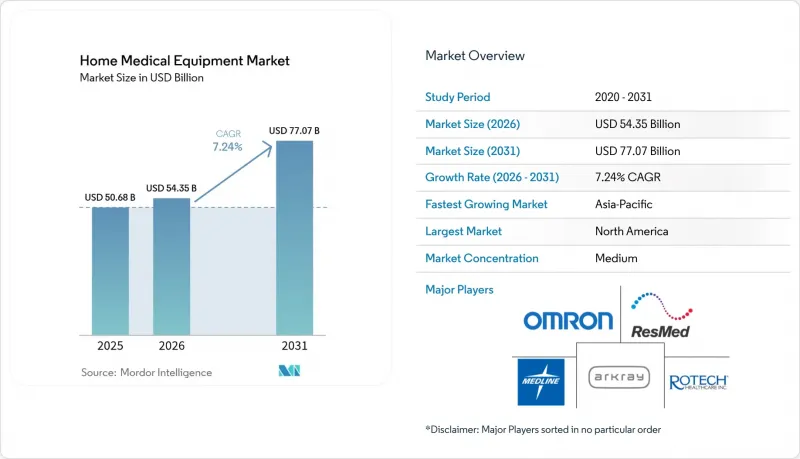
This report is Segmented by Functionality (Therapeutic Equipment, and More), Therapeutic Area (Respiratory Care, Diabetes Care, and More), Connectivity (Smart Devices and Conventional Devices), Distribution Channel (Retail Medical Stores, and More), End-User (Chronic-Disease Home-Care, and More), and Geography (North America, and More). The Market Forecasts are Provided in Terms of Value (USD).
Global Home Medical Equipment Market Trends and Insights
Rising Chronic Disease Burden Accelerates Home Monitoring Adoption
Global prevalence of diabetes, COPD, and cardiovascular disorders is reshaping therapeutic priorities in the home medical equipment market. Continuous glucose monitoring systems now anchor 40% of therapeutic-area revenue, propelled by FDA clearances that allow factory-calibrated sensors and automated insulin-delivery algorithms. Portable oxygen concentrators and home dialysis units follow similar growth trajectories as payers incentivize self-management to prevent costly acute episodes. Healthcare providers increasingly integrate device-generated data into telehealth workflows, enhancing longitudinal care coordination and reinforcing adherence.
Aging Population Drives Demand for Mobility and Monitoring Solutions
Adults aged 65+ will represent 21% of the U.S. population by 2030, and most prefer to age in place. That demographic shift materially enlarges the addressable base for wheelchairs, patient lifts, fall-prevention sensors, and non-invasive vital sign monitors. Lightweight composite frames, power-assist motors, and radar-based occupancy detection reduce caregiver burden and broaden use beyond post-acute scenarios. Long-term services providers expand home-based offerings to capture this persistent demand pool, reinforcing the growth outlook for the home medical equipment market.
Regulatory Complexity Creates Market Entry Barriers
In January 2024 the FDA finalized its Quality Management System Regulation, aligning U.S. requirements with ISO 13485:2016. Manufacturers must update design, supplier, and post-market surveillance processes before enforcement begins February 2, 2026. Simultaneously, the EU Battery Regulation 2023/1542 adds cradle-to-grave obligations for portable-device power sources, impacting infusion pumps and glucose meters alike. Compliance costs and documentation workload weigh heaviest on small firms, trimming near-term expansion pacing within the home medical equipment market.
Other drivers and restraints analyzed in the detailed report include:
- Home-Care Shift Transforms Healthcare Delivery Models
- Technological Advances Enable Remote Patient Monitoring Revolution
- Supply Chain Vulnerabilities Threaten Production Continuity
For complete list of drivers and restraints, kindly check the Table Of Contents.
Segment Analysis
Therapeutic equipment retained a 45.55% revenue contribution in 2025, reflecting the indispensable role of respiratory therapy devices, dialysis systems, and infusion pumps in chronic-disease management. Conversely, mobility assist and patient support equipment is the fastest-expanding cohort at 8.55% CAGR through 2031, mirroring rising demand for aging-in-place services. AI-driven respirators, peritoneal dialysis cyclers outfitted with telemetric modules, and sensor-enabled hospital beds enhance adherence and streamline clinician oversight. The home medical equipment market size for mobility solutions is on track to add USD 6.25 billion between 2026 and 2031, buoyed by reimbursement enhancements and ergonomic advances.
Autonomous vital-sign technologies such as radar-based monitors illustrate ongoing convergence across functionality categories. These contactless systems integrate seamlessly with electronic health records, flagging deterioration events sooner than conventional point-in-time devices. Device neutrality-ability to pair with multiple data platforms-emerges as a principal buying criterion among health systems and large home-care agencies, reinforcing the strategic importance of interoperability within the home medical equipment market.
Diabetes care holds 39.35% of therapeutic-area revenue, supported by widespread deployment of factory-calibrated continuous glucose monitors and hybrid closed-loop insulin pumps. The home medical equipment market size for diabetes management is projected to surpass USD 29.4 billion by 2031 on the back of newer biosensor chemistries and extended-wear adhesives. Neuro-rehabilitation, although smaller in absolute terms, posts the highest forecast CAGR at 9.15%. Robotic exoskeletons, wearable motion-capture sleeves, and interactive VR therapy suites deliver quantifiable functional gains, hastening coverage among workers' compensation plans and neuro-specialty clinics.
Respiratory and cardiovascular applications maintain double-digit revenue shares, driven by COPD prevalence and heart failure hospitalizations. Integrated wound-care kits and home hemodialysis platforms display steady uptake as device makers miniaturize components and embed wireless diagnostics, preventing service interruptions and elevating treatment fidelity across the home medical equipment market.
Complete Report Scope:
- By Functionality
- Therapeutic Equipment
- Respiratory Therapy Equipment
- Dialysis Equipment
- Intravenous / Infusion Pumps
- Negative-Pressure Wound-Therapy Systems
- Patient Monitoring Equipment
- Blood Glucose Monitors
- Blood-Pressure Monitors
- Multi-parameter & Wearables
- Mobility Assist & Patient Support
- Wheelchairs (Manual, Powered)
- Mobility Scooters
- Patient Lifts
- Medical Furniture
- Bathroom Safety Products
- Therapeutic Equipment
- By Therapeutic Area
- Respiratory Care
- Diabetes Care
- Cardiovascular Care
- Renal Care
- Wound & Skin Management
- Neuro-rehabilitation
- By Connectivity
- Connected / Smart Devices
- Conventional Devices
- By Distribution Channel
- Retail Medical Stores
- Online Retailers
- Hospital & Clinic Pharmacies
- Other Channels
- By End-User
- Chronic-Disease Home-Care
- Elderly & Assisted-Living
- Post-operative Care
- Pediatric Home-Care
- Palliative & Hospice
- Geography
- North America
- United States
- Canada
- Mexico
- Europe
- Germany
- United Kingdom
- France
- Italy
- Spain
- Rest of Europe
- Asia-Pacific
- China
- Japan
- India
- South Korea
- Australia
- Rest of Asia-Pacific
- Middle East and Africa
- GCC
- South Africa
- Rest of Middle East and Africa
- South America
- Brazil
- Argentina
- Rest of South America
- North America
Geography Analysis
North America retained 37.75% share in 2025, underpinned by Medicare's Durable Medical Equipment benefit set, private payer parity laws, and prolific early adoption of connected devices. The region's home medical equipment market size for AI-enabled patient monitoring exceeded USD 4.3 billion in 2026 and is pacing double-digit growth as clinical staffing gaps widen. Strategic policy initiatives like Hospital-at-Home waivers extend inpatient-equivalent reimbursement into residential settings, catalyzing further uptake.
Asia-Pacific is the fastest-growing geography with a 10.25% CAGR through 2031. China's Healthy China 2030 roadmap, Japan's Community-Based Integrated Care System, and India's Production-Linked Incentive scheme collectively expand local manufacturing depth and equipment accessibility. A rising middle class, coupled with high mobile broadband penetration, accelerates direct-to-consumer acquisition and regional cloud-hosted telehealth scale-up. The resulting home medical equipment market share uplift is most pronounced in connected glucometers and motorized wheelchairs adapted for smaller dwelling sizes.
Europe maintains substantive volume, leveraging universal coverage and community nursing programs that formalize device deployment protocols. The EU Battery Regulation introduces carbon footprint disclosure and mandatory replaceability for portable device batteries, nudging manufacturers toward modular designs that simplify serviceability and align with the bloc's circular-economy goals. Nordic countries showcase the highest per-capita expenditure owing to strong social-insurance backing, while Southern Europe advances at an accelerated clip from a lower baseline, collectively reinforcing continent-wide stability in the home medical equipment market.
The Middle East & Africa and South America contribute smaller slices but report quickening momentum as health ministries invest in primary-care networks and private insurers launch disease-specific home-care bundles. GCC nations prioritize long-term ventilator procurement amid local respiratory disease prevalence, whereas Brazil's supplementary-health segment contracts direct-to-patient equipment leases. Currency volatility and fragmented reimbursement remain headwinds yet expected infrastructure upgrades promote longer-term penetration gains for the home medical equipment market.
- Abbott Laboratories
- Medline Industries
- GE Healthcare
- Medtronic
- Arkray
- Invacare
- OMRON
- ResMed Corporation
- Smiths Group
- Rotech Healthcare
- Home Medical Products
- Beckton Dickinson
- Stryker
- Koninklijke Philips
- Cardinal Health
- Baxter
- Drive DeVilbiss Healthcare
- Sunrise Medical
- Pride Mobility Products
- B. Braun
Additional Benefits:
- The market estimate (ME) sheet in Excel format
- 3 months of analyst support
TABLE OF CONTENTS
1 Introduction
- 1.1 Study Assumptions & Market Definition
- 1.2 Scope of the Study
2 Research Methodology
3 Executive Summary
4 Market Landscape
- 4.1 Market Overview
- 4.2 Market Drivers
- 4.2.1 Rising Chronic Disease Burden (Respiratory, Diabetes, Cardiovascular)
- 4.2.2 Rapidly Expanding Global Geriatric Population Requiring Mobility & Monitoring Support
- 4.2.3 Healthcare Cost-Containment Shift from In-patient to Home-care Settings
- 4.2.4 Technological Advances in Portable & Connected Therapeutic Devices
- 4.2.5 Broadening Reimbursement Coverage for Home Therapies Across Major Economies
- 4.2.6 Growth of E-commerce & Rental Models for Durable Medical Equipment
- 4.3 Market Restraints
- 4.3.1 Stringent Regulatory & Quality Compliance for Home-use Devices
- 4.3.2 Supply-Chain Volatility Affecting Semiconductor & Sensor Availability
- 4.3.3 Safety-Related Recalls Undermining End-User Confidence
- 4.3.4 High Up-front Costs & Limited Insurance Coverage in Emerging Markets
- 4.4 Technological Outlook
- 4.5 Porter's Five Forces
- 4.5.1 Threat of New Entrants
- 4.5.2 Bargaining Power of Buyers
- 4.5.3 Bargaining Power of Suppliers
- 4.5.4 Threat of Substitutes
- 4.5.5 Intensity of Competitive Rivalry
5 Market Size & Growth Forecasts (Value, USD)
- 5.1 By Functionality
- 5.1.1 Therapeutic Equipment
- 5.1.1.1 Respiratory Therapy Equipment
- 5.1.1.2 Dialysis Equipment
- 5.1.1.3 Intravenous / Infusion Pumps
- 5.1.1.4 Negative-Pressure Wound-Therapy Systems
- 5.1.2 Patient Monitoring Equipment
- 5.1.2.1 Blood Glucose Monitors
- 5.1.2.2 Blood-Pressure Monitors
- 5.1.2.3 Multi-parameter & Wearables
- 5.1.3 Mobility Assist & Patient Support
- 5.1.3.1 Wheelchairs (Manual, Powered)
- 5.1.3.2 Mobility Scooters
- 5.1.3.3 Patient Lifts
- 5.1.3.4 Medical Furniture
- 5.1.3.5 Bathroom Safety Products
- 5.1.1 Therapeutic Equipment
- 5.2 By Therapeutic Area
- 5.2.1 Respiratory Care
- 5.2.2 Diabetes Care
- 5.2.3 Cardiovascular Care
- 5.2.4 Renal Care
- 5.2.5 Wound & Skin Management
- 5.2.6 Neuro-rehabilitation
- 5.3 By Connectivity
- 5.3.1 Connected / Smart Devices
- 5.3.2 Conventional Devices
- 5.4 By Distribution Channel
- 5.4.1 Retail Medical Stores
- 5.4.2 Online Retailers
- 5.4.3 Hospital & Clinic Pharmacies
- 5.4.4 Other Channels
- 5.5 By End-User
- 5.5.1 Chronic-Disease Home-Care
- 5.5.2 Elderly & Assisted-Living
- 5.5.3 Post-operative Care
- 5.5.4 Pediatric Home-Care
- 5.5.5 Palliative & Hospice
- 5.6 Geography
- 5.6.1 North America
- 5.6.1.1 United States
- 5.6.1.2 Canada
- 5.6.1.3 Mexico
- 5.6.2 Europe
- 5.6.2.1 Germany
- 5.6.2.2 United Kingdom
- 5.6.2.3 France
- 5.6.2.4 Italy
- 5.6.2.5 Spain
- 5.6.2.6 Rest of Europe
- 5.6.3 Asia-Pacific
- 5.6.3.1 China
- 5.6.3.2 Japan
- 5.6.3.3 India
- 5.6.3.4 South Korea
- 5.6.3.5 Australia
- 5.6.3.6 Rest of Asia-Pacific
- 5.6.4 Middle East and Africa
- 5.6.4.1 GCC
- 5.6.4.2 South Africa
- 5.6.4.3 Rest of Middle East and Africa
- 5.6.5 South America
- 5.6.5.1 Brazil
- 5.6.5.2 Argentina
- 5.6.5.3 Rest of South America
- 5.6.1 North America
6 Competitive Landscape
- 6.1 Market Concentration
- 6.2 Market Share Analysis
- 6.3 Company Profiles (includes Global level Overview, Market level overview, Core Business Segments, Financials, Headcount, Key Information, Market Rank, Market Share, Products and Services, and analysis of Recent Developments)
- 6.3.1 Abbott Laboratories
- 6.3.2 Medline Industries, Inc.
- 6.3.3 GE Healthcare
- 6.3.4 Medtronic plc
- 6.3.5 ARKRAY Inc.
- 6.3.6 Invacare Corporation
- 6.3.7 Omron Healthcare Inc.
- 6.3.8 ResMed Corporation
- 6.3.9 Smiths Group plc
- 6.3.10 Rotech Healthcare Inc.
- 6.3.11 Home Medical Products Inc.
- 6.3.12 Becton, Dickinson & Co.
- 6.3.13 Stryker Corporation
- 6.3.14 Koninklijke Philips N.V.
- 6.3.15 Cardinal Health Inc.
- 6.3.16 Baxter International Inc.
- 6.3.17 Drive DeVilbiss Healthcare
- 6.3.18 Sunrise Medical LLC
- 6.3.19 Pride Mobility Products
- 6.3.20 Braun Melsungen AG
7 Market Opportunities & Future Outlook
- 7.1 White-space & Unmet-Need Assessment

