PUBLISHER: Mordor Intelligence | PRODUCT CODE: 2116276

PUBLISHER: Mordor Intelligence | PRODUCT CODE: 2116276
Space Lander And Rover - Market Share Analysis, Industry Trends & Statistics, Growth Forecasts (2026 - 2031)
According to Mordor Intelligence, the space lander and rover market size is expected to grow from USD 1.01 billion in 2025 to USD 1.07 billion in 2026 and is forecast to reach USD 1.47 billion by 2031 at 6.43% CAGR over 2026-2031.
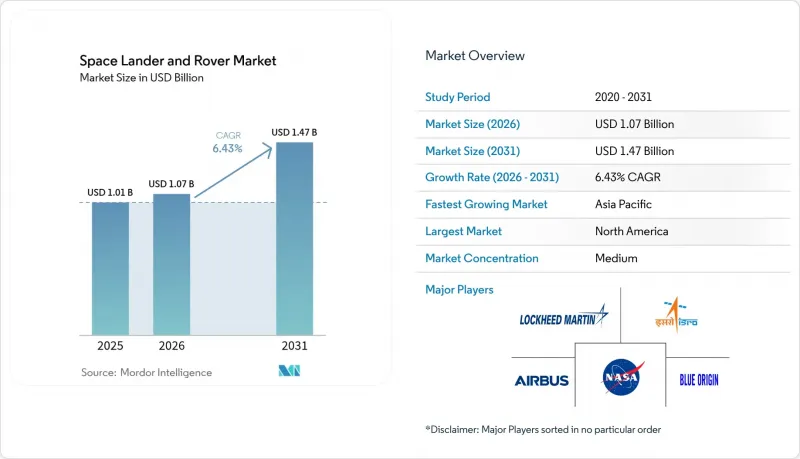
This report is Segmented by Target Body (Moon, Mars, Asteroids and Comets. And More), Platform Mass Class (Micro, Small, and More), Mobility Type (Wheeled Rovers, Hopper Landers, and More), Power Source (Solar, Fuel-Cell, and More), End User (Government Space Agencies, Defense Agencies, and More), and Geography (North America, Europe, and More). The Market Forecasts are Provided in Terms of Value (USD).
Global Space Lander And Rover Market Trends and Insights
Expansion of Globally Coordinated Lunar Exploration Initiatives
Forty-seven nations have signed the Artemis Accords, standardizing surface protocols and enabling interoperable rovers serving multiple stakeholders. China aims to place astronauts on the Moon by 2030, paired with Chang'e 7 and Chang'e 8, and create a parallel infrastructure that multiplies vehicle demand. The LUPEX mission by ISRO and JAXA shows how combining budgets delivers a 250 kg class rover that neither agency would field alone. ESA's Heracles concept, staged from the Lunar Gateway, adds multi-agency cargo runs that require rugged autonomous vehicles. These coalitions shift procurement from bespoke one-off craft to modular fleets suited for diverse payloads.
Growing Planetary Science Investments and Mission Pipeline
NASA's planetary science budget surpasses USD 3 billion annually, and ESA secures EUR 2.7 billion (USD 3.19 billion) for exploration through 2030. A dense manifest now includes low-cost Mars missions at USD 300 million each, China's Tianwen-2 asteroid return in 2025, ESA's Ramses mission to Apophis in 2028, and Japan's MMX visit to Martian moons. The commercial lunar payload services program funnels USD 2.6 billion in fixed-price contracts to private lander firms, encouraging standardized rover frames that are easily tailored for individual payloads. Continuous launches stabilize production lines and shorten learning curves, propelling the space lander and rover market.
Escalating R&D Costs and Frequent Schedule Delays
NASA's Mars Sample Return program grew to USD 11 billion and now faces an undefined launch date. ESA's ExoMars rover was re-scoped after losing Russian hardware, adding years to the calendar. Advanced autonomy, radiation shielding, and deep-drill systems raise qualification hurdles, while smaller firms underestimate planetary certification demands. Cost overruns force agencies to trim flight opportunities, tempering potential gains for the space lander and rover market.
Other drivers and restraints analyzed in the detailed report include:
- Technological Advancements in Ultra-Lightweight Rover Materials
- Acceleration of In-Situ Resource Utilization (ISRU) Testbed Missions
- Limited Planetary-Launch Windows and Capacity
For complete list of drivers and restraints, kindly check the Table Of Contents.
Segment Analysis
Lunar programs contributed 45.62% of the space lander and rover market share in 2025. Continued Artemis surface sorties, Chang'e cargo runs, and commercial payload deliveries anchor spending. However, asteroid and comet projects deliver the fastest 10.21% CAGR to 2031 as small-body sampling feeds science and resource appraisal. Mars missions hold steady with Perseverance and the 2028 ExoMars lander, while outer-solar-system concepts such as Enceladus rovers appear in agency roadmaps. Broader celestial coverage diversifies the space lander and rover market and underpins its long-term stability.
Growing interest in planetary defense also promotes asteroid rovers that map composition and internal structure. The success of the OSIRIS-REx sample return spurs more reconnaissance craft. Europa and Enceladus become reachable as nuclear power and autonomy mature, extending the addressable market into icy-moon environments that demand new thermal designs.
Medium craft held 31.02% of 2025 revenue, balancing payload capacity against launch price. Perseverance exemplifies their endurance and laboratory-grade instruments. At the same time, micro platforms post an 8.39% CAGR by leveraging miniaturized sensors and shared rides. Swarms of sub-100 kg rovers provide redundancy and broad terrain coverage, reshaping mission architecture toward distributed networks.
Small and heavy categories fill niche roles. Small systems scout landing zones, while heavy flagships carry deep drills or ISRU reactors. Yet advances in lightweight alloys mean tasks once reserved for 800 kg vehicles can migrate to 200 kg frames. That shift lowers overall mission cost and enlarges the pool of operators entering the space lander and rover market.
Complete Report Scope:
- By Target Body
- Moon
- Mars
- Asteroids and Comets
- Other Celestial Bodies
- By Platform Mass Class
- Micro
- Small
- Medium
- Heavy
- By Mobility Type
- Wheeled Rovers
- Hopper Landers
- Legged Rovers
- Tracked Rovers
- Hybrid Mobility Platforms
- By Power Source
- Solar
- Radioisotope Thermoelectric Generator
- Fuel-Cell
- Battery-Only
- By End User
- Government Space Agencies
- Commercial Space Companies
- Research Institutions and Universities
- Defense Agencies
- By Geography
- North America
- United States
- Canada
- Mexico
- Europe
- United Kingdom
- Germany
- France
- Italy
- Rest of Europe
- Asia-Pacific
- China
- India
- Japan
- South Korea
- Rest of Asia-Pacific
- South America
- Brazil
- Rest of South America
- Middle East and Africa
- Middle East
- United Arab Emirates
- Saudi Arabia
- Rest of Middle East
- Africa
- South Africa
- Rest of Africa
- Middle East
- North America
Geography Analysis
North America commanded 32.44% of 2025 revenue thanks to NASA's USD 3 billion-plus planetary science line and a dense cluster of prime contractors. Integrated supply chains, test ranges, and regulatory clarity shorten development loops. SpaceX Starship, Blue Origin New Glenn, and ULA Vulcan boost lift capacity, enabling heavier rovers and aggregated payload classes that widen program options.
Europe secures second place on the strength of ESA's EUR 2.7 billion (USD 3.19 billion) exploration envelope and forthcoming ExoMars liftoff in 2028. Airbus, Thales Alenia Space, and OHB supply propulsion, avionics, and structures. The region blends scientific rigor with sustainability aims, accelerating reusable lander stages and low-contamination sampling gear. Inter-agency collaboration remains Europe's hallmark, drawing in Canada and Japan to share cost and expertise.
Asia-Pacific posts the fastest 8.27% CAGR. China's dual-launcher cadence underpins Chang'e and Tianwen missions, while its planned 2030 crewed landing drives procurement of heavy lunar rovers. India's ISRO scales Chandrayaan heritage into the LUPEX drill rover with JAXA, and Japan's MMX mission illustrates multi-body reach. Emerging space startups contribute cost-efficient components, reshaping supply dynamics for the space lander and rover market.
- National Aeronautics & Space Administration (NASA)
- China Aerospace Science and Technology Corporation (CASC)
- Lockheed Martin Corporation
- Northrop Grumman Corporation
- Airbus SE
- ROSCOSMOS
- Canadian Space Agency
- Blue Origin Enterprises, L.P.
- Indian Space Research Organisation (ISRO)
- Japan Aerospace Exploration Agency (JAXA)
- ispace, Inc.
- Spacebit
- ASTROBOTIC TECHNOLOGY, INC.
- Space Exploration Technologies Corp.
- Intuitive Machines, LLC
- Thales Alenia Space
- Moon Express Inc.
- Firefly Aerospace Inc.
- Dynetics (Leidos, Inc.)
Additional Benefits:
- The market estimate (ME) sheet in Excel format
- 3 months of analyst support
TABLE OF CONTENTS
1 INTRODUCTION
- 1.1 Study Assumptions and Market Definition
- 1.2 Scope of the Study
2 RESEARCH METHODOLOGY
3 EXECUTIVE SUMMARY
4 MARKET LANDSCAPE
- 4.1 Market Overview
- 4.2 Market Drivers
- 4.2.1 Expansion of globally coordinated lunar exploration initiatives
- 4.2.2 Growing planetary science investments and mission pipeline
- 4.2.3 Technological advancements in ultra-lightweight rover materials
- 4.2.4 Acceleration of in-situ resource utilization (ISRU) testbed missions
- 4.2.5 Emergence of commercial payload sponsorship and rideshare models
- 4.2.6 Rising demand for autonomy-driven terrain navigation and hazard avoidance
- 4.3 Market Restraints
- 4.3.1 Escalating R&D costs and frequent schedule delays
- 4.3.2 Limited planetary-launch windows and capacity
- 4.3.3 Strict planetary protection and biocontamination compliance
- 4.3.4 Thermal and radiation shielding challenges in extreme environments
- 4.4 Value Chain Analysis
- 4.5 Regulatory Landscape
- 4.6 Technological Outlook
- 4.7 Porter's Five Forces Analysis
- 4.7.1 Bargaining Power of Buyers
- 4.7.2 Bargaining Power of Suppliers
- 4.7.3 Threat of New Entrants
- 4.7.4 Threat of Substitute Products
- 4.7.5 Intensity of Competitive Rivalry
5 MARKET SIZE AND GROWTH FORECASTS (VALUE)
- 5.1 By Target Body
- 5.1.1 Moon
- 5.1.2 Mars
- 5.1.3 Asteroids and Comets
- 5.1.4 Other Celestial Bodies
- 5.2 By Platform Mass Class
- 5.2.1 Micro
- 5.2.2 Small
- 5.2.3 Medium
- 5.2.4 Heavy
- 5.3 By Mobility Type
- 5.3.1 Wheeled Rovers
- 5.3.2 Hopper Landers
- 5.3.3 Legged Rovers
- 5.3.4 Tracked Rovers
- 5.3.5 Hybrid Mobility Platforms
- 5.4 By Power Source
- 5.4.1 Solar
- 5.4.2 Radioisotope Thermoelectric Generator
- 5.4.3 Fuel-Cell
- 5.4.4 Battery-Only
- 5.5 By End User
- 5.5.1 Government Space Agencies
- 5.5.2 Commercial Space Companies
- 5.5.3 Research Institutions and Universities
- 5.5.4 Defense Agencies
- 5.6 By Geography
- 5.6.1 North America
- 5.6.1.1 United States
- 5.6.1.2 Canada
- 5.6.1.3 Mexico
- 5.6.2 Europe
- 5.6.2.1 United Kingdom
- 5.6.2.2 Germany
- 5.6.2.3 France
- 5.6.2.4 Italy
- 5.6.2.5 Rest of Europe
- 5.6.3 Asia-Pacific
- 5.6.3.1 China
- 5.6.3.2 India
- 5.6.3.3 Japan
- 5.6.3.4 South Korea
- 5.6.3.5 Rest of Asia-Pacific
- 5.6.4 South America
- 5.6.4.1 Brazil
- 5.6.4.2 Rest of South America
- 5.6.5 Middle East and Africa
- 5.6.5.1 Middle East
- 5.6.5.1.1 United Arab Emirates
- 5.6.5.1.2 Saudi Arabia
- 5.6.5.1.3 Rest of Middle East
- 5.6.5.2 Africa
- 5.6.5.2.1 South Africa
- 5.6.5.2.2 Rest of Africa
- 5.6.5.1 Middle East
- 5.6.1 North America
6 COMPETITIVE LANDSCAPE
- 6.1 Market Concentration
- 6.2 Strategic Moves
- 6.3 Market Share Analysis
- 6.4 Company Profiles (includes Global level Overview, Market level overview, Core Segments, Financials as available, Strategic Information, Market Rank/Share for key companies, Products and Services, and Recent Developments)
- 6.4.1 National Aeronautics & Space Administration (NASA)
- 6.4.2 China Aerospace Science and Technology Corporation (CASC)
- 6.4.3 Lockheed Martin Corporation
- 6.4.4 Northrop Grumman Corporation
- 6.4.5 Airbus SE
- 6.4.6 ROSCOSMOS
- 6.4.7 Canadian Space Agency
- 6.4.8 Blue Origin Enterprises, L.P.
- 6.4.9 Indian Space Research Organisation (ISRO)
- 6.4.10 Japan Aerospace Exploration Agency (JAXA)
- 6.4.11 ispace, Inc.
- 6.4.12 Spacebit
- 6.4.13 ASTROBOTIC TECHNOLOGY, INC.
- 6.4.14 Space Exploration Technologies Corp.
- 6.4.15 Intuitive Machines, LLC
- 6.4.16 Thales Alenia Space
- 6.4.17 Moon Express Inc.
- 6.4.18 Firefly Aerospace Inc.
- 6.4.19 Dynetics (Leidos, Inc.)
7 MARKET OPPORTUNITIES AND FUTURE OUTLOOK
- 7.1 White-space and Unmet-need Assessment

