PUBLISHER: Mordor Intelligence | PRODUCT CODE: 2116278

PUBLISHER: Mordor Intelligence | PRODUCT CODE: 2116278
Automotive Valves - Market Share Analysis, Industry Trends & Statistics, Growth Forecasts (2026 - 2031)
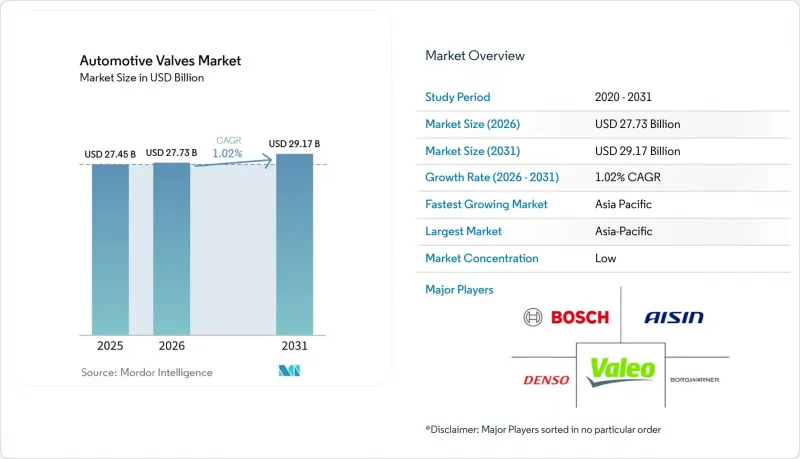
According to Mordor Intelligence, the automotive valves market size is expected to grow from USD 27.45 billion in 2025 to USD 27.73 billion in 2026 and is forecast to reach USD 29.17 billion by 2031 at 1.02% CAGR over 2026-2031.
This report is Segmented by Application Type (Engine Valves, A/C and Thermal-Management Valves, and More), Vehicle Type (Passenger Cars, Light Commercial Vehicles, and More), Function Type (Pneumatic, Hydraulic, and More), Material Type (Steel and More), Propulsion (ICE and More), Sales Channel (OEM and More), and Geography (North America and More). The Market Forecasts are Provided in Terms of Value (USD).
Global Automotive Valves Market Trends and Insights
Electrified Thermal-management Architecture Boom
Battery electric and hybrid vehicles require sophisticated thermal management systems that create entirely new valve applications beyond traditional ICE cooling circuits. Electric coolant valves emerge as the fastest-growing segment at 7.25% CAGR, driven by the need to manage battery pack temperatures, power electronics cooling, and cabin heating without engine waste heat. Rheinmetall's advanced coolant valve portfolio demonstrates the technical complexity required, featuring demand-based control and low flow resistance designs optimized for hybrid and electric vehicle applications. The integration of multiple cooling circuits in EVs battery, motor, power electronics, and cabin requires precise valve coordination that traditional ICE systems never demanded. Sanhua Automotive's specialization in thermal expansion valves, electric expansion valves, and refrigerant solenoid valves illustrates the market's evolution toward integrated thermal solutions
ICE Downsizing and Turbo-penetration
Smaller displacement engines dominate new passenger-car programs in Europe and China, and turbochargers heighten operating temperatures. Premium titanium alloys resist these thermal loads and enable tighter valve-timing windows that help manufacturers comply with Euro 7 and EPA 29. Cummins introduced a hydrogen-ICE turbocharger in April 2025 that illustrates how boosting technology migrates to alternative fuels, blending conventional valve know-how with new combustion demands, and lifting average unit prices across the automotive valves market.
Nickel and Titanium Price Super-cycle
Material cost inflation creates significant margin pressure for valve manufacturers, particularly those utilizing premium alloys in high-performance applications. Titanium and alloy valves, despite representing the fastest-growing material segment at 5.55% CAGR, face cost headwinds that may limit adoption in price-sensitive applications. The automotive industry's increasing reliance on advanced materials for lightweighting and performance enhancement coincides with supply chain constraints and geopolitical tensions affecting raw material availability. U.S. countervailing duties on aluminum extrusions from China, including automotive components, exemplify how trade policies compound material cost pressures.
Other drivers and restraints analyzed in the detailed report include:
- Tightening Euro 7/EPA 29 norms
- Smart Valves with OTA Diagnostics
- BEV Electronics Replacing Multiple Valve Sets
For complete list of drivers and restraints, kindly check the Table Of Contents.
Segment Analysis
Engine valves generated the largest revenue slice in 2025, equal to 40.87% of the automotive valves market.This strong contribution makes the automotive engine valve market an important component of the broader automotive valves industry, particularly across intake, exhaust, and variable valve-timing applications. Turbocharged downsized engines, cylinder-deactivation strategies, and VVT upgrades keep intake and exhaust valves critical, yet electric coolant valves deliver a 6.82% CAGR because every hybrid or BEV needs multi-loop thermal control. End-users now pay premiums for wear-resistant face coatings and sodium-filled stems that mitigate hot-spot formation under turbo boost.
Digital twins simulate flow across motor, battery, and cabin loops. This integration forces coolant valve makers to embed temperature and pressure sensors, adding electronics content per unit. Conversely, demand for fuel-injection valves softens in BEVs but persists in plug-in hybrids and emerging hydrogen-ICE programs. The re-mix of combustion and electric requirements expands lifetime value per vehicle even as overall unit volumes migrate.
Passenger cars represented 71.12% of the automotive valves market revenue in 2025, yet medium and heavy commercial vehicles locked in the highest 2.06% CAGR. Long-haul trucking retains diesel and hydrogen-ICE routes that use robust valve chemistries and longer duty-cycle designs. Hydrogen pilot fleets from MAN and Cummins demand modified seats and stem coatings to accommodate higher water content and combustion variability. Commercial duty cycles require extended service intervals, sometimes 40,000 operating hours, so fleet operators prioritize predictive diagnostics embedded in valve firmware.
Urban bus and delivery fleets electrify fastest, but heavy tractors and construction machinery rely on ICE optimization, prolonging demand for turbo waste-gate valves, EGR, and after-treatment actuators. Passenger-car architectures converge on small-displacement hybrids, cutting high-flow valve counts yet adding electronic coolant modules that offset some volume losses .
Complete Report Scope:
- By Application Type
- Engine Valves
- Intake Valves
- Exhaust Valves
- Variable Valve-Timing Valves
- Cylinder-Deactivation Valves
- A/C and Thermal-Management Valves
- Expansion Valves
- Coolant Control Valves
- Fuel-System Valves
- EGR Valves
- Brake and Safety Valves (ABS, Proportioning)
- Engine Valves
- By Vehicle Type
- Passenger Cars
- Light Commercial Vehicles
- Medium and Heavy Commercial Vehicles
- By Function Type
- Pneumatic
- Conventional
- Smart Mechatronic
- Hydraulic
- Direct-acting
- Pilot-operated
- Electric / Solenoid
- Stepper-motor
- Pneumatic
- By Material Type
- Steel
- Titanium and Alloys
- Aluminum Alloys
- Ceramics and Composites
- By Propulsion
- Internal-Combustion Engine (ICE)
- Hybrid Powertrain (HEV/PHEV)
- Sales Channel
- OEM
- Aftermarket
- Geography
- North America
- United States
- Canada
- Rest of North America
- South America
- Brazil
- Argentina
- Rest of South America
- Europe
- Germany
- United Kingdom
- France
- Italy
- Spain
- Russia
- Rest of Europe
- Asia-Pacific
- China
- Japan
- India
- South Korea
- Australia and New Zealand
- Rest of Asia-Pacific
- Middle East and Africa
- Turkey
- Saudi Arabia
- UAE
- Israel
- South Africa
- Egypt
- Rest of Middle East and Africa
- North America
Geography Analysis
Asia-Pacific occupied 52.01% of the 2025 automotive valves market revenue. China's localization rules and India's 100% FDI policy anchor investment, while Thailand and Vietnam build supply-chain depth for regional OEM hubs. Hyundai's USD 3 billion India plan underscores long-term confidence in local valve production, and Indonesia's export incentives attract pneumatic assembly lines. Cost competitiveness plus vast domestic demand safeguard Asia-Pacific growth despite geopolitical risk. Asia-Pacific is anticipated to witness the fastest growth at 3.08% CAGR during the forecast period.
South America is expected to witness prominent demand for automotive valves. Stellantis' Brazilian Real 30 billion Brazil project and BYD's USD 1 billion Turkish plant highlight OEM interest in cost-effective manufacturing zones proximal to raw materials. Brazil's Rota 2030 program offers tax breaks for low-emission technologies, motivating suppliers to install EGR and coolant-valve production cells. Argentina's component-localization push widens supplier footprints, balancing currency volatility.
Europe and North America are mature but innovation-intensive. Euro 7 and EPA 29 spark investment in advanced EGR and VVT valves across Germany, France, and the United States. Turkey prospers as a bridge market, having produced 1.4 million vehicles in 2023 and ranking first in European commercial-vehicle output. Middle East & Africa gains traction, led by Saudi Arabia's USD 2.9 billion 2024 automotive cluster that includes EV cooling-valve lines targeting regional export corridors.
- Denso Corporation
- Robert Bosch GmbH
- BorgWarner Inc.
- Valeo SA
- Hitachi Astemo Ltd.
- Aisin Corporation
- Cummins Inc.
- Eaton Corporation plc
- Johnson Electric Holdings
- Mahle GmbH
- Continental AG
- Knorr-Bremse AG
- Tenneco Inc.
- Rheinmetall Automotive
- VOSS Automotive
- Mitsubishi Electric Corp.
- Woodward Inc.
- TiAL Sport Inc.
- Schaeffler AG
- Marelli Holdings
Additional Benefits:
- The market estimate (ME) sheet in Excel format
- 3 months of analyst support
TABLE OF CONTENTS
1 Introduction
- 1.1 Study Assumptions and Market Definition
- 1.2 Scope of the Study
2 Research Methodology
3 Executive Summary
4 Market Landscape
- 4.1 Market Overview
- 4.2 Market Drivers
- 4.2.1 Electrified thermal-management architecture boom
- 4.2.2 ICE downsizing and turbo-penetration
- 4.2.3 Tightening Euro 7/EPA 29 norms
- 4.2.4 Smart valves with OTA diagnostics
- 4.2.5 Hydrogen-ICE pilots in CV segment
- 4.2.6 Localisation mandates in India and Indonesia
- 4.3 Market Restraints
- 4.3.1 China export-rebate cuts on pneumatic sub-assemblies
- 4.3.2 ICE-plant repurposing in Europe 2027-30
- 4.3.3 Nickel and titanium price super-cycle
- 4.3.4 BEV electronics replacing multiple valve sets
- 4.4 Value/Supply-Chain Analysis
- 4.5 Regulatory Landscape
- 4.6 Technological Outlook
- 4.7 Porter's Five Forces
- 4.7.1 Threat of New Entrants
- 4.7.2 Bargaining Power of Buyers
- 4.7.3 Bargaining Power of Suppliers
- 4.7.4 Threat of Substitutes
- 4.7.5 Intensity of Competitive Rivalry
5 Market Size and Growth Forecasts (Value in USD)
- 5.1 By Application Type
- 5.1.1 Engine Valves
- 5.1.1.1 Intake Valves
- 5.1.1.2 Exhaust Valves
- 5.1.1.3 Variable Valve-Timing Valves
- 5.1.1.4 Cylinder-Deactivation Valves
- 5.1.2 A/C and Thermal-Management Valves
- 5.1.2.1 Expansion Valves
- 5.1.2.2 Coolant Control Valves
- 5.1.3 Fuel-System Valves
- 5.1.4 EGR Valves
- 5.1.5 Brake and Safety Valves (ABS, Proportioning)
- 5.1.1 Engine Valves
- 5.2 By Vehicle Type
- 5.2.1 Passenger Cars
- 5.2.2 Light Commercial Vehicles
- 5.2.3 Medium and Heavy Commercial Vehicles
- 5.3 By Function Type
- 5.3.1 Pneumatic
- 5.3.1.1 Conventional
- 5.3.1.2 Smart Mechatronic
- 5.3.2 Hydraulic
- 5.3.2.1 Direct-acting
- 5.3.2.2 Pilot-operated
- 5.3.3 Electric / Solenoid
- 5.3.3.1 Stepper-motor
- 5.3.1 Pneumatic
- 5.4 By Material Type
- 5.4.1 Steel
- 5.4.2 Titanium and Alloys
- 5.4.3 Aluminum Alloys
- 5.4.4 Ceramics and Composites
- 5.5 By Propulsion
- 5.5.1 Internal-Combustion Engine (ICE)
- 5.5.2 Hybrid Powertrain (HEV/PHEV)
- 5.6 Sales Channel
- 5.6.1 OEM
- 5.6.2 Aftermarket
- 5.7 Geography
- 5.7.1 North America
- 5.7.1.1 United States
- 5.7.1.2 Canada
- 5.7.1.3 Rest of North America
- 5.7.2 South America
- 5.7.2.1 Brazil
- 5.7.2.2 Argentina
- 5.7.2.3 Rest of South America
- 5.7.3 Europe
- 5.7.3.1 Germany
- 5.7.3.2 United Kingdom
- 5.7.3.3 France
- 5.7.3.4 Italy
- 5.7.3.5 Spain
- 5.7.3.6 Russia
- 5.7.3.7 Rest of Europe
- 5.7.4 Asia-Pacific
- 5.7.4.1 China
- 5.7.4.2 Japan
- 5.7.4.3 India
- 5.7.4.4 South Korea
- 5.7.4.5 Australia and New Zealand
- 5.7.4.6 Rest of Asia-Pacific
- 5.7.5 Middle East and Africa
- 5.7.5.1 Turkey
- 5.7.5.2 Saudi Arabia
- 5.7.5.3 UAE
- 5.7.5.4 Israel
- 5.7.5.5 South Africa
- 5.7.5.6 Egypt
- 5.7.5.7 Rest of Middle East and Africa
- 5.7.1 North America
6 Competitive Landscape
- 6.1 Market Concentration
- 6.2 Strategic Moves
- 6.3 Market Share Analysis
- 6.4 Company Profiles (Includes Global Level Overview, Market Level Overview, Core Segments, Financials as Available, Strategic Information, Market Rank/Share for Key Companies, Products and Services, SWOT Analysis, and Recent Developments)
- 6.4.1 Denso Corporation
- 6.4.2 Robert Bosch GmbH
- 6.4.3 BorgWarner Inc.
- 6.4.4 Valeo SA
- 6.4.5 Hitachi Astemo Ltd.
- 6.4.6 Aisin Corporation
- 6.4.7 Cummins Inc.
- 6.4.8 Eaton Corporation plc
- 6.4.9 Johnson Electric Holdings
- 6.4.10 Mahle GmbH
- 6.4.11 Continental AG
- 6.4.12 Knorr-Bremse AG
- 6.4.13 Tenneco Inc.
- 6.4.14 Rheinmetall Automotive
- 6.4.15 VOSS Automotive
- 6.4.16 Mitsubishi Electric Corp.
- 6.4.17 Woodward Inc.
- 6.4.18 TiAL Sport Inc.
- 6.4.19 Schaeffler AG
- 6.4.20 Marelli Holdings
7 Market Opportunities and Future Outlook
- 7.1 White-space and Unmet-Need Assessment

