PUBLISHER: Mordor Intelligence | PRODUCT CODE: 2116290

PUBLISHER: Mordor Intelligence | PRODUCT CODE: 2116290
United States Commercial Building Automation - Market Share Analysis, Industry Trends & Statistics, Growth Forecasts (2026 - 2031)
According to Mordor Intelligence, the United States commercial building automation market size is expected to grow from USD 21.23 billion in 2025 to USD 22.53 billion in 2026 and is forecast to reach USD 30.34 billion by 2031 at 6.12% CAGR over 2026-2031.
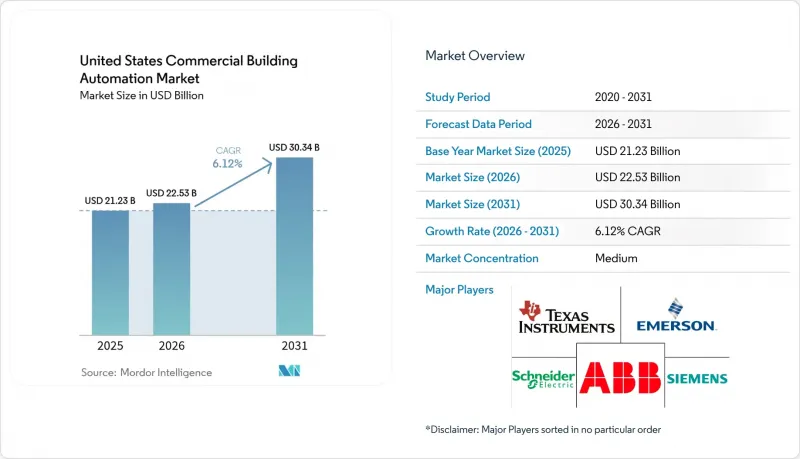
This report is Segmented by Product Type (HVAC Control Systems, Security and Access Control Systems, and More), Building Type (Office, Institutional, Retail, Hospitality, and More), Component (Controllers and Field Devices, Sensors, and More), Communication Protocol (BACnet, Modbus, KNX, and More). The Market Forecasts are Provided in Terms of Value (USD).
United States Commercial Building Automation Market Trends and Insights
Federal and State Net-Zero Electrification Mandates
Federal performance standards compel buildings larger than 25,000 square feet to cut energy use 30% by 2030, pushing owners toward full-featured automation for compliance. California Title 24 and New York Local Law 97 add stricter carbon caps with penalties already in force, prompting rapid upgrades across government, education, and healthcare portfolios. Manual scheduling cannot reach 20-40% reduction thresholds, so connected HVAC, lighting, and plug-load controls have become default specifications in new leases. Vendors now bundle compliance dashboards that translate sensor data into audit-ready reports, shifting procurement decisions from cost-centric to mandate-driven. The ripple effect has expanded bid pipelines beyond early adopters to mainstream owners aiming to avoid fines and attract federal tenants.
Corporate ESG-Driven Demand for Real-Time Energy Data
New SEC climate disclosure rules require Fortune 500 firms to publish 15-minute Scope 2 emissions data, spurring a surge in sub-metering and cloud analytics. Multi-tenant towers are wiring tenant-level meters so landlords can allocate costs accurately and supply ESG dashboards as a premium amenity. SaaS platforms that auto-populate disclosure templates command higher subscription fees while reducing manual reporting labor. Real-time transparency is also reshaping lease negotiations; tenants now insist on buildings capable of validating sustainability targets. In response, automation suppliers have partnered with ESG software vendors to integrate data pipelines that streamline compliance and unlock new recurring-revenue streams.
Cyber-Security Liabilities and Insurance Exclusions for Connected BAS
40% of commercial property policies now exclude IoT-related losses, exposing owners to more than USD 1 million in potential breach costs, according to NAIC. Health-care and financial campuses, already subject to stringent data regulations, hesitate to expose operational technology to the public internet. Specialty cyber cover costs USD 0.50-1.00 per square foot annually, extending paybacks and delaying projects. Standards such as BACnet Secure Connect and NIST profiles remain in draft, leaving uncertainty over future compliance spending. Vendors answer with zero-trust architectures and managed security services, yet buyer caution persists.
Other drivers and restraints analyzed in the detailed report include:
- Inflation Reduction Act Tax Incentives for High-Efficiency HVAC and Controls
- Hybrid-Work Shift Requiring Flexible Space-Utilization Analytics
- Fragmented Legacy Infrastructure and High Integration Costs
For complete list of drivers and restraints, kindly check the Table Of Contents.
Segment Analysis
HVAC control systems accounted for 40.92% of 2025 revenue, driven by state performance standards that mandate the use of automated ventilation and temperature control. Yet, integrated building-management platforms are accelerating at a 7.22% CAGR, as owners pursue 30-50% whole-facility efficiency gains that are unattainable through siloed subsystems. This evolution positions platforms to capture a larger slice of the United States commercial building automation market over the forecast horizon.
Platform adoption also reflects a preference for unified ESG reporting that spans HVAC, lighting, security, and power. Vendors now offer cloud dashboards that aggregate data streams into single-pane-of-glass views, simplifying compliance and maintenance workflows. Interoperability with BACnet and wireless protocols ensures future-proofing, making integrated platforms attractive to investors valuing resilient asset performance.
Office properties retained 35.01% share of the United States commercial building automation market size in 2025, benefiting from corporate ESG disclosure obligations and hybrid-work analytics needs. Mixed-use complexes, however, are forecast to rise at 7.01% CAGR as urban planners combine retail, residential, and workspace functions that demand sophisticated zonal control.
Diverse occupancy patterns in mixed-use assets necessitate flexible automation that can adjust HVAC schedules by the hour. Landlords view such adaptability as a hedge against evolving tenant mixes, while municipalities encourage integrated developments through zoning incentives. Office owners continue to deploy advanced BAS to retain Class A designation, but competition from experience-driven mixed-use projects intensifies the technology race.
Complete Report Scope:
- By Product Type
- HVAC Control Systems
- Security and Access Control Systems
- Energy Management and Power-Monitoring Systems
- Lighting and Shading Control Systems
- Fire and Life-Safety Systems
- Integrated Building-Management Platforms
- By Building Type
- Office
- Institutional (Education and Healthcare)
- Retail
- Hospitality
- Industrial and Warehouse
- Mixed-Use and Other Commercial
- By Component
- Controllers and Field Devices
- Sensors
- Software and Analytics Platforms
- Services (Consulting, Integration and Maintenance)
- By Communication Protocol / Network
- BACnet
- Modbus
- KNX
- LonWorks
- Zigbee and Other Wireless Protocols
- EnOcean and Energy-Harvesting Protocols
- Proprietary Protocols
List of Companies Covered in this Report:
- ABB Ltd.
- Advantech Co., Ltd.
- Autani, LLC
- Carrier Global Corporation
- Crestron Electronics, Inc.
- Delta Electronics, Inc.
- Distech Controls Inc.
- Emerson Electric Co.
- Honeywell International Inc.
- Johnson Controls International plc
- Lutron Electronics Co., Inc.
- Mitsubishi Electric Corporation
- Omron Corporation
- Phoenix Contact GmbH and Co. KG
- Robert Bosch GmbH
- Schneider Electric SE
- Siemens AG
- Texas Instruments Incorporated
- Trane Technologies plc
- Tridium, Inc.
- BuildingIQ, Inc.
- Resideo Technologies, Inc.
Additional Benefits:
- The market estimate (ME) sheet in Excel format
- 3 months of analyst support
TABLE OF CONTENTS
1 INTRODUCTION
- 1.1 Study Assumptions and Market Definition
- 1.2 Scope of the Study
2 RESEARCH METHODOLOGY
3 EXECUTIVE SUMMARY
4 MARKET LANDSCAPE
- 4.1 Market Overview
- 4.2 Market Drivers
- 4.2.1 Federal and state net-zero / electrification mandates
- 4.2.2 Corporate ESG-driven demand for real-time energy data
- 4.2.3 Inflation Reduction Act tax incentives for high-efficiency HVAC and controls
- 4.2.4 Hybrid-work shift requiring flexible space-utilization analytics
- 4.2.5 Falling cost and interoperability of open-source IoT sensors / edge controllers
- 4.2.6 Utility-sponsored demand-response monetisation for automated load-shedding
- 4.3 Market Restraints
- 4.3.1 Cyber-security liabilities and insurance exclusions for connected BAS
- 4.3.2 Fragmented legacy infrastructure -> high integration cost
- 4.3.3 Skilled-labour shortages in BAS commissioning and analytics
- 4.3.4 Unclear ROI for small-/mid-size commercial properties
- 4.4 Industry Value Chain Analysis
- 4.5 Regulatory Landscape
- 4.6 Technological Outlook
- 4.7 Porter's Five Forces Analysis
- 4.7.1 Bargaining Power of Suppliers
- 4.7.2 Bargaining Power of Buyers
- 4.7.3 Threat of New Entrants
- 4.7.4 Threat of Substitutes
- 4.7.5 Intensity of Competitive Rivalry
- 4.8 Impact of Macroeconomic Factors
5 MARKET SIZE AND GROWTH FORECASTS (VALUE)
- 5.1 By Product Type
- 5.1.1 HVAC Control Systems
- 5.1.2 Security and Access Control Systems
- 5.1.3 Energy Management and Power-Monitoring Systems
- 5.1.4 Lighting and Shading Control Systems
- 5.1.5 Fire and Life-Safety Systems
- 5.1.6 Integrated Building-Management Platforms
- 5.2 By Building Type
- 5.2.1 Office
- 5.2.2 Institutional (Education and Healthcare)
- 5.2.3 Retail
- 5.2.4 Hospitality
- 5.2.5 Industrial and Warehouse
- 5.2.6 Mixed-Use and Other Commercial
- 5.3 By Component
- 5.3.1 Controllers and Field Devices
- 5.3.2 Sensors
- 5.3.3 Software and Analytics Platforms
- 5.3.4 Services (Consulting, Integration and Maintenance)
- 5.4 By Communication Protocol / Network
- 5.4.1 BACnet
- 5.4.2 Modbus
- 5.4.3 KNX
- 5.4.4 LonWorks
- 5.4.5 Zigbee and Other Wireless Protocols
- 5.4.6 EnOcean and Energy-Harvesting Protocols
- 5.4.7 Proprietary Protocols
6 COMPETITIVE LANDSCAPE
- 6.1 Market Concentration
- 6.2 Strategic Moves
- 6.3 Market Share Analysis
- 6.4 Company Profiles (includes Global level Overview, Market level overview, Core Segments, Financials as available, Strategic Information, Market Rank/Share for key companies, Products and Services, and Recent Developments)
- 6.4.1 ABB Ltd.
- 6.4.2 Advantech Co., Ltd.
- 6.4.3 Autani, LLC
- 6.4.4 Carrier Global Corporation
- 6.4.5 Crestron Electronics, Inc.
- 6.4.6 Delta Electronics, Inc.
- 6.4.7 Distech Controls Inc.
- 6.4.8 Emerson Electric Co.
- 6.4.9 Honeywell International Inc.
- 6.4.10 Johnson Controls International plc
- 6.4.11 Lutron Electronics Co., Inc.
- 6.4.12 Mitsubishi Electric Corporation
- 6.4.13 Omron Corporation
- 6.4.14 Phoenix Contact GmbH and Co. KG
- 6.4.15 Robert Bosch GmbH
- 6.4.16 Schneider Electric SE
- 6.4.17 Siemens AG
- 6.4.18 Texas Instruments Incorporated
- 6.4.19 Trane Technologies plc
- 6.4.20 Tridium, Inc.
- 6.4.21 BuildingIQ, Inc.
- 6.4.22 Resideo Technologies, Inc.
7 MARKET OPPORTUNITIES AND FUTURE OUTLOOK
- 7.1 White-space and Unmet-Need Assessment

