PUBLISHER: Mordor Intelligence | PRODUCT CODE: 2116291

PUBLISHER: Mordor Intelligence | PRODUCT CODE: 2116291
United States Popcorn - Market Share Analysis, Industry Trends & Statistics, Growth Forecasts (2026 - 2031)
According to Mordor Intelligence, the United States popcorn market size was valued at USD 3.93 billion in 2025 and estimated to grow from USD 4.14 billion in 2026 to reach USD 5.34 billion by 2031, at a CAGR of 5.23% during the forecast period (2026-2031).
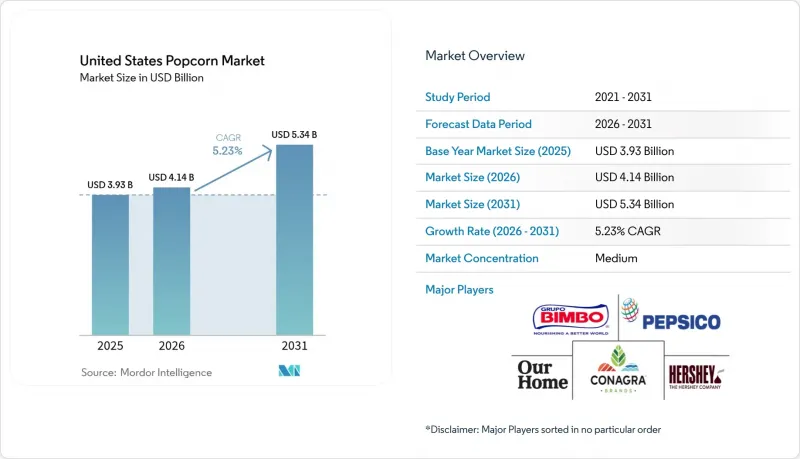
This report is Segmented by Product Type (Microwave Popcorn, Ready-To-Eat Popcorn, and More), Nature (Organic and Conventional), Flavor Profile (Salted/Traditional, Caramel, and More), Packaging Type (Single-Serve, Multi-Serve, and More), and Distribution Channel (Supermarkets/Hypermarkets, Convenience Stores, and More). The Market Forecasts are Provided in Terms of Value (USD).
United States Popcorn Market Trends and Insights
Increasing adoption of snacking as meal replacement
Busy lifestyles, hybrid office models, and remote learning are changing the way Americans eat, with many opting for snacks instead of traditional meals. According to the 2024 International Food Information Council (IFIC) Food and Health Survey, 56% of adults now replace full meals with snacks or smaller portions, showing how snacking has become a key part of daily eating habits. Popcorn is gaining popularity as a convenient meal replacement option, especially when enhanced with added protein, as it offers both portability and nutritional value. Millennials and Gen Z are driving this trend by seeking snacks that are satisfying, made with clean ingredients, and easy to fit into their busy schedules. To meet this growing demand, brands are positioning popcorn as a functional snack that can compete with traditional protein bars. For instance, in 2025 when Khloe Kardashian introduced Khloud Protein Popcorn, which provides 7 grams of protein per serving, 3 times more than regular popcorn. This highlights how celebrity-driven innovation is helping popcorn solidify its role as a practical meal replacement option.
Rising demand for health-positioned salty snacks
Popcorn is becoming a popular healthy snack option because it is 100% whole grain, lower in calories compared to chips or crackers, and a good source of dietary fiber. According to the United States Department of Agriculture (USDA), 1 serving of air-popped popcorn provides about 15% of the daily recommended fiber intake for the United States population. These nutritional benefits match consumer preferences for snacks that are both enjoyable and support health goals. The demand for non-genetically modified organism (Non-GMO) ingredients and transparent sourcing makes popcorn even more appealing to health-conscious buyers. Research into its potential prebiotic benefits also creates opportunities for new functional products. Brands are responding with options like low-sodium, air-popped, and avocado oil popcorn. For example, in June 2024, Be Happy Snacks launched 2 new flavors, Cotton Candy and White Cheddar, which are whole-grain, gluten-free, and low-sodium. This shows how flavors can combine with health-focused features to compete in the "better-for-you" snack aisle alongside trail mixes, dried fruit, and ancient-grain crisps.
Strong competition from alternate snacks
Competition from alternative snacks is a significant challenge for the United States popcorn market, as consumers are increasingly drawn to snacks that offer higher protein content, unique ingredients, or added health benefits. Products like protein-packed nut mixes and plant-based jerky are gaining popularity, especially among health-conscious millennials and Gen Z consumers. These alternatives often provide better nutritional value or novelty, making them more appealing to this demographic. For example, in 2024, Beyond Meat launched its plant-based jerky nationwide in collaboration with PepsiCo's Frito-Lay. This product is marketed as a high-protein, clean-label snack that caters to flexitarian consumers looking for healthier options. Such innovative launches attract significant attention from retailers, as they typically have higher price points and deliver better profit margins compared to traditional popcorn products. Popcorn manufacturers are responding to these challenges by introducing new and exciting flavors, adding nutritional benefits like protein or fiber, and improving packaging to make their products more convenient for consumers.
Other drivers and restraints analyzed in the detailed report include:
- Increased streaming and in-home entertainment
- Rapid flavor and seasoning innovation
- Dependence on corn supply and price volatility
For complete list of drivers and restraints, kindly check the Table Of Contents.
Segment Analysis
Ready-to-eat popcorn led the United States market in 2025, making up 67.92% of total sales. This reflects the growing demand for convenient snacks that are ready to consume without any preparation. Products like multipacks, single-serve pouches, and family-size tubs cater to various needs, whether for individual snacking, sharing with family, or enjoying on the go. The popularity of ready-to-eat popcorn has been further boosted by innovations in flavors, healthier ingredients, and attractive packaging, which allow brands to charge premium prices. Social media trends and limited-edition flavors also play a significant role in attracting younger consumers who are eager to try new and exciting options, driving repeat purchases.
Microwave popcorn is another key segment, expected to be the fastest growing segment at a strong CAGR of 8.12% between 2026 and 2031. Its popularity is tied to its convenience and ability to recreate a theater-like experience at home, making it a favorite for families and older consumers. The segment is also expanding its appeal with health-focused options, such as low-sodium, light butter, and protein-enriched varieties. Microwave popcorn is particularly suited for portion-controlled snacking and aligns well with the increasing time people spend streaming content at home. Together with ready-to-eat popcorn, this segment supports the overall growth of the United States popcorn market by catering to diverse consumer preferences and snacking occasions.
Conventional popcorn led the United States market in 2025, contributing to 84.35% of total sales. Its dominance is largely due to its affordability and widespread availability, making it a go-to choice for everyday snacking. With well-established supply chains, manufacturers can offer competitive pricing, ensuring these products remain accessible to a broad consumer base. Conventional popcorn is a staple in supermarkets, convenience stores, and online platforms, supported by strong brand recognition and consistent quality. This segment caters to value-conscious shoppers who prefer familiar flavors and reliable options for their snacking needs.
On the other hand, organic popcorn is gaining traction as a fast-growing segment, with a projected CAGR of 8.84% from 2026 to 2031. This growth is fueled by increasing demand from millennials and Gen Z consumers who prioritize health, sustainability, and clean-label products. Organic popcorn brands are meeting this demand by offering certified organic options and emphasizing natural, responsibly sourced ingredients. Premium and limited-edition flavors are helping to attract health-conscious and ethically driven buyers. As a result, organic popcorn is carving out a niche in the better-for-you snack category, appealing to those seeking healthier and more sustainable snacking alternatives.
Complete Report Scope:
- By Product Type
- Microwave Popcorn
- Ready-to-Eat Popcorn
- Unpopped Kernel
- By Nature
- Organic
- Conventional
- By Flavor Profile
- Salted/Traditional
- Caramel
- Barbecue
- Cheese
- Butter
- Others
- By Packaging Type
- Single-Serve
- Multi-Serve
- Family/Bulk Packs
- By Distribution Channel
- Supermarkets/Hypermarkets
- Convenience Stores
- Online Retail Channels
- Other Distribution Channels
List of Companies Covered in this Report:
- Conagra Foods Inc.
- PepsiCo Inc.
- The Hershey Company
- Our Home
- Snappy Popcorn
- American Pop Corn Company
- AUA Private Equity Partners LLC (Weaver Popcorn)
- Eagle Family Foods
- Grupo Bimbo, S.A.B. de C.V
- Belles Gourmet Popcorn
- Nexus Capital Management LP (CK Snacks)
- Herr Foods
- Jody's Gourmet Popcorn
- Opopop Popcorns
- Princeton Popcorn Company
- Utz Brands Inc.
- Angie's Artisan Treats
- Great Northern Popcorn Co.
- Old Dutch Foods
- Johnson's Popcorn
Additional Benefits:
- The market estimate (ME) sheet in Excel format
- 3 months of analyst support
TABLE OF CONTENTS
1 INTRODUCTION
- 1.1 Study Assumptions and Market Definition
- 1.2 Scope of the Study
2 RESEARCH METHODOLOGY
3 EXECUTIVE SUMMARY
4 MARKET LANDSCAPE
- 4.1 Market Overview
- 4.2 Market Drivers
- 4.2.1 Increasing adoption of snacking as a meal replacement
- 4.2.2 Convenience and on-the-go formats
- 4.2.3 Rising demand for health-positioned salty snacks
- 4.2.4 Increased streaming and in-home entertainment
- 4.2.5 Rapid flavour and seasoning innovation
- 4.2.6 Influence of social media and trends
- 4.3 Market Restraints
- 4.3.1 Strong competition from alternate snacks
- 4.3.2 Price sensitivity in gourmet segments
- 4.3.3 Health concerns around flavored popcorn
- 4.3.4 Dependence on corn supply and price volatility
- 4.4 Consumer Behaviour Analysis
- 4.5 Regulatory Outlook
- 4.6 Porter's Five Forces
- 4.6.1 Threat of New Entrants
- 4.6.2 Bargaining Power of Buyers
- 4.6.3 Bargaining Power of Suppliers
- 4.6.4 Threat of Substitute Products
- 4.6.5 Intensity of Competitive Rivalry
5 MARKET SIZE AND GROWTH FORECASTS (VALUE)
- 5.1 By Product Type
- 5.1.1 Microwave Popcorn
- 5.1.2 Ready-to-Eat Popcorn
- 5.1.3 Unpopped Kernel
- 5.2 By Nature
- 5.2.1 Organic
- 5.2.2 Conventional
- 5.3 By Flavor Profile
- 5.3.1 Salted/Traditional
- 5.3.2 Caramel
- 5.3.3 Barbecue
- 5.3.4 Cheese
- 5.3.5 Butter
- 5.3.6 Others
- 5.4 By Packaging Type
- 5.4.1 Single-Serve
- 5.4.2 Multi-Serve
- 5.4.3 Family/Bulk Packs
- 5.5 By Distribution Channel
- 5.5.1 Supermarkets/Hypermarkets
- 5.5.2 Convenience Stores
- 5.5.3 Online Retail Channels
- 5.5.4 Other Distribution Channels
6 COMPETITIVE LANDSCAPE
- 6.1 Market Concentration
- 6.2 Strategic Moves
- 6.3 Market Share Analysis
- 6.4 Company Profiles (includes Global-level Overview, Market-level Overview, Core Segments, Financials (if available), Strategic Information, Market Rank/Share, Products and Services, Recent Developments)
- 6.4.1 Conagra Foods Inc.
- 6.4.2 PepsiCo Inc.
- 6.4.3 The Hershey Company
- 6.4.4 Our Home
- 6.4.5 Snappy Popcorn
- 6.4.6 American Pop Corn Company
- 6.4.7 AUA Private Equity Partners LLC (Weaver Popcorn)
- 6.4.8 Eagle Family Foods
- 6.4.9 Grupo Bimbo, S.A.B. de C.V
- 6.4.10 Belles Gourmet Popcorn
- 6.4.11 Nexus Capital Management LP (CK Snacks)
- 6.4.12 Herr Foods
- 6.4.13 Jody's Gourmet Popcorn
- 6.4.14 Opopop Popcorns
- 6.4.15 Princeton Popcorn Company
- 6.4.16 Utz Brands Inc.
- 6.4.17 Angie's Artisan Treats
- 6.4.18 Great Northern Popcorn Co.
- 6.4.19 Old Dutch Foods
- 6.4.20 Johnson's Popcorn
7 MARKET OPPORTUNITIES AND FUTURE OUTLOOK

