PUBLISHER: Mordor Intelligence | PRODUCT CODE: 2116292

PUBLISHER: Mordor Intelligence | PRODUCT CODE: 2116292
United States Coffee Creamer - Market Share Analysis, Industry Trends & Statistics, Growth Forecasts (2026 - 2031)
According to Mordor Intelligence, the US coffee creamer market size was valued at USD 7.1 billion in 2025 and estimated to grow from USD 7.56 billion in 2026 to reach USD 10.36 billion by 2031, at a CAGR of 6.49% during the forecast period (2026-2031).
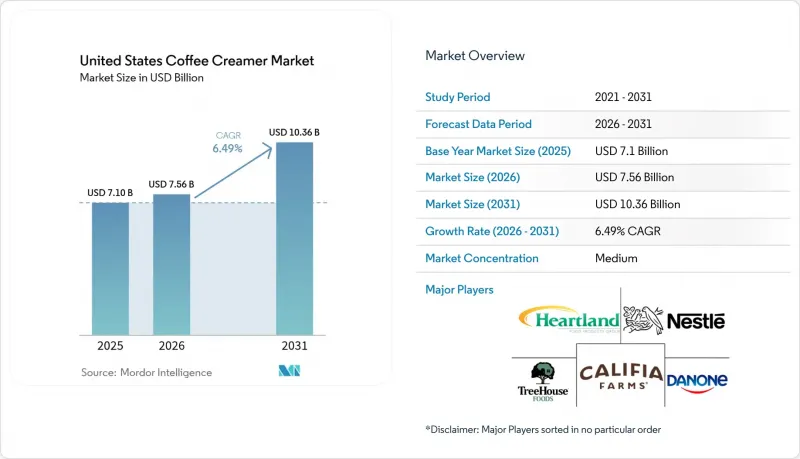
This report is Segmented by Product Type (Powder Coffee Creamer [Dairy-Based Powder, Non-Dairy Powder], and More), Flavor (Unflavored, Flavored [Vanilla, Hazelnut, Caramel, Chocolate, Others]), End-User (On-Trade, Off-Trade [Supermarkets/Hypermarkets, Convenience Stores, Online Retail Stores, Others]), and Geography (United States). The Market Forecasts are Provided in Terms of Value (USD).
United States Coffee Creamer Market Trends and Insights
Flavor and Format Innovation Surge
Richer flavor pipelines and entirely new delivery systems are broadening the US coffee creamer market. Nestle's Coffee-mate has partnered with confectionery brands to roll out KIT KAT and seasonal Caramel Apple Crisp variants, while Danone's International Delight immersed itself in pop-culture tie-ins such as the Home Alone Hot Chocolate Marshmallow launch. The category's first mass-market cold-foam dispensers dispense a micro-foamed creamer that claims 25% less sugar and 25% more servings per can than standard rivals. Engagement spikes on social media underscore strong resonance with Gen Z; the hashtag #ColdFoam registered more than 321 million TikTok views, indicating that shareable, cafe-style experiences can be recreated at home. Flavor licensing, limited-time drops, and a convenient canned format collectively accelerate velocity on shelf while cementing the perception of creamers as an affordable indulgence relative to out-of-home espresso beverages.
Rising Clean-Label and Plant-Based Demand
Ingredient transparency now influences brand choice as consumers scrutinize additives such as carrageenan and artificial sweeteners. SPINS panel data shows plant-based creamers as the only dairy-alternative sub-category to register positive value growth in 2023, rising 10% to USD 701 million. Oatly's life-cycle analysis reveals a 44-76% lower climate footprint than cow's milk, supporting the sustainability narrative embraced by affluent coastal shoppers. Darigold's Belle series features just five ingredients and no oils, targeting lactose-intolerant households seeking a recognizable ingredient list. FDA's revised "healthy" icon set for February 2025 forces formulators to cap added sugars and saturated fat, incentivizing investments in natural sweeteners and coconut-oil-free emulsification. The emphasis on straightforward labels positions plant-based and simplified dairy formulations to capture incremental shelf space, especially in premium refrigerator doors.
Sugar & Additive Health Backlash
Public-health advocates increasingly link added sugars and emulsifiers to chronic disease risk, prompting consumer skepticism toward legacy formulas. Mandatory "added sugar" disclosure on Nutrition Facts panels magnifies visibility of sweetener loads and forces brands to benchmark labels against competitors. Influential cardiology bloggers have spotlighted carrageenan and partially hydrogenated oils, swelling demand for cleaner dairy and plant-based variants. In response, Coffee-mate's cold foam positions a 25% sugar reduction compared with leading flavored liquids, while Darigold substitutes fillers with real cream and enzyme-based lactose removal. Yet taste expectations limit the pace at which mainstream offerings can slash sugar without risking volume losses, creating a delicate balancing act between health, flavor, and price.
Other drivers and restraints analyzed in the detailed report include:
- E-Commerce Subscription Boom
- Cold-Foam/RTD Coffee Pull-Through
- Raw-Material Cost Volatility
For complete list of drivers and restraints, kindly check the Table Of Contents.
Segment Analysis
Liquid coffee creamers held 64.10% of US coffee creamer market share in 2025 and are estimated to maintain a 6.55% CAGR to 2031, a trajectory underpinned by consumer preference for ready-to-pour convenience and novelty flavors. Non-dairy liquids reinforce growth by addressing lactose intolerance and vegan preferences, aligning with the broader plant-based narrative already adding USD 701 million in 2023 value. Powder formats remain a fixture in institutional and on-the-go occasions thanks to longer shelf life and portion-controlled packets.
Cold foam, the newest liquid subset, commands a premium ticket at USD 4.68-5.99 per 14-ounce can and is projected to further enlarge the US coffee creamer market size over the forecast horizon. Early sell-through rates indicate a favorable reception among younger households and indulgence-seekers replicating cafe micro-foam at home. The powder segment responds through dairy-based keto powder launches featuring MCT oils, a nod to functional demand pockets, yet volumes trail liquid counterparts. FDA labeling stipulations for "non-dairy" powders containing sodium caseinate require explicit allergen call-outs, nudging manufacturers toward either full dairy or full plant formulations.
Complete Report Scope:
- By Product Type
- Powder Coffee Creamer
- Dairy-based Powder
- Non-dairy Powder
- Liquid Coffee Creamer
- Dairy-based Liquid
- Non-dairy Liquid
- Powder Coffee Creamer
- By Flavor
- Unflavored
- Flavored
- Vanilla
- Hazelnut
- Caramel
- Chococlate
- Others
- By End-User
- On-trade
- Off-Trade
- Supermarkets / Hypermarkets
- Convenience Stores
- Online Retail Stores
- Others
List of Companies Covered in this Report:
- Nestle S.A.
- Danone S.A. (International Delight)
- TreeHouse Foods Inc.
- Heartland Food Products Group
- HP Hood LLC
- Califia Farms LLC
- Leaner Creamer LLC
- PearlRock Partners (nutpods)
- Northwest Dairy Association- Darigold
- Shamrock Foods Company
- Rich Products Corporation
- Kerry Group plc
- Laird Superfood Inc.
- Chobani LLC
- Ripple Foods PBC
- WhiteWave Foods (International Delight legacy)
- Oatly AB
- Dean Foods Company
- Land O' Lakes Inc.
- Custom Food Group
Additional Benefits:
- The market estimate (ME) sheet in Excel format
- 3 months of analyst support
TABLE OF CONTENTS
1 Introduction
- 1.1 Study Assumptions and Market Definition
- 1.2 Scope of the Study
2 Research Methodology
3 Executive Summary
4 Market Landscape
- 4.1 Market Overview
- 4.2 Market Drivers
- 4.2.1 Flavor and format innovation surge
- 4.2.2 Rising clean-label and plant-based demand
- 4.2.3 E-commerce subscription boom
- 4.2.4 Cold-foam/R-T-D coffee pull-through
- 4.2.5 Southwestern aseptic capacity build-out
- 4.2.6 Functional keto/MCT trend
- 4.3 Market Restraints
- 4.3.1 Sugar & additive health backlash
- 4.3.2 Raw-material cost volatility
- 4.3.3 FDA added-sugar label proposals
- 4.3.4 Climate risk on coconut/oat crops
- 4.4 Value / Supply-Chain Analysis
- 4.5 Regulatory Landscape
- 4.6 Porter's Five Forces
- 4.6.1 Bargaining Power of Buyers
- 4.6.2 Bargaining Power of Suppliers
- 4.6.3 Threat of New Entrants
- 4.6.4 Threat of Substitute Products
- 4.6.5 Intensity of Competitive Rivalry
5 Market Size & Growth Forecasts (Value)
- 5.1 By Product Type
- 5.1.1 Powder Coffee Creamer
- 5.1.1.1 Dairy-based Powder
- 5.1.1.2 Non-dairy Powder
- 5.1.2 Liquid Coffee Creamer
- 5.1.2.1 Dairy-based Liquid
- 5.1.2.2 Non-dairy Liquid
- 5.1.1 Powder Coffee Creamer
- 5.2 By Flavor
- 5.2.1 Unflavored
- 5.2.2 Flavored
- 5.2.2.1 Vanilla
- 5.2.2.2 Hazelnut
- 5.2.2.3 Caramel
- 5.2.2.4 Chococlate
- 5.2.2.5 Others
- 5.3 By End-User
- 5.3.1 On-trade
- 5.3.2 Off-Trade
- 5.3.2.1 Supermarkets / Hypermarkets
- 5.3.2.2 Convenience Stores
- 5.3.2.3 Online Retail Stores
- 5.3.2.4 Others
6 Competitive Landscape
- 6.1 Market Concentration
- 6.2 Strategic Moves
- 6.3 Market Share Analysis
- 6.4 Company Profiles (includes Global level Overview, Market level overview, Core Segments, Financials as available, Strategic Information, Market Rank/Share for key companies, Products & Services, and Recent Developments)
- 6.4.1 Nestle S.A.
- 6.4.2 Danone S.A. (International Delight)
- 6.4.3 TreeHouse Foods Inc.
- 6.4.4 Heartland Food Products Group
- 6.4.5 HP Hood LLC
- 6.4.6 Califia Farms LLC
- 6.4.7 Leaner Creamer LLC
- 6.4.8 PearlRock Partners (nutpods)
- 6.4.9 Northwest Dairy Association- Darigold
- 6.4.10 Shamrock Foods Company
- 6.4.11 Rich Products Corporation
- 6.4.12 Kerry Group plc
- 6.4.13 Laird Superfood Inc.
- 6.4.14 Chobani LLC
- 6.4.15 Ripple Foods PBC
- 6.4.16 WhiteWave Foods (International Delight legacy)
- 6.4.17 Oatly AB
- 6.4.18 Dean Foods Company
- 6.4.19 Land O' Lakes Inc.
- 6.4.20 Custom Food Group
7 Market Opportunities and Future Outlook

