PUBLISHER: Mordor Intelligence | PRODUCT CODE: 2116296

PUBLISHER: Mordor Intelligence | PRODUCT CODE: 2116296
Smart Washing Machine - Market Share Analysis, Industry Trends & Statistics, Growth Forecasts (2026 - 2031)
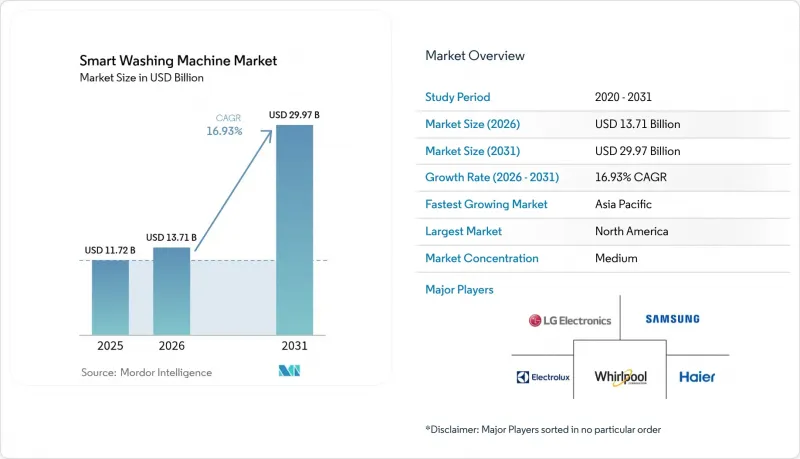
According to Mordor Intelligence, the smart washing machine market size was valued at USD 11.72 billion in 2025 and estimated to grow from USD 13.71 billion in 2026 to reach USD 29.97 billion by 2031, at a CAGR of 16.93% during the forecast period (2026-2031).
This report is Segmented by Product (Front-Load Smart Washers, Top-Load Smart Washers, and More), Capacity (Small, Medium, and Large), Price Band (Economy, Mid-Range, and Premium ), End User (Residential and Commercial), Distribution Channel (B2C/Retail and B2B/Directly From the Manufacturers), and Geography (North America, South America, and More). The Market Forecasts are Provided in Terms of Value (USD).
Global Smart Washing Machine Market Trends and Insights
Integration with Smart-Home Ecosystems
Matter 1.3, released in May 2024, formally added washing-machine support, allowing a single appliance to communicate with Amazon Alexa, Google Home, and Apple HomeKit hubs. This standardization eliminates the app fragmentation that long discouraged consumers and lets manufacturers focus on differentiated features rather than basic connectivity. Major brands such as BSH confirmed that every new washer shipped to the United States in 2025 will be Matter-ready, signaling industry commitment to open protocols. Beyond remote control, open APIs enable predictive scheduling, so washers align cycles with rooftop solar output or low-tariff utility windows, maximizing household self-consumption. Samsung further deepened interoperability by partnering with Procter & Gamble to embed Tide POD-optimized programs, proving that cross-industry collaborations can unlock tailored cleaning performance.
Rapid Consumer Uptake of Remote Monitoring & Predictive Maintenance
Predictive algorithms inside modern washers parse vibration signatures, motor torque, and temperature drift to flag anomalies weeks before failure, a capability Samsung first commercialized through its HomeCare Wizard platform. Commercial operators see clear value: GE Appliances reports that laundromats using its SmartHQ dashboard reduce service calls and cut downtime penalties substantially. Embedded microcontrollers such as STMicroelectronics' NanoEdge AI analyze edge-level sensor data without cloud latency, making in-machine diagnostics viable even where broadband is weak. Residential users benefit from maintenance alerts that pre-order parts and recommend lighter loads, thereby extending both product and clothing life. Positive user experiences continue to spread via word-of-mouth and social media, accelerating replacement demand and enlarging the smart washing machine market.
Cross-Brand Compatibility & Interoperability Issues
Matter promises harmony, yet legacy appliances rarely receive firmware retrofits, forcing households into multiple apps when they mix brands. Small manufacturers hesitate to support diverse protocols, citing engineering costs that erode already thin margins. Property managers outfitting hundreds of units must juggle different dashboards, curbing large-scale smart deployments, and slowing smart washing machine market penetration. Cloud-to-cloud solutions such as the Home Connectivity Alliance Specification exist, but uptake remains limited to well-funded brands. Until seamless multi-brand orchestration arrives, interoperability friction will temper the market's otherwise steep trajectory.
Other drivers and restraints analyzed in the detailed report include:
- Proliferation of IoT-Enabled Major Appliances
- Utility Incentives for Grid-Interactive, Demand-Response Washers
- High Repair & Maintenance Costs for Connected Components
For complete list of drivers and restraints, kindly check the Table Of Contents.
Segment Analysis
Front-load washers accounted for 59.30% of 2025 revenue, reflecting their lower water use and widespread acceptance in Europe and many urban centers. Combo units, however, log a 17.42% CAGR as city dwellers value one-appliance convenience; AI programs auto-sequence wash-to-dry transfers, freeing users from manual transfer steps. LG's WashTower integrates dual sensors that adjust drying temperature to match residual moisture, reducing fabric wear. Portable smart washers advance in co-living spaces, using Bluetooth scheduling so tenants avoid peak shower hours. Commercial heavy-duty smart washers, though niche, benefit from remote diagnostics that maximize uptime, validating premium pricing in laundromats and multi-family basements.
Market anticipation surrounds Samsung's 27-inch Bespoke AI laundry series with 7-inch touch displays that double as smart-home hubs. Design convergence blurs residential and light-commercial boundaries as operators demand consumer-grade UX while homeowners seek commercial-grade robustness. As ecosystem applications grow, the smart washing machine market share of software-rich products increases, cementing combos as a formidable challenger to traditional twin-appliance layouts.
Medium units (6-8 kg) represent 54.40% of shipments because they align with typical household needs and cabinet dimensions. Yet, large models above 8 kg post a 16.55% CAGR, as families discover that one large weekly cycle uses fewer total resources than multiple smaller washes. Utility rebates often key off per-kilogram ratings, nudging buyers toward large, high-efficiency drums. Samsung's 24-inch small-capacity set still appeals in Europe, where urban apartments limit footprint; it meets Class A requirements while consuming 55% less energy than earlier equivalents. Sub-6 kg models thrive in RVs, vacation cabins, and secondary residences, leveraging app alerts so owners can start a cycle before arriving.
The smart washing machine market size for large units will keep expanding as AI load-sensing negates water-waste fears, while smaller drums will linger for edge cases. Capacity diversification helps brands defend against regional water regulations and offers retailers bundles tailored to local living patterns.
Complete Report Scope:
- By Product
- Front-Load Smart Washers
- Top-Load Smart Washers
- Washer-Dryer Combo Units
- Portable / Compact Smart Washers
- Commercial Heavy-Duty Smart Washers
- By Capacity
- Small (Below 6 Kg)
- Medium (6 to 8 Kg)
- Large (Above 8 Kg)
- By Price Band
- Economy (<= USD 500)
- Mid-range (USD 501-1 000)
- Premium ( above USD 1 000)
- By End user
- Residential
- Commercial
- By Distribution Channel
- B2C/Retail
- Multi-brand Stores
- Exclusive Brand Outlets
- Online
- Other Distribution Channels
- B2B/Directly from the Manufacturers
- B2C/Retail
- By Geography
- North America
- Canada
- United States
- Mexico
- South America
- Brazil
- Peru
- Chile
- Argentina
- Rest of South America
- Asia-Pacific
- India
- China
- Japan
- Australia
- South Korea
- South East Asia (Singapore, Malaysia, Thailand, Indonesia, Vietnam, and Philippines)
- Rest of Asia Pacific
- Europe
- United Kingdom
- Germany
- France
- Spain
- Italy
- BENELUX (Belgium, Netherlands, and Luxembourg)
- NORDICS (Denmark, Finland, Iceland, Norway, and Sweden)
- Rest of Europe
- Middle East And Africa
- United Arab of Emirates
- Saudi Arabia
- South Africa
- Nigeria
- Rest of Middle East And Africa
- North America
Geography Analysis
North America retained 31.60% of the smart washing machine market share in 2025, leveraged by high broadband penetration and utility incentives such as National Grid's ConnectedSolutions program that pays users to shift wash cycles away from peaks. GE Appliances' USD 490 million expansion in Kentucky exemplifies domestic investment to shorten lead times for connected models. Premium-segment adoption thrives because households value both convenience and compliance with tightening energy codes.
Asia-Pacific logs the fastest 15.31% CAGR driven by urban migration, rising disposable incomes, and government smart-city projects. Samsung's April 2025 AI top-loaders cater to Asian preferences by merging traditional design with fabric-recognition algorithms, widening appeal. Subscription laundry models gain traction in Indonesia and Thailand, providing affordable access while familiarizing users with smart features.
Europe frames connectivity through sustainability; ecodesign rules in force since March 2021 require Eco 40-60 cycles and reparability indices. The legislation targets 12.4 TWh electricity savings and 1,464 billion L water reductions by 2030, creating demand for washers that confirm savings through cloud telemetry. Electrolux's 2025 smart range highlights resource efficiency and fabric longevity-attributes appealing to environmentally conscious Europeans. Utilities across Germany and Italy now tie rebates to verifiable consumption data, ensuring connected models dominate future replacements.
- LG Electronics Inc.
- Samsung Electronics Co., Ltd.
- Whirlpool Corporation
- Haier Smart Home Co., Ltd. (includes GE Appliances)
- Electrolux AB
- Panasonic Corporation
- Robert Bosch GmbH
- Siemens AG
- IFB Industries Ltd.
- Midea Group Co., Ltd.
- Hisense Group
- Arcelik A.S. (Beko, Grundig)
- Candy Hoover Group S.r.l.
- Xiaomi Corporation
- Sharp Corporation
- Godrej & Boyce Mfg. Co. Ltd.
- Alliance Laundry Systems LLC
- Qingdao LittleSwan Co., Ltd.
- Fisher & Paykel Appliances Ltd.
- Hitachi Global Life Solutions
- Maytag (Whirlpool Corporation)
- Miele & Cie. KG
Additional Benefits:
- The market estimate (ME) sheet in Excel format
- 3 months of analyst support
TABLE OF CONTENTS
1 Introduction
- 1.1 Study Assumptions & Market Definition
- 1.2 Scope of the Study
2 Research Methodology
3 Executive Summary
4 Market Landscape
- 4.1 Market Overview
- 4.2 Market Drivers
- 4.2.1 Integration with Smart-Home Ecosystems
- 4.2.2 Rapid Consumer Uptake of Remote Monitoring & Predictive Maintenance
- 4.2.3 Proliferation of IoT-Enabled Major Appliances
- 4.2.4 Utility Incentives for Grid-Interactive, Demand-Response Washers
- 4.2.5 Embedded On-Device AI for Fabric Recognition & Resource Optimisation
- 4.2.6 Pay-Per-Wash Subscription Models Boosting Ownership in Emerging Markets
- 4.3 Market Restraints
- 4.3.1 Cross-Brand Compatibility & Interoperability Issues
- 4.3.2 High Repair & Maintenance Costs for Connected Components
- 4.3.3 Stricter Cybersecurity / Data-Privacy Compliance Costs
- 4.3.4 Water-Scarcity Regulations Limiting Drum-Capacity Upgrades
- 4.4 Industry Value Chain Analysis
- 4.5 Porter's Five Forces Analysis
- 4.5.1 Threat of New Entrants
- 4.5.2 Bargaining Power of Suppliers
- 4.5.3 Bargaining Power of Buyers
- 4.5.4 Threat of Substitutes
- 4.5.5 Competitive Rivalry
- 4.6 Insights into the Latest Trends and Innovations in the Market
- 4.7 Insights on Recent Developments (New Product Launches, Strategic Initiatives, Investments, Partnerships, JVs, Expansion, M&As, etc.) in the Market
5 Market Size & Growth Forecasts (Value, USD billion)
- 5.1 By Product
- 5.1.1 Front-Load Smart Washers
- 5.1.2 Top-Load Smart Washers
- 5.1.3 Washer-Dryer Combo Units
- 5.1.4 Portable / Compact Smart Washers
- 5.1.5 Commercial Heavy-Duty Smart Washers
- 5.2 By Capacity
- 5.2.1 Small (Below 6 Kg)
- 5.2.2 Medium (6 to 8 Kg)
- 5.2.3 Large (Above 8 Kg)
- 5.3 By Price Band
- 5.3.1 Economy (<= USD 500)
- 5.3.2 Mid-range (USD 501-1 000)
- 5.3.3 Premium ( above USD 1 000)
- 5.4 By End user
- 5.4.1 Residential
- 5.4.2 Commercial
- 5.5 By Distribution Channel
- 5.5.1 B2C/Retail
- 5.5.1.1 Multi-brand Stores
- 5.5.1.2 Exclusive Brand Outlets
- 5.5.1.3 Online
- 5.5.1.4 Other Distribution Channels
- 5.5.2 B2B/Directly from the Manufacturers
- 5.5.1 B2C/Retail
- 5.6 By Geography
- 5.6.1 North America
- 5.6.1.1 Canada
- 5.6.1.2 United States
- 5.6.1.3 Mexico
- 5.6.2 South America
- 5.6.2.1 Brazil
- 5.6.2.2 Peru
- 5.6.2.3 Chile
- 5.6.2.4 Argentina
- 5.6.2.5 Rest of South America
- 5.6.3 Asia-Pacific
- 5.6.3.1 India
- 5.6.3.2 China
- 5.6.3.3 Japan
- 5.6.3.4 Australia
- 5.6.3.5 South Korea
- 5.6.3.6 South East Asia (Singapore, Malaysia, Thailand, Indonesia, Vietnam, and Philippines)
- 5.6.3.7 Rest of Asia Pacific
- 5.6.4 Europe
- 5.6.4.1 United Kingdom
- 5.6.4.2 Germany
- 5.6.4.3 France
- 5.6.4.4 Spain
- 5.6.4.5 Italy
- 5.6.4.6 BENELUX (Belgium, Netherlands, and Luxembourg)
- 5.6.4.7 NORDICS (Denmark, Finland, Iceland, Norway, and Sweden)
- 5.6.4.8 Rest of Europe
- 5.6.5 Middle East And Africa
- 5.6.5.1 United Arab of Emirates
- 5.6.5.2 Saudi Arabia
- 5.6.5.3 South Africa
- 5.6.5.4 Nigeria
- 5.6.5.5 Rest of Middle East And Africa
- 5.6.1 North America
6 Competitive Landscape
- 6.1 Market Concentration
- 6.2 Strategic Moves
- 6.3 Market Share Analysis
- 6.4 Company Profiles (includes Global level Overview, Market level overview, Core Segments, Financials as available, Strategic Information, Market Rank/Share, Products & Services, Recent Developments)
- 6.4.1 LG Electronics Inc.
- 6.4.2 Samsung Electronics Co., Ltd.
- 6.4.3 Whirlpool Corporation
- 6.4.4 Haier Smart Home Co., Ltd. (includes GE Appliances)
- 6.4.5 Electrolux AB
- 6.4.6 Panasonic Corporation
- 6.4.7 Robert Bosch GmbH
- 6.4.8 Siemens AG
- 6.4.9 IFB Industries Ltd.
- 6.4.10 Midea Group Co., Ltd.
- 6.4.11 Hisense Group
- 6.4.12 Arcelik A.S. (Beko, Grundig)
- 6.4.13 Candy Hoover Group S.r.l.
- 6.4.14 Xiaomi Corporation
- 6.4.15 Sharp Corporation
- 6.4.16 Godrej & Boyce Mfg. Co. Ltd.
- 6.4.17 Alliance Laundry Systems LLC
- 6.4.18 Qingdao LittleSwan Co., Ltd.
- 6.4.19 Fisher & Paykel Appliances Ltd.
- 6.4.20 Hitachi Global Life Solutions
- 6.4.21 Maytag (Whirlpool Corporation)
- 6.4.22 Miele & Cie. KG
7 Market Opportunities & Future Outlook
- 7.1 Increasing Focus on Energy Efficiency and Sustainability

