PUBLISHER: Mordor Intelligence | PRODUCT CODE: 2116301

PUBLISHER: Mordor Intelligence | PRODUCT CODE: 2116301
Wound Irrigation System - Market Share Analysis, Industry Trends & Statistics, Growth Forecasts (2026 - 2031)
According to Mordor Intelligence, the wound irrigation system market size was valued at USD 346.87 million in 2025 and estimated to grow from USD 361.47 million in 2026 to reach USD 443.61 million by 2031, at a CAGR of 4.21% during the forecast period (2026-2031).
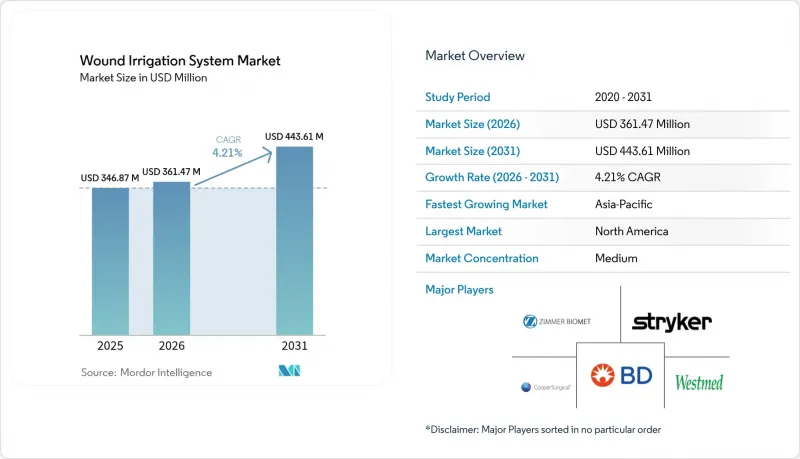
This report is Segmented by Product Type (Manual Systems and Battery-Operated Systems), Application (Surgical Wounds, Chronic Wounds, and More), End-User (Hospitals, Ambulatory Surgical Centers, and More), and Geography (North America, Europe, Asia-Pacific, and More). The Market and Forecasts are Provided in Terms of Value (USD).
Global Wound Irrigation System Market Trends and Insights
Rising Incidence of Traumatic and Surgical Wounds
Surgical volumes continue to climb worldwide, and traumatic injuries remain a major public health challenge. The World Health Organization reports that surgical site infections affect up to 21.1% of patients in developing systems, underscoring the clinical importance of effective lavage . Infection rates reach 11.7% in spine surgeries at resource-limited neurosurgical centers, with Staphylococcus aureus the leading pathogen . Hypervirulent, carbapenem-resistant Klebsiella pneumoniae strains heighten risk, prompting hospitals to pair irrigation with multimodal infection-prevention bundles that have cut surgical site infection rates by up to 95%. Consequently, procurement teams increasingly specify devices that deliver consistent flow and pressure to remove biofilm and debris efficiently. These dynamics place the wound irrigation system market at the heart of hospital quality-improvement programs.
Availability of Advanced Product Lines for Wound Care Management
Manufacturers are converging irrigation, sensing, and data analytics into unified platforms that simplify clinician workflows. Caltech's iCares smart bandage demonstrates real-time biomarker monitoring by sampling exudate and transmitting data wirelessly, a capability now being integrated with powered irrigation tips to guide cleansing intervals. Citrate-based solutions capable of disrupting biofilm more effectively than saline are gaining regulatory traction, while the FDA's 2024 approval of the plant-based Traumagel hydrogel exemplifies the broader shift toward bio-derived, hemostatic adjuncts. Electric bandages that harness water-powered, electronics-free circuits to accelerate healing by 30% are also entering trials. These innovations raise clinician expectations and reshape purchasing criteria, further fueling premium product growth in the wound irrigation system market.
High Cost of Wound Irrigation Systems
Upfront prices for powered irrigation devices and proprietary solution packs strain hospital budgets, especially when payer schedules lag technology costs. Medicare's 2025 Physician Fee Schedule reduced average reimbursement for wound care services by 2.93% while adding caregiver training codes that shift expenses to families. Durable medical equipment rules also mandate extensive documentation for NPWT supplies, delaying cash flow for suppliers. Although outcome studies show lower overall treatment cost through faster closure and fewer nursing visits, financial gatekeepers in emerging markets often defer upgrades, moderating near-term growth in the wound irrigation system market.
Other drivers and restraints analyzed in the detailed report include:
- Growing Aging Population and Chronic Diseases Leading to Chronic Wounds
- Shift Toward Outpatient and Home-Based NPWT
- Reimbursement Gaps in Low- and Middle-Income Countries
For complete list of drivers and restraints, kindly check the Table Of Contents.
Segment Analysis
Manual units generated 61.48% of 2025 revenue, the largest slice within the wound irrigation system market size, reflecting their entrenched role in routine debridement. Hospitals rely on them for predictable flow, easy sterility checks, and low maintenance. Battery-operated platforms, now growing at 5.02% CAGR, appeal to ambulatory surgical centers that prioritize portability and shorter turnover times. The Pulsavac Plus AC line offers dual suction and irrigation without battery waste, cutting environmental impact while matching powered-flow consistency.
Hybrid solutions illustrate convergence. Irrimax's 2024 IRRISEPT kits let clinicians pair antimicrobial solution bags with either manual compression or powered handles, enabling flexible protocols across resource settings. This versatility encourages large GPOs to standardize on single solution platforms, anticipating continued share gains for battery-enhanced systems.
Complete Report Scope:
- By Product Type
- Manual Systems
- Battery-Operated Systems
- By Application
- Surgical Wounds
- Chronic Wounds
- Traumatic and Burn Wounds
- By End-user
- Hospitals and Clinics
- Ambulatory Surgical Centers
- Homecare Settings
- Others
- By Geography
- North America
- United States
- Canada
- Mexico
- Europe
- Germany
- United Kingdom
- France
- Italy
- Spain
- Rest of Europe
- Asia-Pacific
- China
- Japan
- India
- Australia
- South Korea
- Rest of Asia-Pacific
- Middle East and Africa
- GCC
- South Africa
- Rest of Middle East and Africa
- South America
- Brazil
- Argentina
- Rest of South America
- North America
Geography Analysis
North America's leadership stems from deep clinical integration of evidence-based protocols and payer policies that reimburse both saline and antiseptic solutions. Recent billing revisions impose modest payment cuts, yet hospital quality metrics tied to infection rates sustain demand. ASCs in the United States are fast-tracking procurement of battery consoles paired with single-use tips, enabling shorter case times and compliance with device tracking mandates. Canada mirrors these trends, albeit with provincial purchasing collaboratives that emphasize unit cost control.
Europe remains a mature but steadily evolving theater. Hospitals in Germany and the United Kingdom increasingly specify biodegradable consumables to meet sustainability targets. The European Centre for Disease Prevention and Control's surveillance highlights persistent gram-negative resistance, driving adoption of citrate-infused solutions in orthopedic and trauma suites. Nordic health systems pilot IoT-enabled pressure feedback modules that verify flow rates and document lavage volumes automatically in electronic health records.
Asia-Pacific exhibits the fastest expansion as tertiary hospitals upgrade surgical suites. Japan's shift to ISO-aligned post-market surveillance encourages suppliers to incorporate unique device identifiers and digital lot tracing. China's 14th Five-Year Plan incentivizes domestic med-tech pioneers to co-develop powered irrigation pumps, accelerating local competition. In India, private hospital chains bundle irrigation kits with NPWT rentals, targeting diabetic foot clinics in tier-two cities. Collectively, these forces raise regional demand elasticity, underpinning the Asia-Pacific growth premium in the wound irrigation system market.
- Zimmer Biomet
- Stryker
- Beckton Dickinson
- The Cooper Companies
- Westmed
- Medline Industries
- Bionix
- Sanara MedTech
- Irrimax
- Hopkins Medical Products
- Smiths Group
- Molnlycke Health Care
- Solventum
- Cardinal Health
- ConvaTec Group plc
- Halyard Health (Avanos Medical)
- Medela
- DermaRite Industries
- DeRoyal Industries
- Coloplast
Additional Benefits:
- The market estimate (ME) sheet in Excel format
- 3 months of analyst support
TABLE OF CONTENTS
1 Introduction
- 1.1 Study Assumptions & Market Definition
- 1.2 Scope of the Study
2 Research Methodology
3 Executive Summary
4 Market Landscape
- 4.1 Market Overview
- 4.2 Market Drivers
- 4.2.1 Rising incidence of traumatic & surgical wounds
- 4.2.2 Availability of advanced product lines for wound care management
- 4.2.3 Growing aging population & chronic diseases leading to chronic wounds
- 4.2.4 Shift toward outpatient & home-based NPWT increases demand for portable irrigation devices
- 4.2.5 Emergence of antimicrobial citrate-based irrigation solutions amid AMR stewardship
- 4.2.6 IoT-enabled flow & pressure sensors enhancing surgical accuracy & reducing SSI
- 4.3 Market Restraints
- 4.3.1 High cost of wound irrigation systems
- 4.3.2 Reimbursement gaps in low- & middle-income countries
- 4.3.3 Strict environmental regulations on disposable irrigation kits
- 4.3.4 Conflicting clinical guidelines on antiseptic irrigation efficacy
- 4.4 Regulatory Landscape
- 4.5 Technological Outlook
- 4.6 Porters Five Forces Analysis
- 4.6.1 Threat of New Entrants
- 4.6.2 Bargaining Power of Buyers / Consumers
- 4.6.3 Bargaining Power of Suppliers
- 4.6.4 Threat of Substitute Products
- 4.6.5 Intensity of Competitive Rivalry
5 Market Size & Growth Forecasts (Value, USD)
- 5.1 By Product Type
- 5.1.1 Manual Systems
- 5.1.2 Battery-Operated Systems
- 5.2 By Application
- 5.2.1 Surgical Wounds
- 5.2.2 Chronic Wounds
- 5.2.3 Traumatic and Burn Wounds
- 5.3 By End-user
- 5.3.1 Hospitals and Clinics
- 5.3.2 Ambulatory Surgical Centers
- 5.3.3 Homecare Settings
- 5.3.4 Others
- 5.4 By Geography
- 5.4.1 North America
- 5.4.1.1 United States
- 5.4.1.2 Canada
- 5.4.1.3 Mexico
- 5.4.2 Europe
- 5.4.2.1 Germany
- 5.4.2.2 United Kingdom
- 5.4.2.3 France
- 5.4.2.4 Italy
- 5.4.2.5 Spain
- 5.4.2.6 Rest of Europe
- 5.4.3 Asia-Pacific
- 5.4.3.1 China
- 5.4.3.2 Japan
- 5.4.3.3 India
- 5.4.3.4 Australia
- 5.4.3.5 South Korea
- 5.4.3.6 Rest of Asia-Pacific
- 5.4.4 Middle East and Africa
- 5.4.4.1 GCC
- 5.4.4.2 South Africa
- 5.4.4.3 Rest of Middle East and Africa
- 5.4.5 South America
- 5.4.5.1 Brazil
- 5.4.5.2 Argentina
- 5.4.5.3 Rest of South America
- 5.4.1 North America
6 Competitive Landscape
- 6.1 Market Concentration
- 6.2 Market Share Analysis
- 6.3 Company Profiles (includes Global level Overview, Market level overview, Core Segments, Financials as available, Strategic Information, Market Rank/Share for key companies, Products & Services, and Recent Developments)
- 6.3.1 Zimmer Biomet
- 6.3.2 Stryker Corporation
- 6.3.3 Becton, Dickinson and Company
- 6.3.4 CooperSurgical Inc.
- 6.3.5 Westmed Inc.
- 6.3.6 Medline Industries, Inc.
- 6.3.7 Bionix LLC
- 6.3.8 Sanara MedTech Inc.
- 6.3.9 Irrimax Corporation
- 6.3.10 Hopkins Medical Products
- 6.3.11 Smith & Nephew plc
- 6.3.12 Molnlycke Health Care AB
- 6.3.13 Solventum
- 6.3.14 Cardinal Health Inc.
- 6.3.15 ConvaTec Group plc
- 6.3.16 Halyard Health (Avanos Medical)
- 6.3.17 Medela AG
- 6.3.18 DermaRite Industries LLC
- 6.3.19 DeRoyal Industries, Inc.
- 6.3.20 Coloplast A/S
7 Market Opportunities & Future Outlook
- 7.1 White-space & Unmet-Need Assessment

