PUBLISHER: Mordor Intelligence | PRODUCT CODE: 2116304

PUBLISHER: Mordor Intelligence | PRODUCT CODE: 2116304
Vitrification - Market Share Analysis, Industry Trends & Statistics, Growth Forecasts (2026 - 2031)
According to Mordor Intelligence, the vitrification market size was valued at USD 10.78 billion in 2025 and estimated to grow from USD 12.56 billion in 2026 to reach USD 26.96 billion by 2031, at a CAGR of 16.52% during the forecast period (2026-2031).
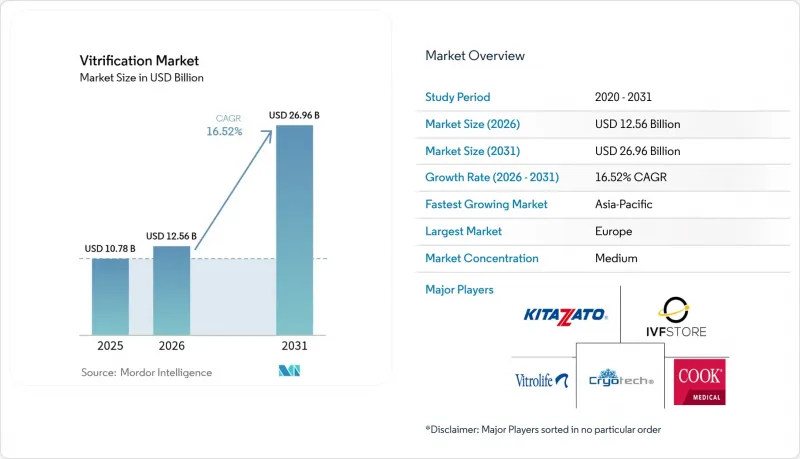
This report is Segmented by Specimen (Oocytes [Devices and Kits & Consumables], Embryos [Devices and Kits & Consumables], and Sperm), End User (IVF Clinics and Biobanks), and Geography (North America, Europe, Asia-Pacific, Middle East and Africa, and South America). The Market Forecasts are Provided in Terms of Value (USD).
Global Vitrification Market Trends and Insights
Growth in Fertility-Preservation Techniques
Improved vitrification protocols have pushed post-thaw embryo survival past 90%, turning what began as a rescue tool for oncology patients into a mainstream option for anyone wanting reproductive flexibility. Live-birth outcomes for vitrified embryos now equal-and in some programs exceed-those of fresh transfers, in part because clinicians can synchronize embryo transfer with an optimally prepared endometrium. Artificial-intelligence software is beginning to tailor cryoprotectant dosing and cooling curves to individual oocyte characteristics, making the procedure more predictable and less operator-dependent. This technical leap is expanding indications beyond strict medical necessity and positioning vitrification as a planning resource integrated throughout the fertility journey. Clinics therefore market cryopreservation not as emergency insurance but as a proactive tool that fits varied lifestyle timelines across multiple continents.
Delayed Child-Bearing Due to Sociodemographic Factors
Across high-income economies, the median age at first birth has exceeded 30 years, a shift driven by education gains, career commitments, and evolving partnership norms. Women increasingly regard elective egg freezing as sound life-planning rather than extraordinary medicine, and employer-funded programs are normalizing the practice. Countries such as Sweden, Japan, and South Korea now publish some of the highest per-capita cryopreservation rates, offering an insight into how demand will unfold elsewhere. This demographic momentum is unlikely to reverse, securing a long-run growth engine for the vitrification market. Fertility centers are therefore recalibrating marketing, patient education, and bundled pricing to serve healthy women in their late twenties and early thirties rather than limiting outreach to couples already struggling with conception.
High Cost of Vitrification Media & Devices
Procedure fees in the United States typically range from USD 8,000 to USD 20,000 per cycle, and yearly storage charges often rise faster than general inflation. In lower-income markets, varying import duties and weakened currencies can make laboratory consumables two to three times more expensive than in origin countries. These economics push clinics to pass costs on to patients, limiting uptake despite high latent demand, especially in populous nations such as India and Indonesia. While automation promises to lower consumable use, the current supply base is concentrated among a handful of device and media suppliers who maintain pricing power through patented formulations. Broader adoption of generic cryoprotectants and local manufacturing could ease the issue, but near-term affordability remains the largest single brake on vitrification market growth.
Other drivers and restraints analyzed in the detailed report include:
- Rising Global Infertility Prevalence
- Automated Micro-Fluidic Vitrification Systems Cut Skill Barriers
- Limited Biobank Capacity in Emerging Markets
For complete list of drivers and restraints, kindly check the Table Of Contents.
Segment Analysis
Oocytes delivered 58.90% of the vitrification market size in 2025 thanks to social-egg-freezing programs, employer reimbursement, and women's rising interest in reproductive optionality. Marketing campaigns from large clinic chains now frame egg freezing as a standard life-planning tool, and survival rates above 90% in leading programs have alleviated earlier quality concerns. The segment benefits disproportionately from microfluidic automation because oocyte viability is sensitive to human-induced osmotic shock; precise fluid-exchange control therefore directly boosts clinical outcomes. Embryos, though smaller in revenue today, show an 17.65% CAGR to 2031 as clinics rely on freeze-all protocols to avoid ovarian hyper-stimulation risk and to stagger multiple transfers over time. A 2024 multicenter analysis reported 12.5% live-birth rates for frozen day-6 blastocysts versus 5.5% for fresh controls, fueling clinician comfort with banking multiple embryos ahead of transfer. As payors shift toward outcome-based reimbursement, embryo banking aligns incentives for both providers and patients, supporting the specimen segment's brisk expansion within the vitrification market.
Technological convergence is narrowing historical outcome gaps between specimen types. AI-driven image analytics can now grade oocyte morphology at a pixel level, flagging sub-optimal samples for tailored cryoprotectant regimes. Meanwhile, embryo monitoring platforms integrate time-lapse photography with metabolic assays, further refining selection and post-thaw implantation odds. These layered innovations increase confidence in deferred transfers, making vitrification an embedded step rather than an optional add-on. Consequently, the share advance of embryos is not expected to erode oocyte revenue; instead both segments will likely grow in parallel, reinforcing the overall momentum of the vitrification market.
Complete Report Scope:
- By Specimen
- Oocytes
- Devices
- Kits & Consumables
- Embryos
- Devices
- Kits & Consumables
- Sperm
- Oocytes
- By End User
- IVF Clinics
- Biobanks
- Geography
- North America
- United States
- Canada
- Mexico
- Europe
- Germany
- United Kingdom
- France
- Italy
- Spain
- Rest of Europe
- Asia-Pacific
- China
- Japan
- India
- South Korea
- Australia
- Rest of Asia-Pacific
- Middle East and Africa
- GCC
- South Africa
- Rest of Middle East and Africa
- South America
- Brazil
- Argentina
- Rest of South America
- North America
Geography Analysis
North America remains a mature but steadily expanding pocket of the vitrification market. High disposable incomes, widespread employer coverage for egg freezing, and FDA clearance of several automation systems keep procedure volumes rising despite a plateau in clinic numbers. The United States also hosts the largest installed base of AI-enabled embryo-assessment platforms, which, in turn, drives higher thaw-survival benchmarks. Canada's single-payer reimbursement for medically indicated fertility preservation further insulates demand from economic cycles, while Mexico's medical-tourism corridor attracts cost-conscious patients from the broader Americas, giving North America its status as an innovation and volume hub within the global vitrification market.
Europe contributes the largest regional share-38.20% of the overall vitrification market size-thanks to long-standing regulatory clarity and consistent reimbursement policies. National programs in France, Germany, and the Scandinavian bloc limit out-of-pocket costs, cementing vitrification as routine clinical practice. Longitudinal registries also capture outcome data, enabling evidence-based refinements. The region's early embrace of elective fertility preservation and well-established biobank networks keep utilisation rates high. A 2024 Mayo Clinic review found that ovarian-tissue vitrification protocols developed in Europe now guide practice worldwide. Consequently, European centers export clinical know-how through partnerships in the Middle East and Latin America, reinforcing their leadership role.
Asia-Pacific, forecast to register an 18.20% CAGR, is the most dynamic arena for the vitrification market. Rising infertility prevalence, supportive government policies in Singapore and Japan, and private-insurance coverage extensions in China are driving double-digit cycle growth. Yet the region also faces marked infrastructure gaps: India's tier-2 cities often lack compliant biobank capacity, and regulatory ambiguity in the Philippines delays clinic license approvals. Nonetheless, device makers are increasingly establishing regional production and training hubs to localize costs. Thailand and Malaysia market themselves as cross-border fertility destinations, offering mid-priced packages that include egg freezing and multi-cycle IVF, broadening access for patients from high-cost home countries. These forces position Asia-Pacific as the primary incremental revenue engine for the vitrification market over the next half-decade.
- Vitrolife
- The Cooper Companies
- Cook Group
- FUJIFILM
- Cryotech Co. Ltd.
- Kitazato
- IMV Technologies Group
- MINITUB GmbH
- Shenzhen VitaVitro Biotech
- IVF Store LLC
- Thermo Fisher Scientific
- Merck
- Genea Biomedx
- Overture Life
- TMRW Life Sciences
- NidaCon International
- ARTbio Scientific
- Biogenics Inc.
- Esco Lifesciences
- Nidacon International
Additional Benefits:
- The market estimate (ME) sheet in Excel format
- 3 months of analyst support
TABLE OF CONTENTS
1 Introduction
- 1.1 Study Assumptions & Market Definition
- 1.2 Scope of the Study
2 Research Methodology
3 Executive Summary
4 Market Landscape
- 4.1 Market Overview
- 4.2 Market Drivers
- 4.2.1 Growth In Fertility-Preservation Techniques
- 4.2.2 Delayed Child-Bearing Due To Sociodemographic Factors
- 4.2.3 Rising Global Infertility Prevalence
- 4.2.4 Greater Public Awareness Of Reproductive Health
- 4.2.5 Automated Micro-Fluidic Vitrification Systems Cut Skill Barriers
- 4.2.6 Asian Private-Insurance Plans Adding Egg-Freezing Coverage
- 4.3 Market Restraints
- 4.3.1 Ethical Debates On Long-Term Gamete Storage
- 4.3.2 High Cost Of Vitrification Media & Devices
- 4.3.3 Limited Biobank Capacity In Emerging Markets
- 4.3.4 Perceived Freeze-All Success-Rate Gap Causing Patient Hesitancy
- 4.4 Porter's Five Forces
- 4.4.1 Threat of New Entrants
- 4.4.2 Bargaining Power of Buyers
- 4.4.3 Bargaining Power of Suppliers
- 4.4.4 Threat of Substitutes
- 4.4.5 Competitive Rivalry
5 Market Size & Growth Forecasts (Value, USD)
- 5.1 By Specimen
- 5.1.1 Oocytes
- 5.1.1.1 Devices
- 5.1.1.2 Kits & Consumables
- 5.1.2 Embryos
- 5.1.2.1 Devices
- 5.1.2.2 Kits & Consumables
- 5.1.3 Sperm
- 5.1.1 Oocytes
- 5.2 By End User
- 5.2.1 IVF Clinics
- 5.2.2 Biobanks
- 5.3 Geography
- 5.3.1 North America
- 5.3.1.1 United States
- 5.3.1.2 Canada
- 5.3.1.3 Mexico
- 5.3.2 Europe
- 5.3.2.1 Germany
- 5.3.2.2 United Kingdom
- 5.3.2.3 France
- 5.3.2.4 Italy
- 5.3.2.5 Spain
- 5.3.2.6 Rest of Europe
- 5.3.3 Asia-Pacific
- 5.3.3.1 China
- 5.3.3.2 Japan
- 5.3.3.3 India
- 5.3.3.4 South Korea
- 5.3.3.5 Australia
- 5.3.3.6 Rest of Asia-Pacific
- 5.3.4 Middle East and Africa
- 5.3.4.1 GCC
- 5.3.4.2 South Africa
- 5.3.4.3 Rest of Middle East and Africa
- 5.3.5 South America
- 5.3.5.1 Brazil
- 5.3.5.2 Argentina
- 5.3.5.3 Rest of South America
- 5.3.1 North America
6 Competitive Landscape
- 6.1 Market Concentration
- 6.2 Market Share Analysis
- 6.3 Company Profiles (includes Global level Overview, Market level overview, Core Segments, Financials as available, Strategic Information, Market Rank/Share for key companies, Products & Services, and Recent Developments)
- 6.3.1 Vitrolife AB
- 6.3.2 CooperSurgical Inc.
- 6.3.3 Cook Medical LLC
- 6.3.4 FUJIFILM Irvine Scientific
- 6.3.5 Cryotech Co. Ltd.
- 6.3.6 Kitazato Corporation
- 6.3.7 IMV Technologies Group
- 6.3.8 MINITUB GmbH
- 6.3.9 Shenzhen VitaVitro Biotech
- 6.3.10 IVF Store LLC
- 6.3.11 Thermo Fisher Scientific Inc.
- 6.3.12 Merck KGaA (EMD Serono)
- 6.3.13 Genea Biomedx
- 6.3.14 Overture Life
- 6.3.15 TMRW Life Sciences
- 6.3.16 NidaCon International
- 6.3.17 ARTbio Scientific
- 6.3.18 Biogenics Inc.
- 6.3.19 Esco Medical
- 6.3.20 Nidacon International AB
7 Market Opportunities & Future Outlook
- 7.1 White-space & Unmet-need Assessment

