PUBLISHER: Mordor Intelligence | PRODUCT CODE: 2116322

PUBLISHER: Mordor Intelligence | PRODUCT CODE: 2116322
Marine Biotechnology - Market Share Analysis, Industry Trends & Statistics, Growth Forecasts (2026 - 2031)
According to Mordor Intelligence, the marine biotechnology market size is projected to be USD 7.49 billion in 2025, USD 8.02 billion in 2026, and reach USD 11.21 billion by 2031, growing at a CAGR of 7.10% from 2026 to 2031.
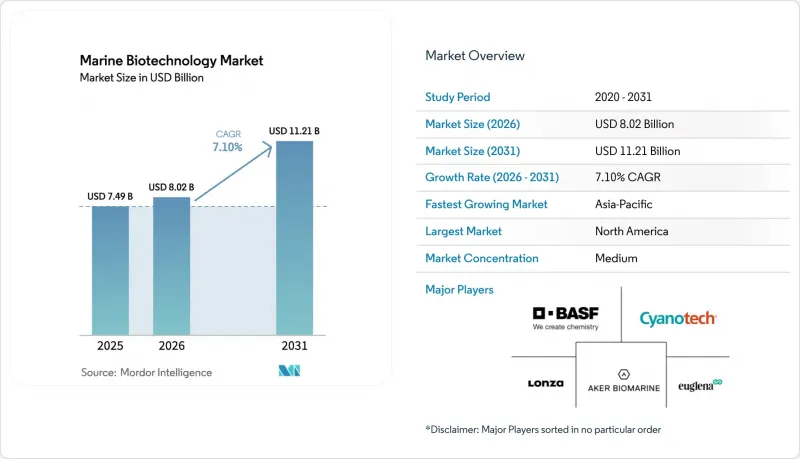
This report Segments the Industry Into by Source (Corals and Sponges, Algae, Marine Viruses, Marine Fungi, and More), Applications (Pharmaceuticals, Nutraceuticals & Dietary Supplements, Cosmetics & Personal Care, and More), and Geography (North America, Europe, Asia-Pacific, Middle East and Africa, and South America). The Market Forecasts are Provided in Terms of Value (USD).
Global Marine Biotechnology Market Trends and Insights
Increase in Marine-Sourced Actives for Pharmaceuticals & Cosmetics
Clinical pipelines are pivoting toward ocean-derived scaffolds as terrestrial natural-product libraries plateau; PharmaMar's tunicate-origin lurbinectedin gained U.S. approval for small-cell lung cancer in 2024. Clean-beauty brands now command price premiums for kelp peptides and sponge polysaccharides, and the FDA's 2024 excipient guidance has trimmed drug-delivery approval timelines by up to nine months. These combined regulatory and efficacy advantages underpin the driver's 1.2% positive impact on the marine biotechnology market.
Rising Demand for Marine-Derived Nutritional Supplements
Vegan omega-3 capsules from micro-algae captured 22% of the global EPA/DHA segment in 2025 as consumers pivot away from fish oil. Schizochytrium-based DHA earned EU Novel Food clearance, unlocking infant-formula channels, while astaxanthin products posted double-digit growth after clinical validation of sports-recovery benefits. Regulatory tailwinds and superior bioavailability sustain a 1.0% boost to CAGR.
Limited Ocean Exploration Depth & Sample Collection
Only one-fifth of the ocean floor has high-resolution mapping, and hadal-zone sampling costs USD 50,000 per dive day, limiting biodiversity access for start-ups. Autonomous drones from Ocean Infinity trimmed costs by two-thirds in 2025, yet throughput still trails terrestrial surveys by two orders of magnitude. This bottleneck subtracts 0.5% from market CAGR.
Other drivers and restraints analyzed in the detailed report include:
- Advances in Fisheries Genomics & Drug-Discovery Platforms
- AI-Enabled Bioprospecting Accelerates Novel Compound Discovery
- Low Cultivability of Many Marine Micro-Organisms
For complete list of drivers and restraints, kindly check the Table Of Contents.
Segment Analysis
Corals and sponges are projected to advance at a 9.24% CAGR from 2026-2031, the swiftest rate among source categories in the marine biotechnology market. Their halogen-rich metabolites underpin oncology and antiviral breakthroughs; PharmaMar's tunicate-origin plitidepsin finished Phase III COVID-19 trials in 2025. GlycoMar's sponge library yielded a heparan-sulfate analog that outperformed enoxaparin in thrombosis models, confirming high therapeutic potential.
Algae maintained a 33.2% marine biotechnology market share in 2025, anchored by spirulina protein, chlorella, and astaxanthin in supplements. Yet growth is moderating as synthetic biology clones high-volume algal metabolites. Marine viruses and fungi remain niche but promising; a 2024 Arctic fungal isolate produced a novel beta-lactamase inhibitor.
Complete Report Scope:
- By Source
- Corals & Sponges
- Algae
- Marine Viruses
- Marine Fungi
- Other Sources
- By Application
- Pharmaceuticals
- Nutraceuticals & Dietary Supplements
- Cosmetics & Personal Care
- Others
- Geography
- North America
- United States
- Canada
- Mexico
- Europe
- Germany
- United Kingdom
- France
- Italy
- Spain
- Rest of Europe
- Asia-Pacific
- China
- Japan
- India
- Australia
- South Korea
- Rest of Asia-Pacific
- Middle East and Africa
- GCC
- South Africa
- Rest of Middle East and Africa
- South America
- Brazil
- Argentina
- Rest of South America
- North America
Geography Analysis
North America captured 45.56% of the marine biotechnology market revenue in 2025 as NIH allocated USD 85 million to a marine natural-products screening program and NOAA launched grants that drew USD 18 million in private seaweed investment to Maine. Regulatory clarity and FDA guidance on marine excipients shorten commercialization cycles, while Canada's Ocean Supercluster co-funds AI-enabled genomics databases.
Asia-Pacific will post an 8.98% regional CAGR, the fastest globally, underpinned by China's USD 200 million deep-sea enzyme initiative and Japan's 500-t Euglena facility that now supplies biojet fuel for 12-month ANA trials. South Korea earmarked KRW 120 billion in 2025 for marine-derived oncology pipelines, and India scales Kappaphycus seaweed farms to cut carrageenan imports.
Europe benefits from EUR 800 million in EMFAF blue-biotech grants and stringent net-zero policies that elevate algae-bioplastic demand. Norway's public salmon pangenome expedites global breeding programs, the UAE pilots algae carbon-capture at desalination plants, South Africa grows kelp for abalone feed, and Brazil's Embrapa assays native seaweeds for carrageenan, rounding out diversified regional contributions.
- Aker BioMarine ASA
- Algatechnologies Ltd
- Aqua Bio Technology ASA
- AstaReal Co., Ltd.
- BASF
- Bluebiotech International
- CP Kelco U.S., Inc.
- Cyanotech
- Euglena Co., Ltd.
- GlycoMar Ltd.
- Lonza Group
- Marinomed Biotech
- Marinova Pty Ltd
- New England Biolabs
- Nutrex Hawaii Inc.
- PharmaMar S.A.
- Royal DSM-Firmenich N.V.
- Sea Run Holdings Inc.
- SEPPIC
Additional Benefits:
- The market estimate (ME) sheet in Excel format
- 3 months of analyst support
TABLE OF CONTENTS
1 Introduction
- 1.1 Study Assumptions & Market Definition
- 1.2 Scope of the Study
2 Research Methodology
3 Executive Summary
4 Market Landscape
- 4.1 Market Overview
- 4.2 Market Drivers
- 4.2.1 Increase In Marine-Sourced Actives for Pharmaceuticals & Cosmetics
- 4.2.2 Rising Demand for Marine-Derived Nutritional Supplements
- 4.2.3 Advances In Fisheries Genomics & Drug-Discovery Platforms
- 4.2.4 AI-Enabled Bioprospecting Accelerates Novel Compound Discovery
- 4.2.5 Net-Zero Policies Stimulating Algae-Based Bioplastics Investment
- 4.2.6 EU Blue Economy Funds Scaling Early-Stage Blue-Biotech Start-Ups
- 4.3 Market Restraints
- 4.3.1 Limited Ocean Exploration Depth & Sample Collection
- 4.3.2 Low Cultivability of Many Marine Micro-Organisms
- 4.3.3 Forthcoming BBNJ Access-And-Benefit-Sharing Compliance Costs
- 4.3.4 Competition From Terrestrial Synthetic-Biology Alternatives
- 4.4 Supply-Chain Analysis
- 4.5 Technological Outlook
- 4.6 Regulatory Landscape
- 4.7 Porter's Five Forces
- 4.7.1 Bargaining Power of Suppliers
- 4.7.2 Bargaining Power of Buyers/Consumers
- 4.7.3 Threat of New Entrants
- 4.7.4 Threat of Substitute Products
- 4.7.5 Intensity of Competitive Rivalry
5 Market Size & Growth Forecasts (Value, USD)
- 5.1 By Source
- 5.1.1 Corals & Sponges
- 5.1.2 Algae
- 5.1.3 Marine Viruses
- 5.1.4 Marine Fungi
- 5.1.5 Other Sources
- 5.2 By Application
- 5.2.1 Pharmaceuticals
- 5.2.2 Nutraceuticals & Dietary Supplements
- 5.2.3 Cosmetics & Personal Care
- 5.2.4 Others
- 5.3 Geography
- 5.3.1 North America
- 5.3.1.1 United States
- 5.3.1.2 Canada
- 5.3.1.3 Mexico
- 5.3.2 Europe
- 5.3.2.1 Germany
- 5.3.2.2 United Kingdom
- 5.3.2.3 France
- 5.3.2.4 Italy
- 5.3.2.5 Spain
- 5.3.2.6 Rest of Europe
- 5.3.3 Asia-Pacific
- 5.3.3.1 China
- 5.3.3.2 Japan
- 5.3.3.3 India
- 5.3.3.4 Australia
- 5.3.3.5 South Korea
- 5.3.3.6 Rest of Asia-Pacific
- 5.3.4 Middle East and Africa
- 5.3.4.1 GCC
- 5.3.4.2 South Africa
- 5.3.4.3 Rest of Middle East and Africa
- 5.3.5 South America
- 5.3.5.1 Brazil
- 5.3.5.2 Argentina
- 5.3.5.3 Rest of South America
- 5.3.1 North America
6 Competitive Landscape
- 6.1 Market Concentration
- 6.2 Market Share Analysis
- 6.3 Company Profiles (includes Global level Overview, Market level overview, Core Segments, Financials as available, Strategic Information, Market Rank/Share for key companies, Products & Services, and Recent Developments)
- 6.3.1 Aker BioMarine ASA
- 6.3.2 Algatechnologies Ltd
- 6.3.3 Aqua Bio Technology ASA
- 6.3.4 AstaReal Co., Ltd.
- 6.3.5 BASF SE
- 6.3.6 Bluebiotech International GmbH
- 6.3.7 CP Kelco U.S., Inc.
- 6.3.8 Cyanotech Corporation
- 6.3.9 Euglena Co., Ltd.
- 6.3.10 GlycoMar Ltd.
- 6.3.11 Lonza Group Ltd
- 6.3.12 Marinomed Biotech AG
- 6.3.13 Marinova Pty Ltd
- 6.3.14 New England Biolabs Inc.
- 6.3.15 Nutrex Hawaii Inc.
- 6.3.16 PharmaMar S.A.
- 6.3.17 Royal DSM-Firmenich N.V.
- 6.3.18 Sea Run Holdings Inc.
- 6.3.19 SEPPIC
7 Market Opportunities & Future Outlook
- 7.1 White-space & Unmet-Need Assessment

