PUBLISHER: Mordor Intelligence | PRODUCT CODE: 2116327

PUBLISHER: Mordor Intelligence | PRODUCT CODE: 2116327
Intrathecal Pumps - Market Share Analysis, Industry Trends & Statistics, Growth Forecasts (2026 - 2031)
According to Mordor Intelligence, intrathecal pumps market size in 2026 is estimated at USD 403.96 million, growing from 2025 value of USD 380.85 million with 2031 projections showing USD 542.43 million, growing at 6.07% CAGR over 2026-2031.
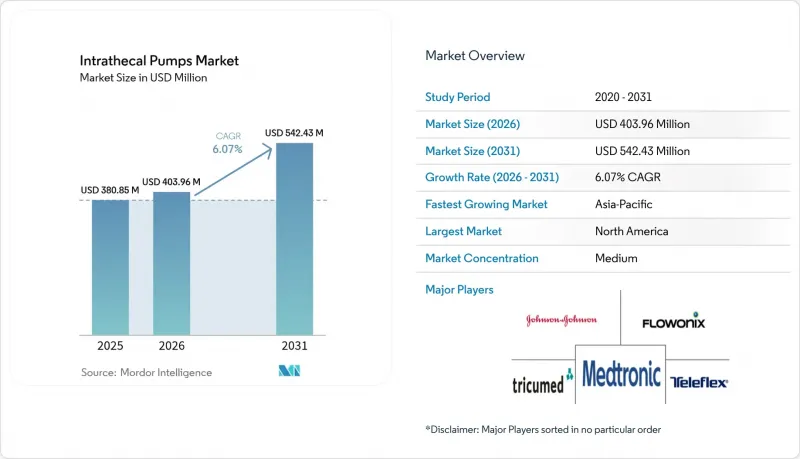
This report is Segmented by Pump Type (Programmable and Constant-Flow (Fixed-Rate) Pumps), Product Class (Baclofen, Morphine, Hydromorphone, and More), Application (Chronic Pain Management and Spasticity Management), End-User (Hospitals & Clinics, Ambulatory Surgery Centers, and More), and Geography (North America, Europe, Asia-Pacific, and More). The Market Forecasts are Provided in Terms of Value (USD).
Global Intrathecal Pumps Market Trends and Insights
Growing Prevalence Of Chronic Back Pain & Spasticity
An aging population and sedentary lifestyles keep the addressable pool for intrathecal therapy expanding, with 50 million adults in the United States alone reporting chronic pain. Rising survival after spinal cord injury and multiple sclerosis enlarges the spasticity segment, and studies show intrathecal baclofen cuts spasticity scores by 40.25% and lifts motor function by 9.62% in cerebral palsy. Better outcomes spur referrals from primary care to specialist centers that house pump surgery programs. Hospitals treat pumps as long-term value propositions that reduce readmissions and bolster patient-reported quality of life. The intrathecal pumps market therefore penetrates deeper into neurology clinics and rehabilitation facilities.
Rising Demand For Targeted Drug-Delivery Alternatives To Systemic Opioids
Health systems confronting opioid misuse pivot toward modalities requiring minimal systemic dosing: intrathecal morphine uses roughly 1/300th of the oral amount yet sustains analgesia. The 2025 NOPAIN Act gives non-opioid devices a separate Medicare payment, nudging hospitals to adopt pump therapy. Half of implanted patients discontinue systemic opioids within 12 months, supporting payer initiatives that link reimbursement to opioid-sparing outcomes. The intrathecal pumps market rides these stewardship programs as formularies explicitly list pumps as preferred non-opioid interventions.
High Upfront Device & Implantation Cost
Acquisition of an implantable pump exceeds USD 20,000, and surgical fees, programmer hardware, and follow-up push the initial bundle higher. The multi-disciplinary expertise needed for implantation raises operational overhead, making return-on-investment math difficult for smaller hospitals. Insurers demand exhaustive documentation of previous conservative failures, delaying therapy onset. Budget-strained health systems in Latin America and parts of APAC allocate funds to primary care rather than advanced devices, slowing market entry even though total three-year cost is favorable versus systemic opioids.
Other drivers and restraints analyzed in the detailed report include:
- Rapid Technology Upgrades (Programmable / MRI-Conditional Pumps)
- Payer-Driven Opioid-Stewardship Programs Boosting Pump Adoption
- Low Clinical-Staff Awareness In Emerging Markets
For complete list of drivers and restraints, kindly check the Table Of Contents.
Segment Analysis
Programmable pumps delivered 76.88% revenue in 2025 and are on a 9.94% growth slope, confirming their status as the mainstay of the intrathecal pumps market. Advanced models integrate wireless charging and 99% five-year survival, minimizing replacement surgeries. Constant-flow pumps retain a contingent niche for straightforward regimens and lower capital outlay. Hospitals adopt dual-inventory strategies, reserving variable-rate devices for complex neuralgia or multi-drug cocktails while allocating constant-flow units to end-of-life cancer pain. Surveys show neurologists value fine-grain programming that mirrors circadian patterns, especially for dystonia and spasticity.
AI modules analyze dosing history, automatically proposing flow adjustments that physicians review. Long-term data indicate reduced side effects and fewer emergency titrations compared with fixed-rate systems, reinforcing the premium footprint of programmable technology. The intrathecal pumps industry continues to funnel R&D toward battery chemistry, miniaturization, and Bluetooth-Low-Energy modules that meet hospital network standards.
Baclofen remained the anchor drug, holding 41.10% of intrathecal pumps market size in 2025 and continuing steady adoption thanks to a well-documented safety profile in spasticity bmcneurol.biomedcentral.com.
Ziconotide's 11.38% CAGR underlines growing confidence following updated PACC titration protocols that mitigate neuropsychiatric events. Morphine and hydromorphone persist for palliative cancer indications, while bupivacaine serves mixed neuropathic pain. Combination reservoirs deliver synergistic effects at lower individual doses, lowering adverse events. Pipeline nanoparticle formulations aim for extended stability, which could shrink refill frequency and expand indications. The intrathecal pumps market therefore balances entrenched baclofen demand with agile ziconotide growth.
Complete Report Scope:
- By Pump Type
- Programmable/Variable-rate Pumps
- Constant-flow (Fixed-rate) Pumps
- By Product Class
- Baclofen
- Morphine
- Hydromorphone
- Bupivacaine
- Ziconotide
- Other APIs (Clonidine, Prialt combinations)
- By Application
- Chronic Pain Management
- Spasticity Management
- By End-user
- Hospitals & Clinics
- Ambulatory Surgery Centers
- Home-care & Long-term Care Settings
- Geography
- North America
- United States
- Canada
- Mexico
- Europe
- Germany
- United Kingdom
- France
- Italy
- Spain
- Rest of Europe
- Asia-Pacific
- China
- Japan
- India
- South Korea
- Australia
- Rest of Asia-Pacific
- Middle East and Africa
- GCC
- South Africa
- Rest of Middle East and Africa
- South America
- Brazil
- Argentina
- Rest of South America
- North America
Geography Analysis
North America commanded 48.10% of global revenue in 2025 due to clear reimbursement, an extensive specialist base, and strong manufacturer presence. Medicare's consistent coding structure shortens billing cycles, while private insurers align with opioid-reduction targets. Research investments nurture continuous device upgrades and feed rapid clinical adoption.
Europe follows a structured pathway emphasizing evidence-based funding schemes such as Germany's NUB program that annually supports novel pump technologies. The British Pain Society's 2024 guideline update clarifies patient selection and standardizes dosing, leading to harmonized referrals across the region. Aging demographics and chronic disease burdens guarantee sustained volume.
Asia-Pacific represents the fastest-expanding segment at 10.44% CAGR, fueled by Japan's universal coverage, China's ongoing health-system reforms, and India's private-sector hospital boom. Academic centers in Seoul and Singapore run collaborative pump registries that build localized evidence. Cost remains the foremost barrier, but public-private partnerships and medical tourism increasingly bridge gaps. Consequently, the intrathecal pumps market stands to witness rapid volume growth once reimbursement pathways mature across Asian economies.
- Medtronic
- Flowonix Medical Inc.
- Tricumed Medizintechnik
- Johnson & Johnson (Codman/Cerenovus)
- Teleflex
- Smiths Group
- Baxter
- B. Braun
- Fresenius
- Terumo Corp.
- Abbott Laboratories
- Boston Scientific
- Nevro
- Durect Corp.
- Advanced Bionics
- Avanos Medical
- InfuTronix Solutions
Additional Benefits:
- The market estimate (ME) sheet in Excel format
- 3 months of analyst support
TABLE OF CONTENTS
1 Introduction
- 1.1 Study Assumptions & Market Definition
- 1.2 Scope of the Study
2 Research Methodology
3 Executive Summary
4 Market Landscape
- 4.1 Market Overview
- 4.2 Market Drivers
- 4.2.1 Growing Prevalence Of Chronic Back Pain & Spasticity
- 4.2.2 Rising Demand For Targeted Drug-Delivery Alternatives To Systemic Opioids
- 4.2.3 Rapid Technology Upgrades (Programmable / MRI-Conditional Pumps)
- 4.2.4 Payer-Driven Opioid-Stewardship Programs Boosting Pump Adoption
- 4.2.5 AI-Guided Refill-Dose Algorithms Improving Clinic Throughput
- 4.2.6 Expansion Into Neuro-Oncology Enabled By MRI-Safe Designs
- 4.3 Market Restraints
- 4.3.1 High Upfront Device & Implantation Cost
- 4.3.2 Low Clinical-Staff Awareness In Emerging Markets
- 4.3.3 Hospital Cybersecurity Concerns Over Wireless Programmers
- 4.3.4 Titanium-Alloy Supply-Chain Bottlenecks Post-2024
- 4.4 Porter's Five Forces
- 4.4.1 Threat of New Entrants
- 4.4.2 Bargaining Power of Buyers
- 4.4.3 Bargaining Power of Suppliers
- 4.4.4 Threat of Substitutes
- 4.4.5 Competitive Rivalry
5 Market Size & Growth Forecasts (Value, USD)
- 5.1 By Pump Type
- 5.1.1 Programmable/Variable-rate Pumps
- 5.1.2 Constant-flow (Fixed-rate) Pumps
- 5.2 By Product Class
- 5.2.1 Baclofen
- 5.2.2 Morphine
- 5.2.3 Hydromorphone
- 5.2.4 Bupivacaine
- 5.2.5 Ziconotide
- 5.2.6 Other APIs (Clonidine, Prialt combinations)
- 5.3 By Application
- 5.3.1 Chronic Pain Management
- 5.3.2 Spasticity Management
- 5.4 By End-user
- 5.4.1 Hospitals & Clinics
- 5.4.2 Ambulatory Surgery Centers
- 5.4.3 Home-care & Long-term Care Settings
- 5.5 Geography
- 5.5.1 North America
- 5.5.1.1 United States
- 5.5.1.2 Canada
- 5.5.1.3 Mexico
- 5.5.2 Europe
- 5.5.2.1 Germany
- 5.5.2.2 United Kingdom
- 5.5.2.3 France
- 5.5.2.4 Italy
- 5.5.2.5 Spain
- 5.5.2.6 Rest of Europe
- 5.5.3 Asia-Pacific
- 5.5.3.1 China
- 5.5.3.2 Japan
- 5.5.3.3 India
- 5.5.3.4 South Korea
- 5.5.3.5 Australia
- 5.5.3.6 Rest of Asia-Pacific
- 5.5.4 Middle East and Africa
- 5.5.4.1 GCC
- 5.5.4.2 South Africa
- 5.5.4.3 Rest of Middle East and Africa
- 5.5.5 South America
- 5.5.5.1 Brazil
- 5.5.5.2 Argentina
- 5.5.5.3 Rest of South America
- 5.5.1 North America
6 Competitive Landscape
- 6.1 Market Concentration Analysis
- 6.2 Market Share Analysis
- 6.3 Company Profiles (includes Global level Overview, Market level overview, Core Segments, Financials as available, Strategic Information, Market Rank/Share for key companies, Products & Services, and Recent Developments)
- 6.3.1 Medtronic plc
- 6.3.2 Flowonix Medical Inc.
- 6.3.3 Tricumed Medizintechnik GmbH
- 6.3.4 Johnson & Johnson (Codman/Cerenovus)
- 6.3.5 Teleflex Inc.
- 6.3.6 Smiths Medical (ICU Medical)
- 6.3.7 Baxter International Inc.
- 6.3.8 B. Braun Melsungen AG
- 6.3.9 Fresenius Kabi
- 6.3.10 Terumo Corp.
- 6.3.11 Abbott Laboratories
- 6.3.12 Boston Scientific Corp.
- 6.3.13 Nevro Corp.
- 6.3.14 Durect Corp.
- 6.3.15 Advanced Bionics AG
- 6.3.16 Avanos Medical Inc.
- 6.3.17 InfuTronix Solutions
7 Market Opportunities & Future Outlook
- 7.1 White-space & Unmet-need Assessment

