PUBLISHER: Mordor Intelligence | PRODUCT CODE: 2116355

PUBLISHER: Mordor Intelligence | PRODUCT CODE: 2116355
China Senior Living - Market Share Analysis, Industry Trends & Statistics, Growth Forecasts (2026 - 2031)
According to Mordor Intelligence, the China senior living market size was valued at USD 36.85 billion in 2025 and is estimated to grow from USD 40.44 billion in 2026 to reach USD 64.34 billion by 2031, at a CAGR of 9.73% during the forecast period (2026-2031).
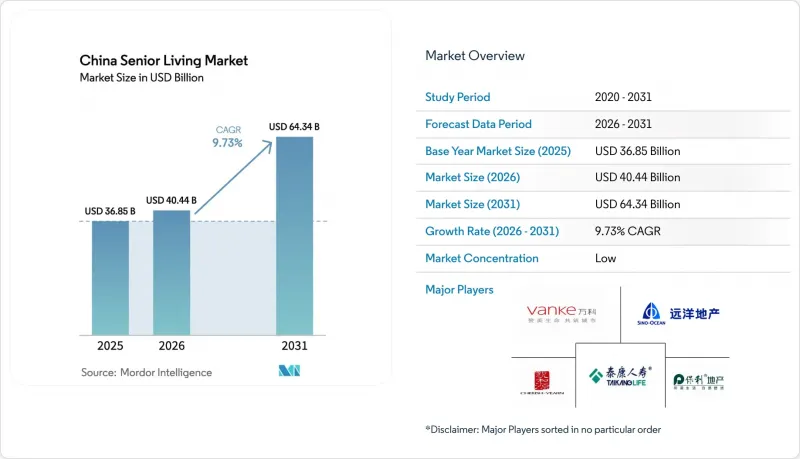
This report is Segmented by Property Type (Assisted Living, Independent Living, Memory Care, Nursing Care), by Business Model (Outright Sale, Long-Lease/Rental, Hybrid), by Age (55-64, 65-74, 75-85, Above 85), and by Major Cities (Beijing, Shanghai, Shenzhen, Guangzhou, Chengdu, Rest of China). The Market Forecasts are Provided in Terms of Value (USD).
China Senior Living Market Trends and Insights
Rapid Aging Cohort Expansion Reshaping Care-Level Mix
China will see its population aged 75 and above outpace all other age brackets by 2031, lifting demand for assisted living, memory care, and skilled nursing. By end-2024, seniors 65 and older totaled 220.23 million, equal to 15.6% of the population. Higher prevalence of diabetes, cardiovascular disease, and cognitive impairment among this group pushes operators to retrofit independent-living wings into dementia-ready units and to embed geriatric clinics on campus. Early adopters tied into LTCI pilots have begun billing bundled rehabilitation services, raising utilization while cutting emergency transfers. The WHO Integrated Care for Older People framework, piloted since 2024, is accelerating the adoption of functional-ability assessments and interoperable electronic records. Operators capable of staffing higher-dependency units are rewarded with longer lengths of stay and pricing power that outstrips inflation.
Wealth Accumulation in Coastal Hubs: Unlocking Premium Segments
Household savings in Tier 1 and Tier 2 cities now support monthly fees ranging from USD 1,100 to USD 2,750 for assisted living, a level unattainable a decade earlier. Rising pension income and property gains underpin a lifestyle-oriented view of professional care. Taikang Life's Wu Garden in Suzhou, opened in 2024, markets "migratory bird" retirement, leveraging China's high-speed rail to shuttle residents seasonally. Ping An's USD 1.7 billion buy-out of its digital-health unit in January 2025 further signals confidence that telehealth ecosystems can justify premium pricing. Despite strength at the top end, mid-market facilities in inland cities still face occupancy below 60%, underscoring uneven wealth dispersion.
Cultural Norms Slowing Institutional Adoption Beyond Tier 1 Cities
Deep-rooted filial piety sustains a family-care bias, especially in smaller cities and rural counties. Surveys in Chengdu during 2024 showed parents resisting relocation despite adult children's willingness to pay, keeping occupancy below 60% in many Tier 2 projects. The Hong Kong-Guangdong RCHE scheme, though cost-efficient, had limited uptake because seniors prefer familiar culture and food. Operators reframe facilities as lifestyle communities with art studios and excursions, but messaging resonates mainly with urban elites. Consequently, the Chinese senior living market grows unevenly, with conversion highest where cultural barriers are weakest.
Other drivers and restraints analyzed in the detailed report include:
- Healthcare Integration Blurring Institutional and Clinical Boundaries
- Government Land and Financing Incentives Accelerating Supply
- Workforce Shortages and Quality Gaps Constraining Service Delivery
For complete list of drivers and restraints, kindly check the Table Of Contents.
Segment Analysis
Assisted living held a commanding 42.3% of China senior living market share in 2025, reflecting its versatility in meeting daily activity assistance needs. Independent living attracts younger retirees, yet operators now pivot to memory care after national dementia-care rules took effect in December 2024. Memory-care units are projected to post a 10.55% CAGR between 2026 and 2031, outpacing every other property type. Taikang Life and Ping An are rolling out secured floors with sensory-stimulation rooms and certified staff, creating high-margin, differentiated products within the Chinese senior living market.
Adding dementia-ready wings raises capital expense but boosts average revenue per occupied bed. Compliance with the new framework requires minimum nurse-to-resident ratios and family-support programs, barriers that tilt competition toward well-funded chains. Independent-living operators retrofit existing campuses to retain couples aging at different paces, while nursing-care facilities leverage LTCI pilots to bill post-acute rehab sessions, strengthening cross-selling. As more residents transition from independent living to higher-acuity care, integrated campuses gain occupancy resilience, supporting long-term cash flow.
Complete Report Scope:
- By Property Type
- Assisted Living
- Independent Living
- Memory Care
- Nursing Care
- By Business Model
- Outright Sale (Freehold)
- Long-Lease / Rental
- Hybrid (Sale + Lease)
- By Age
- 55 to 64 years
- 65 to 74 years
- 75 to 85 years
- Above 85 years
- By Major Cities
- Beijing
- Shanghai
- Shenzhen
- Guangzhou
- Chengdu
- Rest of China
List of Companies Covered in this Report:
- China Vanke
- Sino-Ocean Group
- Taikang Life
- Poly Developments & Holdings
- Cherish-Yearn
- New China Life
- China Taiping
- Lendlease (Ardor Gardens)
- Aveo China
- Wuxi Langgao Elderly Service
- Country Garden Elderly Care
- Greentown China Senior Living
- Longfor Elderly Care
- China Merchants Shekou Elderly Community
- Bluetown Senior Living
- Ping An Good-Doctor & Ping An Home-Care
- R&F Properties Yuelai Elderly Care
- CIFI Ever Sunshine Elderly Services
- Brookdale & CITIC JV
- Abbeyfield China
- Evergrande Elderly Care
Additional Benefits:
- The market estimate (ME) sheet in Excel format
- 3 months of analyst support
TABLE OF CONTENTS
1 Introduction
- 1.1 Study Assumptions & Market Definition
- 1.2 Scope of the Study
2 Research Methodology
3 Executive Summary
4 Market Insight and Dynamics
- 4.1 Market Overview
- 4.2 Market Drivers
- 4.2.1 Rapid aging-growing 75-85+ cohort-expanding demand for independent, assisted, and memory care.
- 4.2.2 Rising household wealth and shifting attitudes toward professional care services in Tier 1-2 cities.
- 4.2.3 Healthcare integration opportunities: rehab, chronic-disease management, and senior-friendly clinics on-campus.
- 4.2.4 Government support for eldercare supply, including pilot programs, land/PPP avenues, and medical insurance linkages.
- 4.2.5 Technology-enabled operations (telehealth, remote monitoring, fall detection) improving outcomes and efficiency.
- 4.3 Market Restraints
- 4.3.1 Cultural preference for family-based care limiting conversion outside top urban markets.
- 4.3.2 Staffing shortages in geriatrics/nursing and uneven operator capability constraining quality scale-up.
- 4.3.3 Affordability gaps and complex licensing/reimbursement frameworks challenging sustainable economics.
- 4.4 Value / Supply-Chain Analysis
- 4.5 Policy & Regulatory Framework (state guidelines, licensing, incentives)
- 4.6 Insight on Upcoming and Ongoing Projects
- 4.7 Insights on Digital & Tech Enablers (telemedicine, smart amenities)
- 4.8 Insights on Business Model & Operator Evolution
- 4.9 Insights on Investment & Financing Trends
- 4.10 Insights Sustainability & Design Innovation
- 4.11 Porter's Five Forces
- 4.11.1 Threat of New Entrants
- 4.11.2 Bargaining Power of Buyers
- 4.11.3 Bargaining Power of Suppliers
- 4.11.4 Threat of Substitutes
- 4.11.5 Intensity of Competitive Rivalry
5 Market Size & Growth Forecasts (Value)
- 5.1 By Property Type
- 5.1.1 Assisted Living
- 5.1.2 Independent Living
- 5.1.3 Memory Care
- 5.1.4 Nursing Care
- 5.2 By Business Model
- 5.2.1 Outright Sale (Freehold)
- 5.2.2 Long-Lease / Rental
- 5.2.3 Hybrid (Sale + Lease)
- 5.3 By Age
- 5.3.1 55 to 64 years
- 5.3.2 65 to 74 years
- 5.3.3 75 to 85 years
- 5.3.4 Above 85 years
- 5.4 By Major Cities
- 5.4.1 Beijing
- 5.4.2 Shanghai
- 5.4.3 Shenzhen
- 5.4.4 Guangzhou
- 5.4.5 Chengdu
- 5.4.6 Rest of China
6 Competitive Landscape
- 6.1 Market Concentration
- 6.2 Strategic Moves
- 6.3 Company Profiles (includes Global level Overview, Market level overview, Core Segments, Financials as available, Strategic Information, Products & Services, and Recent Developments)
- 6.3.1 China Vanke
- 6.3.2 Sino-Ocean Group
- 6.3.3 Taikang Life
- 6.3.4 Poly Developments & Holdings
- 6.3.5 Cherish-Yearn
- 6.3.6 New China Life
- 6.3.7 China Taiping
- 6.3.8 Lendlease (Ardor Gardens)
- 6.3.9 Aveo China
- 6.3.10 Wuxi Langgao Elderly Service
- 6.3.11 Country Garden Elderly Care
- 6.3.12 Greentown China Senior Living
- 6.3.13 Longfor Elderly Care
- 6.3.14 China Merchants Shekou Elderly Community
- 6.3.15 Bluetown Senior Living
- 6.3.16 Ping An Good-Doctor & Ping An Home-Care
- 6.3.17 R&F Properties Yuelai Elderly Care
- 6.3.18 CIFI Ever Sunshine Elderly Services
- 6.3.19 Brookdale & CITIC JV
- 6.3.20 Abbeyfield China
- 6.3.21 Evergrande Elderly Care
7 Market Opportunities & Future Outlook
- 7.1 White-space & Unmet-Need Assessment

