PUBLISHER: Mordor Intelligence | PRODUCT CODE: 2116394

PUBLISHER: Mordor Intelligence | PRODUCT CODE: 2116394
India Gelatin - Market Share Analysis, Industry Trends & Statistics, Growth Forecasts (2026 - 2031)
According to Mordor Intelligence, the indian gelatin market size is expected to grow from USD 287.13 million in 2025 to USD 307.97 million in 2026 and is forecast to reach USD 438.03 million by 2031 at 7.30% CAGR over 2026-2031.
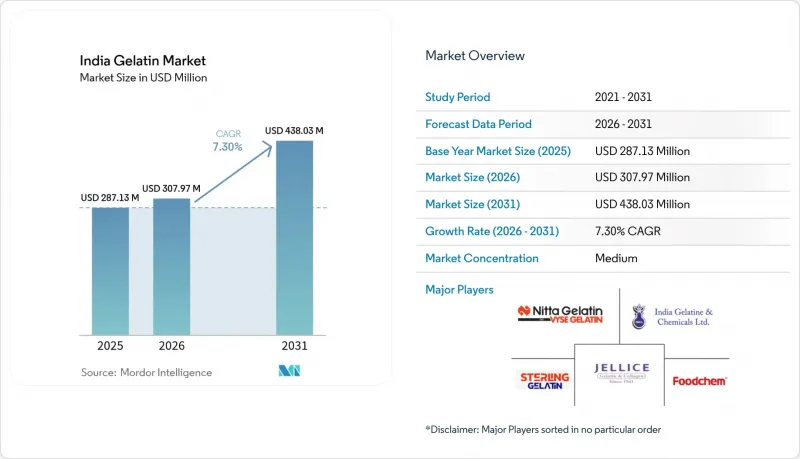
This report is Segmented by Source (Animal-Based and Marine-Based), by Grade (Food Grade and Pharmaceutical Grade), by End-User (Personal Care and Cosmetics, Food and Beverages, Dietary Supplements, Pharmaceuticals, and Others). The Market Forecasts are Provided in Terms of Value (USD).
India Gelatin Market Trends and Insights
Expanding Confectionery and Processed Dairy Sector
India's confectionery market growth has increased the demand for gelatin, as manufacturers use it to enhance texture and extend product shelf life. The market expansion is supported by increasing disposable incomes and changing dietary preferences toward Western products, especially in urban areas where premium confectionery items generate higher margins. The dairy processing segment, supported by India's status as the world's largest milk producer, incorporates gelatin in yogurts, desserts, and functional dairy products to enhance texture and nutritional content. The Ministry of Food Processing Industries (MOFI) provides infrastructure funding to food processing units, enabling them to expand capacity and upgrade technology, which increases gelatin usage in production. The government has identified several growth opportunities in the dairy processing sector for 2025, including advanced dairy processing technologies, cold chain development, and product innovation in cheese, smoothies, flavored milk, custard, yogurt, and traditional Indian products. These developments expand the use of gelatin as a functional ingredient in both confectionery and processed dairy products.
Growth of Functional Food and Beverages
The expansion of India's functional food and beverages segment is driving increased demand for gelatin. Manufacturers are incorporating gelatin into protein-enriched drinks, fortified gummies, and nutritional supplements to meet the needs of health-conscious consumers. In these applications, gelatin serves as both a functional ingredient for texture and stability and an encapsulation medium for vitamins, minerals, and bioactive compounds. The collagen peptides obtained through gelatin hydrolysis provide bioactive properties beneficial for skin health, joint function, and overall wellness, contributing to the development of premium nutrition products. A global study by Wonderful Pistachios revealed that 58% of urban Indians prioritize nutritional benefits over taste when making food purchases, exceeding the global average of 52%. Delhi and Ahmedabad demonstrate the strongest nutrition-first mindset, with over 60% of urban consumers prioritizing health benefits. Bengaluru and Chennai show similar trends, indicating a broader national shift toward health-oriented food choices in 2024. This increased focus on nutrition among Indian consumers reinforces gelatin's position as an essential ingredient in the functional food and beverage market.
Rise of Plant-Based Hydrocolloid Replacements
Plant-based alternatives including agar-agar, carrageenan, and pectin increasingly challenge gelatin's market position, particularly in vegetarian-conscious segments and export markets with sustainability mandates. Technical research demonstrates that κ-carrageenan combined with locust bean gum can replicate gelatin's gelling properties in specific applications, though limitations remain in thermal stability and texture characteristics. The development of sophisticated plant-based formulations by food technologists creates viable alternatives for cost-sensitive applications, though premium segments continue favoring gelatin for superior functional properties. Consumer awareness campaigns by plant-based ingredient suppliers emphasize environmental and ethical advantages, influencing purchasing decisions in urban markets where sustainability concerns drive product selection. However, plant-based alternatives face their own supply chain constraints and price volatility, limiting their ability to completely displace gelatin in price-sensitive applications.
Other drivers and restraints analyzed in the detailed report include:
- Shift Toward Clean Label and Protein-Enriched Products
- Substantial Utilization of Gelatin in Pharmaceuticals
- Regulatory and Certification Challenges
For complete list of drivers and restraints, kindly check the Table Of Contents.
Segment Analysis
Marine-based gelatin demonstrates significant growth potential with a 7.70% CAGR through 2031, despite holding a smaller market share. This growth stems from religious dietary preferences and health benefits compared to animal-based alternatives. India's expanding coastal aquaculture industry and improved fish processing capabilities provide collagen-rich by-products for gelatin extraction. Animal-based gelatin maintains market dominance with an 79.55% share in 2025, supported by established supply chains and India's extensive livestock processing infrastructure. The segment benefits from India's position as a major beef exporter and dairy producer, ensuring a steady bovine raw material supply.
Technological advancements in processing have improved marine gelatin's gel strength and thermal stability, broadening its applications. The Food Safety and Standards Authority of India (FSSAI) provides regulatory oversight through established standards for gelatin purity and safety, with additional requirements for marine sources regarding heavy metal contamination and traceability. Government initiatives supporting blue economy development and sustainable fisheries management contribute to the marine gelatin sector's growth by improving raw material quality and availability.
Complete Report Scope:
- By Source
- Animal-Based
- Marine-Based
- By Grade
- Food Grade
- Pharmaceutical Grade
- By End-User
- Personal Care and Cosmetics
- Food and Beverages
- Bakery
- Beverages
- Confectionery
- Dairy and Dairy Alternatives
- RTE/RTC Food Products
- Dietary Supplements
- Pharmaceuticals
- Others
List of Companies Covered in this Report:
- Nitta Gelatin India Ltd
- India Gelatine & Chemicals Ltd
- Sterling Gelatin (Godrej)
- Narmada Gelatines Ltd
- Pioneer Jellice India Private Limited
- Foodchem International Corp
- Foodmate Co Ltd
- Rousselot (Bhargava Gelatin JV)
- Gelita AG
- Darling Ingredients
- Tessenderlo Group (PB Gelatins)
- CJ Gelatin
- Rama Gelatine
- Raymond Gelatine
- Guangdong Yasin Gelatin
- Lapi Gelatine
- Weishardt Group
- Trobas Gelatine
- Xiamen Gelken Gelatin
- Hangzhou Qingqing Gelatin
Additional Benefits:
- The market estimate (ME) sheet in Excel format
- 3 months of analyst support
TABLE OF CONTENTS
1 INTRODUCTION
- 1.1 Study Assumptions and market definition
- 1.2 Scope of the study
2 RESEARCH METHODOLOGY
3 EXECUTIVE SUMMARY
4 MARKET LANDSCAPE
- 4.1 Market Overview
- 4.2 Market Drivers
- 4.2.1 Expannding confectionery and processed dairy sector
- 4.2.2 Growth of functional food and beverages
- 4.2.3 Shift toward clean label and protein-enriched products
- 4.2.4 Substantial utilization of gelatin in pharmaceuticals
- 4.2.5 Rising adoption in personal care and cosmetics
- 4.2.6 Government incentives for collagen recovery from meat waste
- 4.3 Market Restraints
- 4.3.1 Rise of plant-based hydrocolloid replacements
- 4.3.2 Regulatory and certification challenges
- 4.3.3 Volatile supply and pricing of bovine bone raw material
- 4.3.4 Religious/vegetarian constraints on animal origin
- 4.4 Supply-Chain Analysis
- 4.5 Regulatory and Technological Outlook
- 4.6 Porters Five Force Analysis
- 4.6.1 Bargaining Power of Suppliers
- 4.6.2 Bargaining Power of Buyers
- 4.6.3 Threat of New Entrants
- 4.6.4 Threat of Substitutes
- 4.6.5 Intensity of Competitive Rivalry
5 MARKET SIZE AND GROWTH FORECASTS (VALUE)
- 5.1 By Source
- 5.1.1 Animal-Based
- 5.1.2 Marine-Based
- 5.2 By Grade
- 5.2.1 Food Grade
- 5.2.2 Phramaceutical Grade
- 5.3 By End-User
- 5.3.1 Personal Care and Cosmetics
- 5.3.2 Food and Beverages
- 5.3.2.1 Bakery
- 5.3.2.2 Beverages
- 5.3.2.3 Confectionery
- 5.3.2.4 Dairy and Dairy Alternatives
- 5.3.2.5 RTE/RTC Food Products
- 5.3.3 Dietary Supplements
- 5.3.4 Pharmaceuticals
- 5.3.5 Others
6 COMPETITIVE LANDSCAPE
- 6.1 Most Active Companies
- 6.2 Market Positioning Analysis
- 6.3 Company Profiles
- 6.3.1 Nitta Gelatin India Ltd
- 6.3.2 India Gelatine & Chemicals Ltd
- 6.3.3 Sterling Gelatin (Godrej)
- 6.3.4 Narmada Gelatines Ltd
- 6.3.5 Pioneer Jellice India Private Limited
- 6.3.6 Foodchem International Corp
- 6.3.7 Foodmate Co Ltd
- 6.3.8 Rousselot (Bhargava Gelatin JV)
- 6.3.9 Gelita AG
- 6.3.10 Darling Ingredients
- 6.3.11 Tessenderlo Group (PB Gelatins)
- 6.3.12 CJ Gelatin
- 6.3.13 Rama Gelatine
- 6.3.14 Raymond Gelatine
- 6.3.15 Guangdong Yasin Gelatin
- 6.3.16 Lapi Gelatine
- 6.3.17 Weishardt Group
- 6.3.18 Trobas Gelatine
- 6.3.19 Xiamen Gelken Gelatin
- 6.3.20 Hangzhou Qingqing Gelatin
7 MARKET OPPORTUNITIES AND FUTURE OUTLOOK

