PUBLISHER: Mordor Intelligence | PRODUCT CODE: 2116396

PUBLISHER: Mordor Intelligence | PRODUCT CODE: 2116396
Japan Soy Protein - Market Share Analysis, Industry Trends & Statistics, Growth Forecasts (2026 - 2031)
According to Mordor Intelligence, Japan soy protein market size in 2026 is estimated at USD 205.56 million, growing from 2025 value of USD 199.67 million with 2031 projections showing USD 237.73 million, growing at 2.95% CAGR over 2026-2031.
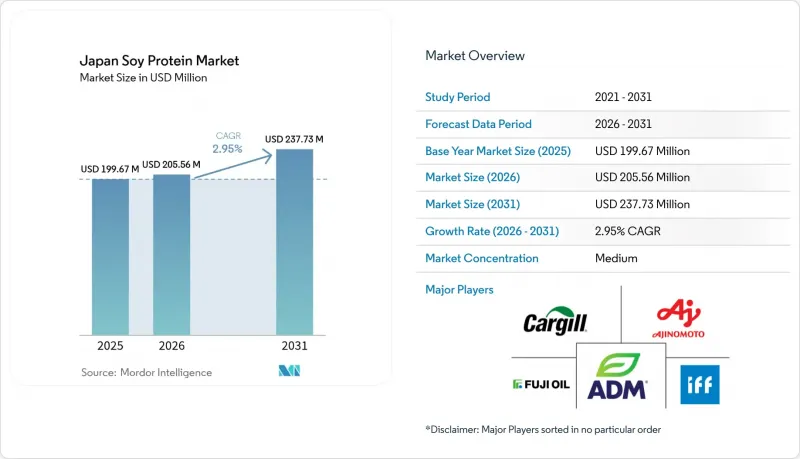
This report is Segmented by Type (Soy Protein Isolates, Soy Protein Concentrates, and Textured/Hydrolyzed Soy Protein), Nature (Conventional and Organic), and End-User (Food and Beverages, Animal Feed, Personal Care and Cosmetics, and Supplements). The Market Forecasts are Provided in Terms of Value (USD).
Japan Soy Protein Market Trends and Insights
Aging population and muscle-health focus
Japan's aging population represents the highest elderly proportion globally, creating substantial market opportunities in protein-enriched clinical nutrition. This demographic transformation drives manufacturers to develop specialized soy protein products for sarcopenia prevention and management. Food companies are actively reformulating their product portfolios to address age-specific nutritional requirements, establishing sustained market growth. The increasing adoption of hydrolyzed soy proteins reflects their enhanced digestibility and absorption characteristics, particularly beneficial for elderly consumers with diminished digestive capabilities. This trend shapes product development strategies across the clinical nutrition segment, influencing both domestic and international market dynamics.
Rising flexitarian eating habits
Japanese urban households are increasingly adopting flexitarian diets by substituting plant-based proteins for animal protein in one or two meals per week. Young consumers associate plant proteins with environmental sustainability and weight control, and favor brands that combine authenticity with convenience. Manufacturers have responded by introducing hybrid products such as patties and dumplings that combine chicken or seafood with soy concentrates, reducing fat content while maintaining price points. This approach extends soy protein's market reach beyond the vegan segment in Japan, increasing the total addressable market. Young consumers associate plant protein with eco-friendliness and weight control, favoring brands that balance authenticity with contemporary convenience. In turn, manufacturers are introducing hybrid patties and dumplings, combining chicken or seafood with soy concentrates. This innovation reduces fat and saturated fat content without raising prices. By adopting this broader strategy, soy is now appealing not just to strict vegans, but to a wider audience, thereby enlarging the potential market for soy protein in Japan.
High dependence on imported soybeans
Japan's soybean supply chain remains vulnerable due to its substantial reliance on imports from the United States, Brazil, and Canada. The country's dependence on international markets makes it susceptible to supply disruptions and geopolitical tensions, which became evident during recent trade disputes and weather-related challenges in commodity markets. While Japan's limited agricultural land continues to restrict domestic production despite government support, companies are taking proactive steps to build more resilient supply chains. These businesses are forming long-term partnerships with international suppliers and investing in vertical integration projects. Significant initiative involves the collaboration between Protein Industries Canada, Alinova Canada Inc., and Marusan Ai Co., who are working together to build a specialized soy processing facility in Ontario dedicated to producing soy milk powder for Japanese consumers. The Observatory of Economic Complexity (OEC) reports that Japan's soybean imports reached 288 billion yen in 2024, with the United States, Brazil, and Canada maintaining their positions as the main suppliers .
Other drivers and restraints analyzed in the detailed report include:
- Government self-sufficiency programmes
- Processing technology advances
- Price volatility of soybeans
For complete list of drivers and restraints, kindly check the Table Of Contents.
Segment Analysis
The Japanese market has embraced Soy Protein Isolates, which now command a substantial 43.60% market share in 2025. These isolates have become essential ingredients for food manufacturers, offering a neutral flavor profile and functional properties that enable effective protein fortification across food products. In the meat alternatives segment, their gelling and water-binding properties create authentic meat-like textures that resonate with consumers. The hydrolyzed soy protein segment shows promise with an anticipated growth rate of 3.42% from 2026 to 2031, as these proteins offer improved digestibility and bioavailability, key factors for Japan's aging population. Meanwhile, Soy Protein Concentrates continue to serve manufacturers in the mid-market segment by balancing cost-effectiveness with protein content requirements.
The market's evolution has been significantly shaped by advancements in enzymatic hydrolysis technology, which has become instrumental in protein modification. Recent research demonstrates the effectiveness of specialized hydrolysis processes, with modified soybean protein hydrolysates achieving 68.86% protein content while reducing bitterness by four-fold compared to standard hydrolysates. These improvements have transformed the competitive landscape across market segments, offering manufacturers more options to meet consumer demands.
Complete Report Scope:
- By Type
- Soy Protein Isolates
- Soy Protein Concentrates
- Textured/Hydrolyzed Soy Protein
- By Nature
- Conventional
- Organic
- By End-User
- Food and Beverages
- Bakery
- Beverages
- Breakfast Cereals
- Meat/Poultry/Seafood and Meat Alternative Products
- Condiments/Sauces
- Dairy and Dairy Alternative Products
- RTE/RTC Food Products
- Snacks
- Animal Feed
- Personal Care and Cosmetics
- Supplements
- Baby Food and Infant Formula
- Elderly and Medical Nutrition
- Sport/Performance Nutrition
- Food and Beverages
List of Companies Covered in this Report:
- Archer Daniels Midland Company
- Fuji Oil Holdings Inc.
- Cargill, Incorporated
- CHS Inc.
- Ajinomoto Co. Inc.
- Kerry Group PLC
- Bunge Limited
- International Flavors & Fragrances Inc.
- Wilmar International Ltd.
- A. Costantino & C. SpA
- The Scoular Company
- Glico Nutrition Co. Ltd.
- Nihon Shokuhin Kako Co. Ltd.
- Foodchem International Corporation
- Sotexpro SAS
- Nagase & Co., Ltd.
- Marubeni Corporation
- Mitsubishi Corporation
- Sojitz Corporation
- Shandong Yuxin Biotechnology Co. Ltd.
Additional Benefits:
- The market estimate (ME) sheet in Excel format
- 3 months of analyst support
TABLE OF CONTENTS
1 INTRODUCTION
- 1.1 Study Assumptions and Market Definition
- 1.2 Scope of the Study
2 RESEARCH METHODOLOGY
3 EXECUTIVE SUMMARY
4 MARKET LANDSCAPE
- 4.1 Market Overview
- 4.2 Market Drivers
- 4.2.1 Aging population and muscle-health focus
- 4.2.2 Rising flexitarian eating habits
- 4.2.3 Government self-sufficiency programmes
- 4.2.4 Ready-to-eat protein-enriched meals
- 4.2.5 Convenience food expansion
- 4.2.6 Processing technology advances
- 4.3 Market Restraints
- 4.3.1 High dependence on imported soybeans
- 4.3.2 Persisting soy allergen concern
- 4.3.3 Competition from alternative plant proteins
- 4.3.4 Price volatility of soybeans
- 4.4 Supply-Chain Analysis
- 4.5 Regulatory Outlook
- 4.6 Porter's Five Forces
- 4.6.1 Threat of New Entrants
- 4.6.2 Bargaining Power of Buyers/Consumers
- 4.6.3 Bargaining Power of Suppliers
- 4.6.4 Threat of Substitute Products
- 4.6.5 Intensity of Competitive Rivalry
5 MARKET SIZE AND GROWTH FORECASTS (VALUE)
- 5.1 By Type
- 5.1.1 Soy Protein Isolates
- 5.1.2 Soy Protein Concentrates
- 5.1.3 Textured/Hydrolyzed Soy Protein
- 5.2 By Nature
- 5.2.1 Conventional
- 5.2.2 Organic
- 5.3 By End-User
- 5.3.1 Food and Beverages
- 5.3.1.1 Bakery
- 5.3.1.2 Beverages
- 5.3.1.3 Breakfast Cereals
- 5.3.1.4 Meat/Poultry/Seafood and Meat Alternative Products
- 5.3.1.5 Condiments/Sauces
- 5.3.1.6 Dairy and Dairy Alternative Products
- 5.3.1.7 RTE/RTC Food Products
- 5.3.1.8 Snacks
- 5.3.2 Animal Feed
- 5.3.3 Personal Care and Cosmetics
- 5.3.4 Supplements
- 5.3.4.1 Baby Food and Infant Formula
- 5.3.4.2 Elderly and Medical Nutrition
- 5.3.4.3 Sport/Performance Nutrition
- 5.3.1 Food and Beverages
6 COMPETITIVE LANDSCAPE
- 6.1 Market Concentration
- 6.2 Strategic Moves
- 6.3 Market Share Analysis
- 6.4 Company Profiles (includes Global level Overview, Market level overview, Core Segments, Financials as available, Strategic Information, Market Rank/Share for key companies, Products and Services, and Recent Developments)
- 6.4.1 Archer Daniels Midland Company
- 6.4.2 Fuji Oil Holdings Inc.
- 6.4.3 Cargill, Incorporated
- 6.4.4 CHS Inc.
- 6.4.5 Ajinomoto Co. Inc.
- 6.4.6 Kerry Group PLC
- 6.4.7 Bunge Limited
- 6.4.8 International Flavors & Fragrances Inc.
- 6.4.9 Wilmar International Ltd.
- 6.4.10 A. Costantino & C. SpA
- 6.4.11 The Scoular Company
- 6.4.12 Glico Nutrition Co. Ltd.
- 6.4.13 Nihon Shokuhin Kako Co. Ltd.
- 6.4.14 Foodchem International Corporation
- 6.4.15 Sotexpro SAS
- 6.4.16 Nagase & Co., Ltd.
- 6.4.17 Marubeni Corporation
- 6.4.18 Mitsubishi Corporation
- 6.4.19 Sojitz Corporation
- 6.4.20 Shandong Yuxin Biotechnology Co. Ltd.
7 MARKET OPPORTUNITIES AND FUTURE OUTLOOK

