PUBLISHER: Mordor Intelligence | PRODUCT CODE: 2116418

PUBLISHER: Mordor Intelligence | PRODUCT CODE: 2116418
North America Flexible Office - Market Share Analysis, Industry Trends & Statistics, Growth Forecasts (2026 - 2031)
According to Mordor Intelligence, the North America flexible office market size is expected to grow from USD 14.90 billion in 2025 to USD 16.98 billion in 2026 and is forecast to reach USD 32.63 billion by 2031 at 13.94% CAGR over 2026-2031.
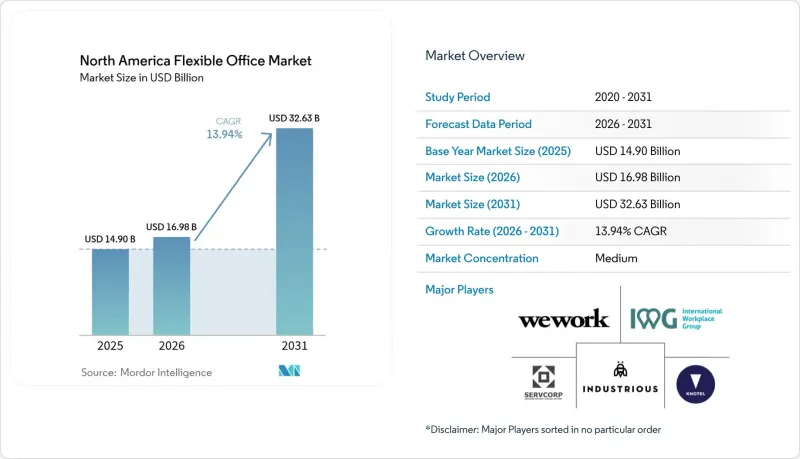
This report is Segmented by Type (Co-Working Spaces, Serviced Offices / Executive Suites, and More) by Sector (Information Technology (IT and ITES), and More), by End Use (Enterprises, Freelancers and Start Ups & Others), and by Country (United States, Canada and Mexico). The Report Provides Market Size and Forecasts in Value (USD) for all the Above Segments.
North America Flexible Office Market Trends and Insights
Surging Hybrid and Remote Work Models Driving Corporate Demand for Flexible Leasing Formats
The shift toward hybrid work models is reshaping corporate occupancy strategies. While hybrid policies now steer 92% of corporate occupancy choices, a mere 17% of companies enforce strict attendance mandates. This leniency has left many corporate headquarters underutilized. In response, enterprises are reallocating 10% to 50% of their portfolios into flexible spaces, a trend management anticipates will surge in the coming two years. Current utilization rates hover between 60% and 85% of 2019 benchmarks, rendering long leases less efficient. Highlighting this shift, major players like Amazon recently inked a deal for 141,000 square feet at a WeWork facility, catering to their dynamic seating requirements. This strategic move emphasizes the growing belief that agile spaces play a pivotal role in talent retention and cost management amidst unpredictable demand fluctuations.
Growth of Startups and SMEs Increasing Preference for Plug-and-Play, Scalable Office Setups
The growing preference for flexible office setups among startups and SMEs is reshaping the commercial real estate landscape. Venture funding, particularly in AI, is luring early-stage firms back to physical offices. Many of these firms are pushing for a four-day office week to boost collaboration. Flexible office spaces are now offering furnished suites, high-speed internet, and reception services. This comes without the typical USD 135 per square foot fit-out cost prevalent across the Americas. By sidestepping this expense, startups showcase capital discipline, a trait highly valued by investors. As teams grow, flexible membership models allow founders to adjust their desk count monthly, aligning real estate costs with headcount. These dynamics collectively underpin the projected 16.55% CAGR growth in startup demand through 2030. The trend highlights the increasing importance of adaptable and cost-efficient office solutions in supporting business growth.
Elevated Leasing and Operating Costs in Tier-1 Metros Impacting Provider Margins
The coworking market in 2024 is navigating a challenging landscape shaped by rising costs and shifting dynamics. In 2024, Class A rents climbed by 3.1%. However, with tenant improvement budgets tightening, operators found themselves absorbing increased fit-out costs while maintaining stable membership prices. Manhattan saw 192 leases surpassing USD 100 per square foot, sidelining numerous coworking brands from iconic buildings. Since 2022, inflation has driven up construction material costs by 11%, inflating per-desk build expenses and narrowing profit margins. In response, providers are adopting dynamic pricing, introducing premium service tiers, and strategically exiting underperforming locations to safeguard their yields.
Other drivers and restraints analyzed in the detailed report include:
- Strategic Expansion of Major Coworking Operators Through Joint Ventures and Asset-Light Models
- Rise of Distributed Teams Encouraging Demand for Satellite and Suburban Flex Locations
- Market Saturation in Major Cities Creating Competitive Pressure and Price Dilution
For complete list of drivers and restraints, kindly check the Table Of Contents.
Segment Analysis
Co-working held 52.55% of 2025 revenue, anchoring the North America flexible office market with familiar open-plan layouts that appeal to freelancers, SMEs, and project teams. Its scale advantage lets operators negotiate favourable management agreements and bulk-buy amenities, keeping desk prices competitive. Yet clients now expect more privacy and advanced tech, prompting co-working brands to retrofit pods and video-ready rooms. These upgrades keep the largest segment sticky even as needs evolve.
Hybrid and virtual office solutions post a 15.20% CAGR and are reshaping expectations through on-demand passes, mailing addresses, and video conference credits bundled under one invoice. As enterprise clients trial four-day office rosters, they reserve smaller blocks of space across multiple locations rather than large dedicated suites. This shift supports occupancy smoothing for operators and unlocks higher yield per square foot, helping the North America flexible office market size for hybrid offerings climb steadily through 2031. Platforms like Industrious's Deskpass merger illustrate how integrated booking networks scale reach without adding leased inventory.
Complete Report Scope:
- By Type
- Co-Working Space
- Serviced offices / Executive suites
- Others (Hybrid, Virtual Office)
- By Sector
- Information Technology (IT and ITES)
- BFSI (Banking, Financial Services and Insurance)
- Business Consulting & Professional Service
- Other Services (Retail, Lifesciences, Energy, Legal Services)
- By End Use
- Freelancers
- Enterprises
- Start Ups and Others
- By Country
- United States
- Canada
- Mexico
List of Companies Covered in this Report:
- International Workplace Group plc
- WeWork
- Industrious
- Knotel
- Servcorp
- Serendipity Labs
- Venture X
- Proximity Space
- Green Desk
- Office Freedom
- Expansive
- LiquidSpace
- Impact Hub
- MakeOffices
- CommonGrounds Workspace
- TechSpace
- District Offices
- Novel Coworking
- HQ Global Workplaces
Additional Benefits:
- The market estimate (ME) sheet in Excel format
- 3 months of analyst support
TABLE OF CONTENTS
1 Introduction
- 1.1 Study Assumptions & Market Definition
- 1.2 Scope of the Study
2 Research Methodology
3 Executive Summary
4 Market Insights and Dynamics
- 4.1 Market Overview
- 4.2 Market Drivers
- 4.2.1 Surging hybrid and remote work models driving corporate demand for flexible leasing formats.
- 4.2.2 Growth of startups and SMEs increasing preference for plug-and-play, scalable office setups.
- 4.2.3 Strategic expansion of major coworking operators through joint ventures and asset-light models.
- 4.2.4 Rise of distributed teams encouraging demand for satellite and suburban flex locations.
- 4.2.5 Tech-enabled workspace solutions improving occupier experience and operational efficiency.
- 4.2.6 Tenant focus on wellness and sustainability boosting demand for green-certified flex spaces.
- 4.3 Market Restraints
- 4.3.1 Elevated leasing and operating costs in Tier-1 metros impacting provider margins.
- 4.3.2 Market saturation in major cities creating competitive pressure and price dilution.
- 4.3.3 Economic slowdown leading to cautious enterprise real estate decision-making.
- 4.3.4 Fragmented regulatory and zoning environments posing hurdles for cross-border expansion.
- 4.4 Value / Supply-Chain Analysis
- 4.4.1 Overview
- 4.4.2 Real Estate Developers and Asset Owners - Key Quantitative and Qualitative Insights
- 4.4.3 Workspace Design and Technology Consultants - Key Quantitative and Qualitative Insights
- 4.4.4 Modular Furniture and Smart Office Solutions Providers - Key Quantitative and Qualitative Insights
- 4.5 Government Regulations and Initiatives in the Industry
- 4.6 Technological Innovations in the Flexible Office Real Estate Market
- 4.7 Insights into the Key Office Real Estate Industry Metrics (Supply, Rentals, Prices, Occupancy/Vacancy (%))
- 4.8 Impact of Remote Working on Space Demand
- 4.9 Porter's Five Forces
- 4.9.1 Bargaining Power of Suppliers
- 4.9.2 Bargaining Power of Buyers
- 4.9.3 Threat of New Entrants
- 4.9.4 Threat of Substitutes
- 4.9.5 Intensity of Competitive Rivalry
5 Market Size & Growth Forecasts (Value USD)
- 5.1 By Type
- 5.1.1 Co-Working Space
- 5.1.2 Serviced offices / Executive suites
- 5.1.3 Others (Hybrid, Virtual Office)
- 5.2 By Sector
- 5.2.1 Information Technology (IT and ITES)
- 5.2.2 BFSI (Banking, Financial Services and Insurance)
- 5.2.3 Business Consulting & Professional Service
- 5.2.4 Other Services (Retail, Lifesciences, Energy, Legal Services)
- 5.3 By End Use
- 5.3.1 Freelancers
- 5.3.2 Enterprises
- 5.3.3 Start Ups and Others
- 5.4 By Country
- 5.4.1 United States
- 5.4.2 Canada
- 5.4.3 Mexico
6 Competitive Landscape
- 6.1 Market Concentration
- 6.2 Strategic Moves
- 6.3 Company Profiles {(includes Global level Overview, Market level overview, Core Segments, Financials as available, Strategic Information, Market Rank/Share for key companies, Products & Services, and Recent Developments)}
- 6.3.1 International Workplace Group plc
- 6.3.2 WeWork
- 6.3.3 Industrious
- 6.3.4 Knotel
- 6.3.5 Servcorp
- 6.3.6 Serendipity Labs
- 6.3.7 Venture X
- 6.3.8 Proximity Space
- 6.3.9 Green Desk
- 6.3.10 Office Freedom
- 6.3.11 Expansive
- 6.3.12 LiquidSpace
- 6.3.13 Impact Hub
- 6.3.14 MakeOffices
- 6.3.15 CommonGrounds Workspace
- 6.3.16 TechSpace
- 6.3.17 District Offices
- 6.3.18 Novel Coworking
- 6.3.19 HQ Global Workplaces
7 Market Opportunities & Future Outlook

