PUBLISHER: Mordor Intelligence | PRODUCT CODE: 2116429

PUBLISHER: Mordor Intelligence | PRODUCT CODE: 2116429
Ankylosing Spondylitis Treatment - Market Share Analysis, Industry Trends & Statistics, Growth Forecasts (2026 - 2031)
According to Mordor Intelligence, the ankylosing spondylitis treatment Market size was valued at USD 7.15 billion in 2025 and estimated to grow from USD 7.67 billion in 2026 to reach USD 10.93 billion by 2031, at a CAGR of 7.32% during the forecast period (2026-2031).
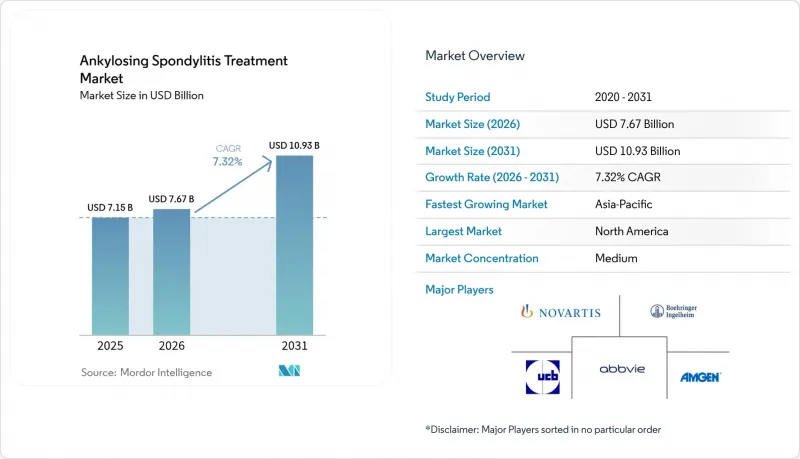
This report is Segmented by Drug Class (NSAIDs, TNF Inhibitors, IL-17 Inhibitors, JAK Inhibitors, Biosimilars and Others), Route of Administration (Oral, Sub-Cutaneous, and Intravenous), Distribution Channel (Hospital Pharmacies, Retail Pharmacies and Online Pharmacies) and Geography (North America, Europe, Asia Pacific, and More). The Market Forecasts are Provided in Terms of Value (USD).
Global Ankylosing Spondylitis Treatment Market Trends and Insights
Growing Global Prevalence & Earlier Diagnosis
Consensus criteria for "early axial spondyloarthritis" let clinicians intervene before structural damage becomes irreversible, adding previously uncounted patients to the ankylosing spondylitis treatment market. Ethnic-specific HLA-B27 subtypes identified in East Asian cohorts refine risk stratification and enable targeted screening. National registries in China and India are reporting higher case ascertainment as rheumatology capacity increases, magnifying demand for both first-line NSAIDs and advanced biologics. These combined shifts are expected to keep new patient starts on an upward curve through the medium term.
Expanding Reimbursement Coverage for Biologics & Biosimilars
Pharmacy benefit managers in the United States now privilege low-priced adalimumab and ustekinumab biosimilars, with several plans offering USD 0 co-pay switching incentives. Parallel moves in the European Union have lifted biosimilar uptake above 70% in certain markets, compressing net prices and broadening access. Latin American payers are adopting tiered formularies that admit two or more biosimilars per molecule, creating multi-supplier competition. Cost savings redirected toward dual IL-17 inhibitors and JAK inhibitors are enlarging the overall ankylosing spondylitis treatment market rather than merely cannibalizing existing spends. Faster market penetration of biosimilars is therefore amplifying volume growth, even as average selling prices soften.
High Cost of Originator Biologics
List prices for established TNF inhibitors continue to test payer budgets, prompting stricter prior authorization and step-therapy mandates. Although the U.S. Inflation Reduction Act promises relief for Medicare beneficiaries, commercial plans still negotiate rebates on a product-by-product basis. Insurers increasingly channel patients toward preferred biosimilars, but uptake remains slower in regions lacking automatic pharmacy-level substitution. In emerging economies, limited public financing forces many patients to defer biologic initiation, restricting the potential universe for the ankylosing spondylitis treatment market until broader subsidy schemes materialize.
Other drivers and restraints analyzed in the detailed report include:
- Oral JAK-Inhibitors Improving Patient Adherence
- AI-Enabled MRI Scoring Speeding Clinical Trial Timelines
- Safety Warnings for JAK Inhibitors & Long-Term Immunosuppression
For complete list of drivers and restraints, kindly check the Table Of Contents.
Segment Analysis
TNF inhibitors retained 53.68% ankylosing spondylitis treatment market share in 2025, supported by two-decade clinical familiarity and extensive payer coverage. However, erosive price competition from eight approved adalimumab biosimilars and the expanding footprint of infliximab-dyyb are moderating revenue growth. IL-17 blockers, led by secukinumab and ixekizumab, are enlarging their patient base in biologic-naive cohorts who value rapid entheseal pain relief. Meanwhile, dual-target bimekizumab is expected to capture early switchers by demonstrating superior radiographic control. JAK inhibitors are carving a niche among patients with prior biologic failure, offering oral convenience and broader cytokine coverage.
NSAIDs are rebounding, registering an 8.79% CAGR to 2031-the highest among all classes-after long-term cohort data confirmed that continuous celecoxib therapy retards spinal damage progression. This evidence has reinstated selective COX-2 inhibitors as quasi-disease-modifying agents rather than mere analgesics. Combined with individualized exercise regimens, etoricoxib has delivered meaningful functional gains, further broadening its uptake. Novel candidates such as anti-GM-CSF antibodies and nanomedicine formulations remain experimental but highlight the innovation pipeline poised to feed future growth in the ankylosing spondylitis treatment market.
Complete Report Scope:
- By Drug Class
- NSAIDs
- TNF Inhibitors
- IL-17 Inhibitors
- JAK Inhibitors
- Biosimilars
- Others
- By Route of Administration
- Oral
- Sub-cutaneous
- Intravenous
- By Distribution Channel
- Hospital Pharmacies
- Retail Pharmacies
- Online Pharmacies
- By Geography
- North America
- United States
- Canada
- Mexico
- Europe
- Germany
- United Kingdom
- France
- Italy
- Spain
- Rest of Europe
- Asia Pacific
- China
- Japan
- India
- South Korea
- Australia
- Rest of Asia Pacific
- Middle East and Africa
- GCC
- South Africa
- Rest of Middle East and Africa
- South America
- Brazil
- Argentina
- Rest of South America
- North America
Geography Analysis
North America's 40.78% contribution in 2025 underscores its role as the innovation nucleus for advanced therapeutics and digital management tools. Early FDA approvals for dual IL-17 agents and rapid biosimilar turnover exemplify a dynamic yet price-sensitive environment. Major payers now embed performance guarantees into contracts, while remote monitoring apps gain traction among high-deductible health plan enrollees. Differences in Medicare Part D formularies create state-level access disparities, influencing switching patterns and overall utilization.
Asia Pacific is forecast to deliver the highest 9.03% CAGR through 2031, anchored by China's 0.26% disease prevalence and distinctive HLA-B27 landscape that makes 88.8% of diagnosed patients genetically predisposed. Rising middle-class insurance coverage, government-funded biosimilar programs, and an expanding network of rheumatology clinics are accelerating first-line biologic uptake. South Korea and Japan continue to operate mature reimbursement models, whereas India's tiered hospital accreditation system is gradually unlocking infliximab and adalimumab access beyond metropolitan centers. Across Southeast Asia, tele-consult services are shortening wait times and bolstering guideline adoption.
Europe maintains a steady revenue base, aided by the region's leadership in biosimilar policy and real-world evidence generation. Germany's national cohort studies inform global dosing optimization, while the United Kingdom's value-based pricing scheme incentivizes measurable functional improvements. Nationalized health systems leverage pooled purchasing power to secure attractive tender prices, promoting broad access yet compressing manufacturer margins. Central and Eastern European countries are narrowing the gap through EU structural funds dedicated to rheumatology infrastructure, paving the way for more uniform penetration of the ankylosing spondylitis treatment market.
- Abbvie
- Novartis
- UCB
- Amgen
- Pfizer
- Eli Lilly and Company
- Johnson & Johnson (Inc. Janssen)
- Boehringer Ingelheim
- Celltrion Healthcare
- Merck
- Gilead Sciences
- Sanofi
- Samsung Bioepis
- Sun Pharma Industries Ltd.
- Takeda Pharmaceutical Co.
- Reliance Life Sciences
Additional Benefits:
- The market estimate (ME) sheet in Excel format
- 3 months of analyst support
TABLE OF CONTENTS
1 Introduction
- 1.1 Study Assumptions & Market Definition
- 1.2 Scope of the Study
2 Research Methodology
3 Executive Summary
4 Market Landscape
- 4.1 Market Overview
- 4.2 Market Drivers
- 4.2.1 Growing global prevalence & earlier diagnosis
- 4.2.2 Expanding reimbursement coverage for biologics & biosimilars
- 4.2.3 Oral JAK-inhibitors improving patient adherence
- 4.2.4 AI-enabled MRI scoring speeding clinical trial timelines
- 4.2.5 Treat-to-target guidelines accelerating therapy switches
- 4.2.6 Emerging dual-IL-17/23 biologics with superior radiographic control
- 4.3 Market Restraints
- 4.3.1 High cost & price-inflation of originator biologics
- 4.3.2 Safety warnings for JAK inhibitors & long-term immunosuppression
- 4.3.3 Inter-changeability scepticism slowing biosimilar uptake
- 4.3.4 Cold-chain logistics gaps in emerging markets
- 4.4 Pipeline Analysis
- 4.5 Regulatory Landscape
- 4.6 Porter's Five Forces Analysis
- 4.6.1 Threat of New Entrants
- 4.6.2 Bargaining Power of Buyers/Patients
- 4.6.3 Bargaining Power of Suppliers
- 4.6.4 Threat of Substitutes
- 4.6.5 Intensity of Competitive Rivalry
5 Market Size & Growth Forecasts (Value)
- 5.1 By Drug Class
- 5.1.1 NSAIDs
- 5.1.2 TNF Inhibitors
- 5.1.3 IL-17 Inhibitors
- 5.1.4 JAK Inhibitors
- 5.1.5 Biosimilars
- 5.1.6 Others
- 5.2 By Route of Administration
- 5.2.1 Oral
- 5.2.2 Sub-cutaneous
- 5.2.3 Intravenous
- 5.3 By Distribution Channel
- 5.3.1 Hospital Pharmacies
- 5.3.2 Retail Pharmacies
- 5.3.3 Online Pharmacies
- 5.4 By Geography
- 5.4.1 North America
- 5.4.1.1 United States
- 5.4.1.2 Canada
- 5.4.1.3 Mexico
- 5.4.2 Europe
- 5.4.2.1 Germany
- 5.4.2.2 United Kingdom
- 5.4.2.3 France
- 5.4.2.4 Italy
- 5.4.2.5 Spain
- 5.4.2.6 Rest of Europe
- 5.4.3 Asia Pacific
- 5.4.3.1 China
- 5.4.3.2 Japan
- 5.4.3.3 India
- 5.4.3.4 South Korea
- 5.4.3.5 Australia
- 5.4.3.6 Rest of Asia Pacific
- 5.4.4 Middle East and Africa
- 5.4.4.1 GCC
- 5.4.4.2 South Africa
- 5.4.4.3 Rest of Middle East and Africa
- 5.4.5 South America
- 5.4.5.1 Brazil
- 5.4.5.2 Argentina
- 5.4.5.3 Rest of South America
- 5.4.1 North America
6 Competitive Landscape
- 6.1 Market Concentration
- 6.2 Market Share Analysis
- 6.3 Company Profiles (includes Global Level Overview, Market Level Overview, Core Segments, Financials as available, Strategic Information, Market Rank/Share for key companies, Products & Services, and Recent Developments)
- 6.3.1 AbbVie Inc.
- 6.3.2 Novartis AG
- 6.3.3 UCB S.A.
- 6.3.4 Amgen Inc.
- 6.3.5 Pfizer Inc.
- 6.3.6 Eli Lilly and Company
- 6.3.7 Johnson & Johnson (Inc. Janssen)
- 6.3.8 Boehringer Ingelheim GmbH
- 6.3.9 Celltrion Healthcare
- 6.3.10 Merck & Co., Inc.
- 6.3.11 Gilead Sciences, Inc.
- 6.3.12 Sanofi S.A.
- 6.3.13 Samsung Bioepis
- 6.3.14 Sun Pharma Industries Ltd.
- 6.3.15 Takeda Pharmaceutical Co.
- 6.3.16 Reliance Life Sciences
7 Market Opportunities & Future Outlook
- 7.1 White-space & Unmet-Need Assessment

