PUBLISHER: Mordor Intelligence | PRODUCT CODE: 2116438

PUBLISHER: Mordor Intelligence | PRODUCT CODE: 2116438
Syringe Pumps - Market Share Analysis, Industry Trends & Statistics, Growth Forecasts (2026 - 2031)
According to Mordor Intelligence, the syringe pumps market size is expected to increase from USD 4.77 billion in 2025 to USD 4.91 billion in 2026 and reach USD 6.06 billion by 2031, growing at a CAGR of 4.27% over 2026-2031.
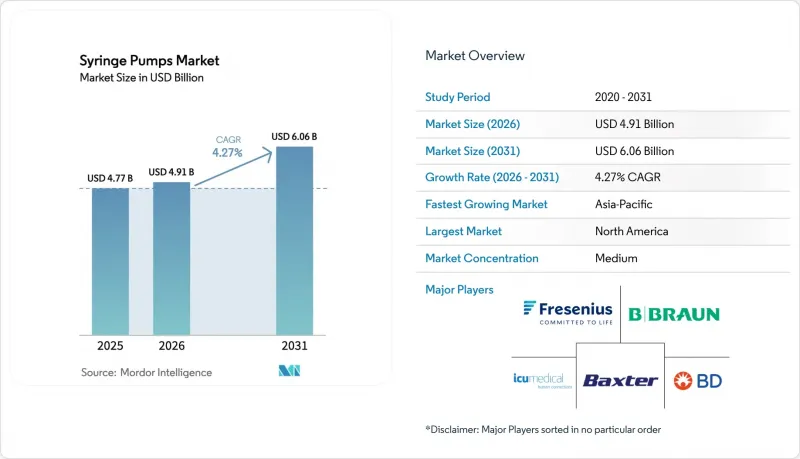
This report is Segmented by Type (Infusion, Withdrawal, Push-Pull/Dual, Programmable/Smart), Channel (Single, Dual, Multi >=3), Application (Oncology, Anesthesia, Neonatal, Pain, Critical Care, Veterinary), End-User (Hospitals, Ascs, Clinics, Homecare, Labs), and Geography (North America, Europe, Asia-Pacific, MEA, South America). Market Forecasts are Provided in Terms of Value (USD).
Global Syringe Pumps Market Trends and Insights
Rising Prevalence of Chronic Diseases Requiring Continuous Drug Infusion
Global non-communicable diseases are projected to cause 73% of all deaths by 2030, ensuring a durable need for precise infusion platforms. Syringe pumps titrate vasopressors in heart-failure management and insulin in diabetic ketoacidosis where a 10% mis-dose risks arrhythmia. U.S. hospital admissions for acute heart failure rose 19% between 2023 and 2025, mirrored by a 22% uptick in critical-care pump use. The diabetic population requiring intensive insulin therapy already exceeds 537 million and continues to expand at a double-digit rate, locking in demand for network-ready smart pumps that liaise with continuous glucose monitoring. Oncology maintains the largest clinical footprint; however, the pivot to oral targeted medicines in select cancers could trim future growth in legacy chemotherapy infusions. Overall, the driver adds 0.9 percentage points to the long-term syringe pumps market CAGR.
Increasing Adoption of Smart Infusion Systems and Hospital Automation
Hospitals are migrating from siloed volumetric pumps to networked syringe fleets linking directly to electronic medical records via HL7 FHIR interfaces. By the end of 2025, 68% of U.S. hospitals with more than 200 beds had interoperable platforms in place, up from 41% in 2023. Automated drug-library uploads slash manual entry by 87% and cut programming time per infusion from 4.2 to 1.1 minutes, freeing clinician bandwidth. The European Union's Medical Device Regulation escalates post-market surveillance duties, compelling suppliers to build secure over-the-air patch processes. Budget-constrained hospitals in emerging markets stretch replacement cycles, but refurbished smart pumps offer an on-ramp, sustaining penetration. With a +1.1% contribution, this driver carries the highest positive weight on the syringe pumps market outlook.
Medication Errors and Safety Recalls Associated With Syringe Pumps
The FDA logged 47 Class I and II syringe-pump recalls from January 2024 to December 2025, with software faults and mechanical failures responsible for 72% of incidents. Baxter withdrew 13,800 Novum IQ pumps in September 2024 after firmware errors caused neonatal underdosing, prompting a safety bulletin. False high-pressure alarms on BD's Alaris module generated clinician desensitization, a risk outlined in a 2025 Critical Care Medicine study. Only 38% of U.S. hospitals completed bi-annual competency checks in 2025 despite ISMP guidance. Recall-linked downtime and liability fears reduce trust and dent the syringe pumps market by 0.5 percentage points over the next two years.
Other drivers and restraints analyzed in the detailed report include:
- Expansion of Outpatient Chemotherapy Services
- Integration of Closed-Loop Drug-Delivery Algorithms
- High Acquisition and Maintenance Costs
For complete list of drivers and restraints, kindly check the Table Of Contents.
Segment Analysis
Infusion syringe pumps owned 64.36% of the syringe pumps market share in 2025, anchored by universal use in anesthesia and neonatal ICUs. Programmable models, however, post an 8.24% CAGR as hospitals seek devices that auto-populate drug libraries and cut transcription errors by 41%. Nine FDA-cleared designs released in 2024-2025 include predictive algorithms certified to IEC 60601-2-24, positioning them for premium adoption.
Basic pumps still serve settings with unstable electricity and scant IT support, yet their slice is shrinking, especially in China where Healthy China 2030 mandates dose-error reduction in tertiary centers. Withdrawal pumps face displacement from automated lab platforms, and dual syringe pumps, selling at USD 22,000, remain confined to high-complexity radiology suites. Over the forecast, programmable units move the syringe pumps market toward higher average selling prices and new recurring-software revenue streams.
Single-channel devices held 39.52% market share in 2025 thanks to their ubiquity in outpatient clinics and veterinary practices. Intensive-care wards, though, are shifting to multi-channel pumps, attracted by the ability to co-infuse vasopressors, sedatives, and analgesics. These systems post a 7.11% CAGR and are backed by evidence showing a 27% cut in medication administration time and an 18% fall in line-related infections.
Dual-channel models remain popular in pediatric hospitals where antibiotic and fluid lines need isolation, but rapid European rules that demand unified cumulative-dose displays are rendering older units obsolete. IT upgrades for data-rich multi-channel integration can reach USD 500,000 for a mid-size hospital, yet Bluetooth Low-Energy-enabled designs lower the hurdle and accelerate adoption. Regulatory focus on end-to-end encryption further drives hospitals toward modern hardware portfolios.
Complete Report Scope:
- By Type
- Infusion Syringe Pumps
- Withdrawal Syringe Pumps
- Push-Pull / Dual Syringe Pumps
- Programmable / Smart Syringe Pumps
- By Channel
- Single-Channel
- Dual-Channel
- Multi-Channel (>=3)
- By Application
- Oncology & Chemotherapy
- Anesthesia
- Neonatal & Pediatric Care
- Pain Management
- Critical Care & ICU
- Veterinary Medicine
- By End-user
- Hospitals
- Ambulatory Surgical Centers
- Clinics
- Homecare Settings
- Research Laboratories
- By Geography
- North America
- United States
- Canada
- Mexico
- Europe
- Germany
- France
- United Kingdom
- Italy
- Spain
- Rest of Europe
- Asia-Pacific
- China
- Japan
- India
- South Korea
- Australia
- Rest of Asia-Pacific
- Middle East & Africa
- GCC
- South Africa
- Rest of Middle East & Africa
- South America
- Brazil
- Argentina
- Rest of South America
- North America
Geography Analysis
North America commanded 42.42% syringe pumps market share in 2025, buoyed by a USD 180 million Veterans Health Administration contract for ICU Medical's Plum 360 systems and FDA cybersecurity mandates that lengthen rival product launches. Canada earmarked CAD 420 million (USD 310 million) in 2025 to replace legacy pumps, targeting 80% smart-pump penetration by 2028. Mexico expanded ICU capacity by 3,200 beds during 2024-2025, choosing refurbished pumps priced 40% below new imports to ease budget strain.
Asia-Pacific is projected at a 7.04% CAGR through 2031, making it the fastest-growing regional slice of the syringe pumps market. China's CNY 2.1 trillion (USD 295 billion) Healthy China 2030 plan funds smart infusion infrastructure, while India's National Health Mission adds 40,000 critical-care beds annually. Japan aligned its cybersecurity rules with IEC 80001 in April 2025, compelling domestic suppliers to retrofit encrypted modules. South Korea boosted reimbursement for smart-pump chemotherapy by 15% in 2025, accelerating oncology center upgrades. Australia approved four new programmable models but stretches replacement cycles to nine years amid flat capital budgets.
Europe holds steady share with Germany, France, and the United Kingdom accounting for 62% of regional volume in 2025. MDR-driven compliance costs rose by up to 22% per device, causing smaller suppliers to exit. Middle East and Africa show mixed performance: Gulf Cooperation Council states invest heavily, whereas sub-Saharan Africa faces persistent supply-chain gaps. South America benefits from Brazil's purchase of 8,400 pumps for oncology services in 2024, though Argentina delays upgrades until macroeconomic stability returns.
- Atom Medical
- Avanos Medical
- B. Braun
- Baxter
- Beckton Dickinson
- Eitan Medical
- Fresenius
- Harvard Apparatus
- Heska
- ICU Medical
- KD Scientific
- Medtronic
- Mindray Bio-Medical Electronics Co., Ltd.
- Moog
- New Era Pump Systems Inc.
- Nipro
- Smiths Group
- Terumo
- Ypsomed
- Zyno Medical
Additional Benefits:
- The market estimate (ME) sheet in Excel format
- 3 months of analyst support
TABLE OF CONTENTS
1 Introduction
2 Research Methodology
3 Executive Summary
4 Market Landscape
- 4.1 Market Overview
- 4.2 Market Drivers
- 4.2.1 Rising Prevalence of Chronic Diseases Requiring Continuous Drug Infusion
- 4.2.2 Growing Number of Surgical Procedures Globally
- 4.2.3 Increasing Adoption of Smart Infusion Systems & Hospital Automation
- 4.2.4 Expansion of Outpatient Chemotherapy Services Driving Demand for Portable Syringe Pumps
- 4.2.5 Integration of Closed-Loop Drug Delivery Algorithms Reducing Dosing Errors
- 4.2.6 Surge In Veterinary Critical Care Boosting Specialized Syringe Pump Segment
- 4.3 Market Restraints
- 4.3.1 Medication Errors & Safety Recalls Associated with Syringe Pumps
- 4.3.2 High Acquisition & Maintenance Costs for Advanced Pumps
- 4.3.3 Supply-Chain Pressure on Semiconductor Components for Motor Control Boards
- 4.3.4 Increasing Regulatory Scrutiny on Cybersecurity of Networked Infusion Devices
- 4.4 Value / Supply-Chain Analysis
- 4.5 Regulatory Landscape
- 4.6 Technological Outlook
- 4.7 Porter's Five Forces Analysis
- 4.7.1 Threat of New Entrants
- 4.7.2 Bargaining Power of Buyers/Consumers
- 4.7.3 Bargaining Power of Suppliers
- 4.7.4 Threat of Substitute Products
- 4.7.5 Intensity of Competitive Rivalry
5 Market Size & Growth Forecasts (Value in USD)
- 5.1 By Type
- 5.1.1 Infusion Syringe Pumps
- 5.1.2 Withdrawal Syringe Pumps
- 5.1.3 Push-Pull / Dual Syringe Pumps
- 5.1.4 Programmable / Smart Syringe Pumps
- 5.2 By Channel
- 5.2.1 Single-Channel
- 5.2.2 Dual-Channel
- 5.2.3 Multi-Channel (>=3)
- 5.3 By Application
- 5.3.1 Oncology & Chemotherapy
- 5.3.2 Anesthesia
- 5.3.3 Neonatal & Pediatric Care
- 5.3.4 Pain Management
- 5.3.5 Critical Care & ICU
- 5.3.6 Veterinary Medicine
- 5.4 By End-user
- 5.4.1 Hospitals
- 5.4.2 Ambulatory Surgical Centers
- 5.4.3 Clinics
- 5.4.4 Homecare Settings
- 5.4.5 Research Laboratories
- 5.5 By Geography
- 5.5.1 North America
- 5.5.1.1 United States
- 5.5.1.2 Canada
- 5.5.1.3 Mexico
- 5.5.2 Europe
- 5.5.2.1 Germany
- 5.5.2.2 France
- 5.5.2.3 United Kingdom
- 5.5.2.4 Italy
- 5.5.2.5 Spain
- 5.5.2.6 Rest of Europe
- 5.5.3 Asia-Pacific
- 5.5.3.1 China
- 5.5.3.2 Japan
- 5.5.3.3 India
- 5.5.3.4 South Korea
- 5.5.3.5 Australia
- 5.5.3.6 Rest of Asia-Pacific
- 5.5.4 Middle East & Africa
- 5.5.4.1 GCC
- 5.5.4.2 South Africa
- 5.5.4.3 Rest of Middle East & Africa
- 5.5.5 South America
- 5.5.5.1 Brazil
- 5.5.5.2 Argentina
- 5.5.5.3 Rest of South America
- 5.5.1 North America
6 Competitive Landscape
- 6.1 Market Concentration
- 6.2 Market Share Analysis
- 6.3 Company Profiles (includes Global level Overview, Market level overview, Core Segments, Financials as available, Strategic Information, Market Rank/Share for key companies, Products and Services, and Recent Developments)
- 6.3.1 Atom Medical Corporation
- 6.3.2 Avanos Medical, Inc.
- 6.3.3 B. Braun Melsungen AG
- 6.3.4 Baxter International Inc.
- 6.3.5 Becton, Dickinson and Company
- 6.3.6 Eitan Medical
- 6.3.7 Fresenius Kabi AG
- 6.3.8 Harvard Apparatus
- 6.3.9 Heska Corporation
- 6.3.10 ICU Medical, Inc.
- 6.3.11 KD Scientific
- 6.3.12 Medtronic plc
- 6.3.13 Mindray Bio-Medical Electronics Co., Ltd.
- 6.3.14 Moog Inc.
- 6.3.15 New Era Pump Systems Inc.
- 6.3.16 Nipro Corporation
- 6.3.17 Smiths Medical
- 6.3.18 Terumo Corporation
- 6.3.19 Ypsomed AG
- 6.3.20 Zyno Medical LLC
7 Market Opportunities & Future Outlook
- 7.1 White-space & Unmet-need Assessment

