PUBLISHER: Mordor Intelligence | PRODUCT CODE: 2116444

PUBLISHER: Mordor Intelligence | PRODUCT CODE: 2116444
Reporter Gene Assay - Market Share Analysis, Industry Trends & Statistics, Growth Forecasts (2026 - 2031)
According to Mordor Intelligence, the reporter gene assay market size is expected to grow from USD 2.89 billion in 2025 to USD 3.18 billion in 2026 and is forecast to reach USD 5.11 billion by 2031 at 9.95% CAGR over 2026-2031.
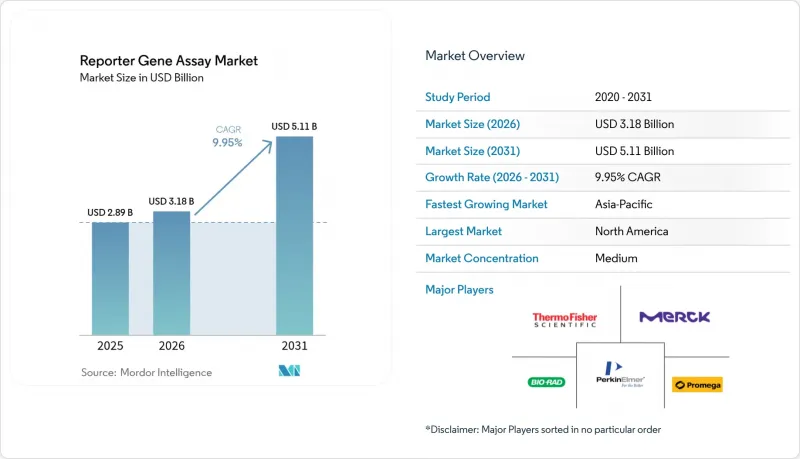
This report is Segmented by Product (Assay Kits, and More), Application (Gene Regulation Studies, and More), Detection Method (Luminescence, Fluorescence, and More), Reporter Gene Type (Luciferase, and More), End User (Pharma & Biotech Companies, and More), and Geography (North America, Europe, Asia-Pacific, Middle East & Africa, South America). The Market Forecasts are Provided in Terms of Value (USD).
Global Reporter Gene Assay Market Trends and Insights
Growing Investment in Life-Sciences Research and Development
Record-high corporate and public R&D budgets continue to widen the installed base of advanced reporter systems. Pharmaceutical companies alone spent USD 288 billion in 2024, lifting demand for assays that streamline target validation and mechanism-of-action studies. Strategic acquisitions funnel additional capital toward next-generation constructs that deliver higher sensitivity and automation compatibility. Long-range forecasts show global R&D outlays could surpass USD 340 billion by 2030, anchoring stable multiyear order pipelines for reagents, kits, and integrated platforms. As budgets scale, the reporter gene assay market gains resilience against cyclical funding dips. This sustained spending posture underpins stronger vendor pricing power and fuels continuous innovation cycles.
Expanding Applications in Drug Discovery and Development
Reporter-based readouts have evolved beyond transcriptional-control screens into sophisticated, cellular-pathway interrogation tools. Optogenetic platforms now permit light-induced activation of integrated-stress responses, enabling compound libraries to be triaged for pathway-specific modulators with minimal cytotoxicity. Automated patch-clamp instruments coupled with reporter constructs accelerate ion-channel drug discovery by delivering real-time functional data at single-cell resolution. Machine-learning analytics embedded in screening workflows cut false-positive rates and sharpen structure-activity relationship insights. The reporter gene assay market therefore becomes indispensable to lead-optimization campaigns that demand high fidelity and throughput. Elevating functional-screen success rates shortens attrition in late-stage pipelines, yielding better capital efficiency for sponsors.
High Capital and Operational Costs of Advanced Assay Instrumentation
Fully automated reporter systems often exceed USD 1 million, making procurement difficult for smaller institutes and labs. Annual service contracts can add another 15-20% of equipment cost, stretching operational budgets. Although streamlined platforms such as the Aptegra genetic-stability assay cut testing time by 66% and reduce expenses by 43%, capex remains a gating factor for many users. Emerging secretory-horseradish-peroxidase constructs that deliver nine-fold cost savings versus classical luciferase help to democratize access, but switching assays requires method-validation resources that are themselves expensive. Until price points align with mid-tier-lab economics, diffusion of advanced hardware could lag behind technology readiness, moderating near-term expansion of the reporter gene assay market.
Other drivers and restraints analyzed in the detailed report include:
- Rising Demand for Personalized Medicine and Gene & Cell Therapies
- Technological Advancements in High-Throughput Screening Platforms
- Stringent Regulatory and Biosafety Requirements for Genetically Modified Assays
For complete list of drivers and restraints, kindly check the Table Of Contents.
Segment Analysis
Assay Kits delivered 41.78% of 2025 revenue, underscoring their indispensability as recurring consumables across academic and industrial labs. Reagent demand scales directly with experiment volume, and bulk purchasing agreements further entrench kit penetration in core workflows. Instruments & Software, however, are projected to expand at 12.27% CAGR as laboratories transition toward fully integrated solutions that consolidate liquid handling, detection, and data analytics. The reporter gene assay market size for integrated instrumentation is growing in sync with efforts to counter reproducibility challenges by embedding QC checkpoints and algorithmic error detection. Vendors increasingly bundle proprietary analysis suites that automate endpoint interpretation, driving total cost of ownership lower over multiyear use cycles.
Reagents & Consumables remain critical for specialty protocols such as dual-luciferase normalization, maintaining steady demand even as kit formats evolve toward ready-to-use multiplex configurations. Services & Custom Assay Development gain momentum because many sponsors lack in-house capacity to design bespoke reporters for novel targets. CROs combine bioinformatics pipelines with wet-lab resources to shorten assay-development sprints, strengthening their value proposition within the reporter gene assay industry. Overall, product diversification, recurrent-revenue channels, and platform convergence together reinforce the growth engine of this market segment.
Gene regulation studies accounted for 37.02% of 2025 revenue, reflecting the enduring relevance of promoter- and enhancer-driven luciferase screens in foundational molecular biology. Oncology-oriented assays leverage similar constructs to track transcriptional-reprogramming responses to targeted therapies, aligning with precision-oncology roadmaps. Drug-Discovery/HTS screens integrate reporter readouts to triage hits by functional potency in large-compound libraries, cementing an essential role for high-throughput formats within pharmaceutical research. Other emerging areas such as neuroscience exploit calcium-sensitive reporters to visualize neuronal-circuit dynamics.
Cell signaling pathways are expected to post a 13.29% CAGR as new biosensors reveal spatiotemporal signaling cascades with single-cell granularity. For instance, CCR2 ligand-sensing constructs allow real-time chemokine-gradient mapping in live tissues, which advances inflammation and oncology research. The reporter gene assay market share captured by pathway-centric applications will widen as multiplex biosensors merge with CRISPR-based perturbation libraries. Far-red calcium indicators now penetrate thick tissues without phototoxicity, permitting chronic imaging in preclinical disease models. These innovations situate pathway analysis at the next frontier of functional genomics, driving continued adoption across translational-research teams.
Complete Report Scope:
- By Product
- Assay Kits
- Reagents & Consumables
- Instruments & Software
- Services & Custom Assay Development
- By Application
- Gene Regulation Studies
- Cell Signaling Pathways
- Drug-Discovery / HTS
- Oncology / Tumor Biology
- Other Applications
- By Detection Method
- Luminescence
- Fluorescence
- Colorimetric / Absorbance
- Bioluminescent Imaging In-vivo
- By Reporter Gene Type
- Luciferase (Firefly, Renilla, Nano)
- ?-galactosidase
- GFP / RFP & Variants
- SEAP / Gaussia
- By End User
- Pharma & Biotech Companies
- Academic & Research Institutes
- CROs & CDMOs
- Clinical & Diagnostic Labs
- Geography
- North America
- United States
- Canada
- Mexico
- Europe
- Germany
- United Kingdom
- France
- Italy
- Spain
- Rest of Europe
- Asia-Pacific
- China
- Japan
- India
- Australia
- South Korea
- Rest of Asia-Pacific
- Middle East & Africa
- GCC
- South Africa
- Rest of Middle East & Africa
- South America
- Brazil
- Argentina
- Rest of South America
- North America
Geography Analysis
North America captured 41.96% of 2025 revenue on the back of the world's deepest R&D funding pools, well-defined regulatory pathways, and the highest concentration of biopharmaceutical headquarters. The United States anchors this dominance through sustained National Institutes of Health appropriations and venture-capital ecosystems that continually spin out platform companies. Canada adds momentum via targeted incentives for genomic medicine and expanding GMP manufacturing clusters, while Mexico's growing generics-production base sources reporters for lot-release testing. Despite stringent oversight, FDA clarity accelerates commercialization cycles for innovative reporter configurations, providing a policy advantage that supports consistent growth within the reporter gene assay market.
Asia-Pacific is expected to clock an 11.2% CAGR, outpacing all other regions. China remains the centerpiece, channeling multibillion-dollar life-sciences grants into oncology and regenerative medicine programs that standardize reporter assays as potency markers. Japan's healthcare focus on aging-population needs spurs adoption of reporter-enabled biomarker panels in neurodegeneration research. India's rapidly scaling CRO sector leverages competitive labor costs to pull in discovery workloads that require high-throughput reporter screening. South Korea's emphasis on biologics manufacturing quality spurs demand for rapid lot-release assays that rely on secreted reporters. Cross-border partnerships with multinational pharmas accelerate technology transfer, tightening APAC's integration into the global reporter gene assay market.
Europe delivers steady though slower gains, supported by entrenched pharmaceutical manufacturing and strong academic consortia. Germany tops regional usage thanks to high per-capita R&D spend and advanced precision-medicine initiatives. The United Kingdom, despite regulatory divergence post-Brexit, maintains assay-development vitality through its Golden Triangle universities. France, Italy, and Spain increasingly outsource manufacturing, creating incremental assay demand for process analytics. Intellectual-property debates around new genomic techniques and field trials for gene-edited crops introduce some uncertainty, yet EMA guidance on advanced therapy products provides predictable pathways for clinical reporter deployment. Consequently, Europe's role in the reporter gene assay market will remain pivotal for standards harmonization and technology validation.
- Thermo Fisher Scientific
- PerkinElmer
- Merck
- Bio-Rad Laboratories
- Promega
- Danaher (Life-Sci arms)
- QIAGEN
- Agilent Technologies
- Beckton Dickinson
- Cell Signaling Technology
- New England Biolabs
- Cell Biolabs
- Eurofins DiscoverX
- Biotium
- InvivoGen
- Indigo Biosciences
- BMG Labtech
- Berthold Technologies
- Promega (Epi ICL)
- Tecan Group
Additional Benefits:
- The market estimate (ME) sheet in Excel format
- 3 months of analyst support
TABLE OF CONTENTS
1 Introduction
- 1.1 Study Assumptions & Market Definition
- 1.2 Scope of the Study
2 Research Methodology
3 Executive Summary
4 Market Landscape
- 4.1 Market Overview
- 4.2 Market Drivers
- 4.2.1 Growing Investment in Life Sciences Research and Development
- 4.2.2 Expanding Applications of Reporter Gene Assays in Drug Discovery And Development
- 4.2.3 Rising Demand for Personalized Medicine and Gene And Cell Therapies
- 4.2.4 Technological Advancements in High-Throughput Screening Platforms
- 4.2.5 Increasing Prevalence of Chronic and Genetic Diseases Requiring Functional Genomics
- 4.2.6 Supportive Government Funding And Academia-Industry Collaborations
- 4.3 Market Restraints
- 4.3.1 High Capital and Operational Costs of Advanced Assay Instrumentation
- 4.3.2 Stringent Regulatory and Biosafety Requirements for Genetically Modified Assays
- 4.3.3 Intellectual Property and Licensing Barriers for Reporter Gene Technologies
- 4.3.4 Technical Challenges Related to Assay Sensitivity, Standardization, and Reproducibility
- 4.4 Regulatory Landscape
- 4.5 Porter's Five Forces Analysis
- 4.5.1 Threat of New Entrants
- 4.5.2 Bargaining Power of Buyers
- 4.5.3 Bargaining Power of Suppliers
- 4.5.4 Threat of Substitutes
- 4.5.5 Intensity of Competitive Rivalry
5 Market Size & Growth Forecasts (Value, USD)
- 5.1 By Product
- 5.1.1 Assay Kits
- 5.1.2 Reagents & Consumables
- 5.1.3 Instruments & Software
- 5.1.4 Services & Custom Assay Development
- 5.2 By Application
- 5.2.1 Gene Regulation Studies
- 5.2.2 Cell Signaling Pathways
- 5.2.3 Drug-Discovery / HTS
- 5.2.4 Oncology / Tumor Biology
- 5.2.5 Other Applications
- 5.3 By Detection Method
- 5.3.1 Luminescence
- 5.3.2 Fluorescence
- 5.3.3 Colorimetric / Absorbance
- 5.3.4 Bioluminescent Imaging In-vivo
- 5.4 By Reporter Gene Type
- 5.4.1 Luciferase (Firefly, Renilla, Nano)
- 5.4.2 ?-galactosidase
- 5.4.3 GFP / RFP & Variants
- 5.4.4 SEAP / Gaussia
- 5.5 By End User
- 5.5.1 Pharma & Biotech Companies
- 5.5.2 Academic & Research Institutes
- 5.5.3 CROs & CDMOs
- 5.5.4 Clinical & Diagnostic Labs
- 5.6 Geography
- 5.6.1 North America
- 5.6.1.1 United States
- 5.6.1.2 Canada
- 5.6.1.3 Mexico
- 5.6.2 Europe
- 5.6.2.1 Germany
- 5.6.2.2 United Kingdom
- 5.6.2.3 France
- 5.6.2.4 Italy
- 5.6.2.5 Spain
- 5.6.2.6 Rest of Europe
- 5.6.3 Asia-Pacific
- 5.6.3.1 China
- 5.6.3.2 Japan
- 5.6.3.3 India
- 5.6.3.4 Australia
- 5.6.3.5 South Korea
- 5.6.3.6 Rest of Asia-Pacific
- 5.6.4 Middle East & Africa
- 5.6.4.1 GCC
- 5.6.4.2 South Africa
- 5.6.4.3 Rest of Middle East & Africa
- 5.6.5 South America
- 5.6.5.1 Brazil
- 5.6.5.2 Argentina
- 5.6.5.3 Rest of South America
- 5.6.1 North America
6 Competitive Landscape
- 6.1 Market Concentration
- 6.2 Market Share Analysis
- 6.3 Company Profiles (Includes Global Level Overview, Market Level Overview, Core Segments, Financials As Available, Strategic Information, Market Rank/Share, Products & Services, Recent Developments)
- 6.3.1 Thermo Fisher Scientific, Inc.
- 6.3.2 PerkinElmer, Inc
- 6.3.3 Merck KGaA
- 6.3.4 Bio-Rad Laboratories, Inc.
- 6.3.5 Promega Corporation
- 6.3.6 Danaher (Life-Sci arms)
- 6.3.7 QIAGEN
- 6.3.8 Agilent Technologies
- 6.3.9 Becton Dickinson
- 6.3.10 Cell Signaling Technology
- 6.3.11 New England Biolabs
- 6.3.12 Cell Biolabs
- 6.3.13 Eurofins DiscoverX
- 6.3.14 Biotium
- 6.3.15 InVivoGen
- 6.3.16 Indigo Biosciences
- 6.3.17 BMG Labtech
- 6.3.18 Berthold Technologies
- 6.3.19 Promega (Epi ICL)
- 6.3.20 Tecan Group
7 Market Opportunities & Future Outlook
- 7.1 White-space & Unmet-need Assessment

