PUBLISHER: Mordor Intelligence | PRODUCT CODE: 2116446

PUBLISHER: Mordor Intelligence | PRODUCT CODE: 2116446
Surgical Lights - Market Share Analysis, Industry Trends & Statistics, Growth Forecasts (2026 - 2031)
According to Mordor Intelligence, the surgical lights market size was valued at USD 1.91 billion in 2025 and estimated to grow from USD 2.01 billion in 2026 to reach USD 2.62 billion by 2031, at a CAGR of 5.43% during the forecast period (2026-2031).
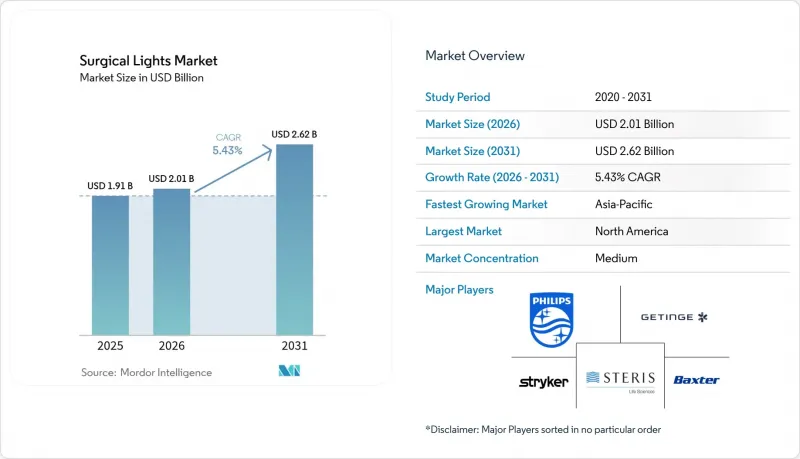
This report is Segmented by Type (LED Lights, Halogen Lights, and More), Mounting Configuration (Ceiling-Mounted, Mobile/Floor-Standing, and More), Light Intensity Range (<=100, 000 Lux, 100, 001-160, 000 Lux, and More), Application (Cardiac Surgery, Gynecological Surgery, and More), End User (Hospitals, Ambulatory Surgical Centers, and More) and Geography. The Market Forecasts are Provided in Terms of Value (USD).
Global Surgical Lights Market Trends and Insights
Rising global surgical volumes in multi-disciplinary ORs
Hospitals are clustering complex specialties such as cardiovascular, neurosurgical, and orthopedic procedures inside hybrid suites that already handled 2.63 million robotic cases in the United States during 2024.Such variety forces luminaires to supply uniform 360-degree coverage, respond to imaging cues, and maintain sterile touch-free control. Stryker's Mako SmartRobotics platform, used in 1.5 million procedures across 45 countries, illustrates how imaging-guided robots and lighting now co-evolve. Growth is reinforced as Asian hospitals emulate North American perioperative workflows, escalating unit sales across the surgical lights market.
Rapid shift to high-efficiency LED and hybrid luminaires
The European Union banned most mercury-containing lamps in August 2023 and finishes the exemption period in February 2025, sending a clear market signal that accelerates substitution of halogen bulbs with LEDs. Modern systems such as STERIS HarmonyAIR A-Series reach 160,000 lux yet consume less energy and run 60,000 hours. Getinge's Maquet Volista adds selectable color temperatures to accommodate tissue types during procedures. Facilities achieve both cost cuts and carbon reductions, which keeps LED adoption on an upward trajectory.
Capital-intensive purchase and maintenance costs
Premium LED arrays cost more upfront than halogen equivalents, and installation often requires ceiling reinforcements, wireless controls, and sterile-field integration. Facilities juggling competing priorities may postpone replacements, particularly in lower-income economies where foreign-exchange swings inflate import costs. Specialized service teams are also needed for calibration, adding to total cost of ownership.
Other drivers and restraints analyzed in the detailed report include:
- Government CAPEX push for ambulatory surgery centers
- OR integration with 4K and AR imaging requiring higher CRI lights
- Rare-earth supply volatility for high-power LEDs
For complete list of drivers and restraints, kindly check the Table Of Contents.
Segment Analysis
LED systems held 53.84% of 2025 revenue and are expanding at a 6.39% CAGR through 2031 as hospitals rush to comply with mercury-phase-out rules and cut operating costs. The long 30,000-50,000-hour lamp life lowers replacement labor, while integrated optics improve color rendering for delicate tissue work. Hybrid conversion kits appeal to budget-sensitive facilities that prefer retrofits over complete ceiling-boom swaps. Halogen's installed base still accounts for 46.16% of units, mainly in mid-tier hospitals that stagger upgrades to match multi-year capital budgets.
Halogen continues to recede as procurement managers prioritize energy savings, sterilizable handles, and AI-driven beam control available only with LEDs. Stryker's November 2024 Oculan platform illustrates the shift by offering Fly Eye optics that eliminate hotspots and respond to voice commands. Meanwhile, STERIS markets LED conversion kits that reuse existing ceiling arms, trimming upfront expense for community hospitals. Cumulatively, these trends move the global installed base closer to full LED saturation before 2031.
Ceiling-mounted luminaires delivered 56.58% of 2025 revenue because they minimize shadows and integrate with camera booms and laminar airflow canopies. Their modular design supports hybrid-OR builds that combine open, endovascular, and imaging zones in one suite. Many tertiary centers specify dual-head configurations that reach 160,000 lux and >=95 CRI for complex cardiac work.
Growth momentum now tilts toward surgeon-worn headlights, which post a 6.88% CAGR through 2031 as minimally invasive techniques spread. Battery-powered models such as MedLED Spectra deliver up to 300,000 lux, allowing uninterrupted focus during laparoscopic or spine cases. Mobile and wall units fill smaller procedure rooms but see slower uptake because ceiling rails are pre-installed in most new theaters. Vendors therefore offer mix-and-match mounting portfolios to suit everything from ambulatory centers to trauma bays.
Complete Report Scope:
- By Type
- LED Lights
- Halogen Lights
- Hybrid / Conversion Kits
- By Mounting Configuration
- Ceiling-Mounted
- Mobile / Floor-Standing
- Wall-Mounted
- Surgical Headlights
- By Light Intensity Range
- <=100,000 lux
- 100,001-160,000 lux
- >160,000 lux
- By Application
- Cardiac Surgery
- Gynecological Surgery
- Neurosurgery
- ENT Surgery
- Orthopedic / Trauma
- Minimally-Invasive & Robotic
- By End User
- Hospitals
- Ambulatory Surgical Centers
- Specialty Clinics & Dental ORs
- By Geography
- North America
- United States
- Canada
- Mexico
- Europe
- Germany
- United Kingdom
- France
- Italy
- Spain
- Rest of Europe
- Asia-Pacific
- China
- Japan
- India
- Australia
- South Korea
- Rest of Asia-Pacific
- Middle East and Africa
- GCC
- South Africa
- Rest of Middle East and Africa
- South America
- Brazil
- Argentina
- Rest of South America
- North America
Geography Analysis
North America remains the largest regional buyer with a 32.02% share. Strong reimbursement pathways and a mature installed base create a steady replacement rhythm, especially for ceiling LEDs integrated with robotic arms. Stryker's November 2024 Oculan launch met immediate demand for AI-assisted beam control in U.S. tertiary hospitals.
Asia-Pacific records an 8.09% CAGR as China, India, and Indonesia expand surgical capacity under public-private healthcare schemes. Stryker opened a Customer Experience Center in Gurgaon to support local clinicians, and Mindray shipped HyLED 9 lights for installations in Turkey and Italy, demonstrating export credibility.
Europe shows consistent growth aided by the EU mercury ban, which forces halogen retirement and accelerates LED procurement. Philips partners with private radiology provider Evidia to deliver blue-seal MRI suites that also replace older lighting with eco-efficient fixtures.
- Baxter
- Getinge
- Stryker
- SIMEON Medical
- STERIS
- A-dec
- Integra LifeSciences
- Skytron
- Mediland Enterprise Corporation
- Koninklijke Philips
- KLS Martin Group
- Dr. Mach GmbH
- Herbert Waldmann GmbH
- Merivaara
- Aspen Surgical
- Brandon Medical
- DARAY Medical
- Mindray Bio-Medical
- Eizo Inc.
Additional Benefits:
- The market estimate (ME) sheet in Excel format
- 3 months of analyst support
TABLE OF CONTENTS
1 Introduction
- 1.1 Study Assumptions and Market Definition
- 1.2 Scope of the Study
2 Research Methodology
3 Executive Summary
4 Market Landscape
- 4.1 Market Overview
- 4.2 Market Drivers
- 4.2.1 Rising Global Surgical Volumes In Multi-Disciplinary ORs
- 4.2.2 Rapid Shift To High-Efficiency LED & Hybrid Luminaires
- 4.2.3 Government CAPEX Push For Ambulatory Surgery Centers
- 4.2.4 OR Integration With 4K/AR Imaging Demanding Higher CRI Lights
- 4.2.5 Sustainability Mandates Phasing-Out Halogen Fixtures
- 4.2.6 AI-Driven Adaptive Lighting Improving Workflow & Outcomes
- 4.3 Market Restraints
- 4.3.1 Capital-Intensive Purchase & Maintenance Costs
- 4.3.2 Long Replacement Cycles Hindering Repeat Sales
- 4.3.3 Cyber-Security Vulnerabilities In Connected OR Lighting
- 4.3.4 Rare-Earth Supply Volatility For High-Power LEDs
- 4.4 Value / Supply-Chain Analysis
- 4.5 Regulatory Landscape
- 4.6 Technology Outlook
- 4.7 Porter's Five Forces Analysis
- 4.7.1 Bargaining Power of Suppliers
- 4.7.2 Bargaining Power of Buyers
- 4.7.3 Threat of New Entrants
- 4.7.4 Threat of Substitutes
- 4.7.5 Intensity of Competitive Rivalry
5 Market Size and Growth Forecasts (Value-USD)
- 5.1 By Type
- 5.1.1 LED Lights
- 5.1.2 Halogen Lights
- 5.1.3 Hybrid / Conversion Kits
- 5.2 By Mounting Configuration
- 5.2.1 Ceiling-Mounted
- 5.2.2 Mobile / Floor-Standing
- 5.2.3 Wall-Mounted
- 5.2.4 Surgical Headlights
- 5.3 By Light Intensity Range
- 5.3.1 <=100,000 lux
- 5.3.2 100,001-160,000 lux
- 5.3.3 >160,000 lux
- 5.4 By Application
- 5.4.1 Cardiac Surgery
- 5.4.2 Gynecological Surgery
- 5.4.3 Neurosurgery
- 5.4.4 ENT Surgery
- 5.4.5 Orthopedic / Trauma
- 5.4.6 Minimally-Invasive & Robotic
- 5.5 By End User
- 5.5.1 Hospitals
- 5.5.2 Ambulatory Surgical Centers
- 5.5.3 Specialty Clinics & Dental ORs
- 5.6 By Geography
- 5.6.1 North America
- 5.6.1.1 United States
- 5.6.1.2 Canada
- 5.6.1.3 Mexico
- 5.6.2 Europe
- 5.6.2.1 Germany
- 5.6.2.2 United Kingdom
- 5.6.2.3 France
- 5.6.2.4 Italy
- 5.6.2.5 Spain
- 5.6.2.6 Rest of Europe
- 5.6.3 Asia-Pacific
- 5.6.3.1 China
- 5.6.3.2 Japan
- 5.6.3.3 India
- 5.6.3.4 Australia
- 5.6.3.5 South Korea
- 5.6.3.6 Rest of Asia-Pacific
- 5.6.4 Middle East and Africa
- 5.6.4.1 GCC
- 5.6.4.2 South Africa
- 5.6.4.3 Rest of Middle East and Africa
- 5.6.5 South America
- 5.6.5.1 Brazil
- 5.6.5.2 Argentina
- 5.6.5.3 Rest of South America
- 5.6.1 North America
6 Competitive Landscape
- 6.1 Market Concentration
- 6.2 Market Share Analysis
- 6.3 Company profiles (includes Global level Overview, Market level overview, Core Segments, Financials as available, Strategic Information, Market Rank/Share for key companies, Products and Services, and Recent Developments)
- 6.3.1 Baxter
- 6.3.2 Getinge AB
- 6.3.3 Stryker Corporation
- 6.3.4 SIMEON Medical
- 6.3.5 STERIS plc
- 6.3.6 A-dec Inc.
- 6.3.7 Integra LifeSciences
- 6.3.8 Skytron LLC
- 6.3.9 Mediland Enterprise Corporation
- 6.3.10 Koninklijke Philips N.V.
- 6.3.11 KLS Martin Group
- 6.3.12 Dr. Mach GmbH
- 6.3.13 Herbert Waldmann GmbH
- 6.3.14 Merivaara Corp.
- 6.3.15 Aspen Surgical
- 6.3.16 Brandon Medical
- 6.3.17 DARAY Medical
- 6.3.18 Mindray Bio-Medical
- 6.3.19 Eizo Inc.
7 Market Opportunities and Future Outlook
- 7.1 White-Space and Unmet-Need Assessment

