PUBLISHER: Mordor Intelligence | PRODUCT CODE: 2116449

PUBLISHER: Mordor Intelligence | PRODUCT CODE: 2116449
Medical Footwear - Market Share Analysis, Industry Trends & Statistics, Growth Forecasts (2026 - 2031)
According to Mordor Intelligence, the medical footwear market size was valued at USD 11.24 billion in 2025 and estimated to grow from USD 11.95 billion in 2026 to reach USD 16.25 billion by 2031, at a CAGR of 6.35% during the forecast period (2026-2031).
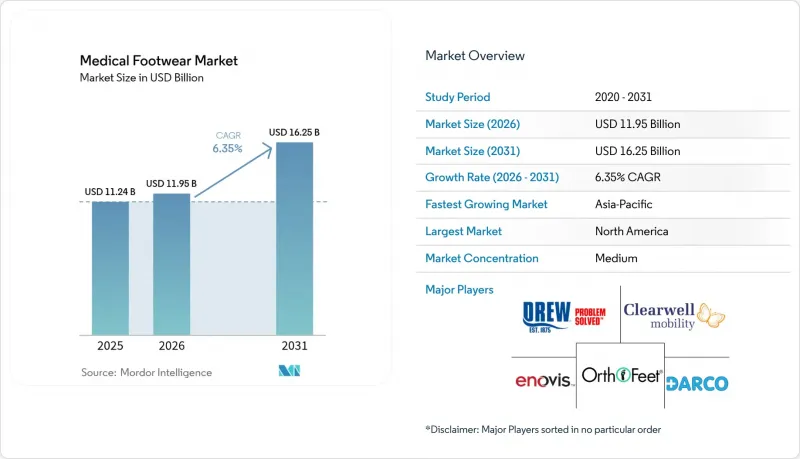
This report is Segmented by Product (Diabetic Shoes & Boots, Orthopaedic/Post-Op Shoes, and More), Medical Condition (Diabetes, Arthritis & Osteoporosis, Plantar Fasciitis, and More), Age Group (Pediatric, Adult, and Geriatric), Distribution Channel (Specialty Stores & Clinics, and More), and Geography (North America, Europe, and More). The Market Forecasts are Provided in Terms of Value (USD).
Global Medical Footwear Market Trends and Insights
Rising Prevalence of Diabetes and Foot Disorders
The accelerating diabetes burden keeps the medical footwear market at the center of preventive care strategies. Worldwide, diabetic foot ulcers affect 6.3% of patients and cost the U.K. NHS USD 7,800 per ulcer case. Evidence shows that 44.4% of patients have peripheral neuropathy and 21.7% progress to amputation, establishing clear clinical benefits for protective footwear. U.S. researchers created a pressure-alternating insole that improves blood flow, directly tackling ulcer risk for 39 million Americans. Ill-fitting shoes raise ulcer odds by more than 10 times, while studies confirm 50-80% of infections are preventable with proper footwear wjgnet.com. As insurers focus on cost offsets, therapeutic shoes move from discretionary purchase to essential medical device within the medical footwear market.
Ageing Population Driving Orthopaedic Needs
Population ageing is amplifying demand for orthopedic footwear across all developed regions. In 2024, 81% of Americans reported foot pain, reflecting both lifestyle shifts and longer lifespans. Colombia expects 39,270 lower-limb arthroplasty procedures by 2050, with women requiring roughly twice as many surgeries as men-a signal that gender-specific designs have a clear audience. Older adults face purchase barriers such as travel costs and complex insurance coding, creating space for mobile fitting services and subscription models. Design studies on fall prevention highlight wider heels, low profiles, and firm midsoles as critical for stability. These findings guide suppliers as they tailor ranges for seniors within the medical footwear market.
High Cost of Specialised Medical Footwear
Affordability remains a headwind, particularly where households pay most healthcare costs. Indian studies show diabetic patients shoulder substantial out-of-pocket expenses, making price the deciding factor in shoe adoption. The Medicare coding maze inflates U.S. dispensing costs, as extra documentation raises clinic overheads. Therapeutic pairs can cost 300-500% more than regular shoes, limiting reach beyond insured or affluent demographics. As a result, lower-priced local brands and leasing models are gaining ground. Without cost relief, the medical footwear market risks leaving vast segments unserved.
Other drivers and restraints analyzed in the detailed report include:
- Technological Advances in Custom 3-D Printed Orthotics
- E-Commerce Expansion Improving Product Accessibility
- Limited Reimbursement in Emerging Economies
For complete list of drivers and restraints, kindly check the Table Of Contents.
Segment Analysis
The medical footwear market size for shoes and boots stood at 43.78% revenue share in 2025, confirming their role as the default solution for complex pathologies. Demand remains stable among diabetics and post-surgical patients who require full-foot protection. Meanwhile, insoles and inserts show the fastest clip at a 9.54% CAGR, propelled by 3-D printed models that disperse plantar pressure and integrate force sensors. Research highlights insoles that combine 22 sensors with solar charging to warn wearers of loading anomalies. Antimicrobial nanocoatings such as Bio-Kil further differentiate premium inserts by lowering infection risk for ulcer-prone users.
Orthopaedic and post-operative shoes maintain a solid base linked to growing joint-replacement volumes and hospital protocols that specify rigid-sole footwear during recovery. Medical sandals gain traction in warm climates for low-level wound care and edema management. Slippers round out the line for at-home use during lengthy therapy cycles. As customization costs fall, suppliers can offer modular kits where insoles, uppers, and fastening systems match specific gait profiles, broadening consumer choice within the medical footwear market.
Diabetes continues to anchor demand, holding 67.72% share in 2025 on the strength of robust clinical guidelines that mandate protected footwear. Preventive shoes lower amputation risk, trimming expensive hospital stays and securing payer support. Yet plantar fasciitis is closing the gap with a 7.28% CAGR as awareness rises that 25% of sufferers experience severe pain and 61% report daily discomfort. Endoscopic plantar fasciotomy delivers 95% pain-free outcomes in six months, elevating the need for supportive shoes during rehabilitation.
Arthritis and osteoporosis shoes gain incremental volume as population ageing accelerates, with orthopaedists recommending designs featuring wide toe boxes and targeted cushioning. Sports injury footwear appeals to a growing cohort of amateur athletes who seek quick returns to activity and value integrated sensor feedback. Wound-care footwear remains a niche but vital category tied directly to surgical throughput. The diversification of conditions served enhances resilience in the medical footwear market.
Complete Report Scope:
- By Product
- Diabetic Shoes & Boots
- Orthopaedic/Post-Op Shoes
- Medical Sandals
- Insoles & Inserts
- Other Products (Slippers, Flip-flops, etc.)
- By Medical Condition
- Diabetes
- Arthritis & Osteoporosis
- Plantar Fasciitis
- Sports Injuries
- Post-Operative / Wound-Care
- Others (e.g., Neuropathy)
- By Age Group
- Pediatric (<18)
- Adult (18-60)
- Geriatric (>60)
- By Distribution Channel
- Specialty Stores & Clinics
- Pharmacies & Orthotic Centres
- Online
- By Geography
- North America
- United States
- Canada
- Mexico
- Europe
- Germany
- United Kingdom
- France
- Italy
- Spain
- Rest of Europe
- Asia-Pacific
- China
- Japan
- India
- Australia
- South Korea
- Rest of Asia-Pacific
- Middle East and Africa
- GCC
- South Africa
- Rest of Middle East and Africa
- South America
- Brazil
- Argentina
- Rest of South America
- North America
Geography Analysis
North America's 33.08% stake in the medical footwear market reflects mature insurance coverage and deeply embedded diabetes management protocols. In the United States alone, 39 million people live with diabetes, many qualifying for Medicare-funded therapeutic shoes. Canadian public health data reveal that 80% of diabetes-related leg amputations are preventable through proper footwear, a statistic that underpins provincial funding schemes. Mexico's expanding middle class is beginning to prioritize preventive shoe purchases, especially as private insurers widen podiatry benefits.
Asia-Pacific is the growth engine, charting an 8.67% CAGR through 2031. India's large diabetic population and improving e-commerce logistics are unlocking latent demand despite reimbursement gaps. China and Japan leverage aging demographics and strong orthopaedic traditions to stimulate uptake of smart insoles and custom sandals. Regulatory harmonization under the ASEAN Medical Device Directive promises smoother entry for foreign brands, provided they adapt to local price points. Innovative offloading devices such as the Mandakini system demonstrate how indigenous solutions can flourish when global designs remain unaffordable.
Europe delivers steady gains anchored by universal healthcare and long-standing orthopaedic craft. Germany and the United Kingdom lead clinical research on sensorized footwear, while France and Italy expand geriatric fall-prevention programs that recommend stable shoes. Sustainability regulations create a conducive environment for bio-based uppers and recyclable midsoles. In contrast, the Middle East and Africa record modest but rising volumes as governments boost healthcare budgets and awareness campaigns emphasize diabetic foot care. Collectively these trends strengthen the worldwide footprint of the medical footwear market.
- Enovis
- Drewshoe Inc.
- Orthofeet
- DARCO International Inc.
- Clearwell Mobility Ltd.
- Cosyfeet (Foot Shop Ltd.)
- Aetrex Worldwide Inc.
- Gravity Defyer
- Kinetec Medical Products Ltd.
- Horng Shin Footwear
- Watts Footwear
- Duna Srl
- New Balance Athletics (Aravon)
- Podartis Srl
- DJO Global (Dr. Scholl's)
- Sigvaris Group
- Propet USA Inc.
- Bauerfeind
- C. & J. Clark Ltd. (Clarks)
- Stryker (Foot & Ankle)
Additional Benefits:
- The market estimate (ME) sheet in Excel format
- 3 months of analyst support
TABLE OF CONTENTS
1 Introduction
- 1.1 Study Assumptions and Market Definition
- 1.2 Scope of the Study
2 Research Methodology
3 Executive Summary
4 Market Landscape
- 4.1 Market Overview
- 4.2 Market Drivers
- 4.2.1 Rising Prevalence Of Diabetes & Foot-Related Disorders
- 4.2.2 Ageing Population Driving Orthopaedic Needs
- 4.2.3 Technological Advances In Custom 3-D Printed Orthotics
- 4.2.4 E-Commerce Expansion Improving Product Accessibility
- 4.2.5 Integration Of Smart Sensors For Remote Patient Monitoring
- 4.2.6 Bio-Based Antimicrobial Materials Boosting Sustainability
- 4.3 Market Restraints
- 4.3.1 High Cost Of Specialised Medical Footwear
- 4.3.2 Limited Reimbursement In Emerging Economies
- 4.3.3 Proliferation Of Counterfeit / Grey-Market Orthotics
- 4.3.4 Supply-Chain Bottlenecks For Medical-Grade Materials
- 4.4 Value / Supply-Chain Analysis
- 4.5 Regulatory Landscape
- 4.6 Technology Outlook
- 4.7 Porter's Five Forces Analysis
- 4.7.1 Bargaining Power of Suppliers
- 4.7.2 Bargaining Power of Buyers
- 4.7.3 Threat of New Entrants
- 4.7.4 Threat of Substitutes
- 4.7.5 Intensity of Competitive Rivalry
5 Market Size and Growth Forecasts (Value-USD)
- 5.1 By Product
- 5.1.1 Diabetic Shoes & Boots
- 5.1.2 Orthopaedic/Post-Op Shoes
- 5.1.3 Medical Sandals
- 5.1.4 Insoles & Inserts
- 5.1.5 Other Products (Slippers, Flip-flops, etc.)
- 5.2 By Medical Condition
- 5.2.1 Diabetes
- 5.2.2 Arthritis & Osteoporosis
- 5.2.3 Plantar Fasciitis
- 5.2.4 Sports Injuries
- 5.2.5 Post-Operative / Wound-Care
- 5.2.6 Others (e.g., Neuropathy)
- 5.3 By Age Group
- 5.3.1 Pediatric (<18)
- 5.3.2 Adult (18-60)
- 5.3.3 Geriatric (>60)
- 5.4 By Distribution Channel
- 5.4.1 Specialty Stores & Clinics
- 5.4.2 Pharmacies & Orthotic Centres
- 5.4.3 Online
- 5.5 By Geography
- 5.5.1 North America
- 5.5.1.1 United States
- 5.5.1.2 Canada
- 5.5.1.3 Mexico
- 5.5.2 Europe
- 5.5.2.1 Germany
- 5.5.2.2 United Kingdom
- 5.5.2.3 France
- 5.5.2.4 Italy
- 5.5.2.5 Spain
- 5.5.2.6 Rest of Europe
- 5.5.3 Asia-Pacific
- 5.5.3.1 China
- 5.5.3.2 Japan
- 5.5.3.3 India
- 5.5.3.4 Australia
- 5.5.3.5 South Korea
- 5.5.3.6 Rest of Asia-Pacific
- 5.5.4 Middle East and Africa
- 5.5.4.1 GCC
- 5.5.4.2 South Africa
- 5.5.4.3 Rest of Middle East and Africa
- 5.5.5 South America
- 5.5.5.1 Brazil
- 5.5.5.2 Argentina
- 5.5.5.3 Rest of South America
- 5.5.1 North America
6 Competitive Landscape
- 6.1 Market Concentration
- 6.2 Market Share Analysis
- 6.3 Company profiles (includes Global level Overview, Market level overview, Core Segments, Financials as available, Strategic Information, Market Rank/Share for key companies, Products and Services, and Recent Developments)
- 6.3.1 Enovis (Dr. Comfort)
- 6.3.2 Drewshoe Inc.
- 6.3.3 Orthofeet Inc.
- 6.3.4 DARCO International Inc.
- 6.3.5 Clearwell Mobility Ltd.
- 6.3.6 Cosyfeet (Foot Shop Ltd.)
- 6.3.7 Aetrex Worldwide Inc.
- 6.3.8 Gravity Defyer Corp.
- 6.3.9 Kinetec Medical Products Ltd.
- 6.3.10 Horng Shin Footwear Co.
- 6.3.11 Watts Footwear
- 6.3.12 Duna Srl
- 6.3.13 New Balance Athletics (Aravon)
- 6.3.14 Podartis Srl
- 6.3.15 DJO Global (Dr. Scholl's)
- 6.3.16 Sigvaris Group
- 6.3.17 Propet USA Inc.
- 6.3.18 Bauerfeind AG
- 6.3.19 C. & J. Clark Ltd. (Clarks)
- 6.3.20 Stryker (Foot & Ankle)
7 Market Opportunities and Future Outlook
- 7.1 White-Space and Unmet-Need Assessment

