PUBLISHER: Mordor Intelligence | PRODUCT CODE: 2116450

PUBLISHER: Mordor Intelligence | PRODUCT CODE: 2116450
Graft Versus Host Disease Treatment - Market Share Analysis, Industry Trends & Statistics, Growth Forecasts (2026 - 2031)
According to Mordor Intelligence, GVHD treatment market size in 2026 is estimated at USD 3.32 billion, growing from 2025 value of USD 3.08 billion with 2031 projections showing USD 4.87 billion, growing at 7.91% CAGR over 2026-2031.
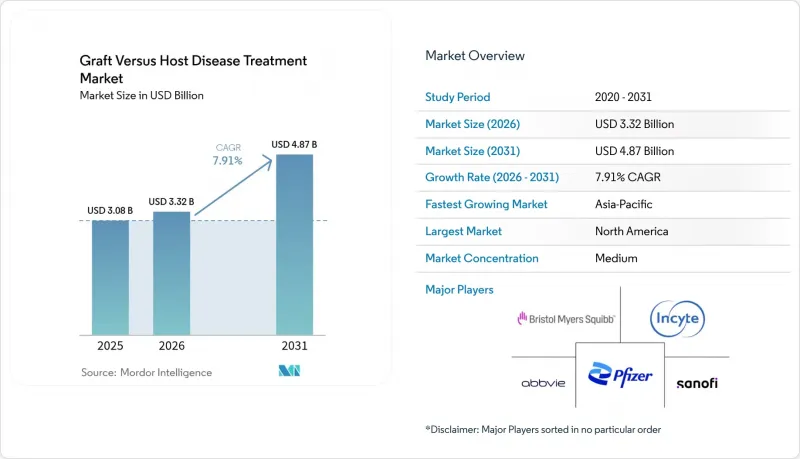
This report is Segmented by Disease (Acute GVHD and More), Product Category (Corticosteroids and More), Therapeutic Modality (Small-Molecule Drugs, and More), Treatment Line (First-Line, and More), Route of Administration (Oral and More), End User (Hospital Pharmacies and More), Patient Age Group (Paediatric and More), and Geography. The Market Forecasts are Provided in Terms of Value (USD).
Global Graft Versus Host Disease Treatment Market Trends and Insights
Broader Eligibility Driving Allogeneic HSCT Volumes
CMS expanded Medicare coverage for allogeneic HSCT in myelodysplastic syndrome during March 2024, permitting transplants in older or comorbid patients and directly enlarging the pool that may experience GVHD. Hospitals now treat candidates once deemed ineligible, and mixed-chimerism data from non-myeloablative regimens reinforce this inclusive approach. Growing procedure counts translate into higher prophylaxis usage and recurring therapy needs, sustaining GVHD treatment market momentum.
Wave of FDA Approvals
FDA endorsements for remestemcel-L in pediatric steroid-refractory acute GVHD and axatilimab in chronic GVHD provide new therapeutic angles and premium pricing opportunities. Each approval encourages investment in analogous mechanisms, accelerates trial enrollment, and underscores regulatory commitment to address unmet need. Rapid commercialization of these assets heightens competition and enriches the product mix within the GVHD treatment market.
High Cost of Biologics & Cell Therapies
Remestemcel-L and axatilimab list prices strain payer budgets, especially where health-technology-assessment frameworks emphasize cost-effectiveness. Emerging markets face particular hurdles, delaying uptake despite clear clinical benefit. Prior authorization rules and step-therapy protocols sometimes deter clinicians from adopting next-generation agents, tempering growth potential in the near term.
Other drivers and restraints analyzed in the detailed report include:
- Expanding Pipeline of Biologics & Cell Therapies
- Growing Incidence of Hematologic Malignancies
- Infection Risk from Profound Immunosuppression
For complete list of drivers and restraints, kindly check the Table Of Contents.
Segment Analysis
Acute GVHD retained 61.12% of 2025 GVHD treatment market share, reflecting the still-greater clinical frequency of early post-transplant inflammation. Chronic GVHD, however, is on track for an 11.17% CAGR to 2031, the fastest among disease segments. This acceleration stems from longer post-transplant survival that enlarges the chronic-phase patient pool and from fresh options such as JAK inhibitors and monoclonal antibodies that specifically target fibrosis, B-cell activation, or ROCK2 signaling. Lower-GI prophylaxis with vedolizumab has already lifted day-180 survival to 85.5%, which decreases acute events yet leaves more patients alive to develop chronic manifestations.
Multidisciplinary clinics are now treating chronic GVHD more like systemic autoimmune disease, adding pulmonary rehab, ocular lubricants, and topical ruxolitinib to standard immunosuppression. Teduglutide's 64.7% overall response in severe intestinal cases underlines how organ-directed biologics can lift remission rates. As a result, chronic therapies are expected to raise their portion of GVHD treatment market size each year through 2031, creating a sustained addressable base for innovators.
Corticosteroids commanded 38.12% GVHD treatment market share in 2025, largely because guideline writers still endorse methylprednisolone as first-line therapy for acute episodes. Yet JAK inhibitors are expanding at a 12.44% CAGR, buoyed by ruxolitinib's 94.1% overall effectiveness in children and by growing adult experience in steroid-refractory disease. Mini-dose methotrexate now combines with steroids to push 1-year failure-free survival to 69% versus 41% for steroids alone, highlighting incremental innovations that maintain steroid relevance.
Beyond JAK blockade, monoclonal antibodies such as axatilimab are taking share in chronic GVHD, and BTK inhibitors are being repurposed from oncology programs. Cell and gene therapies, while still holding a modest slice today, carry premium pricing and deliver durable responses that can displace prolonged drug courses. Collectively, these dynamics are expected to chip away at the steroid portion of GVHD treatment market size while broadening therapeutic diversity.
Small-molecule drugs-corticosteroids, JAK inhibitors, calcineurin-sparing agents-held 43.98% of 2025 GVHD treatment market size. Cell and gene therapies are the fastest movers at an 11.66% CAGR, lifted by FDA endorsement of remestemcel-L for pediatric acute GVHD and late-stage programs such as tabelecleucel. Biologics remain a steady middle ground, with antibodies against CSF-1R, CD38, and a4B7 integrin incrementally widening indications.
The manufacturing gap for mesenchymal stem cells and viral vectors is narrowing as closed-system bioreactors and in-house plasmid suites come online, letting sponsors meet commercial demand. Platform advances also allow allogeneic "off-the-shelf" products that avoid patient-specific lead times. Looking ahead, the modality mix will keep shifting toward cell-based solutions that promise sustained, possibly curative, control of GVHD and thereby lift cell therapy share of GVHD treatment market size.
Complete Report Scope:
- By Disease
- Acute GVHD
- Chronic GVHD
- By Product Category
- Corticosteroids
- Monoclonal Antibodies
- JAK Inhibitors
- BTK Inhibitors
- Tyrosine Kinase Inhibitors (non-JAK/BTK)
- mTOR Inhibitors
- Cell & Gene Therapies
- Other Products
- By Therapeutic Modality
- Small-Molecule Drugs
- Biologics
- Cell & Gene Therapies
- By Treatment Line
- First-Line (Steroid Sensitive)
- Second-Line (Steroid-Refractory)
- Late-Line / Salvage
- By Route of Administration
- Oral
- Intravenous
- Sub-cutaneous
- By Distribution Channel
- Hospital Pharmacies
- Retail Pharmacies
- Online Pharmacies
- By Patient Age Group
- Paediatric
- Adult
- Geriatric
- By Geography
- North America
- United States
- Canada
- Mexico
- Europe
- Germany
- United Kingdom
- France
- Italy
- Spain
- Rest of Europe
- Asia-Pacific
- China
- Japan
- India
- Australia
- South Korea
- Rest of Asia-Pacific
- Middle East and Africa
- GCC
- South Africa
- Rest of Middle East and Africa
- South America
- Brazil
- Argentina
- Rest of South America
- North America
Geography Analysis
North America captured 41.82% of 2025 revenue, buoyed by an FDA environment that expedites novel approvals and by insurer willingness to reimburse high-cost agents. Medicare's 2024 decision to fund broader transplant indications further enlarges domestic patient pools. Transplant centers in the United States integrate telehealth follow-up and home-infusion services, limiting inpatient stays and supporting outpatient adoption of oral agents.
Asia-Pacific is projecting a 10.54% CAGR, the fastest worldwide, as China and Japan expand transplant capacity and approve new anti-viral and GVHD therapies. Public-private investment in cell-processing facilities reduces reliance on imported vectors, improving supply security. Rising incidence of hematologic malignancies, coupled with broader insurance schemes, positions the region as a prime contributor to global GVHD treatment market growth.
Europe remains stable and well-penetrated, but tight budget controls moderate uptake of premium therapies. Collaborative trial networks hasten evidence generation, yet payer scrutiny delays reimbursement for frontier products. South America, the Middle East, and Africa remain nascent; technology-transfer deals and donor-registry collaborations are necessary to unlock their long-term GVHD treatment market potential.
- Incyte
- Bristol-Myers Squibb
- Sanofi
- Abbvie
- Pfizer
- Novartis
- Astellas Pharma
- Roche
- Takeda Pharmaceuticals
- Merck
- Gamida Cell Ltd.
- Gilead
- Bluebird bio Inc.
- Atara Biotherapeutics Inc.
- Mesoblast Limited
- Omeros Corporation
- Amgen
- Eli Lilly and Company
- CSL Behring
Additional Benefits:
- The market estimate (ME) sheet in Excel format
- 3 months of analyst support
TABLE OF CONTENTS
1 Introduction
- 1.1 Study Assumptions and Market Definition
- 1.2 Scope of the Study
2 Research Methodology
3 Executive Summary
4 Market Landscape
- 4.1 Market Overview
- 4.2 Market Drivers
- 4.2.1 Broader Eligibility Driving Allogeneic HSCT Volumes
- 4.2.2 Wave Of FDA Approvals
- 4.2.3 Expanding Pipeline Of Biologics & Cell Therapies
- 4.2.4 Growing Incidence Of Hematologic Malignancies
- 4.2.5 Microbiome-Modulation Therapeutics Opening New Niches
- 4.2.6 Post-Transplant Cyclophosphamide Enabling Haplo-Identical HSCT
- 4.3 Market Restraints
- 4.3.1 High Cost Of Biologics & Cell Therapies
- 4.3.2 Infection Risk From Profound Immunosuppression
- 4.3.3 Supply Constraints For MSC & Viral-Vector Manufacturing
- 4.3.4 Reimbursement Gaps For Off-Label Regimens In EMS
- 4.4 Value / Supply-Chain Analysis
- 4.5 Regulatory Landscape
- 4.6 Technology Outlook
- 4.7 Porter's Five Forces Analysis
- 4.7.1 Bargaining Power of Suppliers
- 4.7.2 Bargaining Power of Buyers
- 4.7.3 Threat of New Entrants
- 4.7.4 Threat of Substitutes
- 4.7.5 Intensity of Competitive Rivalry
5 Market Size and Growth Forecasts (Value-USD)
- 5.1 By Disease
- 5.1.1 Acute GVHD
- 5.1.2 Chronic GVHD
- 5.2 By Product Category
- 5.2.1 Corticosteroids
- 5.2.2 Monoclonal Antibodies
- 5.2.3 JAK Inhibitors
- 5.2.4 BTK Inhibitors
- 5.2.5 Tyrosine Kinase Inhibitors (non-JAK/BTK)
- 5.2.6 mTOR Inhibitors
- 5.2.7 Cell & Gene Therapies
- 5.2.8 Other Products
- 5.3 By Therapeutic Modality
- 5.3.1 Small-Molecule Drugs
- 5.3.2 Biologics
- 5.3.3 Cell & Gene Therapies
- 5.4 By Treatment Line
- 5.4.1 First-Line (Steroid Sensitive)
- 5.4.2 Second-Line (Steroid-Refractory)
- 5.4.3 Late-Line / Salvage
- 5.5 By Route of Administration
- 5.5.1 Oral
- 5.5.2 Intravenous
- 5.5.3 Sub-cutaneous
- 5.6 By Distribution Channel
- 5.6.1 Hospital Pharmacies
- 5.6.2 Retail Pharmacies
- 5.6.3 Online Pharmacies
- 5.7 By Patient Age Group
- 5.7.1 Paediatric
- 5.7.2 Adult
- 5.7.3 Geriatric
- 5.8 By Geography
- 5.8.1 North America
- 5.8.1.1 United States
- 5.8.1.2 Canada
- 5.8.1.3 Mexico
- 5.8.2 Europe
- 5.8.2.1 Germany
- 5.8.2.2 United Kingdom
- 5.8.2.3 France
- 5.8.2.4 Italy
- 5.8.2.5 Spain
- 5.8.2.6 Rest of Europe
- 5.8.3 Asia-Pacific
- 5.8.3.1 China
- 5.8.3.2 Japan
- 5.8.3.3 India
- 5.8.3.4 Australia
- 5.8.3.5 South Korea
- 5.8.3.6 Rest of Asia-Pacific
- 5.8.4 Middle East and Africa
- 5.8.4.1 GCC
- 5.8.4.2 South Africa
- 5.8.4.3 Rest of Middle East and Africa
- 5.8.5 South America
- 5.8.5.1 Brazil
- 5.8.5.2 Argentina
- 5.8.5.3 Rest of South America
- 5.8.1 North America
6 Competitive Landscape
- 6.1 Market Concentration
- 6.2 Market Share Analysis
- 6.3 Company profiles (includes Global level Overview, Market level overview, Core Segments, Financials as available, Strategic Information, Market Rank/Share for key companies, Products and Services, and Recent Developments)
- 6.3.1 Incyte Corporation
- 6.3.2 Bristol Myers Squibb Company
- 6.3.3 Sanofi SA
- 6.3.4 AbbVie Inc.
- 6.3.5 Pfizer Inc.
- 6.3.6 Novartis AG
- 6.3.7 Astellas Pharma Inc.
- 6.3.8 F. Hoffmann-La Roche Ltd.
- 6.3.9 Takeda Pharmaceutical Co. Ltd.
- 6.3.10 Merck & Co., Inc.
- 6.3.11 Gamida Cell Ltd.
- 6.3.12 Gilead
- 6.3.13 Bluebird bio Inc.
- 6.3.14 Atara Biotherapeutics Inc.
- 6.3.15 Mesoblast Limited
- 6.3.16 Omeros Corporation
- 6.3.17 Amgen Inc.
- 6.3.18 Eli Lilly and Company
- 6.3.19 CSL Behring
7 Market Opportunities & Future Outlook
- 7.1 White-space & Unmet-Need Assessment

