PUBLISHER: Mordor Intelligence | PRODUCT CODE: 2116463

PUBLISHER: Mordor Intelligence | PRODUCT CODE: 2116463
Sciatica - Market Share Analysis, Industry Trends & Statistics, Growth Forecasts (2026 - 2031)
According to Mordor Intelligence, the sciatica market size is expected to grow from USD 15.56 billion in 2025 to USD 16.97 billion in 2026 and is forecast to reach USD 26.19 billion by 2031 at 9.08% CAGR over 2026-2031.
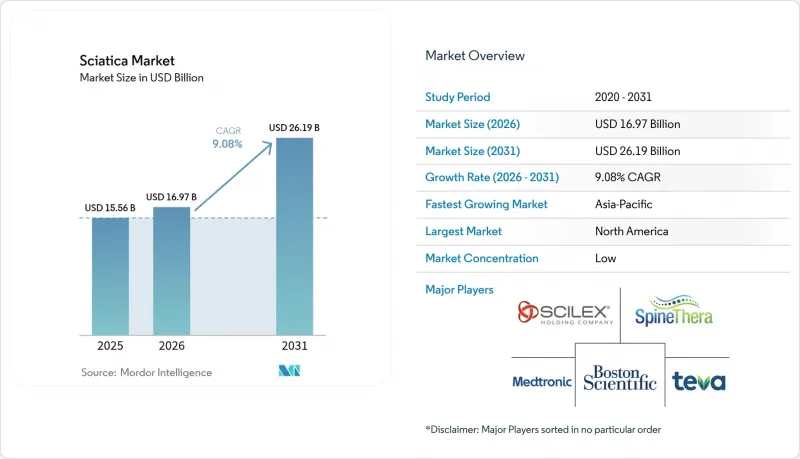
This report is Segmented by Sciatica Type (Acute Sciatica and Chronic Sciatica), Pharmacological Therapies (Non-Steroidal Anti-Inflammatory Drug (NSAIDs), and More), Non-Pharmacological Treatment Modality (Physical & Exercise Therapy, and More), Route of Administration (Oral, and More), End User (Hospitals, and More), and Geography (North America, and More). The Market Forecasts are Provided in Terms of Value (USD).
Global Sciatica Market Trends and Insights
Ageing Populations & Rising Lumbar-Disc Degeneration Rates
Demographic transition is raising chronic pain prevalence as the >=65-year cohort expands and 27.5 million elderly individuals live with spinal deformities. Degenerative disc disease already affects 266 million people worldwide, translating into steady demand for conservative and interventional care. Payers are broadening coverage for minimally invasive techniques that reduce surgical risk in comorbid seniors, and device makers are tailoring implants for osteoporotic bone quality. Together these factors underpin a durable growth base for the sciatica market.
High Diagnostic Imaging Penetration in OECD Economies
AI-reconstructed lumbar MRI can cut scan time by 45% without sacrificing accuracy. Automated image analysis improves early detection of disc herniation and stenosis, steering patients toward preventive therapies rather than delayed surgery. Hospitals report MRI throughput gains that ease bottlenecks in elective care, and reimbursement policies reward evidence-based triage. Faster diagnosis strengthens clinical outcomes and accelerates revenue cycles, reinforcing imaging as a catalyst for the sciatica market.
Abundant Low-Cost Off-Label NSAID Usage
NSAIDs account for 39.53% of pharmacological sciatica therapies and remain inexpensive first-line options despite safety issues. High-risk prescribing consumes USD 31 million annually in the NHS and leads to 6,000 lost QALYs over 10 years. Long-term NSAID users face elevated knee-replacement risk, yet prescribers still favor these drugs where budgets are tight. As specialized biologics must prove superior value, cheap generics dampen near-term growth of the sciatica market.
Other drivers and restraints analyzed in the detailed report include:
- Shift Toward Minimally-Invasive, Outpatient Pain Procedures
- Expanded Payor Coverage for Epidural Steroid Injections
- Post-Opioid-Crisis Caution Limiting Prescription Renewals
For complete list of drivers and restraints, kindly check the Table Of Contents.
Segment Analysis
Chronic cases held 54.05% of the sciatica market share in 2025, underpinning steady demand for long-term management solutions. Acute presentations expand at 9.92% CAGR as prompt AI-assisted imaging redirects patients to early intervention. Emerging biologics, including NF-kappa B decoy oligonucleotides, are delivering 12-month pain relief and disc height restoration, highlighting disease-modifying potential. Acute episodes benefit from proactive epidural injections and guided exercise that prevent degeneration. Combined, these trends reinforce segmentation-specific investment across the sciatica market.
A growing body of evidence positions intradiscal stem-cell therapy as a viable option for refractory chronic pain, with trials demonstrating improved disc volume and function. Health insurers are piloting value-based payment bundles that differentiate reimbursement for acute versus chronic pathways. As clinical guidelines mature, stakeholders expect clearer coding and accelerated coverage decisions-a dynamic that enlarges overall sciatica market size at the segment level.
Traditional NSAIDs led revenue with 39.05% share in 2025, yet safety-driven prescribing curbs sustained use. Biologics and regenerative injectables are growing 9.85% annually, reflecting payer readiness to reimburse interventions that delay surgery. Corticosteroids remain central for flare management, while anticonvulsants treat neuropathic components.
Innovations target disc pathology directly: allogeneic disc progenitor cells have improved pain and disability scores in randomized trials, with regulators reviewing fast-track designations. Novel COX-2 inhibitors aim to mitigate GI toxicity, though cardiovascular risk surveillance persists. The segment's shift from symptomatic relief to regenerative repair supports premium pricing and lifts the sciatica market size for advanced pharmacology.
Complete Report Scope:
- By Sciatica Type
- Acute Sciatica
- Chronic Sciatica
- By Pharmacological Therapies
- Non-steroidal Anti-inflammatory Drugs (NSAIDs)
- Corticosteroids
- Antidepressants
- Anticonvulsants
- Opioids
- Emerging Biologics & Regenerative Injectables
- By Non-Pharmacological Treatment Modality
- Physical & Exercise Therapy
- Epidural Steroid Injection
- Radio-frequency Ablation
- Spinal Cord Stimulation
- Chemonucleolysis (Condoliase etc.)
- Complementary & Alternative (Acupuncture, Herbal)
- By Route of Administration
- Oral
- Topical
- Parenteral / Epidural
- Transdermal
- By End User
- Hospitals
- Specialty Pain Clinics
- Ambulatory Surgical Centers
- Home-care
- Rehabilitation Centers
- Geography
- North America
- United States
- Canada
- Mexico
- Europe
- Germany
- United Kingdom
- France
- Italy
- Spain
- Rest of Europe
- Asia-Pacific
- China
- Japan
- India
- South Korea
- Australia
- Rest of Asia-Pacific
- Middle East and Africa
- GCC
- South Africa
- Rest of Middle East and Africa
- South America
- Brazil
- Argentina
- Rest of South America
- North America
Geography Analysis
North America commanded 39.20% of global revenue in 2025, underpinned by comprehensive insurance coverage and rapid adoption of closed-loop spinal cord stimulators cleared by the FDA in 2024 and 2025. Medicare continues to reimburse epidural injections and selective nerve-root blocks under strict indications, supporting procedure volumes. An aging, sedentary population and high obesity prevalence sustain long-term demand, while robust research funding accelerates translational innovation.
Europe remains sizeable but faces reimbursement cuts that temper procedure growth; nonetheless, cost-effective minimally invasive techniques align with EU health-system objectives. Adoption of AI-enabled MRI triage mitigates waiting-list pressures and improves early treatment access. Germany, the United Kingdom, and France prioritize evidence-based pathways, creating a stable environment for clinically validated devices and biologics.
Asia-Pacific is the fastest-growing region at 9.88% CAGR as healthcare investments rise and aging demographics resemble Western patterns. Japan and South Korea lead technological uptake, while India expands access through insurance schemes and public-private partnerships. Multinational device makers localize production to meet regulatory requirements and tap cost-sensitive segments. Collectively these dynamics enlarge regional contributions to the sciatica market size.
- Sorrento Therapeutics
- Scilex Holding
- SpineThera
- Eliem Therapeutics
- Sollis Therapeutics
- Sinfonia Biotherapeutics
- Seikagaku
- Kolon Life Science
- Aurobindo Pharma
- Teva Pharmaceutical Industries
- Pfizer
- Johnson & Johnson
- Medtronic
- Boston Scientific
- Abbott Laboratories
- Glenmark Pharmaceuticals
- Zydus Lifesciences
- Spine BioPharma
- Teikoku Pharma
- PainTEQ
- Vertex Pharmaceuticals
Additional Benefits:
- The market estimate (ME) sheet in Excel format
- 3 months of analyst support
TABLE OF CONTENTS
1 Introduction
- 1.1 Study Assumptions & Market Definition
- 1.2 Scope of the Study
2 Research Methodology
3 Executive Summary
4 Market Landscape
- 4.1 Market Overview
- 4.2 Market Drivers
- 4.2.1 Ageing Populations & Rising Lumbar-Disc Degeneration Rates
- 4.2.2 High Diagnostic Imaging Penetration In OECD Economies
- 4.2.3 Shift Toward Minimally-Invasive, Outpatient Pain Procedures
- 4.2.4 Expanded Payor Coverage For Epidural Steroid Injections
- 4.2.5 AI-Enabled MRI Triage Tools Slash Waiting Times
- 4.2.6 Growing Direct-To-Consumer Nutraceutical Bundles For Sciatica
- 4.3 Market Restraints
- 4.3.1 Lack Of Universally Accepted Diagnostic Criteria
- 4.3.2 Abundant Low-Cost Off-Label NSAID Usage
- 4.3.3 Procedure Reimbursement Cuts In Europe
- 4.3.4 Post-Opioid-Crisis Caution Limiting Prescription Renewals
- 4.4 Porter's Five Forces Analysis
- 4.4.1 Threat of New Entrants
- 4.4.2 Bargaining Power of Buyers
- 4.4.3 Bargaining Power of Suppliers
- 4.4.4 Threat of Substitute Products
- 4.4.5 Intensity of Competitive Rivalry
5 Market Size & Growth Forecasts (Value, USD)
- 5.1 By Sciatica Type
- 5.1.1 Acute Sciatica
- 5.1.2 Chronic Sciatica
- 5.2 By Pharmacological Therapies
- 5.2.1 Non-steroidal Anti-inflammatory Drugs (NSAIDs)
- 5.2.2 Corticosteroids
- 5.2.3 Antidepressants
- 5.2.4 Anticonvulsants
- 5.2.5 Opioids
- 5.2.6 Emerging Biologics & Regenerative Injectables
- 5.3 By Non-Pharmacological Treatment Modality
- 5.3.1 Physical & Exercise Therapy
- 5.3.2 Epidural Steroid Injection
- 5.3.3 Radio-frequency Ablation
- 5.3.4 Spinal Cord Stimulation
- 5.3.5 Chemonucleolysis (Condoliase etc.)
- 5.3.6 Complementary & Alternative (Acupuncture, Herbal)
- 5.4 By Route of Administration
- 5.4.1 Oral
- 5.4.2 Topical
- 5.4.3 Parenteral / Epidural
- 5.4.4 Transdermal
- 5.5 By End User
- 5.5.1 Hospitals
- 5.5.2 Specialty Pain Clinics
- 5.5.3 Ambulatory Surgical Centers
- 5.5.4 Home-care
- 5.5.5 Rehabilitation Centers
- 5.6 Geography
- 5.6.1 North America
- 5.6.1.1 United States
- 5.6.1.2 Canada
- 5.6.1.3 Mexico
- 5.6.2 Europe
- 5.6.2.1 Germany
- 5.6.2.2 United Kingdom
- 5.6.2.3 France
- 5.6.2.4 Italy
- 5.6.2.5 Spain
- 5.6.2.6 Rest of Europe
- 5.6.3 Asia-Pacific
- 5.6.3.1 China
- 5.6.3.2 Japan
- 5.6.3.3 India
- 5.6.3.4 South Korea
- 5.6.3.5 Australia
- 5.6.3.6 Rest of Asia-Pacific
- 5.6.4 Middle East and Africa
- 5.6.4.1 GCC
- 5.6.4.2 South Africa
- 5.6.4.3 Rest of Middle East and Africa
- 5.6.5 South America
- 5.6.5.1 Brazil
- 5.6.5.2 Argentina
- 5.6.5.3 Rest of South America
- 5.6.1 North America
6 Competitive Landscape
- 6.1 Market Concentration
- 6.2 Market Share Analysis
- 6.3 Company Profiles (includes Global level Overview, Market level overview, Core Segments, Financials as available, Strategic Information, Market Rank/Share for key companies, Products & Services, and Recent Developments)
- 6.3.1 Sorrento Therapeutics
- 6.3.2 Scilex Holding
- 6.3.3 SpineThera
- 6.3.4 Eliem Therapeutics
- 6.3.5 Sollis Therapeutics
- 6.3.6 Sinfonia Biotherapeutics
- 6.3.7 Seikagaku Corporation
- 6.3.8 Kolon Life Science
- 6.3.9 Aurobindo Pharma
- 6.3.10 Teva Pharmaceutical Industries
- 6.3.11 Pfizer Inc.
- 6.3.12 Johnson & Johnson (Janssen)
- 6.3.13 Medtronic plc
- 6.3.14 Boston Scientific Corporation
- 6.3.15 Abbott Laboratories
- 6.3.16 Glenmark Pharmaceuticals
- 6.3.17 Zydus Lifesciences
- 6.3.18 Spine BioPharma
- 6.3.19 Teikoku Pharma
- 6.3.20 PainTEQ
- 6.3.21 Vertex Pharmaceuticals
7 Market Opportunities & Future Outlook
- 7.1 White-space & Unmet-need Assessment

