PUBLISHER: Mordor Intelligence | PRODUCT CODE: 2116466

PUBLISHER: Mordor Intelligence | PRODUCT CODE: 2116466
Ambulatory Surgery Center - Market Share Analysis, Industry Trends & Statistics, Growth Forecasts (2026 - 2031)
According to Mordor Intelligence, ambulatory surgery center market size in 2026 is estimated at USD 88.17 billion, growing from 2025 value of USD 83.88 billion with 2031 projections showing USD 113.18 billion, growing at 5.12% CAGR over 2026-2031.
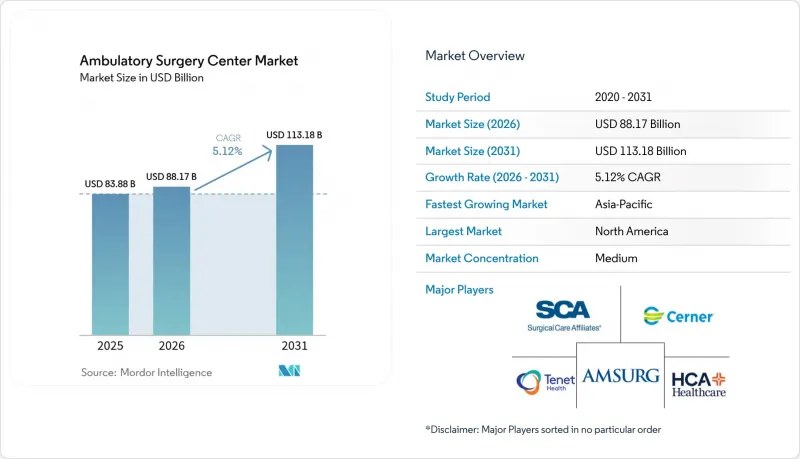
This report Segments the Industry Into by Center Type (Single-Specialty Centers, Multi-Specialty Centers), Modality (Hospital-Based ASCs, Freestanding ASCs), Ownership (Physician-Owned, and More), Services, Specialty, and Geography (North America, Europe, Asia-Pacific, Middle East and Africa, South America). The Market Forecasts are Provided in Terms of Value (USD).
Global Ambulatory Surgery Center Market Trends and Insights
Expansion of CMS-Approved ASC Procedure List Accelerating High-Acuity Shift
The CY 2025 Hospital Outpatient Prospective Payment System final rule added 20 complex interventions, including select percutaneous coronary procedures, to the ambulatory list.Centers that upgrade imaging suites and credential multidisciplinary teams are already capturing new referral streams and securing premium commercial contracts. Cardiovascular throughput is expected to sustain a 9.65% CAGR to 2030, giving early movers a defensible payor-mix advantage. Larger health systems are converting underutilised hospital outpatient departments into dedicated hybrid ASCs to comply with the 24-hour discharge rule while tapping higher case volumes.
Certificate-of-Need Deregulation Enabling Rapid Build-Outs
Legislative rollbacks in Georgia, Florida, and West Virginia are lowering barriers to entry for greenfield developments. Georgia's HB 1339, in force since July 2024, exempts many new centers from the previous CON process, prompting a pipeline of more than 30 filings in metro Atlanta alone. Operators with sophisticated site-selection analytics are locking in leases near population growth corridors ahead of rivals and leveraging local physician partnerships to accelerate payer credentialing. The pace of filings indicates a likely supply surge that could compress occupancy in the medium term yet should widen patient access in historically underserved suburbs.
Peri-operative Nurse & Anesthetist Shortages Limiting OR Utilisation Rates
The supply of certified registered nurse anesthetists remains below demand, especially in rural markets where they are often the sole anaesthesia providers. Rising wage inflation and burnout have compounded recruitment challenges, forcing some centers to cap block times even when demand exists. Operators are responding with accelerated residency pipelines and tuition assistance agreements tied to multi-year employment contracts. Centers that offer flexible scheduling and clinical ladders are holding turnover to the low single digits, sustaining utilisation levels.
Other drivers and restraints analyzed in the detailed report include:
- High-Deductible Health Plans & Price Transparency Steering Patients Toward Low-Cost ASCs
- AI-Driven Workflow Solutions Raising Throughput in Ophthalmology & Orthopedics
- Reimbursement Gaps vs HOPD Eroding Margins in Cardiac & Spine Cases
For complete list of drivers and restraints, kindly check the Table Of Contents.
Segment Analysis
Single-specialty centers generated 61.78% of 2025 revenue, underpinned by clinically efficient musculoskeletal, ophthalmic, and pain-management service lines. The operators of single-specialty sites reported average same-room turnover times under 14 minutes, a key factor in physician loyalty. Focused staffing models, equipment reuse, and aligned implant formularies have historically driven EBITDA margins into the mid-30% range.
Multi-specialty centers, while smaller today, are forecast to outgrow single-discipline peers at 8.09% annually through 2031. Diversified case mixes cushion reimbursement volatility and boost scheduling density across the week. Larger systems are layering endoscopy, ENT, and women's health into existing orthopedic hubs, raising yield on fixed costs. This pivot is expected to push the multi-specialty slice of the ambulatory surgical centers market share several points higher over the next five years.
Freestanding facilities held 66.10% of 2025 revenue. Their independence from hospital campuses allows flexible site selection near high-income suburbs and employer clusters, a distinct access advantage. Many also operate extended hours, capturing after-work cases that hospitals struggle to schedule.
Hospital-based ASCs represented 33.90% of revenue but are set to grow at a 8.76% CAGR. Health systems are converting underused procedural suites into compliant ambulatory sites to defend referral bases and secure downstream imaging and inpatient volumes. Early evidence suggests that alignment with hospital electronic health records shortens referral cycles, driving incremental growth. This shift should steadily lift the hospital-affiliated slice of the ambulatory surgical centers market size, especially for spine and structural heart programs that demand costly imaging infrastructure.
Complete Report Scope:
- By Center Type
- Single-Specialty Centers
- Gastroenterology Centers
- Ophthalmology Centers
- Orthopedic Centers
- Pain Management Centers
- Cardiology Centers
- Cosmetic Surgery Centers
- Other Single-Specialty
- Multi-Specialty Centers
- Single-Specialty Centers
- By Modality
- Hospital-based ASCs
- Freestanding ASCs
- By Ownership
- Physician-Owned
- Hospital-Owned
- Corporate / Private-Equity-Owned
- Joint-Venture
- By Services
- Surgical Services
- Diagnostic and Imaging Services
- By Specialty
- Gastroenterology
- Ophthalmology
- Orthopedics
- Pain / Neurology
- Cardiovascular
- ENT
- Urology
- Gynecology
- Plastics and Reconstructive
- Geography
- North America
- United States
- Canada
- Mexico
- Europe
- Germany
- United Kingdom
- France
- Italy
- Spain
- Rest of Europe
- Asia-Pacific
- China
- Japan
- India
- South Korea
- Australia
- Rest of Asia-Pacific
- Middle East and Africa
- GCC
- South Africa
- Rest of Middle East and Africa
- South America
- Brazil
- Argentina
- Rest of South America
- North America
Geography Analysis
North America captured 36.10% of 2025 revenue, cementing its leadership position. Continued Certificate-of-Need rollbacks and consistent CMS payment updates encourage regional expansion. Robotic-enabled spine programs, underpinned by a USD 1 million donation to Halifax's QEII Health Sciences Centre in January 2024, showcase the region's tilt toward technology-rich high-acuity cases. These investments should lift regional case acuity and support modest pricing power despite payer scrutiny.
Europe presents a more heterogeneous adoption pattern. The United Kingdom, Germany, and France lead development, each leveraging public-private partnership frameworks that balance access mandates with private-sector efficiency. Stringent postoperative quality metrics and integrated care pathways support steady conversion of day-case potential into ambulatory volumes.
Asia delivers the fastest expansion, logging a projected 9.95% CAGR through 2031. Rising middle-class demand, private health-insurance growth, and public incentives for infrastructure build-outs spur construction across China and India. Multinational operators are trial-launching joint-venture ASCs within tertiary hospitals to mitigate regulatory risk while capturing self-pay demand. As procedure migration takes hold, the Asian contribution to global ambulatory surgical centers market share is set to rise materially.
- AMSURG
- United Surgical Partners International
- HCA Healthcare
- Surgery Partners
- Surgical Care Affiliates (Optum)
- Envision Healthcare
- SurgCenter Development
- Regent Surgical Health
- PE GI Solutions
- NueHealth / ValueHealth
- NorthStar Healthcare
- TriasMD
- Vision Integrated Partners
- Nobilis Health
- Covenant Physician Partners
- Mednax Services
- TeamHealth
- SCA Health International
- St. George Surgical Center
- Muve Health (ValueHealth)
Additional Benefits:
- The market estimate (ME) sheet in Excel format
- 3 months of analyst support
TABLE OF CONTENTS
1 Introduction
- 1.1 Study Assumptions & Market Definition
- 1.2 Scope of the Study
2 Research Methodology
3 Executive Summary
4 Market Landscape
- 4.1 Market Overview
- 4.2 Market Drivers
- 4.2.1 Expansion of CMS-approved ASC Procedure List Accelerating High-Acuity Shift
- 4.2.2 Certificate-of-Need (CON) Deregulation Enabling Rapid ASC Build-Outs
- 4.2.3 High-Deductible Health Plans & Price-Transparency Rules Steering Patients Toward Low-Cost ASCs
- 4.2.4 AI-driven Workflow/Navigation Solutions Raising Throughput in Ophthalmology and Ortho ASCs
- 4.2.5 Rising Demand for Outpatient Surgeries
- 4.2.6 Patient Convenience and Expansion in Emerging Markets
- 4.3 Market Restraints
- 4.3.1 Peri-operative Nurse and Anesthetist Shortages Limiting OR Utilisation Rates
- 4.3.2 Reimbursement Gaps vs HOPD Eroding Margins in Cardiac & Spine Cases
- 4.3.3 High Initial Setup Costs
- 4.3.4 Shortage of Skilled Healthcare Professionals
- 4.4 Porter's Five Forces Analysis
- 4.4.1 Threat of New Entrants
- 4.4.2 Bargaining Power of Buyers/Consumers
- 4.4.3 Bargaining Power of Suppliers
- 4.4.4 Threat of Substitute Products
- 4.4.5 Intensity of Competitive Rivalry
5 Market Size & Growth Forecasts (Value in USD)
- 5.1 By Center Type
- 5.1.1 Single-Specialty Centers
- 5.1.1.1 Gastroenterology Centers
- 5.1.1.2 Ophthalmology Centers
- 5.1.1.3 Orthopedic Centers
- 5.1.1.4 Pain Management Centers
- 5.1.1.5 Cardiology Centers
- 5.1.1.6 Cosmetic Surgery Centers
- 5.1.1.7 Other Single-Specialty
- 5.1.2 Multi-Specialty Centers
- 5.1.1 Single-Specialty Centers
- 5.2 By Modality
- 5.2.1 Hospital-based ASCs
- 5.2.2 Freestanding ASCs
- 5.3 By Ownership
- 5.3.1 Physician-Owned
- 5.3.2 Hospital-Owned
- 5.3.3 Corporate / Private-Equity-Owned
- 5.3.4 Joint-Venture
- 5.4 By Services
- 5.4.1 Surgical Services
- 5.4.2 Diagnostic and Imaging Services
- 5.5 By Specialty
- 5.5.1 Gastroenterology
- 5.5.2 Ophthalmology
- 5.5.3 Orthopedics
- 5.5.4 Pain / Neurology
- 5.5.5 Cardiovascular
- 5.5.6 ENT
- 5.5.7 Urology
- 5.5.8 Gynecology
- 5.5.9 Plastics and Reconstructive
- 5.6 Geography
- 5.6.1 North America
- 5.6.1.1 United States
- 5.6.1.2 Canada
- 5.6.1.3 Mexico
- 5.6.2 Europe
- 5.6.2.1 Germany
- 5.6.2.2 United Kingdom
- 5.6.2.3 France
- 5.6.2.4 Italy
- 5.6.2.5 Spain
- 5.6.2.6 Rest of Europe
- 5.6.3 Asia-Pacific
- 5.6.3.1 China
- 5.6.3.2 Japan
- 5.6.3.3 India
- 5.6.3.4 South Korea
- 5.6.3.5 Australia
- 5.6.3.6 Rest of Asia-Pacific
- 5.6.4 Middle East and Africa
- 5.6.4.1 GCC
- 5.6.4.2 South Africa
- 5.6.4.3 Rest of Middle East and Africa
- 5.6.5 South America
- 5.6.5.1 Brazil
- 5.6.5.2 Argentina
- 5.6.5.3 Rest of South America
- 5.6.1 North America
6 Competitive Landscape
- 6.1 Market Concentration
- 6.2 Market Share Analysis
- 6.3 Company Profiles (includes Global level Overview, Market level overview, Core Segments, Financials as available, Strategic Information, Market Rank/Share for key companies, Products & Services, and Recent Developments)
- 6.3.1 AMSURG
- 6.3.2 United Surgical Partners International
- 6.3.3 HCA Healthcare
- 6.3.4 Surgery Partners
- 6.3.5 Surgical Care Affiliates (Optum)
- 6.3.6 Envision Healthcare
- 6.3.7 SurgCenter Development
- 6.3.8 Regent Surgical Health
- 6.3.9 PE GI Solutions
- 6.3.10 NueHealth / ValueHealth
- 6.3.11 NorthStar Healthcare
- 6.3.12 TriasMD
- 6.3.13 Vision Integrated Partners
- 6.3.14 Nobilis Health
- 6.3.15 Covenant Physician Partners
- 6.3.16 Mednax Services
- 6.3.17 TeamHealth
- 6.3.18 SCA Health International
- 6.3.19 St. George Surgical Center
- 6.3.20 Muve Health (ValueHealth)
7 Market Opportunities & Future Outlook
- 7.1 White-space & Unmet-need Assessment

