PUBLISHER: Mordor Intelligence | PRODUCT CODE: 2116468

PUBLISHER: Mordor Intelligence | PRODUCT CODE: 2116468
Peripheral Vascular Devices And Accessories - Market Share Analysis, Industry Trends & Statistics, Growth Forecasts (2026 - 2031)
According to Mordor Intelligence, the peripheral vascular devices and accessories market size is expected to grow from USD 18.41 billion in 2025 to USD 19.38 billion in 2026 and is forecast to reach USD 25.07 billion by 2031 at 5.28% CAGR over 2026-2031.
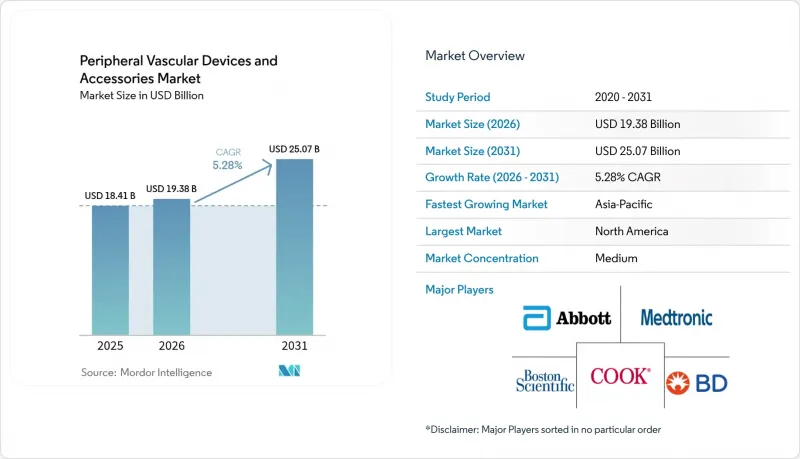
This report Segments the Industry Into by Product Type (Devices and Accessories), by Application (Peripheral Artery Disease, Deep Vein Thrombosis and More), by End User (Hospitals, Ambultory Surgical Centers and More) and Geography (North America, Europe, Asia-Pacific and More). The Market Forecasts are Provided in Terms of Value (USD).
Global Peripheral Vascular Devices And Accessories Market Trends and Insights
Rising PAD Prevalence in Ageing Population
More than 20 million U.S. adults live with PAD, and growth in the 65-plus population is increasing procedure volumes. Elderly patients frequently present multivessel, calcified lesions that require premium drug-coated balloons, bio-absorbable scaffolds and advanced atherectomy tools. Medicare reimbursement for outpatient vascular interventions broadens access, and hospital networks lean on same-day discharge pathways to manage capacity. Demand for patient-specific grafts is rising because anatomical variability increases with age, supporting early adoption of 3-D-printed or tissue-engineered options. Collectively, the demographic wave sustains double-digit growth in the high-value device sub-segments of the peripheral vascular devices and accessories market.
Preference for Minimally Invasive Endovascular Therapy
Clinical evidence indicates that endovascular approaches reduce complications and speed recovery compared with open surgery, with ASCs emerging as the fastest-growing site of service and spurring compact, integrated device designs, while drug-coated balloons and intravascular lithotripsy catheters deliver hospital-level outcomes without major capital outlays, and CMS now provides distinct outpatient reimbursement codes for these technologies. As payers lean on bundled payments, suppliers that bundle devices, navigation software and post-procedure monitoring apps gain negotiating leverage.
Stringent US-FDA & EU-MDR Evidence Requirements
Since September 2024 European regulators demand deeper clinical datasets and ongoing post-market surveillance before renewing licenses, lengthening development timelines and raising compliance costs . The U.S. Quality System Regulation rewrite, effective February 2026, mirrors ISO 13485 and obliges manufacturers to document risk-management loops from design through end of life. Mid-size firms struggle to bankroll new randomized trials, which accelerates consolidation as they seek the shelter of multinationals' regulatory infrastructures. While the bar deters fast followers, first movers with mature quality systems turn the compliance burden into a durable moat within the peripheral vascular devices and accessories market.
Other drivers and restraints analyzed in the detailed report include:
- Favourable Reimbursement for Drug-Eluting Stents & Balloons
- AI-Guided Intravascular Imaging Catheters Boost Procedural Success
- High Device Recall Incidence Hurting Clinician Confidence
For complete list of drivers and restraints, kindly check the Table Of Contents.
Segment Analysis
The device category accounted for 73.85% of peripheral vascular devices and accessories market share in 2025, anchored by percutaneous transluminal angioplasty (PTA) balloons and self-expanding stents with proven long-term patency. Drug-eluting formulations and next-generation nitinol architectures allow these workhorse products to defend unit prices even as hospitals push bulk-buy contracts. Atherectomy and thrombectomy systems deepen margins by addressing calcific, chronic total occlusion and venous thromboembolism cases that demand specialized toolkits. IVC filters and embolic-protection lines remain smaller niches, yet their critical safety roles secure formulary access.
Accessories, although accounting for only 26.15% of 2025 revenue, are projected to outpace the parent class at a 5.94% CAGR through 2031, thereby lifting the overall peripheral vascular devices and accessories market size trajectory. Hydrophilic-coated guidewires, torque-responsive catheters and steerable sheaths shorten procedure times in tortuous anatomy, directly translating into ASC throughput gains. Vascular closure devices such as MYNX CONTROL cut time-to-ambulation by more than 50%, aligning with value-based metrics. Compression systems and pressure-monitoring kits unlock post-discharge revenue streams and embed vendors deeper into episode-of-care economics.
Complete Report Scope:
- By Product Type
- Device (Value)
- Percutaneous Transluminal Angioplasty (PTA) Balloons
- Peripheral Stents (Bare-metal, Drug-eluting, Covered)
- Atherectomy Devices
- Thrombectomy Devices
- Inferior Vena Cava (IVC) Filters
- Embolic Protection Devices
- Accessories (Value)
- Guidewires
- Introducer Sheaths
- Vascular Closure Devices
- Compression Devices
- Device (Value)
- By Application (Value)
- Peripheral Artery Disease
- Deep Vein Thrombosis
- Varicose Veins
- Hemodialysis Access
- By End User (Value)
- Hospitals
- Ambulatory Surgical Centers
- Specialty Clinics
- By Geography (Value)
- North America
- United States
- Canada
- Mexico
- Europe
- Germany
- United Kingdom
- France
- Italy
- Spain
- Rest of Europe
- Asia-Pacific
- China
- Japan
- India
- South Korea
- Australia
- Rest of Asia-Pacific
- Middle East and Africa
- GCC
- South Africa
- Rest of Middle East and Africa
- North America
Geography Analysis
North America delivered 39.92% of global revenue in 2025, powered by early reimbursement for breakthrough devices such as Abbott's Esprit BTK dissolving scaffold and Humacyte's SYMVESS tissue-engineered vessel . The region's hospitals adopt predictive analytics to flag restenosis risk, and payers expand peripheral bundles that reward durable patency. M&A activity-Stryker's USD 4.9 billion Inari purchase and Boston Scientific's serial bolt-ons-reflect scale plays to defend share amid price compression. Canada and Mexico trail U.S. adoption curves by two to three years but accelerate catheter-lab capacity expansion under public-private partnership models.
Europe balances innovation leadership against intensified regulation. Full EU-MDR enforcement forces companies to run longer pivotal trials, stretching average approval timelines past 24 months. National health systems pivot to value-based procurement, pushing suppliers to package devices with training, registries and remote monitoring. Germany and the United Kingdom remain the top adopters of AI-guided imaging, while France channels stimulus funds into outpatient facility upgrades. Southern European nations emphasize cost-effective DES and guidewire kits to manage rising PAD burden without inflating hospital budgets.
Asia-Pacific is the fastest-growing theatre, set to grow at 7.05% CAGR through 2031. China's central government is underwriting cath-lab rollouts in more than 120 tier-2 cities, directly fueling bulk tenders for balloons, stents and IVL consoles. Local manufacturing incentives reduce tariff barriers and encourage Western OEMs to form joint ventures for value-engineering. Japan's super-aged society drives demand for low-contrast, low-radiation tools, and insurers reimburse IVL at hospital-outpatient parity to cut length of stay. India expands private cardiac-care chains, seeking mid-price devices that balance cost and durability, while Australia and South Korea prioritize AI-enabled guidance to offset interventional radiologist shortages. Collectively, the region reshapes competitive dynamics by favoring companies that tailor portfolios to diverse price points within the peripheral vascular devices and accessories market.
List of Companies Covered in this Report:
- Abbott Laboratories
- Terumo Corp.
- Cook Group
- B. Braun
- Cardinal Health
- Cardinal Health (Access business)
- W. L. Gore & Associates
- Endologix
- Penumbra
- AngioDynamics
- Merit Medical Systems
- Straub Medical
- BIOTRONIK
- Philips (Spectranetics)
- Shockwave Medical
- CSI - Cardiovascular Systems Inc.
- Reflow Medical
- InspireMD
- BD - Becton, Dickinson and Company
- MicroPort
- JOTEC GmbH (CryoLife)
Additional Benefits:
- The market estimate (ME) sheet in Excel format
- 3 months of analyst support
TABLE OF CONTENTS
1 A
2 Introduction
- 2.1 Study Assumptions & Market Definition
- 2.2 Scope of the Study
3 Research Methodology
4 Executive Summary
5 Market Landscape
- 5.1 Market Overview
- 5.2 Market Drivers
- 5.2.1 Rising PAD prevalence in ageing population
- 5.2.2 Preference for minimally-invasive endovascular therapy
- 5.2.3 Favourable reimbursement for drug-eluting stents & balloons
- 5.2.4 AI-guided intravascular imaging catheters boost procedural success
- 5.2.5 3-D printed, patient-specific vascular grafts enter pilot use
- 5.2.6 Government cath-lab build-outs in tier-2 cities
- 5.3 Market Restraints
- 5.3.1 Stringent US-FDA & EU MDR evidence requirements
- 5.3.2 High device recall incidence hurting clinician confidence
- 5.3.3 Shortage of trained interventional radiologists in ASEAN & LATAM
- 5.3.4 Hospital CAPEX freezes amid value-based procurement in Europe
- 5.4 Supply-Chain Analysis
- 5.5 Regulatory Landscape
- 5.6 Technological Outlook
- 5.7 Porter's Five Forces
- 5.7.1 Threat of New Entrants
- 5.7.2 Bargaining Power of Suppliers
- 5.7.3 Bargaining Power of Buyers
- 5.7.4 Threat of Substitutes
- 5.7.5 Competitive Rivalry
6 5. Market Size & Growth Forecasts (Value)
- 6.1 By Product Type
- 6.1.1 Device (Value)
- 6.1.1.1 Percutaneous Transluminal Angioplasty (PTA) Balloons
- 6.1.1.2 Peripheral Stents (Bare-metal, Drug-eluting, Covered)
- 6.1.1.3 Atherectomy Devices
- 6.1.1.4 Thrombectomy Devices
- 6.1.1.5 Inferior Vena Cava (IVC) Filters
- 6.1.1.6 Embolic Protection Devices
- 6.1.2 Accessories (Value)
- 6.1.2.1 Guidewires
- 6.1.2.2 Introducer Sheaths
- 6.1.2.3 Vascular Closure Devices
- 6.1.2.4 Compression Devices
- 6.1.1 Device (Value)
- 6.2 By Application (Value)
- 6.2.1 Peripheral Artery Disease
- 6.2.2 Deep Vein Thrombosis
- 6.2.3 Varicose Veins
- 6.2.4 Hemodialysis Access
- 6.3 By End User (Value)
- 6.3.1 Hospitals
- 6.3.2 Ambulatory Surgical Centers
- 6.3.3 Specialty Clinics
- 6.4 By Geography (Value)
- 6.4.1 North America
- 6.4.1.1 United States
- 6.4.1.2 Canada
- 6.4.1.3 Mexico
- 6.4.2 Europe
- 6.4.2.1 Germany
- 6.4.2.2 United Kingdom
- 6.4.2.3 France
- 6.4.2.4 Italy
- 6.4.2.5 Spain
- 6.4.2.6 Rest of Europe
- 6.4.3 Asia-Pacific
- 6.4.3.1 China
- 6.4.3.2 Japan
- 6.4.3.3 India
- 6.4.3.4 South Korea
- 6.4.3.5 Australia
- 6.4.3.6 Rest of Asia-Pacific
- 6.4.4 Middle East and Africa
- 6.4.4.1 GCC
- 6.4.4.2 South Africa
- 6.4.4.3 Rest of Middle East and Africa
- 6.4.1 North America
7 Competitive Landscape
- 7.1 Market Concentration
- 7.2 Strategic Moves
- 7.3 Market Share Analysis
- 7.4 Company Profiles (includes Global level Overview, Market level overview, Core Segments, Financials as available, Strategic Information, Market Rank/Share for key companies, Products & Services, and Recent Developments)
- 7.4.1 Abbott Laboratories
- 7.4.2 Terumo Corp.
- 7.4.3 Cook Medical
- 7.4.4 B. Braun Melsungen AG
- 7.4.5 Cordis (Cardinal Health)
- 7.4.6 Cardinal Health (Access business)
- 7.4.7 W. L. Gore & Associates
- 7.4.8 Endologix
- 7.4.9 Penumbra Inc.
- 7.4.10 AngioDynamics
- 7.4.11 Merit Medical Systems
- 7.4.12 Straub Medical
- 7.4.13 Biotronik SE & Co. KG
- 7.4.14 Philips (Spectranetics)
- 7.4.15 Shockwave Medical
- 7.4.16 CSI - Cardiovascular Systems Inc.
- 7.4.17 Reflow Medical
- 7.4.18 InspireMD
- 7.4.19 BD - Becton, Dickinson and Company
- 7.4.20 MicroPort Scientific
- 7.4.21 JOTEC GmbH (CryoLife)
8 Market Opportunities & Future Outlook
- 8.1 White-space & Unmet-need Assessment

