PUBLISHER: Mordor Intelligence | PRODUCT CODE: 2116474

PUBLISHER: Mordor Intelligence | PRODUCT CODE: 2116474
Blood Screening - Market Share Analysis, Industry Trends & Statistics, Growth Forecasts (2026 - 2031)
According to Mordor Intelligence, blood screening market size in 2026 is estimated at USD 3.51 billion, growing from 2025 value of USD 3.24 billion with 2031 projections showing USD 5.23 billion, growing at 8.33% CAGR over 2026-2031.
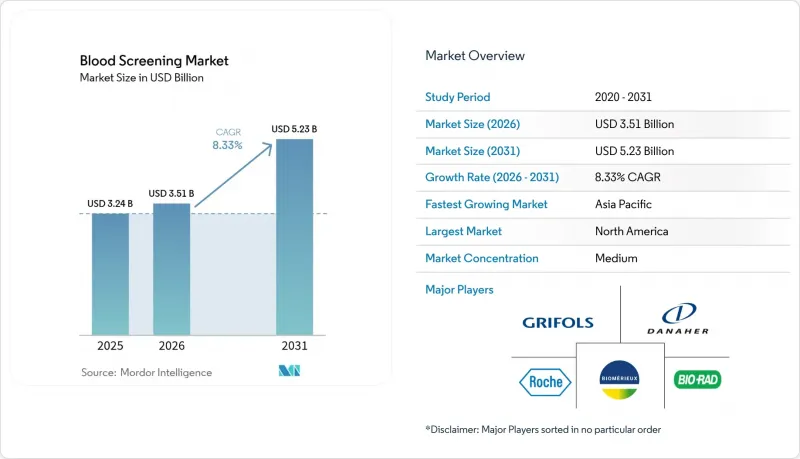
This report is Segmented by Product (Reagents and Kits, Instruments and More), Technology (Nucleic Acid Amplification Test [TMA and More], Immunoassay, Rapid Tests and More), Screening Target (Infectious Disease Panels [HIV and More], Blood Group Typing and More), End-User (Blood Banks, Hospitals, and More), and Geography (North America and More). The Market Forecasts are Provided in Terms of Value (USD).
Global Blood Screening Market Trends and Insights
Rising blood donations leading to higher transfusion screenings
Group-donation campaigns, such as China's 2025 initiative that rewards repeat donors, are reversing the pandemic dip in supply and creating fresh demand for scalable screening. A parallel shift by the United States Food and Drug Administration (FDA) to risk-based donor assessment removes categorical deferrals for men who have sex with men, enlarging the eligible pool while increasing the complexity of per-unit screening. Together, higher volumes and donor diversity are encouraging blood establishments to adopt fully automated assays and robotics so that throughput rises without compromising sensitivity.
Greater prevalence of transfusion-transmissible infections
The Centers for Disease Control and Prevention (CDC) issued a 2025 alert after 13 million dengue cases occurred in the Americas during 2024, more than twice the prior year.Concurrent West Nile outbreaks in Bulgaria and isolated monkeypox transmissions through platelet products underline the need for multiplex assays that go beyond the HIV-HBV-HCV triad. Rapid expansion of such panels has lifted demand for NAT reagents that can screen for emerging flaviviruses, orthopoxviruses, and region-specific pathogens within one workflow.
High capital and consumable costs
Compliance with the newly finalized LDT rule will cost the U.S. screening sector an estimated USD 566 million to USD 3.56 billion each year, according to FDA modelling. Emerging economies struggle even more because NAT platforms require significant upfront spending and high-grade cold-chain reagents. Although microfluidic chips have driven per-test costs down to USD 9.5, overall affordability remains a challenge for smaller blood centres.
Other drivers and restraints analyzed in the detailed report include:
- Stricter regulatory guidelines for blood safety
- Technological advances in screening methods
- Limited skilled workforce and lab infrastructure
For complete list of drivers and restraints, kindly check the Table Of Contents.
Segment Analysis
Reagents and kits retained 55.62% of blood screening market share in 2025 due to recurring demand for NAT, immunoassay and confirmatory components. Their dominance is reinforced by batch-specific regulatory validation that locks in proprietary formulations. The instruments category is expanding at 9.78% CAGR as laboratories upgrade to fully automated NAT workcells and next-generation immunoassay analyzers that integrate robotic pipetting, bar-code tracking and LIS connectivity.
A surge in AI-enabled middleware is also notable; OneBlood's deployment cut inventory levels by 40%, proving the operational value of real-time analytics. Software & services revenues therefore accelerate as blood banks seek predictive dashboards and automated deviation reporting, a trend likely to outpace reagent growth beyond 2028. Meanwhile, the emergence of portable molecular diagnostic devices, typified by the Dragonfly platform, suggests that decentralized testing could further fragment the instruments sub-segment over the long term.
NAT maintained a robust 41.88% share of the blood screening market in 2025 as its capacity to detect viral nucleic acids during window periods remains unmatched for HIV-1/2, HBV and HCV. Nevertheless, next-generation sequencing is scaling quickly at an 11.02% CAGR. mNGS can uncover unexpected pathogens, pinpoint co-infections and support genomic surveillance during outbreaks, evidenced by a 74.0% detection rate in sepsis studies.
Traditional enzyme immunoassays (ELISA/CLIA) still dominate in lower-resource settings because of lower instrumentation costs and simpler workflows. Rapid tests fill emergency needs but struggle with sensitivity versus NAT. Western blot retains a niche for confirmatory HIV workups. As AI tools mine large molecular datasets, labs may unify NAT and NGS within a common informatics layer, eventually blurring the boundaries between technologies.
Complete Report Scope:
- By Product
- Reagents & Kits
- NAT Reagents and Kits
- Immunoassay Reagents and Kits
- Other Reagents and Kits (WB, Rapid, WB)
- Instruments
- Automated NAT Systems
- Immunoassay Analysers (ELISA/CLIA)
- Point-of-Care Molecular Devices
- Software & Services
- Reagents & Kits
- By Technology
- Nucleic Acid Amplification Test (NAT)
- TMA
- Real-time PCR
- Immunoassay
- ELISA
- CLIA / EIA
- Rapid Tests (Lateral-flow)
- Next-Generation Sequencing (NGS)
- Western Blotting
- Emerging Point-of-Care Molecular Tests
- Nucleic Acid Amplification Test (NAT)
- By Screening Target
- Infectious Disease Panels
- HIV
- HBV
- HCV
- Emerging Pathogens (Zika, WNV, Dengue)
- Blood Group Typing
- Rare Antigen Genotyping
- Infectious Disease Panels
- By End-User
- Blood Banks
- Hospitals
- Clinical Laboratories
- Plasma Fractionation Centres
- By Geography
- North America
- United States
- Canada
- Mexico
- Europe
- Germany
- United Kingdom
- France
- Italy
- Spain
- Rest of Europe
- Asia-Pacific
- China
- Japan
- India
- Australia
- South Korea
- Rest of Asia-Pacific
- Middle East and Africa
- GCC
- South Africa
- Rest of Middle East and Africa
- South America
- Brazil
- Argentina
- Rest of South America
- North America
Geography Analysis
North America held 35.10% of the blood screening market in 2025. The FDA's risk-based donor eligibility guidance, AI-assisted inventory management, and ongoing implementation of LDT oversight collectively maintain the region's technology edge. Canada's diagnostics sector expanded after Quest Diagnostics took full control of LifeLabs, deepening molecular-testing capacity and cross-border sample logistics. Meanwhile, Mexico is improving rural donation infrastructure, which lifts demand for mid-tier immunoassay analyzers.
Asia-Pacific is the growth engine, projected at a 9.86% CAGR to 2031. Japan's 2025 hemoglobin-vesicle trial-the world's first artificial-blood clinical study-could eventually reduce dependence on donor supply and lengthen storage life to two years at room temperature. India's Quick Vitals facial-scan platform delivers non-invasive hemogram readouts within a minute and is being piloted in public hospitals, underscoring the region's openness to disruptive diagnostics. China's national carrier rate of 8.95% for thalassemia points to substantial prenatal and donor screening volume, while ongoing group-donation campaigns expand collection points in second-tier cities.
Europe shows steady progress under Regulation (EU) 2024/1938, which pools oversight across member states and allocates funds for crisis readiness. Germany and France are trial-ling pathogen-reduced platelets alongside traditional screening, whereas Bulgaria's West Nile outbreak prompted expanded NAT panels at regional blood bank. The regulation's unified guidance will streamline vendor approvals, encouraging pan-European platform standardization.
- Roche
- Grifols
- Abbott Laboratories
- bioMerieux
- Bio-Rad Laboratories
- Beckton Dickinson
- Danaher
- DiaSorin
- Siemens Healthineers
- Thermo Fisher Scientific
- Ortho Clinical Diagnostics
- Revvity
- Hologic
- QIAGEN
- Illumina
- GRAIL, Inc
- Immucor
- Meril Life Sciences
- Mindray
- Sysmex
Additional Benefits:
- The market estimate (ME) sheet in Excel format
- 3 months of analyst support
TABLE OF CONTENTS
1 Introduction
- 1.1 Study Assumptions and Market Definition
- 1.2 Scope of the Study
2 Research Methodology
3 Executive Summary
4 Market Landscape
- 4.1 Market Overview
- 4.2 Market Drivers
- 4.2.1 Rising Blood Donations Leading To Increased Transfusion Screenings
- 4.2.2 Increasing Prevalence Of Transfusion-Transmissible Infections
- 4.2.3 Stringent Regulatory Guidelines For Blood Safety
- 4.2.4 Technological Advancement In Blood Screening Methods
- 4.2.5 Rising Awareness For Blood Transmitted Infections And Increasing Number Of Blood Banks
- 4.2.6 AI-Driven Inventory Optimisation Platforms In Blood Banks
- 4.3 Market Restraints
- 4.3.1 High Capital & Consumable Cost For Screening
- 4.3.2 Limited Skilled Workforce And Laboratory Infrastructure
- 4.3.3 Competition From Pathogen-Reduction Technologies
- 4.3.4 Reagent Supply-Chain Disruptions (Geo-Politics & Cold-Chain)
- 4.4 Value / Supply-Chain Analysis
- 4.5 Regulatory Landscape
- 4.6 Technology Outlook
- 4.7 Porter's Five Forces Analysis
- 4.7.1 Bargaining Power of Suppliers
- 4.7.2 Bargaining Power of Buyers
- 4.7.3 Threat of New Entrants
- 4.7.4 Threat of Substitutes
- 4.7.5 Intensity of Competitive Rivalry
5 Market Size and Growth Forecasts (Value-USD)
- 5.1 By Product
- 5.1.1 Reagents & Kits
- 5.1.1.1 NAT Reagents and Kits
- 5.1.1.2 Immunoassay Reagents and Kits
- 5.1.1.3 Other Reagents and Kits (WB, Rapid, WB)
- 5.1.2 Instruments
- 5.1.2.1 Automated NAT Systems
- 5.1.2.2 Immunoassay Analysers (ELISA/CLIA)
- 5.1.2.3 Point-of-Care Molecular Devices
- 5.1.3 Software & Services
- 5.1.1 Reagents & Kits
- 5.2 By Technology
- 5.2.1 Nucleic Acid Amplification Test (NAT)
- 5.2.1.1 TMA
- 5.2.1.2 Real-time PCR
- 5.2.2 Immunoassay
- 5.2.2.1 ELISA
- 5.2.2.2 CLIA / EIA
- 5.2.3 Rapid Tests (Lateral-flow)
- 5.2.4 Next-Generation Sequencing (NGS)
- 5.2.5 Western Blotting
- 5.2.6 Emerging Point-of-Care Molecular Tests
- 5.2.1 Nucleic Acid Amplification Test (NAT)
- 5.3 By Screening Target
- 5.3.1 Infectious Disease Panels
- 5.3.1.1 HIV
- 5.3.1.2 HBV
- 5.3.1.3 HCV
- 5.3.1.4 Emerging Pathogens (Zika, WNV, Dengue)
- 5.3.2 Blood Group Typing
- 5.3.3 Rare Antigen Genotyping
- 5.3.1 Infectious Disease Panels
- 5.4 By End-User
- 5.4.1 Blood Banks
- 5.4.2 Hospitals
- 5.4.3 Clinical Laboratories
- 5.4.4 Plasma Fractionation Centres
- 5.5 By Geography
- 5.5.1 North America
- 5.5.1.1 United States
- 5.5.1.2 Canada
- 5.5.1.3 Mexico
- 5.5.2 Europe
- 5.5.2.1 Germany
- 5.5.2.2 United Kingdom
- 5.5.2.3 France
- 5.5.2.4 Italy
- 5.5.2.5 Spain
- 5.5.2.6 Rest of Europe
- 5.5.3 Asia-Pacific
- 5.5.3.1 China
- 5.5.3.2 Japan
- 5.5.3.3 India
- 5.5.3.4 Australia
- 5.5.3.5 South Korea
- 5.5.3.6 Rest of Asia-Pacific
- 5.5.4 Middle East and Africa
- 5.5.4.1 GCC
- 5.5.4.2 South Africa
- 5.5.4.3 Rest of Middle East and Africa
- 5.5.5 South America
- 5.5.5.1 Brazil
- 5.5.5.2 Argentina
- 5.5.5.3 Rest of South America
- 5.5.1 North America
6 Competitive Landscape
- 6.1 Market Concentration
- 6.2 Market Share Analysis
- 6.3 Company profiles (includes Global level Overview, Market level overview, Core Segments, Financials as available, Strategic Information, Market Rank/Share for key companies, Products and Services, and Recent Developments)
- 6.3.1 F. Hoffmann-La Roche Ltd.
- 6.3.2 Grifols S.A.
- 6.3.3 Abbott Laboratories Inc.
- 6.3.4 bioMerieux SA
- 6.3.5 Bio-Rad Laboratories Inc.
- 6.3.6 Becton, Dickinson and Company
- 6.3.7 Danaher Corporation (Beckman Coulter)
- 6.3.8 DiaSorin S.p.A.
- 6.3.9 Siemens Healthineers
- 6.3.10 Thermo Fisher Scientific Inc.
- 6.3.11 Ortho Clinical Diagnostics
- 6.3.12 Revvity
- 6.3.13 Hologic Inc.
- 6.3.14 Qiagen N.V.
- 6.3.15 Illumina Inc.
- 6.3.16 GRAIL, Inc
- 6.3.17 Immucor Inc.
- 6.3.18 Meril Life Sciences
- 6.3.19 Shenzhen Mindray Bio-Medical Electronics
- 6.3.20 Sysmex Corporation
7 Market Opportunities and Future Outlook
- 7.1 White-Space and Unmet-Need Assessment

