PUBLISHER: Mordor Intelligence | PRODUCT CODE: 2116475

PUBLISHER: Mordor Intelligence | PRODUCT CODE: 2116475
Knee Cartilage Repair - Market Share Analysis, Industry Trends & Statistics, Growth Forecasts (2026 - 2031)
According to Mordor Intelligence, the knee cartilage repair market size is expected to grow from USD 1.88 billion in 2025 to USD 1.99 billion in 2026 and is forecast to reach USD 2.62 billion by 2031 at 5.71% CAGR over 2026-2031.
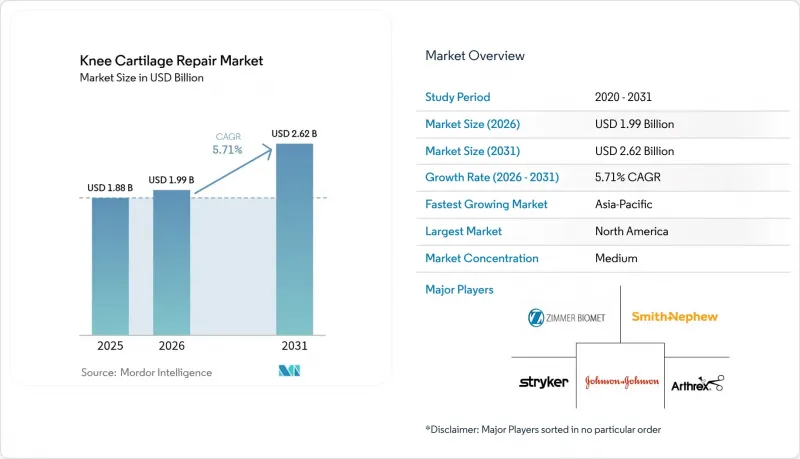
This report is Segmented by Application (Arthroscopic Chondroplasty, Microfracture, and More), Surgical Approach (Open Surgery, Conventional Arthroscopy, and More), Biomaterial Type (Collagen-Based, and More), Cell Source (Autologous Chondrocytes, and More), End User (Hospitals, and More), Patient Age Group (<25, 25-44, and More), and Geography. The Market Forecasts are Provided in Terms of Value (USD).
Global Knee Cartilage Repair Market Trends and Insights
Rapidly ageing population and knee osteoarthritis prevalence
Global osteoarthritis cases exceeded 607 million in 2021, with knee disease making up the largest share. Female patients carry a disproportionate burden and high body mass index multiplies disability risk, driving earlier intervention needs. Younger yet heavier cohorts therefore seek durable regenerative solutions rather than short-term palliative care. The resulting demand for scalable therapies stretches across regions and underpins long-term growth for the knee cartilage repair market.
Rising sports and road-trauma injuries
Younger adults account for a sharp rise in acute cartilage lesions. The 25-44-year bracket shows the fastest procedure growth because athletes and accident patients insist on high-function recovery. Engineered nasal-septum cartilage matured for two weeks has outperformed traditional constructs in recent trials, helping players return to impact activities sooner. Insurers and employers value the productivity gains, supporting premium pricing within the knee cartilage repair market.
High episode-of-care cost and reimbursement uncertainty
Robot-assisted total knee surgery carries extra costs of USD 2,400-15,000 per case despite shorter stays and fewer complications. When payers question long-term value, hospitals hesitate to adopt new implants, restraining early volumes in the knee cartilage repair market.
Other drivers and restraints analyzed in the detailed report include:
- Preference for minimally invasive and outpatient arthroscopy
- Regulatory approval of allogeneic chondrocyte products
- Variability in long-term clinical outcomes
For complete list of drivers and restraints, kindly check the Table Of Contents.
Segment Analysis
Autologous chondrocyte implantation captured 30.84% knee cartilage repair market share in 2025 on the back of long-standing clinical data and growing use of MACI patches. Prospective trials showed durable pain relief and structural repair when compared with microfracture at five years. Synthetic and 3D printed scaffolds are expanding at an 8.56% CAGR to 2031 because they eliminate two-stage harvest and culture, improve logistics, and lower overall operating room time.
Microfracture remains common for small defects but faces erosion as larger lesions demand true hyaline repair. Osteochondral autografts and allografts serve focal cavities where immediate structural support is essential. Research teams have also reported "dancing molecule" peptides that trigger rapid chondrogenesis, a discovery that could transform early-stage interventions should human data confirm preclinical findings.
Conventional arthroscopy represented 61.92% of the knee cartilage repair market size in 2025 due to its familiarity, short case times, and widespread instrumentation. Robotic systems, however, advance at an 8.01% CAGR through 2031 as hospitals seek reproducible alignment and defect mapping. Clinical audits found the VELYS platform cut 90-day revisit rates to 13.9% against 22.8% for other robots and trimmed total episode costs.
Open surgery still matters for complex reconstructions that surpass the reach of arthroscopic portals, yet volume declines as scopes and robots extend capability. Artificial intelligence overlays and augmented reality displays are already in pilot use, offering step-by-step guidance that shortens the learning curve and raises consistency across the knee cartilage repair market.
Complete Report Scope:
- By Application
- Arthroscopic Chondroplasty
- Microfracture
- Osteochondral Graft
- Autologous Chondrocyte Implantation (ACI & MACI)
- Cell-based Cartilage Resurfacing (MSC, SVF, iPSC)
- Synthetic / 3-D Printed Scaffold Implants
- By Surgical Approach
- Open Surgery
- Conventional Arthroscopy
- Robotic-Assisted Arthroscopy
- By Biomaterial Type
- Collagen-based
- Hyaluronic-Acid / Chitosan
- Synthetic Polymer (PGA, PLA, PCL)
- Ceramic / Composite
- 3-D Bioprinted Osteochondral Scaffolds
- By Cell Source
- Autologous Chondrocytes
- Allogeneic Chondrocytes
- Mesenchymal Stem Cells
- Acellular Biologic Grafts
- By End User
- Hospitals
- Ambulatory Surgical Centers
- Orthopaedic & Sports-Medicine Clinics
- By Patient Age Group
- < 25 years
- 25 - 44 years
- 45 - 64 years
- >= 65 years
- By Geography
- North America
- United States
- Canada
- Mexico
- Europe
- Germany
- United Kingdom
- France
- Italy
- Spain
- Rest of Europe
- Asia-Pacific
- China
- Japan
- India
- Australia
- South Korea
- Rest of Asia-Pacific
- Middle East and Africa
- GCC
- South Africa
- Rest of Middle East and Africa
- South America
- Brazil
- Argentina
- Rest of South America
- North America
Geography Analysis
North America accounted for 35.05% knee cartilage repair market share in 2025, supported by robust reimbursement, a large installed base of arthroscopes and robots, and ongoing surgeon training programs. Autologous procedures dominate, yet insurers now authorize donor-cell implants under coverage with evidence pathways, broadening therapeutic choice. CPT and HCPCS code updates in 2025 streamline claims, reducing administrative delays and reinforcing volume growth.
Europe remains technologically advanced but cost containment policies moderate high-price implant uptake. EU Medical Devices Regulation mandates stricter post-market vigilance, pushing suppliers to expand clinical follow-up and registry participation. Nations with bundled payment pilots, such as Germany and the Netherlands, prioritize day-surgery conversions that benefit arthroscopic MACI and scaffold implants.
Asia-Pacific advances at an 8.35% CAGR through 2031 as China, South Korea, and Australia scale specialty orthopedic centers. Hospital records show escalating knee arthroplasty in younger Chinese patients, a warning sign that early cartilage repair demand will grow rapidly. Japan confronts consumer hesitancy; only 17% of patients have opted for knee surgery in surveys, citing fear and limited awareness. Educational campaigns and minimally invasive options aim to lift uptake, providing upside for the knee cartilage repair market.
Emerging Middle East and South American economies invest in private orthopedic clinics catering to medical tourists. Although procedure counts remain small, improving insurance coverage and surgeon repatriation programs indicate long-term opportunity. Import tariffs and registration lags, however, currently restrict immediate market entry.
- Anika Therapeutics
- Arthrex
- B. Braun
- Conmed
- Johnson & Johnson
- Kolon TissueGene
- MEDIPOST
- Smiths Group
- Stryker
- Vericel
- Zimmer Biomet
- Geistlich Pharma
- Orthocell
- BioTissue AG
- CollPlant Biotechnologies
- Tissue Regenix Group
- Hyalex Orthopaedics
- CytexOrtho
Additional Benefits:
- The market estimate (ME) sheet in Excel format
- 3 months of analyst support
TABLE OF CONTENTS
1 Introduction
- 1.1 Study Assumptions and Market Definition
- 1.2 Scope of the Study
2 Research Methodology
3 Executive Summary
4 Market Landscape
- 4.1 Market Overview
- 4.2 Market Drivers
- 4.2.1 Rapidly-Ageing Population & Knee-OA Prevalence
- 4.2.2 Rising Sports & Road-Trauma Injuries
- 4.2.3 Preference For Minimally-Invasive & Outpatient Arthroscopy
- 4.2.4 Regulatory Green-Lighting Of Allogeneic Chondrocyte Products
- 4.2.5 3-D Printed Osteochondral Scaffolds Entering Pivotal Trials
- 4.2.6 Bundled-Payment Shift Accelerating Same-Day Knee Procedures
- 4.3 Market Restraints
- 4.3.1 High Episode-Of-Care Cost & Reimbursement Uncertainty
- 4.3.2 Variability In Long-Term Clinical Outcomes (Lack Of Standardised ACI Failure Definition)
- 4.3.3 Limited GMP Cell-Processing Capacity Causing Therapy Delays
- 4.3.4 Surgeon Learning-Curve For Advanced Biologic Techniques
- 4.4 Value / Supply-Chain Analysis
- 4.5 Regulatory Landscape
- 4.6 Technology Outlook
- 4.7 Porter's Five Forces Analysis
- 4.7.1 Bargaining Power of Suppliers
- 4.7.2 Bargaining Power of Buyers
- 4.7.3 Threat of New Entrants
- 4.7.4 Threat of Substitutes
- 4.7.5 Intensity of Competitive Rivalry
5 Market Size and Growth Forecasts (Value-USD)
- 5.1 By Application
- 5.1.1 Arthroscopic Chondroplasty
- 5.1.2 Microfracture
- 5.1.3 Osteochondral Graft
- 5.1.4 Autologous Chondrocyte Implantation (ACI & MACI)
- 5.1.5 Cell-based Cartilage Resurfacing (MSC, SVF, iPSC)
- 5.1.6 Synthetic / 3-D Printed Scaffold Implants
- 5.2 By Surgical Approach
- 5.2.1 Open Surgery
- 5.2.2 Conventional Arthroscopy
- 5.2.3 Robotic-Assisted Arthroscopy
- 5.3 By Biomaterial Type
- 5.3.1 Collagen-based
- 5.3.2 Hyaluronic-Acid / Chitosan
- 5.3.3 Synthetic Polymer (PGA, PLA, PCL)
- 5.3.4 Ceramic / Composite
- 5.3.5 3-D Bioprinted Osteochondral Scaffolds
- 5.4 By Cell Source
- 5.4.1 Autologous Chondrocytes
- 5.4.2 Allogeneic Chondrocytes
- 5.4.3 Mesenchymal Stem Cells
- 5.4.4 Acellular Biologic Grafts
- 5.5 By End User
- 5.5.1 Hospitals
- 5.5.2 Ambulatory Surgical Centers
- 5.5.3 Orthopaedic & Sports-Medicine Clinics
- 5.6 By Patient Age Group
- 5.6.1 < 25 years
- 5.6.2 25 - 44 years
- 5.6.3 45 - 64 years
- 5.6.4 >= 65 years
- 5.7 By Geography
- 5.7.1 North America
- 5.7.1.1 United States
- 5.7.1.2 Canada
- 5.7.1.3 Mexico
- 5.7.2 Europe
- 5.7.2.1 Germany
- 5.7.2.2 United Kingdom
- 5.7.2.3 France
- 5.7.2.4 Italy
- 5.7.2.5 Spain
- 5.7.2.6 Rest of Europe
- 5.7.3 Asia-Pacific
- 5.7.3.1 China
- 5.7.3.2 Japan
- 5.7.3.3 India
- 5.7.3.4 Australia
- 5.7.3.5 South Korea
- 5.7.3.6 Rest of Asia-Pacific
- 5.7.4 Middle East and Africa
- 5.7.4.1 GCC
- 5.7.4.2 South Africa
- 5.7.4.3 Rest of Middle East and Africa
- 5.7.5 South America
- 5.7.5.1 Brazil
- 5.7.5.2 Argentina
- 5.7.5.3 Rest of South America
- 5.7.1 North America
6 Competitive Landscape
- 6.1 Market Concentration
- 6.2 Market Share Analysis
- 6.3 Company profiles (includes Global level Overview, Market level overview, Core Segments, Financials as available, Strategic Information, Market Rank/Share for key companies, Products and Services, and Recent Developments)
- 6.3.1 Anika Therapeutics
- 6.3.2 Arthrex
- 6.3.3 B. Braun
- 6.3.4 CONMED
- 6.3.5 Johnson & Johnson
- 6.3.6 Kolon TissueGene
- 6.3.7 MEDIPOST
- 6.3.8 Smith & Nephew
- 6.3.9 Stryker
- 6.3.10 Vericel
- 6.3.11 Zimmer Biomet
- 6.3.12 Geistlich Pharma
- 6.3.13 Orthocell Ltd
- 6.3.14 BioTissue AG
- 6.3.15 CollPlant Biotechnologies
- 6.3.16 Tissue Regenix Group
- 6.3.17 Hyalex Orthopaedics
- 6.3.18 CytexOrtho
7 Market Opportunities and Future Outlook
- 7.1 White-Space and Unmet-Need Assessment

