PUBLISHER: Mordor Intelligence | PRODUCT CODE: 2116479

PUBLISHER: Mordor Intelligence | PRODUCT CODE: 2116479
Dental Bone Void Filler - Market Share Analysis, Industry Trends & Statistics, Growth Forecasts (2026 - 2031)
According to Mordor Intelligence, the dental bone void filler market size was valued at USD 106.32 million in 2025 and estimated to grow from USD 112.74 million in 2026 to reach USD 151.18 million by 2031, at a CAGR of 6.04% during the forecast period (2026-2031).
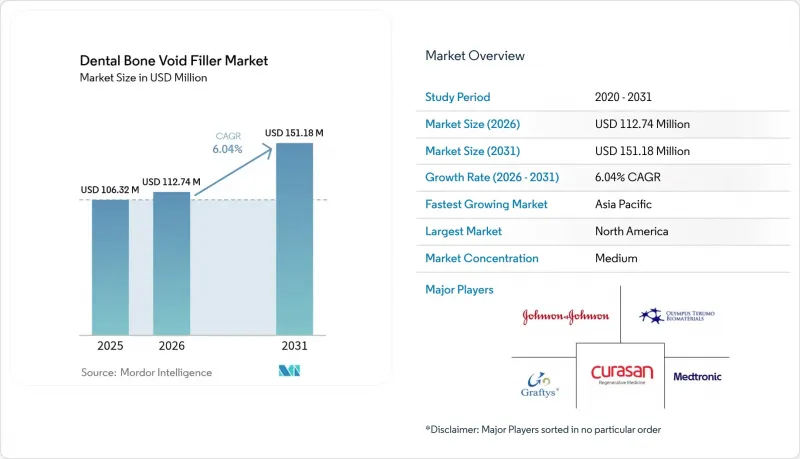
This report is Segmented by Material Type (B-Tricalcium Phosphate (B-TCP), Biphasic Calcium-Phosphate, and More), Form Factor (Granules, Putty/Paste, and More), Application (Socket Preservation, Ridge Augmentation, and More), End User (Hospitals, Ambulatory Surgical Centers, and More), and Geography (North America, Europe, Asia-Pacific, and More). The Market Forecasts are Provided in Terms of Value (USD).
Global Dental Bone Void Filler Market Trends and Insights
Growing Adoption of Bioceramics for Dental Reconstruction
Next-generation, ion-doped hydroxyapatite and B-TCP formulations demonstrate superior bone formation and reduced inflammatory response. Fluorine-incorporated hydroxyapatite significantly accelerates socket healing by modulating macrophage activity. Clinicians embrace these synthetic options to avoid donor-site morbidity and achieve predictable outcomes. Broader regulatory acceptance and positive long-term data boost surgeon confidence. As prices stabilize, adoption permeates mid-tier markets, reinforcing the dental bone void filler market growth.
Rapid Rise in Dental-Implant Procedures Among Aging Population
A global cohort of more than 280 million older adults experiences tooth loss yet seeks fixed restorations rather than dentures. Implant success exceeding 95% when supported by quality grafts fuels procedure volumes. Age-related alveolar resorption necessitates bone augmentation, anchoring sustained demand for fillers. Public-health campaigns that emphasize oral health in senior care further lift procedure utilization. Consequently, the dental bone void filler market benefits from demographics that ensure multi-year procedural pipelines.
Unpredictable Resorption & Clinical Limitations of Certain Bioceramics
Interpatient variability in bioceramic degradation complicates treatment planning and implant stability. Highly porous scaffolds may fracture under load, restricting posterior-jaw usage. Systematic reviews highlight contamination risks that compromise biocompatibility. Regulators demand extensive post-market surveillance, lengthening product approval cycles. These uncertainties temper the dental bone void filler market expansion until next-wave formulations demonstrate consistent performance.
Other drivers and restraints analyzed in the detailed report include:
- Advances in Synthetic Biomaterials (Nano-HA, B-TCP) Enhancing Osteoinduction
- Chair-Side 3-D Printing of Custom Graft Scaffolds
- High Procedure Cost & Reimbursement Gaps
For complete list of drivers and restraints, kindly check the Table Of Contents.
Segment Analysis
B-tricalcium phosphate retains 40.78% share of the dental bone void filler market in 2025 because surgeons trust its resorption profile and osteoconductivity. Calcium-phosphate cements, advancing at a 9.03% CAGR, satisfy demand for injectable solutions that simplify minimally invasive techniques. Biphasic blends combine hydroxyapatite volume stability with B-TCP resorption, winning cases that need balanced remodeling. Recent cement upgrades shorten setting times and improve compressive strength, broadening indications beyond socket preservation. Growth prospects favor materials offering surgeon-friendly handling, predictable integration, and compatibility with digital delivery systems.
Procedural selection now hinges on clinical objective: fast-resorbing powders for sockets, slower materials for ridge augmentation. Regulatory approvals are accelerating as dossier evidence meets stringent safety endpoints. Supply resilience, aided by synthetic production, shields clinicians from xenograft shortages. Consequently, competitive intensity centers on proprietary ion-doping and nanostructuring that enhance bioactivity without escalating cost.
Granules commanded 40.12% of the dental bone void filler market in 2025, favored for versatility and straightforward application. Injectable formats rise at an 8.12% CAGR by providing precise placement through specialized cannulas and reducing surgical trauma. Putty and paste options fill irregular defects, while rigid blocks remain essential for non-contained augmentation. Customizable, chair-side printed scaffolds blur the line between traditional form factors and bespoke constructs.
Digitally guided delivery systems synchronize implant drills with graft injection, decreasing material wastage and operative time. Surgeons increasingly value closed syringe packaging that maintains sterility and eases workflow. As printing technologies mature, hybrid approaches-injecting a flowable phase around a printed core-promise enhanced stability and vascularization. Market acceptance will hinge on clinical evidence demonstrating that convenience does not sacrifice long-term structural integrity.
Complete Report Scope:
- By Material Type
- Beta-Tricalcium Phosphate (Beta-TCP)
- Biphasic Calcium-Phosphate
- Calcium-Phosphate Cements
- Others
- By Form Factor
- Granules
- Putty/Paste
- Injectable
- Blocks/Molds & Others
- By Application
- Socket Preservation
- Ridge Augmentation
- Periodontal Defect Regeneration
- Implant Bone Regeneration
- Others
- By End User
- Hospitals
- Dental Clinics
- Ambulatory Surgical Centers
- Academic & Research Institutes
- Geography
- North America
- United States
- Canada
- Mexico
- Europe
- Germany
- United Kingdom
- France
- Italy
- Spain
- Rest of Europe
- Asia-Pacific
- China
- Japan
- India
- South Korea
- Australia
- Rest of Asia-Pacific
- Middle East and Africa
- GCC
- South Africa
- Rest of Middle East and Africa
- South America
- Brazil
- Argentina
- Rest of South America
- North America
Geography Analysis
North America maintained 35.41% of the dental bone void filler market in 2025, driven by sophisticated reimbursement, clinician familiarity with advanced biomaterials, and stringent FDA performance pathways that protect innovation investment. Premium pricing prevails because practitioners prioritize long-term success over material cost. Professional societies disseminate evidence-based protocols, accelerating uptake of ion-doped and nano-structured grafts.
Asia-Pacific records a 9.33% CAGR through 2031 as dental tourism funnels international patients into cost-competitive hubs. Procedure pricing in destinations like Malaysia and Thailand averages 60-80% lower than in Australia or the United States, yet maintains robust quality benchmarks. Rising middle-class incomes and government spending on oral-health infrastructure amplify domestic demand. Multinational manufacturers localize production to benefit from tariff relief and supply-chain resiliency.
Europe exhibits steady expansion supported by an aging populace and payer systems that reimburse evidence-backed biomaterials. Harmonized Medical Device Regulation fosters predictable approvals for synthetic grafts emphasizing sustainability and traceability. Swiss and German R&D centers collaborate with universities to refine calcium-phosphate chemistries, while the region's cross-border directive facilitates patient mobility, allowing clinics in Spain and Portugal to attract Northern European patients seeking competitive pricing.
- Medtronic
- Johnson & Johnson
- ZimVie
- Dentsply Sirona
- Geistlich Pharma
- Straumann Group
- BioHorizons
- RTI Surgical
- BoneSupport AB
- Graftys
- Olympus-Terumo Biomaterials
- Orthorebirth Co Ltd
- OsteoBiol (Tecnoss)
- Kuros Biosciences
- NovaBone Products
- Collagen Matrix
- Genoss
- Stryker
- LifeNet Health
- Curasan
Additional Benefits:
- The market estimate (ME) sheet in Excel format
- 3 months of analyst support
TABLE OF CONTENTS
1 Introduction
- 1.1 Study Assumptions & Market Definition
- 1.2 Scope of the Study
2 Research Methodology
3 Executive Summary
4 Market Landscape
- 4.1 Market Overview
- 4.2 Market Drivers
- 4.2.1 Growing Adoption Of Bioceramics For Dental Reconstruction
- 4.2.2 Rapid Rise In Dental-Implant Procedures Among Aging Population
- 4.2.3 Advances In Synthetic Biomaterials (Nano-HA, B-TCP) Enhancing Osteoinduction
- 4.2.4 Chair-Side 3-D Printing Of Custom Graft Scaffolds
- 4.2.5 Dental-Tourism-Led Demand Surge In Cost-Competitive APAC & MEA Hubs
- 4.3 Market Restraints
- 4.3.1 Unpredictable Resorption & Clinical Limitations Of Certain Bioceramics
- 4.3.2 High Procedure Cost & Reimbursement Gaps
- 4.3.3 Supply-Chain Risk For Xenografts Amid Tighter Zoonotic-Disease Surveillance
- 4.4 Technological Outlook
- 4.5 Porter's Five Forces
- 4.5.1 Threat of New Entrants
- 4.5.2 Bargaining Power of Buyers/Consumers
- 4.5.3 Bargaining Power of Suppliers
- 4.5.4 Threat of Substitute Products
- 4.5.5 Intensity of Competitive Rivalry
5 Market Size & Growth Forecasts (Value, USD)
- 5.1 By Material Type
- 5.1.1 Beta-Tricalcium Phosphate (Beta-TCP)
- 5.1.2 Biphasic Calcium-Phosphate
- 5.1.3 Calcium-Phosphate Cements
- 5.1.4 Others
- 5.2 By Form Factor
- 5.2.1 Granules
- 5.2.2 Putty/Paste
- 5.2.3 Injectable
- 5.2.4 Blocks/Molds & Others
- 5.3 By Application
- 5.3.1 Socket Preservation
- 5.3.2 Ridge Augmentation
- 5.3.3 Periodontal Defect Regeneration
- 5.3.4 Implant Bone Regeneration
- 5.3.5 Others
- 5.4 By End User
- 5.4.1 Hospitals
- 5.4.2 Dental Clinics
- 5.4.3 Ambulatory Surgical Centers
- 5.4.4 Academic & Research Institutes
- 5.5 Geography
- 5.5.1 North America
- 5.5.1.1 United States
- 5.5.1.2 Canada
- 5.5.1.3 Mexico
- 5.5.2 Europe
- 5.5.2.1 Germany
- 5.5.2.2 United Kingdom
- 5.5.2.3 France
- 5.5.2.4 Italy
- 5.5.2.5 Spain
- 5.5.2.6 Rest of Europe
- 5.5.3 Asia-Pacific
- 5.5.3.1 China
- 5.5.3.2 Japan
- 5.5.3.3 India
- 5.5.3.4 South Korea
- 5.5.3.5 Australia
- 5.5.3.6 Rest of Asia-Pacific
- 5.5.4 Middle East and Africa
- 5.5.4.1 GCC
- 5.5.4.2 South Africa
- 5.5.4.3 Rest of Middle East and Africa
- 5.5.5 South America
- 5.5.5.1 Brazil
- 5.5.5.2 Argentina
- 5.5.5.3 Rest of South America
- 5.5.1 North America
6 Competitive Landscape
- 6.1 Market Concentration
- 6.2 Market Share Analysis
- 6.3 Company Profiles (includes Global level Overview, Market level overview, Core Business Segments, Financials, Headcount, Key Information, Market Rank, Market Share, Products and Services, and analysis of Recent Developments)
- 6.3.1 Medtronic plc
- 6.3.2 Johnson & Johnson
- 6.3.3 ZimVie Inc
- 6.3.4 Dentsply Sirona
- 6.3.5 Geistlich Pharma
- 6.3.6 Straumann Group
- 6.3.7 BioHorizons
- 6.3.8 RTI Surgical
- 6.3.9 BoneSupport AB
- 6.3.10 Graftys
- 6.3.11 Olympus-Terumo Biomaterials
- 6.3.12 Orthorebirth Co Ltd
- 6.3.13 OsteoBiol (Tecnoss)
- 6.3.14 Kuros Biosciences
- 6.3.15 NovaBone Products
- 6.3.16 Collagen Matrix
- 6.3.17 Genoss
- 6.3.18 Stryker Corporation
- 6.3.19 LifeNet Health
- 6.3.20 Curasan Inc
7 Market Opportunities & Future Outlook
- 7.1 White-space & Unmet-Need Assessment

