PUBLISHER: Mordor Intelligence | PRODUCT CODE: 2116486

PUBLISHER: Mordor Intelligence | PRODUCT CODE: 2116486
Health Caregiving - Market Share Analysis, Industry Trends & Statistics, Growth Forecasts (2026 - 2031)
According to Mordor Intelligence, the health caregiving market size in 2026 is estimated at USD 256.3 billion, growing from 2025 value of USD 228.91 billion with 2031 projections showing USD 451.27 billion, growing at 11.97% CAGR over 2026-2031.
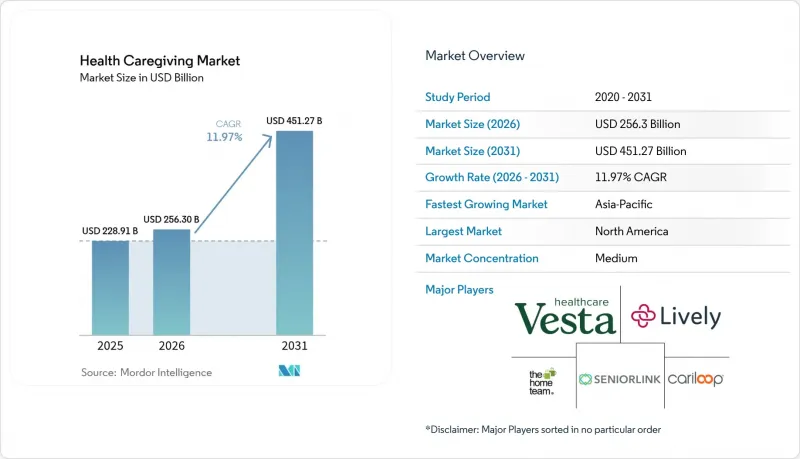
This report is Segmented by Care Type (Daily Essential Activities, Health & Safety Awareness, and More), End User (Geriatric Population, Disabled Population, and More), Payment Source (Public, Private Insurance, Out-of-Pocket/Self-Pay), and Geography (North America, Europe, Asia-Pacific, Middle East & Africa, and South America). The Market Forecasts are Provided in Terms of Value (USD).
Global Health Caregiving Market Trends and Insights
Rapidly Expanding Geriatric Population
Adults aged 65 and above increasingly choose to remain at home, with 77% stating this preference in 2024. Family-care capacity declines as dual-career households and geographic dispersion limit informal support, creating a gap filled by professional services. The monthly cost difference between home-based and nursing-home care averages USD 2,800, steering families and payers toward community options. Medicare Advantage plans reacted by offering supplemental in-home benefits in 89% of plans in 2025, up from 67% two years earlier. These shifts anchor long-term demand and reinforce a supply pipeline for specialized home-care providers.
Growing Burden of Chronic Diseases
Multiple chronic conditions affected 67% of Medicare beneficiaries in 2024. Integrated platforms that combine clinical oversight and daily living support have reduced hospitalizations and emergency visits, demonstrating 38% fewer readmissions among heart-failure patients when remote monitoring pairs with home nursing. Continuous data capture unlocks new revenue streams for providers while lowering payer costs, sustaining healthy margins within the health caregiving market.
Acute Caregiver Workforce Shortages & High Turnover
Home-health turnover reached 82% in 2024, straining care continuity. Wage gaps versus hospital roles widen attrition risk, and rural vacancy rates run 34% higher than urban averages. Skill-mix shortages emerge as chronic-disease management and device proficiency become mandatory. These constraints limit near-term expansion capacity in parts of the health caregiving market.
Other drivers and restraints analyzed in the detailed report include:
- Accelerated Adoption of Telehealth & Remote-Patient-Monitoring Platforms
- Expansion of Value-Based Reimbursement Models
- High Cost of Care and Uneven Insurance Reimbursement
For complete list of drivers and restraints, kindly check the Table Of Contents.
Segment Analysis
Daily essential activities commanded 38.12% of the health caregiving market in 2025, signaling demand for help with bathing, meals, and mobility. Institutional/Nursing Care is poised for a 13.89% CAGR, reflecting rising acceptance of higher-acuity services at home. Advanced monitoring devices cleared by the FDA in 2024 enable hospital-grade oversight that supports this shift. In a parallel trend, Health & Safety Awareness services pair devices with rapid response teams, while Social Well-Being programs reduce isolation risks. Collectively, these lines are reshaping the health caregiving market size through bundled clinical and non-clinical offerings.
Growth in Institutional/Nursing Care underscores the blurring boundary between medical and supportive functions. Providers integrate skilled nursing, physical therapy, and social services under unified care plans, boosting patient retention and reimbursement rates. As clinical oversight deepens, technology platforms track vitals, medication adherence, and environmental safety in real time, helping agencies scale without escalating labor hours. These changes reinforce the long-term expansion path of the health caregiving market.
Complete Report Scope:
- By Care Type
- Daily Essential Activities
- Health & Safety Awareness
- Social Well-Being
- Institutional / Nursing Care
- Other Care Types
- By End User
- Geriatric Population
- Disabled Population
- Post-Acute / Chronic-Disease Patients
- Post-partum Mothers & Infants
- By Payment Source
- Public
- Private Insurance
- Out-of-Pocket / Self-Pay
- Geography
- North America
- United States
- Canada
- Mexico
- Europe
- Germany
- United Kingdom
- France
- Italy
- Spain
- Rest of Europe
- Asia-Pacific
- China
- Japan
- India
- Australia
- South Korea
- Rest of Asia-Pacific
- Middle East & Africa
- GCC
- South Africa
- Rest of Middle East & Africa
- South America
- Brazil
- Argentina
- Rest of South America
- North America
Geography Analysis
North America retained 40.78% of the health caregiving market in 2025 thanks to mature reimbursement structures and high remote-monitoring penetration. U.S. Medicare Advantage enrollment in RPM programs reached 34% in 2024. Canada leverages universal coverage to pivot more services into communities, and Mexico's rising middle class is fueling private-insurance uptake. Providers focus on technology-driven efficiency that offsets wage pressures and wide service areas.
Asia-Pacific is forecast to grow at 13.18% CAGR, led by China and India. China's demographic inversion accelerates demand, while policy shifts invite private capital into elder-care ventures. Japan pioneers robotics for personal assistance, modeling workforce solutions for the region. India's middle-class growth and expanding insurance base create fertile ground for organized care networks. Australia's National Disability Insurance Scheme underwrites comprehensive home supports, offering a blueprint for neighboring markets.
Europe enjoys steady progress as universal systems reposition around home-based care. Germany's long-term-care insurance funds extensive in-home benefits, France incentives home modifications through tax credits, and the United Kingdom's NHS sets community-care targets to cut hospital occupancy. Strict GDPR rules raise compliance costs but also heighten public trust in digital solutions, supporting adoption of secure data flows and connected devices in the health caregiving market.
List of Companies Covered in this Report:
- AccentCare
- Addus HomeCare
- Amedisys
- Bayada Home Health Care
- Brookdale Senior Living
- Care.com
- Cariloop
- Comfort Keepers
- Encompass Health
- HomeTeam
- Honor Technology
- Kindred Healthcare
- Knight Health Holdings
- LHC Group
- Lively
- Right at Home
- Room2Care
- Senior Helpers
- Seniorlink
- Vesta Healthcare
- Visiting Angels
Additional Benefits:
- The market estimate (ME) sheet in Excel format
- 3 months of analyst support
TABLE OF CONTENTS
1 Introduction
- 1.1 Study Assumptions & Market Definition
- 1.2 Scope of the Study
2 Research Methodology
3 Executive Summary
4 Market Landscape
- 4.1 Market Overview
- 4.2 Market Drivers
- 4.2.1 Rapidly Expanding Geriatric Population
- 4.2.2 Growing Burden of Chronic Diseases
- 4.2.3 Accelerated Adoption of Telehealth & Remote-Patient-Monitoring Platforms
- 4.2.4 Expansion of Value-Based Reimbursement Models that Reward Home-Based Care
- 4.2.5 Gig-Economy Caregiver Platforms Boosting On-Demand Labour Supply
- 4.2.6 AI-Driven Predictive Analytics Enabling Proactive, Preventive Interventions
- 4.3 Market Restraints
- 4.3.1 Acute Caregiver Workforce Shortages & High Turnover
- 4.3.2 High Cost Of Care And Uneven Insurance Reimbursement
- 4.3.3 Escalating Cybersecurity And Data-Privacy Liabilities For Connected Care Tech
- 4.3.4 Regulatory Uncertainty From Proposed CMS 'Access Rule' Margin Caps
- 4.4 Value / Supply-Chain Analysis
- 4.5 Regulatory Landscape
- 4.6 Technological Outlook
- 4.7 Porter's Five Forces
- 4.7.1 Threat of New Entrants
- 4.7.2 Bargaining Power of Buyers/Consumers
- 4.7.3 Bargaining Power of Suppliers
- 4.7.4 Threat of Substitutes
- 4.7.5 Intensity of Competitive Rivalry
5 Market Size & Growth Forecasts (Value)
- 5.1 By Care Type
- 5.1.1 Daily Essential Activities
- 5.1.2 Health & Safety Awareness
- 5.1.3 Social Well-Being
- 5.1.4 Institutional / Nursing Care
- 5.1.5 Other Care Types
- 5.2 By End User
- 5.2.1 Geriatric Population
- 5.2.2 Disabled Population
- 5.2.3 Post-Acute / Chronic-Disease Patients
- 5.2.4 Post-partum Mothers & Infants
- 5.3 By Payment Source
- 5.3.1 Public
- 5.3.2 Private Insurance
- 5.3.3 Out-of-Pocket / Self-Pay
- 5.4 Geography
- 5.4.1 North America
- 5.4.1.1 United States
- 5.4.1.2 Canada
- 5.4.1.3 Mexico
- 5.4.2 Europe
- 5.4.2.1 Germany
- 5.4.2.2 United Kingdom
- 5.4.2.3 France
- 5.4.2.4 Italy
- 5.4.2.5 Spain
- 5.4.2.6 Rest of Europe
- 5.4.3 Asia-Pacific
- 5.4.3.1 China
- 5.4.3.2 Japan
- 5.4.3.3 India
- 5.4.3.4 Australia
- 5.4.3.5 South Korea
- 5.4.3.6 Rest of Asia-Pacific
- 5.4.4 Middle East & Africa
- 5.4.4.1 GCC
- 5.4.4.2 South Africa
- 5.4.4.3 Rest of Middle East & Africa
- 5.4.5 South America
- 5.4.5.1 Brazil
- 5.4.5.2 Argentina
- 5.4.5.3 Rest of South America
- 5.4.1 North America
6 Competitive Landscape
- 6.1 Market Concentration
- 6.2 Market Share Analysis
- 6.3 Company Profiles (includes Global level Overview, Market level overview, Core Segments, Financials as available, Strategic Information, Market Rank/Share for key companies, Products & Services, and Recent Developments)
- 6.3.1 AccentCare
- 6.3.2 Addus HomeCare
- 6.3.3 Amedisys
- 6.3.4 Bayada Home Health Care
- 6.3.5 Brookdale Senior Living
- 6.3.6 Care.com
- 6.3.7 Cariloop
- 6.3.8 Comfort Keepers
- 6.3.9 Encompass Health
- 6.3.10 HomeTeam
- 6.3.11 Honor Technology
- 6.3.12 Kindred Healthcare
- 6.3.13 Knight Health Holdings
- 6.3.14 LHC Group
- 6.3.15 Lively
- 6.3.16 Right at Home
- 6.3.17 Room2Care
- 6.3.18 Senior Helpers
- 6.3.19 Seniorlink
- 6.3.20 Vesta Healthcare
- 6.3.21 Visiting Angels
7 Market Opportunities & Future Outlook
- 7.1 White-Space & Unmet-Need Assessment

