PUBLISHER: Mordor Intelligence | PRODUCT CODE: 2116488

PUBLISHER: Mordor Intelligence | PRODUCT CODE: 2116488
Cardiac Mapping - Market Share Analysis, Industry Trends & Statistics, Growth Forecasts (2026 - 2031)
According to Mordor Intelligence, the cardiac mapping market size was valued at USD 2.17 billion in 2025 and estimated to grow from USD 2.36 billion in 2026 to reach USD 3.62 billion by 2031, at a CAGR of 8.88% during the forecast period (2026-2031).
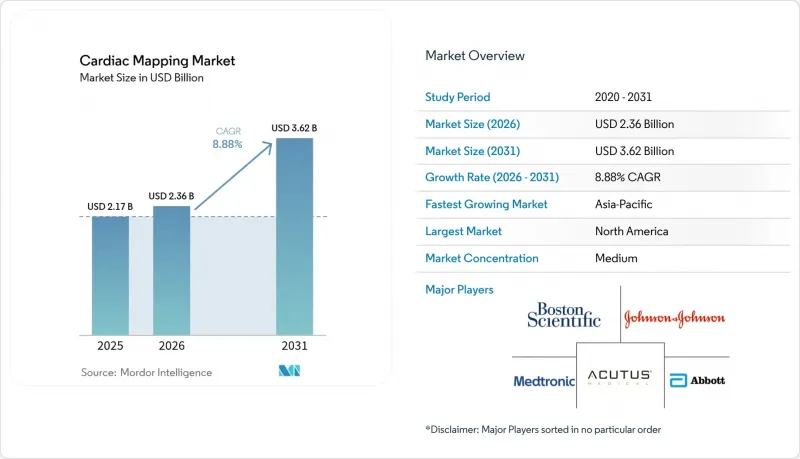
This report is Segmented by Product Type (Contact Mapping Systems and Non-Contact Mapping Systems), Indication (Atrial Fibrillation, and More), End-User (Tertiary Hospitals, Electrophysiology & Cath Labs, and More), and Geography (North America, Europe, Asia-Pacific, Middle East & Africa, South America). The Market Forecasts are Provided in Terms of Value (USD).
Global Cardiac Mapping Market Trends and Insights
Growing Burden of Cardiovascular Diseases
Atrial fibrillation prevalence doubled in South Korea from 1.1% to 2.2% of adults between 2013 and 2022, illustrating how aging populations and lifestyle factors magnify arrhythmia caseloads. Higher CHA2DS2-VASc scores and multiple comorbidities mean physicians need granular electrical roadmaps to guide targeted lesions. More than 9,500 clinicians attended Heart Rhythm 2024, underscoring infrastructural expansion and professional focus on electrophysiology. Emerging economies mirror this trajectory as cardiovascular disease incidence rises alongside urbanization. Hospitals therefore allocate larger capital budgets to high-density mapping consoles, ensuring readiness for a patient cohort that will persist for decades. The result is predictable, long-cycle demand that anchors the cardiac mapping market.
Advancements in Electrophysiology Mapping Technologies
Randomized evidence confirms technology gains: the TAILORED-AF study reported 88% 12-month freedom-from-AF when AI directed lesion sets, eclipsing the 70% rate for routine pulmonary vein isolation. Hardware moves in lockstep, with 64-electrode catheters embedding contact-force sensors that relay sub-gram accuracy in real time. Companies such as Volta Medical and GE Healthcare combine algorithmic mapping with established recording systems, creating integrated ecosystems. Pulsed field ablation shifts lesion creation from thermal to non-thermal energy, with trials documenting 100% acute PV isolation and minimal oesophageal impact. Continuous innovation imposes upgrade pressure on hospitals that wish to maintain competitive clinical outcomes and referral volumes. Consequently, capital budgets for mapping platforms remain resilient even in constrained reimbursement environments.
Shortage of Skilled Electrophysiologists
Fellowship programs cannot match demand; US training pipelines deliver too few specialists according to the Journal of the American College of Cardiology. Emerging markets feel the pinch more acutely because hospital expansion outstrips staff growth. AdventHealth built an 8-month orientation curriculum covering 48 team members to accelerate in-house capability, yet the gap persists. Skill shortages delay utilization of installed systems and lengthen patient wait times. Vendors respond with automation and intuitive user interfaces to reduce learning curves. Health systems also explore tele-mentoring, yet credentialling and liability frameworks remain underdeveloped, extending the constraint's long-term influence on the cardiac mapping market.
Other drivers and restraints analyzed in the detailed report include:
- Increasing Adoption of Minimally Invasive Ablation Procedures
- Integration of Artificial Intelligence and Cloud Analytics in Mapping Workflows
- High Capital and Procedural Costs
For complete list of drivers and restraints, kindly check the Table Of Contents.
Segment Analysis
Contact platforms delivered 63.45% of the cardiac mapping market size in 2025 owing to widespread clinical familiarity, robust reimbursement, and improvements such as 64-electrode grids that yield sub-millimeter resolution. Abbott's TactiCath catheter registers 0.3 gram precision that helps operators titrate energy safely. The segment's momentum is fortified by integration with popular ablation generators, ensuring procedural continuity.
Non-contact modalities are advancing at a 10.12% CAGR because AI body-surface algorithms and ultrasound acoustical sensors can reconstruct 3-D chambers without extensive catheter manipulation, thereby reducing fluoroscopy exposure. Basket and multi-electrode arrays provide panoramic data that identifies extra-pulmonary triggers overlooked by point-by-point systems. Hybrid workflows merge contact accuracy for lesion validation with global non-contact scans that guide strategy, illustrating technology convergence that will sustain segment diversity within the cardiac mapping market.
Complete Report Scope:
- By Product Type
- Contact Mapping Systems
- Conventional RF Contact Catheters
- Contact-Force Sensing Catheters
- High-Density Grid Catheters
- Non-Contact Mapping Systems
- Basket & Multielectrode Arrays
- Ultrasound / Acoustical Mapping
- AI-Based Body-Surface Mapping
- Contact Mapping Systems
- By Indication
- Atrial Fibrillation
- Atrial Flutter
- Ventricular Tachycardia
- Supraventricular Tachycardia
- By End-User
- Tertiary Hospitals
- Electrophysiology & Cath Labs
- Ambulatory Surgical Centres
- Academic & Research Institutes
- Geography
- North America
- United States
- Canada
- Mexico
- Europe
- Germany
- United Kingdom
- France
- Italy
- Spain
- Rest of Europe
- Asia-Pacific
- China
- Japan
- India
- Australia
- South Korea
- Rest of Asia-Pacific
- Middle East & Africa
- GCC
- South Africa
- Rest of Middle East & Africa
- South America
- Brazil
- Argentina
- Rest of South America
- North America
Geography Analysis
North America booked 42.55% revenue in 2025 thanks to mature reimbursement and early PFA clearances that encourage rapid technology refresh cycles. US centers participate in pivotal trials for dual-energy ablation and AI mapping, securing clinical leadership. Moderate growth through 2031 reflects saturation at top hospitals, though outpatient expansion offsets plateau effects.
Asia-Pacific delivers the highest 9.21% CAGR because cardiovascular disease burdens rise in tandem with economic growth. Fortis Healthcare's USD 156 million expansion that adds AI-equipped cath labs typifies regional investment. Chinese device firms target FDA and CE pathways, intensifying price competition while broadening product availability. Japan, South Korea, and Australia leverage aging demographics and sophisticated insurance systems to adopt new modalities quickly.
Europe sustains incremental gains as payers scrutinize cost-utility yet reward proven innovations through harmonized regulatory channels. Germany, the United Kingdom, and France absorb most installations, while Italy and Spain emphasize regional equity in access. Brexit mildly disrupts supply chains but clinical collaboration endures. Middle East & Africa and South America form smaller bases yet offer long-run upside as public health budgets climb. Overall, diversified regional trajectories collectively reinforce global expansion of the cardiac mapping market.
- Biosense Webster (Johnson & Johnson)
- Abbott Laboratories
- Boston Scientific
- Medtronic
- Acutus Medical
- Koninklijke Philips
- MicroPort
- Lepu Medical
- AngioDynamics
- Kardium
- APN Health
- BioSig Technologies
- Vektor Medical
- HeartBeam Inc.
- AtriCure
- Volta Medical
- CathVision
- Imricor Medical
- OSYPKA
- BIOTRONIK
Additional Benefits:
- The market estimate (ME) sheet in Excel format
- 3 months of analyst support
TABLE OF CONTENTS
1 Introduction
- 1.1 Study Assumptions & Market Definition
- 1.2 Scope of the Study
2 Research Methodology
3 Executive Summary
4 Market Landscape
- 4.1 Market Overview
- 4.2 Market Drivers
- 4.2.1 Growing Burden of Cardiovascular Diseases
- 4.2.2 Advancements in Electrophysiology Mapping Technologies
- 4.2.3 Increasing Adoption of Minimally Invasive Ablation Procedures
- 4.2.4 Favorable Regulatory and Reimbursement Policies
- 4.2.5 Expansion of Cardiac Electrophysiology Infrastructure in Emerging Markets
- 4.2.6 Integration of Artificial Intelligence and Cloud Analytics in Mapping Workflows
- 4.3 Market Restraints
- 4.3.1 Shortage of Skilled Electrophysiologists
- 4.3.2 High Capital and Procedural Costs
- 4.3.3 Cybersecurity and Patient Data Privacy Concerns
- 4.3.4 Semiconductor Supply Chain Vulnerabilities
- 4.4 Regulatory Landscape
- 4.5 Technological Outlook (Emerging Modalities)
- 4.6 Porter's Five Forces Analysis
- 4.6.1 Threat Of New Entrants
- 4.6.2 Bargaining Power Of Buyers/Consumers
- 4.6.3 Bargaining Power Of Suppliers
- 4.6.4 Threat Of Substitute Products
- 4.6.5 Intensity Of Competitive Rivalry
5 Market Size & Growth Forecasts (Value, USD)
- 5.1 By Product Type
- 5.1.1 Contact Mapping Systems
- 5.1.1.1 Conventional RF Contact Catheters
- 5.1.1.2 Contact-Force Sensing Catheters
- 5.1.1.3 High-Density Grid Catheters
- 5.1.2 Non-Contact Mapping Systems
- 5.1.2.1 Basket & Multielectrode Arrays
- 5.1.2.2 Ultrasound / Acoustical Mapping
- 5.1.2.3 AI-Based Body-Surface Mapping
- 5.1.1 Contact Mapping Systems
- 5.2 By Indication
- 5.2.1 Atrial Fibrillation
- 5.2.2 Atrial Flutter
- 5.2.3 Ventricular Tachycardia
- 5.2.4 Supraventricular Tachycardia
- 5.3 By End-User
- 5.3.1 Tertiary Hospitals
- 5.3.2 Electrophysiology & Cath Labs
- 5.3.3 Ambulatory Surgical Centres
- 5.3.4 Academic & Research Institutes
- 5.4 Geography
- 5.4.1 North America
- 5.4.1.1 United States
- 5.4.1.2 Canada
- 5.4.1.3 Mexico
- 5.4.2 Europe
- 5.4.2.1 Germany
- 5.4.2.2 United Kingdom
- 5.4.2.3 France
- 5.4.2.4 Italy
- 5.4.2.5 Spain
- 5.4.2.6 Rest of Europe
- 5.4.3 Asia-Pacific
- 5.4.3.1 China
- 5.4.3.2 Japan
- 5.4.3.3 India
- 5.4.3.4 Australia
- 5.4.3.5 South Korea
- 5.4.3.6 Rest of Asia-Pacific
- 5.4.4 Middle East & Africa
- 5.4.4.1 GCC
- 5.4.4.2 South Africa
- 5.4.4.3 Rest of Middle East & Africa
- 5.4.5 South America
- 5.4.5.1 Brazil
- 5.4.5.2 Argentina
- 5.4.5.3 Rest of South America
- 5.4.1 North America
6 Competitive Landscape
- 6.1 Market Concentration
- 6.2 Market Share Analysis
- 6.3 Company Profiles (includes Global level Overview, Market level overview, Core Business Segments, Financials, Headcount, Key Information, Market Rank, Market Share, Products and Services, and analysis of Recent Developments)
- 6.3.1 Biosense Webster (Johnson & Johnson)
- 6.3.2 Abbott
- 6.3.3 Boston Scientific Corporation
- 6.3.4 Medtronic Plc
- 6.3.5 Acutus Medical
- 6.3.6 Koninklijke Philips
- 6.3.7 MicroPort Scientific
- 6.3.8 Lepu Medical
- 6.3.9 AngioDynamics
- 6.3.10 Kardium
- 6.3.11 APN Health
- 6.3.12 BioSig Technologies
- 6.3.13 Vektor Medical
- 6.3.14 HeartBeam Inc.
- 6.3.15 AtriCure
- 6.3.16 Volta Medical
- 6.3.17 CathVision
- 6.3.18 Imricor Medical
- 6.3.19 OSYPKA AG
- 6.3.20 Biotronik
7 Market Opportunities & Future Outlook
- 7.1 White-Space & Unmet-Need Assessment

