PUBLISHER: Mordor Intelligence | PRODUCT CODE: 2116495

PUBLISHER: Mordor Intelligence | PRODUCT CODE: 2116495
Dental Suture - Market Share Analysis, Industry Trends & Statistics, Growth Forecasts (2026 - 2031)
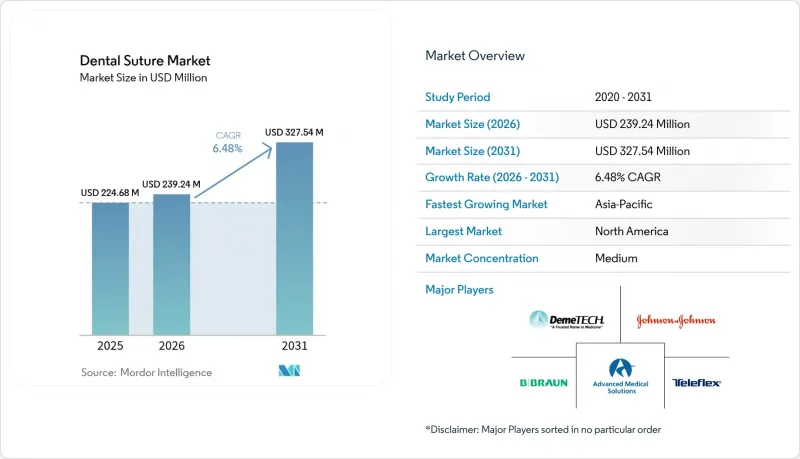
According to Mordor Intelligence, the global dental suture market size in 2026 is estimated at USD 239.24 million, growing from 2025 value of USD 224.68 million with 2031 projections showing USD 327.54 million, growing at 6.48% CAGR over 2026-2031.
This report is Segmented by Suture Type (Absorbable, Non-Absorbable), Material (Synthetic Material, Natural Material), Patient Age Group (Up To 17 and More), Application (Tooth Extraction, Periodontal Procedure, and More), End-Use (Dental Clinics, Hospitals, Ambulatory Surgical Centers), and Geography (North America, Europe, Asia-Pacific, and More). The Market Forecasts are Provided in Terms of Value (USD).
Global Dental Suture Market Trends and Insights
Rising Prevalence of Periodontal Disease and Tooth-Loss Procedures
More than 1 billion people were affected by periodontal disease in 2024, and epidemiological modeling anticipates 1.56 billion cases by 2050. Disease incidence rises sharply with age and displays pronounced socioeconomic variation, which leads to a diverse set of clinical protocols that rely on precise tissue approximation to curb bacterial infiltration. Surgical guidelines emphasize premium suture selection as a non-negotiable tool for flap stability, especially in patients with comorbid diabetes or cardiovascular conditions that complicate healing.
Growth in Dental-Implant Surgeries Worldwide
U.S. implant prevalence was 5.7% in 2016 and is anticipated to reach as high as 23% by 2026 if accessibility trends continue. Implants usually mandate several suturing episodes-including initial fixture placement, membrane fixation, and soft-tissue reshaping-which multiply suture use per patient. Positioning errors persist in 56.6% of implant cases, leading to revision surgeries that further augment suture demand.
Availability of Tissue Adhesives and Sealants as Substitutes
Clinical trials show intraoral cyanoacrylate can secure 71.97% root coverage in periodontal surgery compared with 61.36% for sutures, while reducing closure time from 7.31 minutes to 2.16 minutes. Adhesives also eliminate removal appointments, a cost advantage in high-volume practices. Their growing acceptance threatens routine suture volumes, particularly for small incisions.
Other drivers and restraints analyzed in the detailed report include:
- Increasing Adoption of Resorbable Sutures in Dentistry
- Expansion of Outpatient Dental Microsurgery Enabled by Chairside Microscopes
- High Cost of Advanced Synthetic Absorbable Sutures
For complete list of drivers and restraints, kindly check the Table Of Contents.
Segment Analysis
Non-absorbable filaments held 54.10% of the dental suture market in 2025, yet absorbable variants are forecast to deliver the leading 6.78% CAGR to 2031. The absorbable category benefits from synthetic polymers that offer controlled degradation and tensile retention matching tissue-healing kinetics. Dental suture market size for absorbable lines is projected to expand as regulatory frameworks validate their biodegradation profiles. Because removal appointments disappear, clinics gain scheduling flexibility and lower chair-time per patient, reinforcing uptake.
Polyglactin and polyglycolic-acid braids now achieve tensile strengths comparable to silk and nylon while provoking lower tissue reactivity, a critical feature in the oral cavity's microbe-rich milieu. As product portfolios widen to include monofilament designs for esthetic zones, the adoption curve steepens. Over the forecast horizon, non-absorbable will continue to dominate specific indications that demand permanent tensile support, yet their share is expected to erode gradually in favor of absorbables.
Synthetic fibers accounted for 59.62% of 2025 revenue and are projected to compound at 7.02% annually through 2031, maintaining clear leadership in the dental suture market. Their low bacterial retention and consistent absorption rates outperform natural alternatives, especially important in procedures where infection control is paramount. Conversely, natural offerings such as silk or cellulose retain niche relevance for patients sensitive to chemical additives.
The regulatory push for eco-friendly materials is catalyzing hybrid R&D that bonds synthetic strength with plant-derived substrates. Early prototypes of cellulose-reinforced polylactide braids suggest a credible bridge between performance and sustainability demands. While not yet commercialized, such products could shift buyer criteria toward environmental credentials.
Complete Report Scope:
- By Suture Type
- Absorbable
- Non-Absorbable
- By Material
- Synthetic Material
- Natural Material
- By Patient Age Group
- Up to 17
- Above 17 - Up to 65
- Above 65
- By Application
- Tooth Extraction
- Periodontal Procedure
- Orthodontic Procedure
- Cosmetic Dentistry
- Other Applications
- By End-Use
- Dental Clinics
- Hospitals
- Ambulatory Surgical Centers
- By Geography
- North America
- United States
- Canada
- Mexico
- Europe
- Germany
- United Kingdom
- France
- Italy
- Spain
- Rest of Europe
- Asia-Pacific
- China
- Japan
- India
- Australia
- South Korea
- Rest of Asia-Pacific
- Middle East and Africa
- GCC
- South Africa
- Rest of Middle East and Africa
- South America
- Brazil
- Argentina
- Rest of South America
- North America
Geography Analysis
North America generated 36.90% of global revenue in 2025, anchored by high procedural volumes, robust insurance coverage, and practitioner familiarity with premium materials. United States-specific initiatives on opioid-sparing analgesia, such as the 2025 approval of suzetrigine, help safeguard patient comfort and promote elective procedures. Recent 10% tariffs on imported dental consumables may shift sourcing toward local suture manufacturers, but the market remains attractive given a 7.05% regional CAGR through 2031. Asia-Pacific represents the fastest 7.25% CAGR trajectory thanks to rising disposable income, urbanization, and large-scale public health investments. While per-capita procedure rates are lower than in North America, the vast population base translates to unparalleled volume potential. Domestic firms in India, China, and South Korea are scaling capacity to meet demand while offering cost-competitive alternatives. Europe recorded a steady 6.80% annual growth, buoyed by single-payer insurance schemes that cover a baseline of restorative care. Strict environmental policy accelerates the shift to biodegradable filaments. Local content regulations in France and Germany stimulate intra-regional production, offering European brands a competitive edge over imports. Latin America and the Middle East & Africa display 6.33% and 5.95% growth rates, respectively. Economic volatility is a recurring challenge, yet targeted government programs-such as Brazil's Expanded National Oral Health Policy-create pockets of accelerated uptake. GCC countries leverage medical tourism to attract affluent patients seeking advanced aesthetic restoration, supporting premium suture consumption.
- Advanced Medical Solutions Group PLC
- Assut Medical Sarl
- B. Braun
- Coltene Holding
- DemeTECH
- DSI Dental Solutions
- Envista
- Henry Schein
- HuFriedyGroup
- Johnson & Johnson
- Katsan Medical Devices
- LUX-SUTURES S.A.
- MANI
- SERAG-WIESSNER GmbH & Co. KG
- Shandong Weigao Group Medical Polymer Co., Ltd.
- SMI AG
- Sutumed Corp.
- Teleflex
- Theragenics
- TI Medical Private Limited
Additional Benefits:
- The market estimate (ME) sheet in Excel format
- 3 months of analyst support
TABLE OF CONTENTS
1 Introduction
- 1.1 Study Assumptions & Market Definition
- 1.2 Scope of the Study
2 Research Methodology
3 Executive Summary
4 Market Landscape
- 4.1 Market Overview
- 4.2 Market Drivers
- 4.2.1 Rising Prevalence of Periodontal Disease & Tooth-Loss Procedures
- 4.2.2 Growth in Dental Implant Surgeries Worldwide
- 4.2.3 Increasing Adoption of Resorbable Sutures in Dentistry
- 4.2.4 Growth of Outpatient Dental Microsurgery Enabled by Chairside Microscopes
- 4.2.5 Regulatory Push for Biodegradable Dental Materials
- 4.2.6 Adoption of 3-D Printed Patient-Specific Graft Membranes Needing Finer Closure
- 4.3 Market Restraints
- 4.3.1 Availability of Tissue Adhesives & Sealants as Substitutes
- 4.3.2 High Cost of Advanced Synthetic Absorbable Sutures
- 4.3.3 Skill Gap in Advanced Suturing Techniques among General Dentists
- 4.3.4 Stringent Waste-Disposal Rules for Single-Use Dental Devices
- 4.4 Supply Chain Analysis
- 4.5 Regulatory Landscape
- 4.6 Porter's Five Forces Analysis
- 4.6.1 Threat of New Entrants
- 4.6.2 Bargaining Power of Suppliers
- 4.6.3 Bargaining Power of Buyers
- 4.6.4 Threat of Substitutes
- 4.6.5 Competitive Rivalry
5 Market Size & Growth Forecasts (Value)
- 5.1 By Suture Type
- 5.1.1 Absorbable
- 5.1.2 Non-Absorbable
- 5.2 By Material
- 5.2.1 Synthetic Material
- 5.2.2 Natural Material
- 5.3 By Patient Age Group
- 5.3.1 Up to 17
- 5.3.2 Above 17 - Up to 65
- 5.3.3 Above 65
- 5.4 By Application
- 5.4.1 Tooth Extraction
- 5.4.2 Periodontal Procedure
- 5.4.3 Orthodontic Procedure
- 5.4.4 Cosmetic Dentistry
- 5.4.5 Other Applications
- 5.5 By End-Use
- 5.5.1 Dental Clinics
- 5.5.2 Hospitals
- 5.5.3 Ambulatory Surgical Centers
- 5.6 By Geography
- 5.6.1 North America
- 5.6.1.1 United States
- 5.6.1.2 Canada
- 5.6.1.3 Mexico
- 5.6.2 Europe
- 5.6.2.1 Germany
- 5.6.2.2 United Kingdom
- 5.6.2.3 France
- 5.6.2.4 Italy
- 5.6.2.5 Spain
- 5.6.2.6 Rest of Europe
- 5.6.3 Asia-Pacific
- 5.6.3.1 China
- 5.6.3.2 Japan
- 5.6.3.3 India
- 5.6.3.4 Australia
- 5.6.3.5 South Korea
- 5.6.3.6 Rest of Asia-Pacific
- 5.6.4 Middle East and Africa
- 5.6.4.1 GCC
- 5.6.4.2 South Africa
- 5.6.4.3 Rest of Middle East and Africa
- 5.6.5 South America
- 5.6.5.1 Brazil
- 5.6.5.2 Argentina
- 5.6.5.3 Rest of South America
- 5.6.1 North America
6 Competitive Landscape
- 6.1 Market Concentration
- 6.2 Competitive Benchmarking
- 6.3 Market Share Analysis
- 6.4 Company Profiles (includes Global level Overview, Market level overview, Core Segments, Financials as available, Strategic Information, Market Rank/Share for key companies, Products & Services, and Recent Developments)
- 6.4.1 Advanced Medical Solutions Group PLC
- 6.4.2 Assut Medical Sarl
- 6.4.3 B. Braun Melsungen AG
- 6.4.4 COLTENE Holding AG
- 6.4.5 DemeTECH Corporation
- 6.4.6 DSI Dental Solutions
- 6.4.7 Envista Holdings Corporation
- 6.4.8 Henry Schein, Inc.
- 6.4.9 HuFriedyGroup
- 6.4.10 Johnson & Johnson Services, Inc.
- 6.4.11 Katsan Medical Devices
- 6.4.12 LUX-SUTURES S.A.
- 6.4.13 Mani, Inc.
- 6.4.14 SERAG-WIESSNER GmbH & Co. KG
- 6.4.15 Shandong Weigao Group Medical Polymer Co., Ltd.
- 6.4.16 SMI AG
- 6.4.17 Sutumed Corp.
- 6.4.18 Teleflex Incorporated
- 6.4.19 Theragenics Corporation
- 6.4.20 TI Medical Private Limited
7 Market Opportunities & Future Outlook
- 7.1 White-space & Unmet-Need Assessment

