PUBLISHER: Mordor Intelligence | PRODUCT CODE: 2116496

PUBLISHER: Mordor Intelligence | PRODUCT CODE: 2116496
Intravenous Therapy And Vein Access - Market Share Analysis, Industry Trends & Statistics, Growth Forecasts (2026 - 2031)
According to Mordor Intelligence, the intravenous therapy and vein access market size is expected to grow from USD 27.10 billion in 2025 to USD 28.37 billion in 2026 and is forecast to reach USD 35.66 billion by 2031 at 4.69% CAGR over 2026-2031.
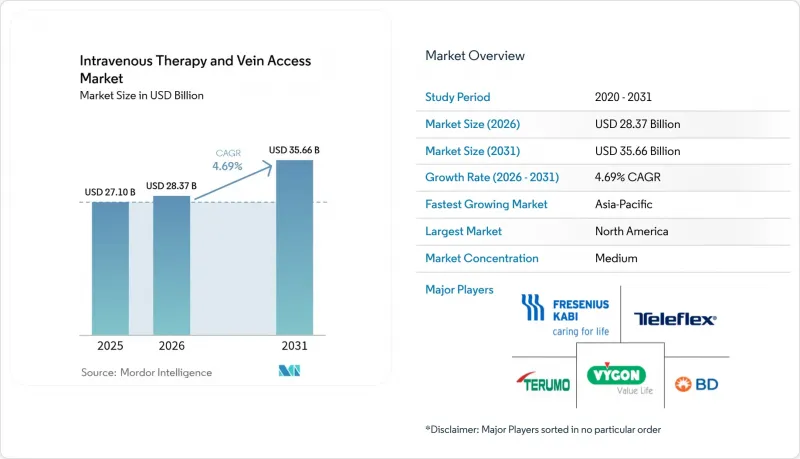
This report is Segmented by Product Type (Intravenous Catheters, Administration Sets & Connectors, IV Fluids & Solutions and More), Application (Oncology, Infectious Diseases, Gastroenterology & Parenteral Nutrition and More), End-User (Hospitals & Clinics, Homecare Settings and More), and Geography (North America, and More). The Market Forecasts are Provided in Terms of Value (USD).
Global Intravenous Therapy And Vein Access Market Trends and Insights
Aging population increasing chronic-disease burden
Nearly 90% of hospitalized patients require intravenous access, and the proportion rises in geriatric wards where multi-drug regimens dominate care plans. Growing use of peptide and monoclonal-antibody therapies, many of which require controlled infusion rates, has spurred investment in smart pumps that can maintain flow within +-5 mL/hour across long sessions. Hospitals are expanding vascular-access teams to handle higher procedure volumes, and outpatient centers are adopting semi-autonomous placement tools to mitigate staffing shortages. As chronic care shifts outside acute facilities, manufacturers that pair devices with remote analytics and drug-library updates are gaining traction. Payers view continuous home infusion as a cost-saving alternative to repeat admissions, reinforcing long-term demand for networked pumps and secure cloud interfaces
Home-infusion adoption
The home-infusion segment is expanding at 7.5% annually, propelled by Medicare G-code reimbursements covering clinical services such as remote dosing oversight. Oncology and infectious-disease patients report improved quality of life and up to 30% lower total care costs when treatments move from the ward to the living room. Device design has followed suit; compact pumps with two-way EMR connectivity allow clinicians to adjust parameters without on-site visits, cutting nurse travel hours by 22% in large pilots. Pharmacy chains are developing integrated drug-dispensing and logistics services that synchronize deliveries with pump-usage data, further embedding the model
Antimicrobial-resistant infections at access sites
Biofilm-forming organisms such as methicillin-resistant Staphylococcus aureus now colonize 18% of central lines beyond 10 days of dwell time despite line-change protocols. Resistant outbreaks can double antimicrobial costs per episode, prompting some facilities to delay elective infusions, which suppresses near-term device volumes. Researchers are experimenting with photodynamic coatings and lock solutions containing ethanol and minocycline, but regulatory pathways remain protracted, slowing widespread adoption. Hospitals under budget strain may prioritize essential disposables over premium antimicrobial lines, constraining revenue for advanced products until stewardship programs mature.
Other drivers and restraints analyzed in the detailed report include:
- Infection-control mandates for closed IV systems
- AI-guided catheter placement
- Supply-chain constraints for medical-grade plastics & resins
For complete list of drivers and restraints, kindly check the Table Of Contents.
Segment Analysis
The catheter segment retained a 36.78% revenue lead in 2025, reflecting high replacement cadence across inpatient and outpatient settings. Infusion pumps, though smaller in volume, are projected to post a 5.19% CAGR, the fastest within the intravenous therapy and vein access market, as hospitals deploy connected platforms to mitigate medication errors and integrate dosage analytics.
Consumables such as administration sets and connectors retain steady demand because closed-loop designs align with infection-control targets, while IV fluids navigate periodic price spikes tied to resin shortages. Needles, syringes, and accessories continue to grow in line with procedure volumes; however, margins compress as group-purchasing organizations bundle them with pump contracts, forcing suppliers to differentiate through safety-engineered designs.
Complete Report Scope:
- By Product Type
- Intravenous Catheters
- Infusion Pumps
- Administration Sets & Connectors
- IV Fluids & Solutions
- Needles & Syringes
- Accessories (Caps, Dressings, Securement)
- By Application
- Oncology
- Infectious Diseases
- Gastroenterology & Parenteral Nutrition
- Neurology
- Other Applications
- By End-User
- Hospitals & Clinics
- Homecare Settings
- Ambulatory Surgical Centers
- Long-term Care Facilities
- By Geography
- North America
- United States
- Canada
- Mexico
- Europe
- Germany
- United Kingdom
- France
- Italy
- Spain
- Rest of Europe
- Asia-Pacific
- China
- India
- Japan
- South Korea
- Australia
- Rest of Asia-Pacific
- South America
- Brazil
- Argentina
- Rest of South America
- Middle East and Africa
- GCC
- South Africa
- Rest of Middle East and Africa
- North America
Geography Analysis
North America retained a 40.66% share of the intravenous therapy and vein access market in 2025, underpinned by mature reimbursement channels, high device ASPs, and early uptake of smart pump interoperability standards. The FDA's expedited pathways for infusion-pump software updates shorten product cycles and incentivize continuous innovation; however, natural-disaster-driven plant outages underscored critical supply-chain fragility, leading to strategic multi-sourcing among group-purchasing organizations. Cross-border trade with Canada and Mexico supplies tubing sets and fluids, providing some buffer against localized disruptions.
Asia-Pacific recorded the fastest 6.12% CAGR and is forecast to expand its revenue share by 315 basis points by 2031 on the back of hospital-capacity builds in China and India and accelerated device approvals in Japan and South Korea. Domestic pump manufacturers in China are entering price-sensitive tiers, but premium US and European brands retain leadership in oncology centers where EMR integration is mandatory. Australia's nationwide electronic medication management initiative is drawing vendors that can provide HL7-compliant transmission modules, foreshadowing connectivity requirements across the region.
Europe shows balanced growth as aging populations push chronic-care volumes higher and the EU Medical Device Regulation (MDR) creates a uniform compliance framework that rewards quality systems. Germany and France continue to dominate spending, but Eastern European countries are modernizing oncology infusion suites through cohesion-fund financing. In Western Europe, the intravenous therapy and vein access market size is driven by biosimilar uptake and national cancer plan outlays.
- Beckton Dickinson
- B. Braun
- Baxter
- Fresenius
- ICU Medical
- Terumo
- Smiths Group
- Teleflex
- AngioDynamics
- Vygon
- Nipro
- Poly Medicure Ltd.
- Cook Group
- Cardinal Health
- CODAN Medizinische Gerate GmbH
- Grifols
- Mindray
- Q-Core Medical
- Becton Dickinson - C.R. Bard Access Systems
- Vascular Solutions LLC
- Hamilton Medical
Additional Benefits:
- The market estimate (ME) sheet in Excel format
- 3 months of analyst support
TABLE OF CONTENTS
1 Introduction
- 1.1 Study Assumptions & Market Definition
- 1.2 Scope of the Study
2 Research Methodology
3 Executive Summary
4 Market Landscape
- 4.1 Market Overview
- 4.2 Market Drivers
- 4.2.1 Aging-population driven chronic disease burden
- 4.2.2 Shift toward home-infusion therapies
- 4.2.3 Hospital infection-control mandates boosting closed IV systems
- 4.2.4 AI-guided catheter placement systems reduce failure rates (under-reported)
- 4.2.5 Rapid biosimilar & biologics pipeline requiring specialty infusion (under-reported)
- 4.3 Market Restraints
- 4.3.1 Rising antimicrobial-resistant infections at access sites
- 4.3.2 Supply-chain constraints for medical-grade plastics & resins
- 4.3.3 Increasing payor scrutiny on inpatient infusion reimbursement (under-reported)
- 4.4 Value / Supply-Chain Analysis
- 4.5 Regulatory Landscape
- 4.6 Technological Outlook
- 4.7 Porter's Five Forces
- 4.7.1 Threat of New Entrants
- 4.7.2 Bargaining Power of Buyers
- 4.7.3 Bargaining Power of Suppliers
- 4.7.4 Threat of Substitutes
- 4.7.5 Competitive Rivalry
5 Market Size & Growth Forecasts (Value, USD)
- 5.1 By Product Type
- 5.1.1 Intravenous Catheters
- 5.1.2 Infusion Pumps
- 5.1.3 Administration Sets & Connectors
- 5.1.4 IV Fluids & Solutions
- 5.1.5 Needles & Syringes
- 5.1.6 Accessories (Caps, Dressings, Securement)
- 5.2 By Application
- 5.2.1 Oncology
- 5.2.2 Infectious Diseases
- 5.2.3 Gastroenterology & Parenteral Nutrition
- 5.2.4 Neurology
- 5.2.5 Other Applications
- 5.3 By End-User
- 5.3.1 Hospitals & Clinics
- 5.3.2 Homecare Settings
- 5.3.3 Ambulatory Surgical Centers
- 5.3.4 Long-term Care Facilities
- 5.4 By Geography
- 5.4.1 North America
- 5.4.1.1 United States
- 5.4.1.2 Canada
- 5.4.1.3 Mexico
- 5.4.2 Europe
- 5.4.2.1 Germany
- 5.4.2.2 United Kingdom
- 5.4.2.3 France
- 5.4.2.4 Italy
- 5.4.2.5 Spain
- 5.4.2.6 Rest of Europe
- 5.4.3 Asia-Pacific
- 5.4.3.1 China
- 5.4.3.2 India
- 5.4.3.3 Japan
- 5.4.3.4 South Korea
- 5.4.3.5 Australia
- 5.4.3.6 Rest of Asia-Pacific
- 5.4.4 South America
- 5.4.4.1 Brazil
- 5.4.4.2 Argentina
- 5.4.4.3 Rest of South America
- 5.4.5 Middle East and Africa
- 5.4.5.1 GCC
- 5.4.5.2 South Africa
- 5.4.5.3 Rest of Middle East and Africa
- 5.4.1 North America
6 Competitive Landscape
- 6.1 Market Concentration
- 6.2 Market Share Analysis
- 6.3 Company Profiles (includes Global level Overview, Market level overview, Core Segments, Financials as available, Strategic Information, Market Rank/Share for key companies, Products & Services, and Recent Developments)
- 6.3.1 Becton, Dickinson and Company (BD)
- 6.3.2 B. Braun Melsungen AG
- 6.3.3 Baxter International Inc.
- 6.3.4 Fresenius Kabi AG
- 6.3.5 ICU Medical Inc.
- 6.3.6 Terumo Corporation
- 6.3.7 Smiths Medical (ICU Medical)
- 6.3.8 Teleflex Incorporated
- 6.3.9 AngioDynamics Inc.
- 6.3.10 Vygon SA
- 6.3.11 Nipro Corporation
- 6.3.12 Poly Medicure Ltd.
- 6.3.13 Cook Medical
- 6.3.14 Cardinal Health
- 6.3.15 CODAN Medizinische Gerate GmbH
- 6.3.16 Grifols S.A.
- 6.3.17 Shenzhen Mindray Bio-Medical Electronics
- 6.3.18 Q-Core Medical
- 6.3.19 Becton Dickinson - C.R. Bard Access Systems
- 6.3.20 Vascular Solutions LLC
- 6.3.21 Hamilton Medical
7 Market Opportunities & Future Outlook
- 7.1 White-space & Unmet-Need Assessment

