PUBLISHER: Mordor Intelligence | PRODUCT CODE: 2116504

PUBLISHER: Mordor Intelligence | PRODUCT CODE: 2116504
Graves Disease - Market Share Analysis, Industry Trends & Statistics, Growth Forecasts (2026 - 2031)
According to Mordor Intelligence, the graves' disease market size was valued at USD 2.15 billion in 2025 and estimated to grow from USD 2.26 billion in 2026 to reach USD 2.87 billion by 2031, at a CAGR of 4.92% during the forecast period (2026-2031).
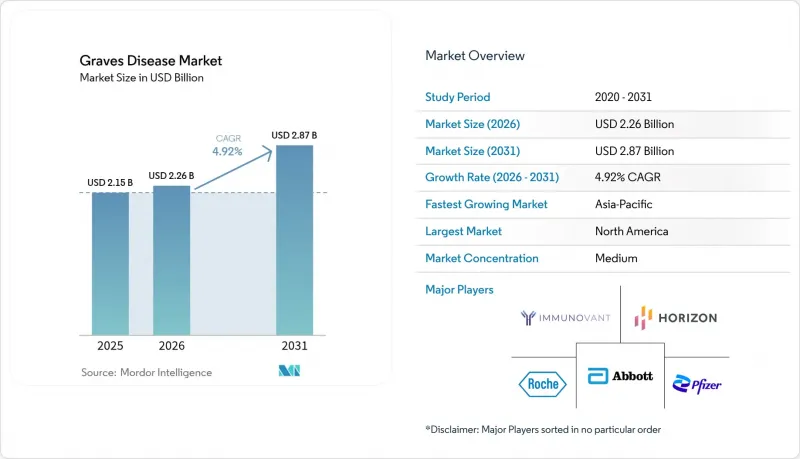
Global Graves Disease Market Trends and Insights
Rising Prevalence of Hyperthyroidism & Graves' Disease
The Graves' disease market continues to expand as incidence climbs in both developed and emerging economies. During the pandemic period, pediatric cases rose 60%, underscoring the role of viral triggers in autoimmune thyroid dysfunction. Higher diagnostic penetration in iodine-replete regions uncovers previously missed subclinical disease, particularly among Asian and White populations with strong genetic predisposition. Pharmaceutical developers leverage these epidemiological insights to refine inclusion criteria, improve trial enrollment, and boost the likelihood of regulatory success. Health systems respond by scaling endocrinology tele-consultation services that lower specialist bottlenecks and enhance early intervention rates. As lifestyle and nutritional transitions continue, incidence growth remains a key demand driver across every tier of care delivery.
Pipeline of Targeted Immunotherapies
Novel FcRn inhibitors and CD40 antagonists reinforce the innovation narrative that positions the Graves' disease market for sustained premium pricing. Batoclimab posted a 76% response rate in patients uncontrolled on antithyroid drugs, with more than half discontinuing conventional therapy entirely. Clinical differentiation reduces the need for lifelong thyroid replacement and mitigates relapse risk, shifting payer calculus toward disease-modifying solutions. Breakthrough Therapy and orphan drug designations shorten development timelines, encouraging venture investment and licensing deals. As multi-indication platforms emerge, developers exploit scale economies in manufacturing and distribution that further strengthen long-run margins.
High Total Cost of Lifelong Disease Management
The Graves' disease market absorbs significant cost pressure when biologic courses exceed USD 380,000, and annual levothyroxine prescriptions top 82 million in the United States. Indirect expenses from monitoring, lost productivity, and comorbidity management add to the burden, especially in low-resource settings where insurance penetration is limited. Currency volatility inflates import costs for active pharmaceutical ingredients, threatening generic supply security. These economic frictions drive value-based-care pilots that link payment to long-term outcomes and stimulate demand for solutions that shorten or eliminate chronic medication use.
Other drivers and restraints analyzed in the detailed report include:
- Growing Adoption of Radio-Iodine Therapy in High-CV-Risk Patients
- Expanding Reimbursement & Funding for Rare Autoimmune Disorders
- I-131 Isotope Supply Chain and Disposal Constraints
For complete list of drivers and restraints, kindly check the Table Of Contents.
Segment Analysis
TSH testing retained 45.92% revenue share in 2025, underscoring its status as the primary screening and monitoring tool. Nevertheless, antibody assays are expanding at a 6.15% CAGR as clinicians correlate thyroid-stimulating immunoglobulin (TSI) titers with disease activity and treatment response. The Graves' disease market accommodates both modalities, yet rapid-turnaround antibody panels increasingly guide personalized treatment strategies. Free T4 and T3 measurements remain indispensable for dose titration, while thyroglobulin tests monitor post-surgical recurrence. Vitamin D status testing is gaining ground after studies linked serum levels of 20-29 ng/mL to better TRAb remission rates.
A growing installed base of point-of-care platforms moves initial diagnostics closer to primary care, accelerating specialist referrals and expanding the overall Graves' Disease market. High-resolution ultrasound and fusion imaging add structural insights that drive selection between radioiodine, surgery, or emerging ablation techniques. The Graves' disease industry benefits from bundled diagnostic-and-therapy offerings that streamline patient journeys and raise provider margins. As reimbursement policies catch up with the clinical value of antibody profiling, labs capable of multiplex testing are poised to capture additional share.
Anti-thyroid drugs still control 40.78% revenue in 2025, reflecting easy oral dosing and low acquisition cost. Yet FcRn inhibitors and IGF-1R antagonists are set to generate the fastest 6.02% CAGR through 2031, rewriting the value hierarchy of the Graves' disease market. Batoclimab's 76% response rate in refractory patients illustrates the step-change in efficacy. Radioactive iodine therapy persists, favored for elderly cardiovascular-risk cohorts, while supply uncertainty limits aggressive expansion plans.
Thermal ablation offers a minimally invasive bridge option, achieving 96% one-year euthyroid status with minimal complications. Surgical thyroidectomy remains the definitive approach for large goiters, malignancy suspicion, or treatment failure, with updated nerve-monitoring protocols reducing complication rates. Overall, diversified modality availability protects patient choice, though the revenue mix skews increasingly toward biologics as payers embrace long-term cost avoidance.
Complete Report Scope:
- By Treatment
- Anti-Thyroid Medication
- Radioactive Iodine Therapy
- Surgery (Thyroidectomy)
- Targeted Immunotherapies & Biologics
- Ultrasound-Guided Thermal Ablation
- By Patient Age Group
- Pediatrics
- Adults
- Geriatrics
- By End-User
- Hospitals
- Specialty Clinics & Endocrinology Centers
- Ambulatory Surgical Centers
- Retail & Online Pharmacies
- By Geography
- North America
- United States
- Canada
- Mexico
- Europe
- Germany
- United Kingdom
- France
- Italy
- Spain
- Rest of Europe
- Asia-Pacific
- China
- India
- Japan
- Australia
- South Korea
- Rest of Asia-Pacific
- Middle East and Africa
- GCC
- South Africa
- Rest of Middle East and Africa
- South America
- Brazil
- Argentina
- Rest of South America
- North America
Geography Analysis
North America maintains leadership with 39.42% revenue share in 2025, supported by advanced infrastructure, deep clinical-trial networks, and payer readiness to cover first-in-class biologics. The region's 4.38% CAGR through 2031 stems from steady transition to value-based care and widening access to precision diagnostics. United States providers increasingly bundle imaging, antibody panels, and endocrine consultations into integrated care pathways, reducing time to treatment initiation. High private-equity investment in specialty clinics further accelerates patient throughput and data generation for real-world evidence studies.
Asia Pacific is the fastest-growing arena for the Graves' disease market, rising at 5.98% CAGR. Government health-insurance expansions in China and India drive higher diagnostic uptake, while Japan pioneers outpatient ablation protocols that shorten wait times and lower total cost of care. Domestic biotech investment unlocks localized manufacturing for biosimilar antibodies, boosting affordability. Telemedicine adoption soars in rural provinces, enabling specialists to manage complex cases remotely. Overall, demographic scale, economic growth, and policy reform combine to make Asia Pacific the primary engine of incremental revenue. Europe contributes a balanced 4.59% CAGR, anchored by public healthcare systems that emphasize cost-effectiveness and early technology assessment. Harmonized regulatory frameworks streamline biologic approvals, while well-established thyroid research consortia facilitate multicenter trials. Middle East & Africa achieves a 5.61% CAGR as infrastructure upgrades and rising chronic-disease awareness improve specialist access. Regional centers of excellence in the Gulf export know-how across North Africa, while pharmaceutical manufacturers target tender contracts to secure formulary placements. South America advances at 5.05% CAGR, with Brazil's universal health system adding antibody testing reimbursement and Argentina incentivizing domestic levothyroxine production to cut import dependence. Collectively, these developments widen the global footprint of the Graves' disease market and encourage multinational players to localize both manufacturing and medical education programs.
- Abbott Laboratories
- Argenx SE
- bioMerieux
- Cardinal Health
- Eisai
- Roche
- GE HealthCare Technologies Inc.
- Horizon Therapeutics
- Immunovant Inc.
- Institute of Isotopes
- Jubilant Group
- Medtronic
- Merck
- Nanjing Nuoyuan Medical Devices Co.
- Novartis
- Pfizer
- Sun Pharmaceuticals Industries
- Teijin Pharma Ltd.
- Thermo Fisher Scientific
- Viridian Therapeutics Inc.
Additional Benefits:
- The market estimate (ME) sheet in Excel format
- 3 months of analyst support
TABLE OF CONTENTS
1 Introduction
- 1.1 Study Assumptions & Market Definition
- 1.2 Scope of the Study
2 Research Methodology
3 Executive Summary
4 Market Landscape
- 4.1 Market Overview
- 4.2 Market Drivers
- 4.2.1 Rising prevalence of hyperthyroidism & Graves' disease
- 4.2.2 Growing adoption of radio-iodine therapy in high-CV-risk patients
- 4.2.3 Expanding reimbursement & funding for rare autoimmune disorders
- 4.2.4 Advances in high-resolution, fusion-guided thyroid imaging
- 4.2.5 Pipeline of targeted immunotherapies (FcRn & CD40 antagonists)
- 4.2.6 Rapid uptake of ultrasound-guided thermal ablation techniques
- 4.3 Market Restraints
- 4.3.1 High total cost of lifelong disease management
- 4.3.2 Relapse & adverse-event profile of anti-thyroid drugs
- 4.3.3 I-131 isotope supply chain and disposal constraints
- 4.3.4 Regulatory uncertainty around first-in-class biologics
- 4.4 Epidemiology & Disease-Burden Analysis
- 4.5 Regulatory Landscape
- 4.6 Technological Outlook
- 4.7 Porter's Five Forces Analysis
- 4.7.1 Threat of New Entrants
- 4.7.2 Bargaining Power of Buyers
- 4.7.3 Bargaining Power of Suppliers
- 4.7.4 Threat of Substitutes
- 4.7.5 Intensity of Competitive Rivalry
5 Market Size & Growth Forecasts (Value)
- 5.1 By Treatment
- 5.1.1 Anti-Thyroid Medication
- 5.1.2 Radioactive Iodine Therapy
- 5.1.3 Surgery (Thyroidectomy)
- 5.1.4 Targeted Immunotherapies & Biologics
- 5.1.5 Ultrasound-Guided Thermal Ablation
- 5.2 By Patient Age Group
- 5.2.1 Pediatrics
- 5.2.2 Adults
- 5.2.3 Geriatrics
- 5.3 By End-User
- 5.3.1 Hospitals
- 5.3.2 Specialty Clinics & Endocrinology Centers
- 5.3.3 Ambulatory Surgical Centers
- 5.3.4 Retail & Online Pharmacies
- 5.4 By Geography
- 5.4.1 North America
- 5.4.1.1 United States
- 5.4.1.2 Canada
- 5.4.1.3 Mexico
- 5.4.2 Europe
- 5.4.2.1 Germany
- 5.4.2.2 United Kingdom
- 5.4.2.3 France
- 5.4.2.4 Italy
- 5.4.2.5 Spain
- 5.4.2.6 Rest of Europe
- 5.4.3 Asia-Pacific
- 5.4.3.1 China
- 5.4.3.2 India
- 5.4.3.3 Japan
- 5.4.3.4 Australia
- 5.4.3.5 South Korea
- 5.4.3.6 Rest of Asia-Pacific
- 5.4.4 Middle East and Africa
- 5.4.4.1 GCC
- 5.4.4.2 South Africa
- 5.4.4.3 Rest of Middle East and Africa
- 5.4.5 South America
- 5.4.5.1 Brazil
- 5.4.5.2 Argentina
- 5.4.5.3 Rest of South America
- 5.4.1 North America
6 Competitive Landscape
- 6.1 Market Concentration
- 6.2 Competitive Benchmarking
- 6.3 Market Share Analysis
- 6.4 Company Profiles (includes Global level Overview, Market level overview, Core Segments, Financials as available, Strategic Information, Market Rank/Share for key companies, Products & Services, and Recent Developments)
- 6.4.1 Abbott Laboratories
- 6.4.2 Argenx SE
- 6.4.3 bioMerieux SA
- 6.4.4 Cardinal Health
- 6.4.5 Eisai Co. Ltd.
- 6.4.6 F. Hoffmann-La Roche AG
- 6.4.7 GE HealthCare Technologies Inc.
- 6.4.8 Horizon Therapeutics plc
- 6.4.9 Immunovant Inc.
- 6.4.10 Institute of Isotopes Co. Ltd.
- 6.4.11 Jubilant Pharma Holdings Inc.
- 6.4.12 Medtronic plc
- 6.4.13 Merck KGaA
- 6.4.14 Nanjing Nuoyuan Medical Devices Co.
- 6.4.15 Novartis AG
- 6.4.16 Pfizer Inc.
- 6.4.17 Sun Pharmaceutical Industries Ltd.
- 6.4.18 Teijin Pharma Ltd.
- 6.4.19 Thermo Fisher Scientific Inc.
- 6.4.20 Viridian Therapeutics Inc.
7 Market Opportunities & Future Outlook
- 7.1 White-space & Unmet-Need Assessment

