PUBLISHER: Mordor Intelligence | PRODUCT CODE: 2116506

PUBLISHER: Mordor Intelligence | PRODUCT CODE: 2116506
Pharmacy Benefit Management - Market Share Analysis, Industry Trends & Statistics, Growth Forecasts (2026 - 2031)
According to Mordor Intelligence, the pharmacy benefit management market size is expected to grow from USD 657.51 billion in 2025 to USD 692.47 billion in 2026 and is forecast to reach USD 897.16 billion by 2031 at 5.32% CAGR over 2026-2031.
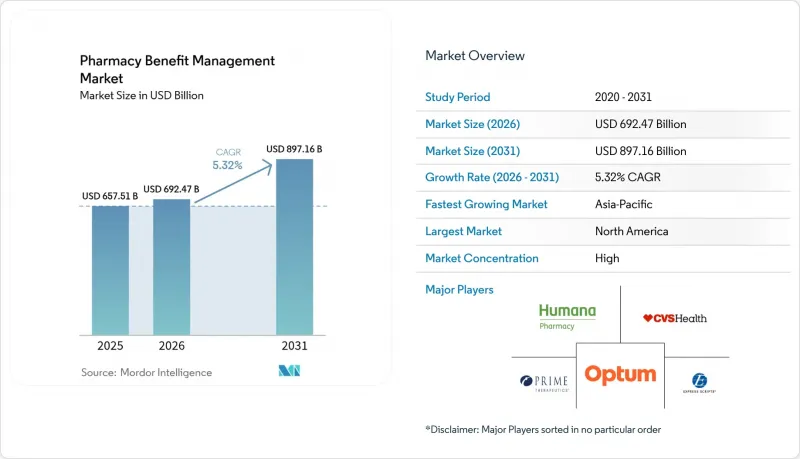
This report is Segmented by Service (Specialty Pharmacy Services, Drug Formulary Management, and More), Business Model (Government Health Programs, Employer-Sponsored Programs, and More), End User (PBM Organizations (In-House & External), Mail-Order Pharmacies, and More), and Geography (North America, Europe, Asia-Pacific, and More). The Market Forecasts are Provided in Terms of Value (USD).
Global Pharmacy Benefit Management Market Trends and Insights
Escalating Prescription-Drug Expenditure & Therapeutic Complexity
Specialty medicines accounted for 54% of hospital drug spend in 2025, pressuring payers to adopt PBM models that integrate clinical expertise with utilization controls. The popularity of GLP-1 agonists for diabetes and obesity may lift that therapeutic class toward USD 100 billion within five years, requiring tighter formulary rules and step-therapy edits. Oncology pipelines and orphan drugs compound complexity, while multimorbidity drives polypharmacy across age cohorts. PBMs deploying advanced analytics can coordinate regimens, flag duplication, and negotiate indication-based contracting that balances outcomes with affordability. These pressures support sustained demand for Pharmacy Benefit Management market solutions through 2030.
Expansion of Public & Private Health-Coverage Pools
Medicare Part D is forecast to reach 36% of U.S. drug spending by 2032, up from 2024 levels. The Inflation Reduction Act caps out-of-pocket Part D costs at USD 2,000 for 18.7 million members beginning in 2025. Commercial employers are simultaneously re-bidding contracts, with 52% exploring new PBM partners within three years. As coverage pools widen, PBMs that master disparate formulary rules, vaccine mandates, and reporting obligations gain scale advantages. Ongoing enrollment growth in India's Ayushman Bharat and China's urban employee insurance adds regional tailwinds, enhancing the Pharmacy Benefit Management market outlook.
Intensifying Legislative & Regulatory Scrutiny of PBM Practices
State legislatures introduced 34 targeted PBM bills for the 2025 session, covering spread pricing bans and audit rights. The FTC's January 2025 interim report claimed the Big Three captured USD 7.3 billion in excess specialty generic markups between 2017 and 2022. Federal proposals, such as the Patients Before Monopolies Act, would separate PBMs from insurer and pharmacy affiliates, raising structural risk for vertically integrated firms. Compliance costs and contract renegotiations may trim margins and slow acquisition pipelines, tempering Pharmacy Benefit Management market expansion in the near term.
Other drivers and restraints analyzed in the detailed report include:
- Shift Toward Value-Based & Outcome-Linked Pharmacy Benefits
- Digital Transformation & Workflow Automation in PBM Operations
- Erosion of Rebate Economics from Biosimilar & Generic Competition
For complete list of drivers and restraints, kindly check the Table Of Contents.
Segment Analysis
Specialty Pharmacy Services captured 33.42% of 2025 revenue as complex biologics proliferated in oncology and rare-disease care. Unified care teams, cold-chain logistics, and adherence coaching define this high-touch service line, anchoring the Pharmacy Benefit Management market size leadership among service categories. Claims Processing & Adjudication is projected to grow at 7.12% CAGR to 2031, powered by AI-enabled claim engines that curtail error rates and flag wasteful spending. Capital Rx's February 2025 launch of Judi Health(TM) exemplifies the shift to integrated, cloud-native platforms that reconcile medical and pharmacy claims in real time.
Drug Formulary Management continues to pivot from price-tier grids to outcome-centric scorecards that weight real-world evidence and patient-reported metrics. Benefit Plan Design & Consultation helps employers evaluate copay maximizer programs and GLP-1 coverage carve-outs as that class gains weight-management indications. Together, these advisory services supplement transaction-based revenue and support wider adoption of transparent pass-through arrangements across the Pharmacy Benefit Management market.
Complete Report Scope:
- By Service
- Specialty Pharmacy Services
- Drug Formulary Management
- Benefit Plan Design & Consultation
- Other Services
- By Business Model
- Government Health Programs
- Employer-Sponsored Programs
- Commercial Health-Insurance Management
- Direct-to-Consumer Discount-Card Programs
- By End User
- PBM Organizations (In-house & External)
- Mail-Order Pharmacies
- Retail Pharmacies
- Other End Users
- Geography
- North America
- United States
- Canada
- Mexico
- Europe
- Germany
- United Kingdom
- France
- Italy
- Spain
- Rest of Europe
- Asia-Pacific
- China
- Japan
- India
- South Korea
- Australia
- Rest of Asia-Pacific
- Middle-East and Africa
- GCC
- South Africa
- Rest of Middle East and Africa
- South America
- Brazil
- Argentina
- Rest of South America
- North America
Geography Analysis
North America led with 45.88% of 2025 revenue, anchored by U.S. drug-spend intensity and deep PBM penetration. The region's oligopolistic PBM triad prompts policy activism, evident in 170 state bills introduced in 2024 to curb spread pricing and clawbacks Bloomberg Law. Inflation Reduction Act provisions that start in 2025 reshape formulary math, prompting contract rewrites and shifting rebate flows within the Pharmacy Benefit Management market.
Asia Pacific registers a 7.29% CAGR outlook, the fastest globally. China alone is projected to hit USD 159.86 billion by 2031 on rising chronic-disease prevalence and policy moves to centralize bulk-drug procurement. India's growth stems from the Production-Linked Incentive scheme and expansion of Jan Aushadhi generic outlets to 10,500 by March 2025. Japan's focus on biopharmaceutical R&D and value-based reimbursement may lift specialty-drug uptake, extending scope for PBM-like services despite demographic headwinds. Europe maintains sizable volume under reference-pricing rules and HTA frameworks. Germany's AMNOG negotiations and the UK's Voluntary Scheme for Branded Medicines Pricing push PBMs to demonstrate cost-offsets beyond list-price concessions. Middle East & Africa and South America contribute modest shares but display accelerating demand as mandatory health-insurance models roll out. Brazil's unified procurement of high-cost drugs underscores the region's appetite for centralized benefit management within the global Pharmacy Benefit Management market.
- Optum
- CVS Health (Caremark)
- Express Scripts (Cigna Evernorth)
- Humana Pharmacy Solutions
- Prime Therapeutics LLC
- Elevance Health (CarelonRx)
- Centene Corp. (Envolve Health)
- MedImpact Healthcare Systems
- Magellan Rx Management
- SS&C Technologies Inc.
- Elixir Rx Solutions LLC
- Abarca Health
- Navitus Health Solutions
- Benecard Services LLC
- ProCare Rx
- CaptureRx
- ClearScript (Fairview)
- Change Healthcare (Optum Insight)
- Kroger Prescription Plans
Additional Benefits:
- The market estimate (ME) sheet in Excel format
- 3 months of analyst support
TABLE OF CONTENTS
1 Introduction
- 1.1 Study Assumptions & Market Definition
- 1.2 Scope of the Study
2 Research Methodology
3 Executive Summary
4 Market Landscape
- 4.1 Market Overview
- 4.2 Market Drivers
- 4.2.1 Escalating Prescription-Drug Expenditure & Therapeutic Complexity
- 4.2.2 Expansion of Public & Private Health-Coverage Pools
- 4.2.3 Shift Toward Value-Based & Outcome-Linked Pharmacy Benefits
- 4.2.4 Digital Transformation & Workflow Automation in PBM Operations
- 4.2.5 Rising Demand for Cost Transparency & Pass-Through Pricing Models
- 4.2.6 Consolidation & Vertical Integration Across the Drug-Supply Chain
- 4.3 Market Restraints
- 4.3.1 Intensifying Legislative & Regulatory Scrutiny of PBM Practices
- 4.3.2 Erosion of Rebate Economics from Biosimilar & Generic Competition
- 4.3.3 Litigation & Margin Pressure from Independent-Pharmacy/DIR Reform
- 4.3.4 Data-Privacy & Interoperability Barriers Limiting Advanced Analytics
- 4.4 Porter's Five Forces Analysis
- 4.4.1 Threat of New Entrants
- 4.4.2 Bargaining Power of Buyers/Consumers
- 4.4.3 Bargaining Power of Suppliers
- 4.4.4 Threat of Substitute Products
- 4.4.5 Intensity of Competitive Rivalry
5 Market Size & Growth Forecasts (Value, USD)
- 5.1 By Service
- 5.1.1 Specialty Pharmacy Services
- 5.1.2 Drug Formulary Management
- 5.1.3 Benefit Plan Design & Consultation
- 5.1.4 Other Services
- 5.2 By Business Model
- 5.2.1 Government Health Programs
- 5.2.2 Employer-Sponsored Programs
- 5.2.3 Commercial Health-Insurance Management
- 5.2.4 Direct-to-Consumer Discount-Card Programs
- 5.3 By End User
- 5.3.1 PBM Organizations (In-house & External)
- 5.3.2 Mail-Order Pharmacies
- 5.3.3 Retail Pharmacies
- 5.3.4 Other End Users
- 5.4 Geography
- 5.4.1 North America
- 5.4.1.1 United States
- 5.4.1.2 Canada
- 5.4.1.3 Mexico
- 5.4.2 Europe
- 5.4.2.1 Germany
- 5.4.2.2 United Kingdom
- 5.4.2.3 France
- 5.4.2.4 Italy
- 5.4.2.5 Spain
- 5.4.2.6 Rest of Europe
- 5.4.3 Asia-Pacific
- 5.4.3.1 China
- 5.4.3.2 Japan
- 5.4.3.3 India
- 5.4.3.4 South Korea
- 5.4.3.5 Australia
- 5.4.3.6 Rest of Asia-Pacific
- 5.4.4 Middle-East and Africa
- 5.4.4.1 GCC
- 5.4.4.2 South Africa
- 5.4.4.3 Rest of Middle East and Africa
- 5.4.5 South America
- 5.4.5.1 Brazil
- 5.4.5.2 Argentina
- 5.4.5.3 Rest of South America
- 5.4.1 North America
6 Competitive Landscape
- 6.1 Market Concentration
- 6.2 Market Share Analysis
- 6.3 Company Profiles (includes Global-level Overview, Market-level Overview, Core Segments, Financials as available, Strategic Information, Market Rank/Share, Products & Services, and Recent Developments)
- 6.3.1 Optum Inc.
- 6.3.2 CVS Health (Caremark)
- 6.3.3 Express Scripts (Cigna Evernorth)
- 6.3.4 Humana Pharmacy Solutions
- 6.3.5 Prime Therapeutics LLC
- 6.3.6 Elevance Health (CarelonRx)
- 6.3.7 Centene Corp. (Envolve Health)
- 6.3.8 MedImpact Healthcare Systems
- 6.3.9 Magellan Rx Management
- 6.3.10 SS&C Technologies Inc.
- 6.3.11 Elixir Rx Solutions LLC
- 6.3.12 Abarca Health
- 6.3.13 Navitus Health Solutions
- 6.3.14 Benecard Services LLC
- 6.3.15 ProCare Rx
- 6.3.16 CaptureRx
- 6.3.17 ClearScript (Fairview)
- 6.3.18 Change Healthcare (Optum Insight)
- 6.3.19 Kroger Prescription Plans
7 Market Opportunities & Future Outlook
- 7.1 White-Space & Unmet-Need Assessment

