PUBLISHER: Mordor Intelligence | PRODUCT CODE: 2116507

PUBLISHER: Mordor Intelligence | PRODUCT CODE: 2116507
Gynecological Examination Chairs - Market Share Analysis, Industry Trends & Statistics, Growth Forecasts (2026 - 2031)
According to Mordor Intelligence, the gynecological examination chairs market size was valued at USD 543.80 million in 2025 and is estimated to grow from USD 579.75 million in 2026 to reach USD 798.41 million by 2031, at a CAGR of 6.61% during the forecast period (2026-2031).
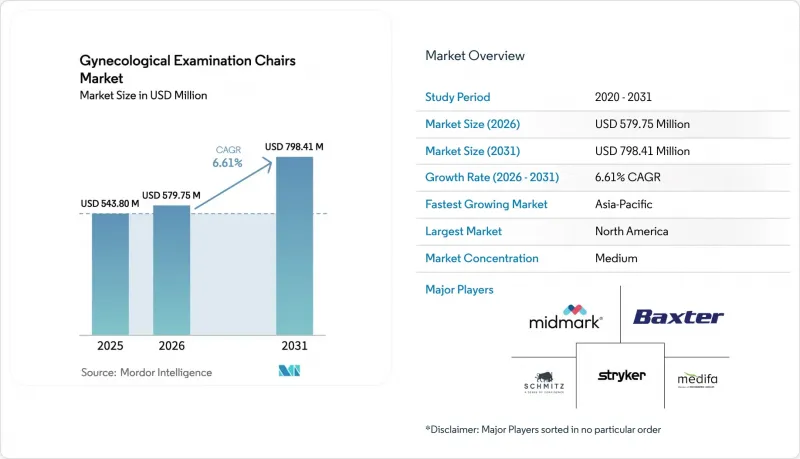
This report is Segmented by Product Type (Non-Electric Manual, and More), End User (Hospitals, Private Clinics, Diagnostic Centres, Ambulatory Surgical Centres, and Retail Minute Clinics), and Geography (North America, Europe, Asia-Pacific, Middle East & Africa, and South America). Market Forecasts are Provided in Terms of Value (USD).
Global Gynecological Examination Chairs Market Trends and Insights
Growing Burden of Women's Health Disorders
The 2021 Global Burden of Disease update reported 1.21 billion prevalent reproductive-system conditions, a figure that continues to rise as screening programs expand in key markets such as India, China, and Indonesia. This increasing diagnostic coverage is driving higher patient revisit rates and prompting clinics to replace outdated fixed-height tables with advanced multi-position electric chairs. These chairs, designed to optimize space, support multiple functions, including pelvic exams, colposcopy, and prenatal monitoring. Furthermore, national mandates for universal cervical-cancer screening are fueling demand for chairs equipped with imaging mounts and ADA-compliant transfer surfaces, aligning with evolving regulatory and operational requirements.
Expansion of Global Healthcare Infrastructure
Health-care expenditure in the Asia-Pacific region is projected to reach USD 5 trillion by 2030, fueled by key initiatives such as India's Ayushman Bharat insurance program, China's 14th Five-Year Plan commitment to establish 1,000 county-level hospitals for women and children, and multilateral funding aimed at expanding clinic networks in Indonesia. With new facilities adhering to modern WHO ergonomic and infection-control standards, there is a growing preference for advanced electric or electro-hydraulic chairs over traditional low-cost manual tables, driving a significant shift in medical equipment adoption.
High Capital Expenditure Requirements
Electric gynecological chairs list at USD 2,950-7,500, compared with USD 1,050-2,400 for manual models, a 2-3X differential that strains ASC and rural-clinic budgets. Add 10-15% for installation and USD 500-1,100 for accessories and the outlay becomes formidable; a 10-room women's center can spend USD 50-75 thousand on chairs alone. Refurbished or subscription-priced offerings lower entry barriers, but uptake remains modest amid concerns about warranties and residual value.
Other drivers and restraints analyzed in the detailed report include:
- Technological Advancements in Examination Chairs
- Increasing Focus on Patient Comfort and Safety
- Stringent Regulatory and Compliance Standards
For complete list of drivers and restraints, kindly check the Table Of Contents.
Segment Analysis
In 2025, electric motorized units accounted for 47.67% of the gynecological examination chairs market share and are projected to grow at a CAGR of 8.54%. This growth is driven by programmable memory presets, which reduce patient setup time by nearly 40%. Hospitals increasingly favor these units due to their IoT telemetry capabilities, which integrate directly with asset-management software. As a result, electric motorized units are becoming the standard choice in high-income regions. While hydraulic and electro-hydraulic hybrids remain prevalent in cost-sensitive markets, demand for powered height adjustments is rising to meet forthcoming accessibility regulations. Although smart, fully connected chairs currently represent less than 5% of shipments, they have demonstrated a nearly one-third reduction in downtime during North American pilot programs. This positions the segment for significant growth as cybersecurity frameworks mature.
Regulatory and sustainability pressures are further driving the adoption of powered models. Compliance with EPA sterilant regulations is simplified when detachable components are reprocessed with hydrogen peroxide or radiation rather than ethylene oxide. In 2024, OEM reprocessing programs recovered 5 million pounds of equipment, resulting in USD 239 million in customer savings. These lifecycle-cost advantages align with the priorities of value-based procurement committees. Meanwhile, manual tables are increasingly non-compliant with ADA height-adjustment standards and are expected to be relegated to ultra-low-budget or humanitarian applications.
Complete Report Scope:
- By Product Type
- Non-Electric (Manual)
- Electric (Motorised)
- Hydraulic
- Electro-Hydraulic Hybrid
- Smart / IoT-Integrated Models
- By End User
- Hospitals
- Private Clinics
- Diagnostic Centres
- Ambulatory Surgical Centres
- Retail / Minute Clinics
- Geography
- North America
- United States
- Canada
- Mexico
- Europe
- Germany
- United Kingdom
- France
- Italy
- Spain
- Rest of Europe
- Asia-Pacific
- China
- Japan
- India
- Australia
- South Korea
- Rest of Asia-Pacific
- Middle East & Africa
- GCC
- South Africa
- Rest of Middle East & Africa
- South America
- Brazil
- Argentina
- Rest of South America
- North America
Geography Analysis
In 2025, North America contributed 41.56% of the total revenue, driven by over 6,300 Ambulatory Surgical Centers (ASCs), ongoing hospital refresh cycles, and the enforcement of accessibility regulations disqualifying many fixed-height tables. The expansion of retail clinics in the U.S. is attracting new non-hospital buyers, while Canadian provincial mandates are fueling demand for ISO-certified equipment with bilingual support.
Asia-Pacific is positioned as the fastest-growing region, with a projected 7.54% CAGR through 2031. Key drivers include India's Ayushman Bharat initiative, China's plan to establish 1,000 county-level hospitals for women and children, and AIIB-funded clinic modernizations in Indonesia. These developments are generating significant demand for electric and hybrid chairs that comply with WHO ergonomic standards. Local manufacturers are maintaining competitive pricing below USD 2,000, enabling widespread adoption even in tier-two cities.
In Europe, single-payer procurement systems ensure stable volumes but exert pressure on margins. Sustainability clauses in procurement contracts are increasingly favoring vendors offering circular-economy solutions. The Middle East market is bifurcated, with high-end Gulf hospital chains contrasting with donor-funded initiatives in Sub-Saharan regions, which primarily procure manual or cost-effective hybrid solutions. In Latin America, currency fluctuations moderate growth; however, Brazil and Argentina continue to drive steady public tender activity aligned with national women's health programs.
- A-dec
- ABCO Health Care
- AGA Sanitatsartikel GmbH
- ArjoHuntleigh
- Avante Health Solutions
- Desco Medical
- GIMA S.p.A.
- Hill Laboratories Company
- Hill-Rom Holdings Inc. (Baxter)
- Inmoclinc S.A.
- Innomed Kozep-Europai Zrt.
- LINET Group
- Malvestio S.p.A.
- Medifa-Hesse GmbH & Co. KG
- Midmark
- Oakworks Medical Inc.
- PMT Healthcare Pvt. Ltd.
- Promotal
- Schmitz u. Sohne GmbH & Co. KG
- Sonesta AB
- Stryker
- Taicang Kang Hui (Medik)
Additional Benefits:
- The market estimate (ME) sheet in Excel format
- 3 months of analyst support
TABLE OF CONTENTS
1 Introduction
- 1.1 Study Assumptions & Market Definition
- 1.2 Scope of the Study
2 Research Methodology
3 Executive Summary
4 Market Landscape
- 4.1 Market Overview
- 4.2 Market Drivers
- 4.2.1 Growing Burden of Women's Health Disorders
- 4.2.2 Expansion of Global Healthcare Infrastructure
- 4.2.3 Technological Advancements in Examination Chairs
- 4.2.4 Increasing Focus on Patient Comfort and Safety
- 4.2.5 Integration of Digital Health and IoT Solutions
- 4.2.6 Shift Toward Decentralized and Outpatient Care Delivery
- 4.3 Market Restraints
- 4.3.1 High Capital Expenditure Requirements
- 4.3.2 Stringent Regulatory and Compliance Standards
- 4.3.3 Limited Space and Workflow Constraints in Clinics
- 4.3.4 Environmental Sustainability and Lifecycle Considerations
- 4.4 Value / Supply-Chain Analysis
- 4.5 Regulatory Landscape
- 4.6 Technological Outlook
- 4.7 Porter's Five Forces Analysis
- 4.7.1 Threat Of New Entrants
- 4.7.2 Bargaining Power Of Buyers
- 4.7.3 Bargaining Power Of Suppliers
- 4.7.4 Threat Of Substitutes
- 4.7.5 Competitive Rivalry
5 Market Size & Growth Forecasts (Value, USD)
- 5.1 By Product Type
- 5.1.1 Non-Electric (Manual)
- 5.1.2 Electric (Motorised)
- 5.1.3 Hydraulic
- 5.1.4 Electro-Hydraulic Hybrid
- 5.1.5 Smart / IoT-Integrated Models
- 5.2 By End User
- 5.2.1 Hospitals
- 5.2.2 Private Clinics
- 5.2.3 Diagnostic Centres
- 5.2.4 Ambulatory Surgical Centres
- 5.2.5 Retail / Minute Clinics
- 5.3 Geography
- 5.3.1 North America
- 5.3.1.1 United States
- 5.3.1.2 Canada
- 5.3.1.3 Mexico
- 5.3.2 Europe
- 5.3.2.1 Germany
- 5.3.2.2 United Kingdom
- 5.3.2.3 France
- 5.3.2.4 Italy
- 5.3.2.5 Spain
- 5.3.2.6 Rest of Europe
- 5.3.3 Asia-Pacific
- 5.3.3.1 China
- 5.3.3.2 Japan
- 5.3.3.3 India
- 5.3.3.4 Australia
- 5.3.3.5 South Korea
- 5.3.3.6 Rest of Asia-Pacific
- 5.3.4 Middle East & Africa
- 5.3.4.1 GCC
- 5.3.4.2 South Africa
- 5.3.4.3 Rest of Middle East & Africa
- 5.3.5 South America
- 5.3.5.1 Brazil
- 5.3.5.2 Argentina
- 5.3.5.3 Rest of South America
- 5.3.1 North America
6 Competitive Landscape
- 6.1 Market Concentration
- 6.2 Market Share Analysis
- 6.3 Company Profiles {(Includes Global Level Overview, Market Level Overview, Core Segments, Financials as Available, Strategic Information, Market Rank/Share for Key Companies, Products & Services, and Recent Developments)}
- 6.3.1 A-Dec Inc.
- 6.3.2 ABCO Health Care
- 6.3.3 AGA Sanitatsartikel GmbH
- 6.3.4 ArjoHuntleigh
- 6.3.5 Avante Health Solutions
- 6.3.6 Desco Medical India
- 6.3.7 GIMA S.p.A.
- 6.3.8 Hill Laboratories Company
- 6.3.9 Hill-Rom Holdings Inc. (Baxter)
- 6.3.10 Inmoclinc S.A.
- 6.3.11 Innomed Kozep-Europai Zrt.
- 6.3.12 LINET Group SE
- 6.3.13 Malvestio S.p.A.
- 6.3.14 Medifa-Hesse GmbH & Co. KG
- 6.3.15 Midmark Corporation
- 6.3.16 Oakworks Medical Inc.
- 6.3.17 PMT Healthcare Pvt. Ltd.
- 6.3.18 Promotal SAS
- 6.3.19 Schmitz u. Sohne GmbH & Co. KG
- 6.3.20 Sonesta AB
- 6.3.21 Stryker Corporation
- 6.3.22 Taicang Kang Hui (Medik)
7 Market Opportunities & Future Outlook
- 7.1 White-Space & Unmet-Need Assessment

