PUBLISHER: Mordor Intelligence | PRODUCT CODE: 2116510

PUBLISHER: Mordor Intelligence | PRODUCT CODE: 2116510
Healthcare Equipment Leasing - Market Share Analysis, Industry Trends & Statistics, Growth Forecasts (2026 - 2031)
According to Mordor Intelligence, the healthcare equipment leasing market size is expected to grow from USD 129.83 billion in 2025 to USD 149.69 billion in 2026 and is forecast to reach USD 304.93 billion by 2031 at 15.29% CAGR over 2026-2031.
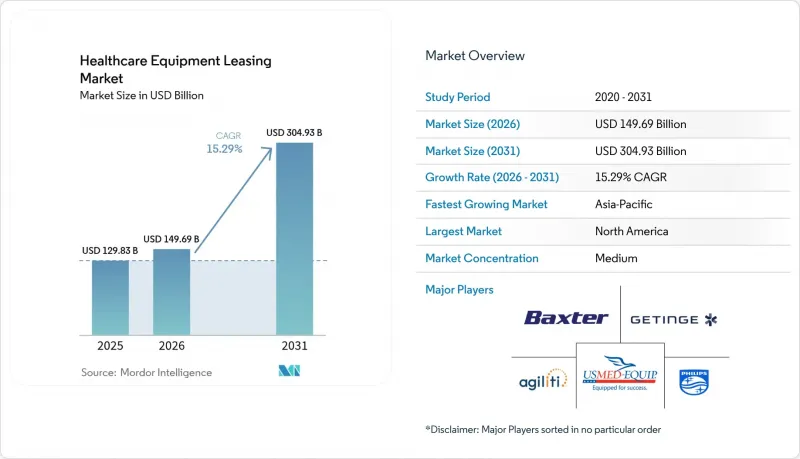
This report is Segmented by Product (Diagnostic Imaging Equipment, and More), Lease Type (Operating Lease, and More), End User (Hospitals & Clinics, and More), Duration (Short-Term, Medium-Term, Long-Term), and Geography (North America, Europe, Asia-Pacific, Middle East & Africa, South America). The Market Forecasts are Provided in Terms of Value (USD).
Global Healthcare Equipment Leasing Market Trends and Insights
Escalating Capital Expenditure for Medical Technology
Hospitals face capital allocation stress as MRI, CT, and robotic surgery platforms exceed multi-million-dollar price points while reimbursement schedules tighten. Leasing shifts these costs from balance sheets to predictable operating lines, freeing cash for clinical programs. Siemens Healthineers' 10-year value partnership with Tower Health illustrates the model, bundling equipment, lifecycle management, and upgrades to mitigate obsolescence. Providers redirect preserved capital toward patient-centric initiatives yet still secure leading-edge technology. As high-spec imaging and therapy systems evolve every two to three years, the healthcare equipment leasing market becomes the preferred pathway for modernization without large-scale capex spikes.
Shift Toward Asset-Light Operating Models in Healthcare
Health systems adopt asset-light strategies to concentrate on clinical outcomes rather than equipment ownership. Everything-as-a-Service arrangements replace lump-sum purchases with performance-linked monthly fees, aligning technology use with value delivered. The model improves leverage metrics, reduces depreciation pressure, and enhances agility in uncertain economic climates. Providers allocate freed capital to telehealth, workforce retention, and digital front-door initiatives while lessors specialize in depreciation management. The widening gap between brisk innovation cycles and limited budgets cements leasing as a core pillar of financial resilience across the healthcare equipment leasing market.
Stringent Accounting Standards Increasing On-Balance-Sheet Liabilities
ASC 842 and IFRS 16 oblige health systems to record lease liabilities, reducing prior off-balance-sheet advantages. The change raises reported leverage, complicates debt-covenant compliance, and forces CFOs to revisit purchase-versus-lease models. Operating leases now appear alongside finance leases, narrowing the gap to loan financing. U.S. Bank's advisory notes that proper classification remains vital for rating reviews. Although transparency improves, the rule tempers aggressive growth in the healthcare equipment leasing market for organizations sensitive to headline debt metrics.
Other drivers and restraints analyzed in the detailed report include:
- Expansion of Diagnostic Imaging and Surgical Infrastructure
- Rise of Outcome-Based Managed Equipment Service Contracts
- Availability of Refurbished and Second-Life Equipment Alternatives
For complete list of drivers and restraints, kindly check the Table Of Contents.
Segment Analysis
Diagnostic imaging held 28.05% of 2025 revenue, underscoring its critical role in treatment pathways and its sizable capital requirements. MRI, CT, and ultrasound systems command premium lease rates, and providers rely on these arrangements to avoid aging fleets that hinder clinical throughput. The healthcare equipment market share for imaging remains stable as demand for precision diagnostics and minimally invasive interventions rises in oncology and cardiology.
Digital and electronic equipment is advancing at 17.12% CAGR, the highest among product categories, propelled by AI-integrated monitors, connected ventilators, and smart IV pumps. Short technology cycles encourage two- to three-year terms with mid-cycle upgrades. The healthcare equipment market size for connected devices widens as interoperability mandates push hospitals toward platform overhaul. Patient monitoring, life-support, and surgical robotics follow with steady gains, each supported by leasing programs that bundle training and analytics support. Durable medical equipment and laboratory analyzers sustain predictable replacement schedules, while portable home-care devices open a new frontier for the healthcare equipment leasing market among aging populations.
Operating leases represented 63.68% of 2025 transactions, favored for their flexible end-of-term options and off-setting of obsolescence risk. Hospitals align these structures with budget cycles, often embedding variable usage clauses to match seasonal procedure volumes. The healthcare equipment leasing market size tied to operating agreements benefits from predictable monthly payments that preserve credit lines.
Managed equipment service agreements are expanding at 17.24% CAGR, reflecting demand for turnkey solutions that combine hardware, software, and managed services. Lessors assume maintenance, compliance, and performance metrics, easing the operational burden on providers. Capital leases appeal to institutions targeting eventual ownership for long-life assets such as radiotherapy vaults, while sale-leaseback structures monetize legacy fleets to fund digital upgrades. The growing appeal of full-service models demonstrates the healthcare equipment leasing market progression from financing tool to integrated performance partnership.
Complete Report Scope:
- By Product
- Diagnostic Imaging Equipment
- Durable Medical Equipment
- Surgical & Therapy Equipment
- Patient Monitoring & Life-support
- Digital & Electronic Equipment
- Storage & Transport Equipment
- Home-care Equipment
- Laboratory & Analytical Equipment
- By Lease Type
- Operating Lease
- Capital/Finance Lease
- Sale-Leaseback
- Managed Equipment Service Agreement
- By End User
- Hospitals & Clinics
- Diagnostic Imaging Centers
- Ambulatory Surgical Centers
- Home Healthcare Providers
- Long-term Care & Rehabilitation Facilities
- By Duration
- Short-term (< 12 months)
- Medium-term (1-3 years)
- Long-term (> 3 years)
- Geography
- North America
- United States
- Canada
- Mexico
- Europe
- Germany
- United Kingdom
- France
- Italy
- Spain
- Rest of Europe
- Asia-Pacific
- China
- Japan
- India
- Australia
- South Korea
- Rest of Asia-Pacific
- Middle East & Africa
- GCC
- South Africa
- Rest of Middle East & Africa
- South America
- Brazil
- Argentina
- Rest of South America
- North America
Geography Analysis
North America contributed 41.25% of 2025 revenue, supported by sophisticated reimbursement models, established leasing infrastructure, and regulators that value operational flexibility. Providers replace capital-intensive imaging suites and surgical robots via service contracts that ensure uptime and continuous updates. The healthcare equipment market size in the region benefits from tight hospital margins and competitive technology benchmarks.
Europe posts steady growth as modernization programs and cross-border procurement initiatives standardize leasing frameworks. Aging populations and digital health directives create recurring replacement cycles for imaging, infusion, and monitoring systems. Asia-Pacific, the fastest-growing territory at 16.08% CAGR, witnesses rapid infrastructure build-out across China, India, and ASEAN states. Public-private partnerships, rising middle-class demand, and clinical capacity shortages make leasing integral to timely facility expansion. Middle East and Africa add incremental demand as government projects in the Gulf integrate turnkey leasing packages for new specialty centers. South America experiences cyclical uptake tied to economic stability, with private payers in Brazil and Chile emphasizing AI-enhanced diagnostics. The geographic spread underscores that the healthcare equipment leasing market scales across maturity levels by tailoring contract terms to regulatory, fiscal, and clinical nuances.
- Agiliti Health Inc.
- Avensys UK Ltd.
- Baxter
- GE Healthcare
- Getinge
- Koninklijke Philips
- Med One Group
- Mizuho Leasing Company Ltd.
- Prudential Leasing
- Siemens Healthineers
- US Med-Equip
- De Lage Landen International (DLL)
- Stryker
- Siemens Financial Services
- Key Equipment Finance
- Meridian Leasing Corp.
- First American Healthcare Finance
- Canon Medical Systems USA Inc.
- National Technology Leasing Services
- Dragerwerk
- Hill-Rom
Additional Benefits:
- The market estimate (ME) sheet in Excel format
- 3 months of analyst support
TABLE OF CONTENTS
1 Introduction
- 1.1 Study Assumptions & Market Definition
- 1.2 Scope of the Study
2 Research Methodology
3 Executive Summary
4 Market Landscape
- 4.1 Market Overview
- 4.2 Market Drivers
- 4.2.1 Escalating Capital Expenditure for Medical Technology
- 4.2.2 Shift Toward Asset-Light Operating Models In Healthcare
- 4.2.3 Expansion of Diagnostic Imaging And Surgical Infrastructure
- 4.2.4 Growing Preference for Operational Flexibility And Cash-Flow Management
- 4.2.5 Acceleration of Technology Refresh Cycles in Medtech
- 4.2.6 Rise of Outcome-Based Managed Equipment Service Contracts
- 4.3 Market Restraints
- 4.3.1 Stringent Accounting Standards Increasing on-Balance-Sheet Liabilities
- 4.3.2 Availability of Refurbished and Second-Life Equipment Alternatives
- 4.3.3 Rising Cybersecurity and Data-Privacy Compliance Costs
- 4.3.4 Limited Awareness of Leasing Benefits Among Small Healthcare Providers
- 4.4 Regulatory Landscape
- 4.5 Porter's Five Forces Analysis
- 4.5.1 Threat of New Entrants
- 4.5.2 Bargaining Power of Buyers/Consumers
- 4.5.3 Bargaining Power of Suppliers
- 4.5.4 Threat of Substitute Products
- 4.5.5 Intensity of Competitive Rivalry
5 Market Size & Growth Forecasts (Value, USD)
- 5.1 By Product
- 5.1.1 Diagnostic Imaging Equipment
- 5.1.2 Durable Medical Equipment
- 5.1.3 Surgical & Therapy Equipment
- 5.1.4 Patient Monitoring & Life-support
- 5.1.5 Digital & Electronic Equipment
- 5.1.6 Storage & Transport Equipment
- 5.1.7 Home-care Equipment
- 5.1.8 Laboratory & Analytical Equipment
- 5.2 By Lease Type
- 5.2.1 Operating Lease
- 5.2.2 Capital/Finance Lease
- 5.2.3 Sale-Leaseback
- 5.2.4 Managed Equipment Service Agreement
- 5.3 By End User
- 5.3.1 Hospitals & Clinics
- 5.3.2 Diagnostic Imaging Centers
- 5.3.3 Ambulatory Surgical Centers
- 5.3.4 Home Healthcare Providers
- 5.3.5 Long-term Care & Rehabilitation Facilities
- 5.4 By Duration
- 5.4.1 Short-term (< 12 months)
- 5.4.2 Medium-term (1-3 years)
- 5.4.3 Long-term (> 3 years)
- 5.5 Geography
- 5.5.1 North America
- 5.5.1.1 United States
- 5.5.1.2 Canada
- 5.5.1.3 Mexico
- 5.5.2 Europe
- 5.5.2.1 Germany
- 5.5.2.2 United Kingdom
- 5.5.2.3 France
- 5.5.2.4 Italy
- 5.5.2.5 Spain
- 5.5.2.6 Rest of Europe
- 5.5.3 Asia-Pacific
- 5.5.3.1 China
- 5.5.3.2 Japan
- 5.5.3.3 India
- 5.5.3.4 Australia
- 5.5.3.5 South Korea
- 5.5.3.6 Rest of Asia-Pacific
- 5.5.4 Middle East & Africa
- 5.5.4.1 GCC
- 5.5.4.2 South Africa
- 5.5.4.3 Rest of Middle East & Africa
- 5.5.5 South America
- 5.5.5.1 Brazil
- 5.5.5.2 Argentina
- 5.5.5.3 Rest of South America
- 5.5.1 North America
6 Competitive Landscape
- 6.1 Market Concentration
- 6.2 Market Share Analysis
- 6.3 Company Profiles (includes Global level Overview, Market level overview, Core Business Segments, Financials, Headcount, Key Information, Market Rank, Market Share, Products and Services, and analysis of Recent Developments)
- 6.3.1 Agiliti Health Inc.
- 6.3.2 Avensys UK Ltd.
- 6.3.3 Baxter International Inc.
- 6.3.4 GE Healthcare
- 6.3.5 Getinge AB
- 6.3.6 Koninklijke Philips N.V.
- 6.3.7 Med One Group
- 6.3.8 Mizuho Leasing Company Ltd.
- 6.3.9 Prudential Leasing Inc.
- 6.3.10 Siemens Healthineers AG
- 6.3.11 US Med-Equip
- 6.3.12 De Lage Landen International (DLL)
- 6.3.13 Stryker Corporation
- 6.3.14 Siemens Financial Services
- 6.3.15 Key Equipment Finance
- 6.3.16 Meridian Leasing Corp.
- 6.3.17 First American Healthcare Finance
- 6.3.18 Canon Medical Systems USA Inc.
- 6.3.19 National Technology Leasing Services
- 6.3.20 Dragerwerk AG & Co. KGaA
- 6.3.21 Hill-Rom Holdings Inc.
7 Market Opportunities & Future Outlook
- 7.1 White-space & Unmet-Need Assessment

