PUBLISHER: Mordor Intelligence | PRODUCT CODE: 2116534

PUBLISHER: Mordor Intelligence | PRODUCT CODE: 2116534
China Dental Implants - Market Share Analysis, Industry Trends & Statistics, Growth Forecasts (2026 - 2031)
According to Mordor Intelligence, the China dental implants market size is expected to grow from USD 0.80 billion in 2025 to USD 0.85 billion in 2026 and is forecast to reach USD 1.14 billion by 2031 at 6.12% CAGR over 2026-2031.
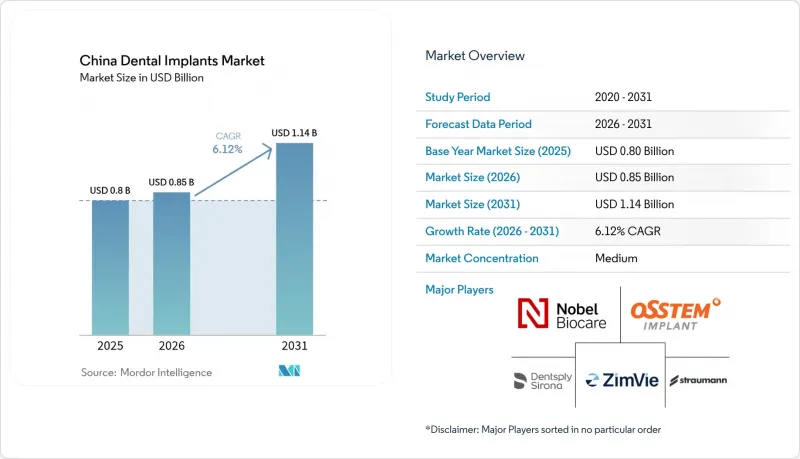
This report is Segmented by Part (Fixture and Abutment), Material (Titanium Implants, Zirconium Implants, and Polymer Implants), Implant Type (Endosteal, Subperiosteal, Transosteal, and Intramucosal), Design (Tapered and Parallel-Walled), Procedure (Single-Stage and Two-Stage), End-User (Dental Clinics, Hospitals, and More). The Market Forecasts are Provided in Terms of Value (USD).
China Dental Implants Market Trends and Insights
Rapidly Growing Geriatric & Edentulous Population in China
Edentulism is projected to affect 130.23 million Chinese residents by 2050, representing nearly one-fifth of the global burden. Older adults with fewer than 10 teeth face higher odds of frailty and malnutrition; Chinese cohort studies link edentulism to a 20% rise in all-cause mortality. Dental implants therefore address both functional and systemic health risks, elevating their perceived value among clinicians. Eastern provinces with higher life expectancy show the greatest concentration of demand. Public health messaging that positions oral rehabilitation as part of healthy aging is further reinforcing long-term volume growth.
Government Oral-Health Policies and Emerging Reimbursement Pathways
VBP price ceilings cut system costs yet stimulate procedures as more hospitals and private clinics participate. Parallel initiatives under "Healthy China 2030" encourage local pilots that subsidize dentures or crowns for low-income seniors. While national insurance still excludes most restorative fees, city-level reimbursement pilots are narrowing the gap, especially in Shanghai and Shenzhen.
Persistently High Out-of-Pocket Costs Despite VBP Price Caps
VBP sets a CNY 4,500 ceiling for a single implant system in public hospitals, yet total treatment costs remain high once surgical and prosthetic fees are included. Limited insurance reimbursement forces patients to self-finance, discouraging uptake among lower-income groups. Comparative data from South Korea show implant usage rose 60.5% after broader senior coverage, illustrating the potential lift if China's social insurance expands benefits. Without similar reforms, procedure growth may taper in lower-tier cities.
Other drivers and restraints analyzed in the detailed report include:
- Continuous Advances in Implant Materials, Surface Coatings & Digital Dentistry
- Rising Disposable Incomes and Heightened Aesthetic Awareness
- Limited Clinical Infrastructure & Implant Penetration in Rural Provinces
For complete list of drivers and restraints, kindly check the Table Of Contents.
Segment Analysis
Fixtures contributed the majority of the China dental implants market in 2025, generating 64.55% of sector revenue amid high procedure counts and their pivotal role in osseointegration. Manufacturers refine micro-roughened and HA-coated surfaces to shorten healing periods, catering to aging patients with reduced bone density. Domestic producers have cut lead times by localizing titanium billet sourcing, augmenting cost advantages created by VBP.
Abutments represent a smaller but faster-growing share, forecast to rise at 9.86% CAGR through 2031. CAD/CAM platforms now deliver patient-specific zirconia abutments within 48 hours, improving soft-tissue contours and esthetics. As VBP lowers fixture costs, clinics redirect savings toward customized prosthetic components, propelling abutment upgrades.
Titanium implants delivered 74.35% of the China dental implants market share in 2025, upheld by well-documented biocompatibility and mechanical resilience. Research on low-modulus B-type alloys promises to lessen peri-implant stress shielding without compromising strength. Local foundries have increased output by 12% to meet growing fixture demand, shielding pricing against nickel-titanium alloy volatility.
Zirconium volumes are set to grow 12.12% CAGR on rising esthetic preferences and improved fracture resistance through doped composite matrices. High translucency makes zirconia favored for anterior restorations, and VBP tender rounds now include ceramic systems, which will accelerate hospital adoption.
Complete Report Scope:
- By Part
- Fixture
- Abutment
- By Material
- Titanium Implants
- Zirconium Implants
- PEEK / Polymer Implants
- By Implant Type
- Endosteal
- Subperiosteal
- Transosteal
- Intramucosal
- By Design
- Tapered
- Parallel-Walled
- By Procedure
- Single-Stage
- Two-Stage
- By End-User
- Dental Clinics
- Hospitals
- Academic & Research Institutes
List of Companies Covered in this Report:
- Straumann Group
- Nobel Biocare Services
- Dentsply Sirona
- ZimVie
- Osstem Implant Co., Ltd.
- Dentium Co., Ltd.
- Henry Schein
- Thommen Medical
- BEGO GmbH & Co. KG
- Solventum Corporation
- BioHorizons IPH, Inc.
- Shandong Weigao Orthopaedic Device Co., Ltd.
- Beijing AK Medical Co., Ltd.
- Guangdong Huge Dental Material Co., Ltd.
- Shining 3D Tech Co., Ltd.
- Hangzhou Minsheng Lide Medical Sci.& Tech. Co., Ltd.
- Anthogyr
- MegaGen Implant Co., Ltd.
- CAMLOG Biotechnologies
- Bicon
- Weihai Weigaojie Likang Biomaterials
Additional Benefits:
- The market estimate (ME) sheet in Excel format
- 3 months of analyst support
TABLE OF CONTENTS
1 Introduction
- 1.1 Study Assumptions & Market Definition
- 1.2 Scope of the Study
2 Research Methodology
3 Executive Summary
4 Market Landscape
- 4.1 Market Overview
- 4.2 Market Drivers
- 4.2.1 Rapidly Growing Geriatric & Edentulous Population in China
- 4.2.2 Government Oral-Health Policies and Emerging Reimbursement Pathways
- 4.2.3 Continuous Advances in Implant Materials, Surface Coatings & Digital Dentistry
- 4.2.4 Rising Disposable Incomes and Heightened Aesthetic Awareness
- 4.2.5 Inbound Medical Tourism to Greater Bay Area for Cost-Effective Implantology
- 4.2.6 Expansion of Private Multi-Site Dental Chains into Tier-2/3 Cities
- 4.3 Market Restraints
- 4.3.1 Persistently High Out-of-Pocket Costs Despite VBP Price Caps
- 4.3.2 Limited Clinical Infrastructure & Implant Penetration in Rural Provinces
- 4.3.3 Lengthy and Stringent NMPA Regulatory Approval for Novel Systems
- 4.3.4 Low Post-Surgery Follow-Up Compliance Driving Complication Risks
- 4.4 Regulatory Outlook
- 4.5 Technological Outlook
- 4.6 Porter's Five Forces
- 4.6.1 Threat of New Entrants
- 4.6.2 Bargaining Power of Buyers/Consumers
- 4.6.3 Bargaining Power of Suppliers
- 4.6.4 Threat of Substitute Products
- 4.6.5 Intensity of Competitive Rivalry
5 Market Size & Growth Forecasts (Value, USD)
- 5.1 By Part
- 5.1.1 Fixture
- 5.1.2 Abutment
- 5.2 By Material
- 5.2.1 Titanium Implants
- 5.2.2 Zirconium Implants
- 5.2.3 PEEK / Polymer Implants
- 5.3 By Implant Type
- 5.3.1 Endosteal
- 5.3.2 Subperiosteal
- 5.3.3 Transosteal
- 5.3.4 Intramucosal
- 5.4 By Design
- 5.4.1 Tapered
- 5.4.2 Parallel-Walled
- 5.5 By Procedure
- 5.5.1 Single-Stage
- 5.5.2 Two-Stage
- 5.6 By End-User
- 5.6.1 Dental Clinics
- 5.6.2 Hospitals
- 5.6.3 Academic & Research Institutes
6 Competitive Landscape
- 6.1 Market Concentration
- 6.2 Market Share Analysis
- 6.3 Company Profiles (includes Global level Overview, Market level overview, Core Business Segments, Financials, Headcount, Key Information, Market Rank, Market Share, Products and Services, and analysis of Recent Developments)
- 6.3.1 Straumann Group
- 6.3.2 Nobel Biocare Services AG
- 6.3.3 Dentsply Sirona Inc.
- 6.3.4 ZimVie Inc.
- 6.3.5 Osstem Implant Co., Ltd.
- 6.3.6 Dentium Co., Ltd.
- 6.3.7 Henry Schein Inc.
- 6.3.8 Thommen Medical AG
- 6.3.9 BEGO GmbH & Co. KG
- 6.3.10 Solventum Corporation
- 6.3.11 BioHorizons IPH, Inc.
- 6.3.12 Shandong Weigao Orthopaedic Device Co., Ltd.
- 6.3.13 Beijing AK Medical Co., Ltd.
- 6.3.14 Guangdong Huge Dental Material Co., Ltd.
- 6.3.15 Shining 3D Tech Co., Ltd.
- 6.3.16 Hangzhou Minsheng Lide Medical Sci.& Tech. Co., Ltd.
- 6.3.17 Anthogyr SAS
- 6.3.18 MegaGen Implant Co., Ltd.
- 6.3.19 CAMLOG Biotechnologies GmbH
- 6.3.20 Bicon LLC
- 6.3.21 Weihai Weigaojie Likang Biomaterials
7 Market Opportunities & Future Outlook
- 7.1 White-Space & Unmet-Need Assessment

