PUBLISHER: Mordor Intelligence | PRODUCT CODE: 2116538

PUBLISHER: Mordor Intelligence | PRODUCT CODE: 2116538
United Kingdom Digital Health - Market Share Analysis, Industry Trends & Statistics, Growth Forecasts (2026 - 2031)
According to Mordor Intelligence, the United Kingdom digital health market size was valued at USD 15.46 billion in 2025 and is estimated to grow from USD 18.40 billion in 2026 to reach USD 43.98 billion by 2031, at a CAGR of 19.10% during the forecast period (2026-2031).
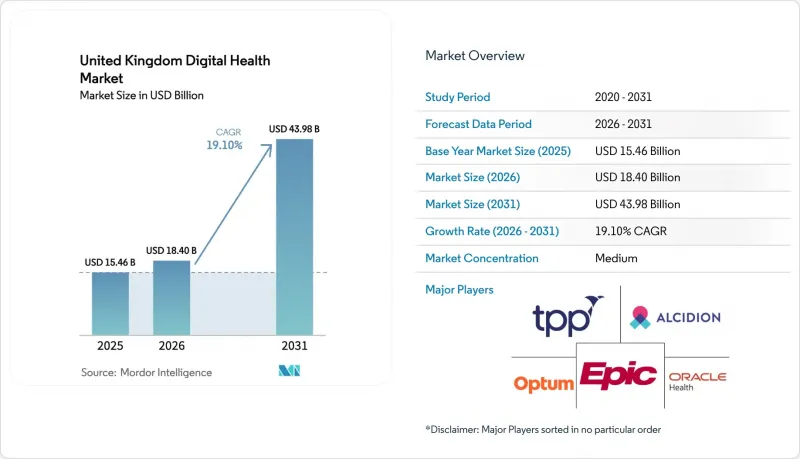
This report is Segmented by Technology (Tele-Healthcare, Mhealth Applications, Digital Health Systems, and Healthcare Analytics & AI), Component (Software, Hardware, and Services), Application (Chronic Disease Management, Diagnostics & Decision Support, and More), End-User (Hospitals & NHS Trusts, Primary Care & GP Practices and More). Market Forecasts are in Value (USD).
United Kingdom Digital Health Market Trends and Insights
NHS Long-Term Digital Funding Commitments
NHS England's GBP 13.4 billion digital transformation allocation through 2025 created a predictable procurement pipeline that underpinned vendor investment, allowing trusts to replace patient-administration systems averaging 15 years of age in 2020 with software only eight years old by 2025. Scotland added GBP 300 million and NHS Wales GBP 200 million for comparable programs, producing parallel opportunities for suppliers capable of multi-jurisdiction deployment. Front-loaded funding compressed implementation timetables, increasing demand for managed-service partners that can absorb short-term staffing peaks.
Accelerating EPR Roll-Outs Across Secondary Care
EPR coverage in English acute trusts rose from 43% in 2023 to an anticipated 80% by mid-2026, propelled by elective-recovery incentives and integrated care system (ICS) maturity metrics. Oracle Health's Millennium went live at Newcastle Hospitals under a GBP 32.5 million deal, and a multi-trust London deployment consolidated three standalone records into one, illustrating economies of scale in larger footprints. Early adopters are now layering population-health analytics onto mature data sets, widening capability gaps between digital leaders and late adopters.
Cyber-Security & Data-Privacy Concerns
Ransomware disrupted several trusts in 2024-2025, forcing temporary reliance on paper records and delaying elective procedures. Annual Data Security and Protection Toolkit assessments now require trusts to exceed baseline cyber-maturity standards, adding GBP 0.5 million in annual compliance costs. Extended procurement due diligence cycles particularly strain smaller vendors that lack formal security certifications.
Other drivers and restraints analyzed in the detailed report include:
- Majority of Population's Monthly Use Target for NHS App
- Expansion of Virtual Wards & Remote Monitoring
- Interoperability Gaps in Legacy NHS IT
For complete list of drivers and restraints, kindly check the Table Of Contents.
Segment Analysis
Healthcare Analytics & AI is projected to grow at a 19.80% CAGR, outstripping the mature Tele-Healthcare segment that held a 35.12% share of the United Kingdom digital health market in 2025. Trusts redirect budgets from pandemic-era video-consultation tools to predictive analytics that forecast emergency-department volumes and allocate staff accordingly, demonstrated by 85% prediction accuracy in early FDP pilots. Tele-Healthcare remains essential for GP and specialist consultations but faces slower incremental growth as adoption reaches saturation in urban areas.
The digital health systems layer, dominated by Oracle Health and Epic, anchors hospital workflows, while remote monitoring & wearables gain momentum through virtual-ward expansion. mHealth applications, epitomized by the NHS App, provide a ubiquitous patient front door yet generate lower revenue per user than AI-powered analytics. Data-platform apps built on the FDP create a marketplace that diffuses innovation across multiple vendors instead of consolidating power within EPR incumbents.
Software licenses and SaaS subscriptions delivered 59.18% of United Kingdom digital health market revenue in 2025, but Services implementation, integration, and managed support are forecast to rise at a 20.35% CAGR through 2031, almost matching overall market growth. Migration from legacy databases, workforce training, and ongoing interoperability maintenance drive sustained demand for professional services long after initial go-lives.
Infosys's GBP 1.17 billion Electronic Staff Record contract exemplifies bundled software-plus-services engagements that transfer operational risk to the vendor. Hardware sales shrink as trusts shift workloads to hyperscale cloud platforms. Service providers also absorb the cost of retrofitting HL7 interfaces to FHIR and decommissioning shadow-IT workarounds, reinforcing their strategic role throughout the transformation cycle.
Complete Report Scope:
- By Technology
- Tele-Healthcare
- mHealth Applications
- Digital Health Systems (EPR, PAS, Shared-Care Records)
- Healthcare Analytics & AI
- By Component
- Software
- Hardware
- Services
- By Application
- Chronic Disease Management
- Preventive & Wellness
- Diagnostics & Decision Support
- Administration & Workflow Automation
- Mental & Behavioural Health
- Genomics & Precision Medicine
- Virtual Care & Hospital-at-Home
- By End-User
- Hospitals & NHS Trusts
- Primary Care & GP Practices
- Patients / Home-Care Settings
- Payers & Commissioners (ICBs, NI HSC, NHS Wales, NHS Scotland)
List of Companies Covered in this Report:
- Accurx
- Ada Health
- Alcidion
- Babylon Health
- Better EHR
- Cisco (Healthcare UK)
- Doctor Care Anywhere
- DrDoctor
- EMIS Health (Optum)
- Epic Systems
- Graphnet Health
- Huma
- IBM Watson Health (Merative)
- InterSystems
- Livi
- Oracle Health
- Palantir UK (FDP)
- Philips UK &I
- Push Doctor
- Sectra Ltd
- Siilo
- Teladoc (HealthHero UK)
- TPP (SystmOne)
- Vitalpac (Alcidion)
Additional Benefits:
- The market estimate (ME) sheet in Excel format
- 3 months of analyst support
TABLE OF CONTENTS
1 Introduction
- 1.1 Study Assumptions & Market Definition
- 1.2 Scope of the Study
2 Research Methodology
3 Executive Summary
4 Market Landscape
- 4.1 Market Overview
- 4.2 Market Drivers
- 4.2.1 NHS Long-Term Digital Funding Commitments
- 4.2.2 Accelerating EPR Roll-Outs Across Secondary Care
- 4.2.3 The Majority Of The Population's Monthly Use Target For The NHS App
- 4.2.4 Expansion Of Virtual Wards & Remote Monitoring
- 4.2.5 Federated Data Platform-Enabled AI "App-Store" Ecosystem
- 4.3 Market Restraints
- 4.3.1 Cyber-Security & Data-Privacy Concerns
- 4.3.2 Interoperability Gaps In Legacy NHS IT
- 4.3.3 Clinician "Shadow-It" Workarounds Inflating Technical Debt
- 4.3.4 Rising Carbon-Reduction Compliance Costs For Data Centres
- 4.4 Value Chain Analysis
- 4.5 Regulatory Landscape
- 4.6 Technological Outlook
- 4.7 Porter's Five Forces
- 4.7.1 Threat of New Entrants
- 4.7.2 Bargaining Power of Buyers
- 4.7.3 Bargaining Power of Suppliers
- 4.7.4 Threat of Substitutes
- 4.7.5 Competitive Rivalry
5 Market Size & Growth Forecasts (Value)
- 5.1 By Technology
- 5.1.1 Tele-Healthcare
- 5.1.2 mHealth Applications
- 5.1.3 Digital Health Systems (EPR, PAS, Shared-Care Records)
- 5.1.4 Healthcare Analytics & AI
- 5.2 By Component
- 5.2.1 Software
- 5.2.2 Hardware
- 5.2.3 Services
- 5.3 By Application
- 5.3.1 Chronic Disease Management
- 5.3.2 Preventive & Wellness
- 5.3.3 Diagnostics & Decision Support
- 5.3.4 Administration & Workflow Automation
- 5.3.5 Mental & Behavioural Health
- 5.3.6 Genomics & Precision Medicine
- 5.3.7 Virtual Care & Hospital-at-Home
- 5.4 By End-User
- 5.4.1 Hospitals & NHS Trusts
- 5.4.2 Primary Care & GP Practices
- 5.4.3 Patients / Home-Care Settings
- 5.4.4 Payers & Commissioners (ICBs, NI HSC, NHS Wales, NHS Scotland)
6 Competitive Landscape
- 6.1 Market Concentration
- 6.2 Market Share Analysis
- 6.3 Company Profiles (includes Global level Overview, Market level overview, Core Segments, Financials as available, Strategic Information, Market Rank/Share for key companies, Products & Services, and Recent Developments)
- 6.3.1 Accurx
- 6.3.2 Ada Health
- 6.3.3 Alcidion
- 6.3.4 Babylon Health
- 6.3.5 Better EHR
- 6.3.6 Cisco (Healthcare UK)
- 6.3.7 Doctor Care Anywhere
- 6.3.8 DrDoctor
- 6.3.9 EMIS Health (Optum)
- 6.3.10 Epic Systems
- 6.3.11 Graphnet Health
- 6.3.12 Huma
- 6.3.13 IBM Watson Health (Merative)
- 6.3.14 InterSystems
- 6.3.15 Livi
- 6.3.16 Oracle Health
- 6.3.17 Palantir UK (FDP)
- 6.3.18 Philips UK &I
- 6.3.19 Push Doctor
- 6.3.20 Sectra Ltd
- 6.3.21 Siilo
- 6.3.22 Teladoc (HealthHero UK)
- 6.3.23 TPP (SystmOne)
- 6.3.24 Vitalpac (Alcidion)
7 Market Opportunities & Future Outlook
- 7.1 White-Space & Unmet-Need Assessment

