PUBLISHER: Mordor Intelligence | PRODUCT CODE: 2116539

PUBLISHER: Mordor Intelligence | PRODUCT CODE: 2116539
United States Pet Care And Services - Market Share Analysis, Industry Trends & Statistics, Growth Forecasts (2026 - 2031)
According to Mordor Intelligence, the United States pet care and services market size is expected to grow from USD 62.1 billion in 2025 to USD 66.27 billion in 2026 and is forecast to reach USD 91.74 billion by 2031 at 6.72% CAGR over 2026-2031.
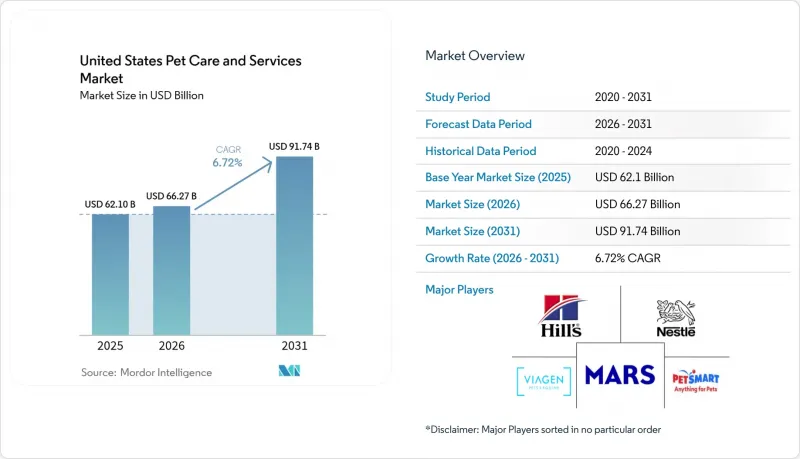
This report is Segmented by Pet Type (cat, Dog, Horse, and Other Animals), Product Type (pet Food, Grooming Products, and Pet Care), and Service Type (grooming, Pet Transportation, Pet Boarding, Pet Sitting, Pet Walking, and Other Services). The Report Offers the Value (in USD) for the Above Segments.
United States Pet Care And Services Market Trends and Insights
Rising Pet Humanization & Service Premiumization
Average monthly pet spend reached USD 318 in 2024 as owners equate animal wellness with household wellbeing. Demand for advanced diagnostics mirrors human healthcare, with 67% of owners ready to pay more for perceived health benefits. These dynamics reinforce premium-price elasticity across veterinary, grooming, and boarding subcategories in the United States pet care and services market.
Expanding Pet-Insurance Coverage & Awareness
Premiums exceeded USD 4 billion in 2024, yet only 4% of pets are insured, signaling vast headroom. Standardization under the 2024 NAIC Model Act in 14 states heightens transparency and consumer trust. Employer sponsorship accelerates uptake as 32% of owners would switch jobs for pet coverage. However, rising loss ratios tied to veterinary-service inflation strain carrier profitability, prompting selective policy exits that may temper short-term growth in the United States pet care and services market.
Escalating Veterinary-Service Inflation
Service prices have outpaced general inflation by 60% since 2005 and rose 8% year-over-year to August 2024. Cost drivers include labor shortages, high-tech equipment, and local monopoly pricing. Veterinary visits fell 3% in 2023, indicating income sensitivity and potential deferred care consequences. Regulatory scrutiny of consolidation is nascent, but rising political attention could reshape pricing power in the United States pet care and services market.
Other drivers and restraints analyzed in the detailed report include:
- Surge in E-commerce & Subscription Models
- Growing Investment in AI-Enabled Veterinary Tele-health
- Veterinary-Workforce Shortage & Burnout
For complete list of drivers and restraints, kindly check the Table Of Contents.
Segment Analysis
Service revenues accelerate at a 6.98% CAGR even as products retain 62.45% of 2025 revenue, underscoring a clear shift toward experiential spending within the United States pet care and services market. Veterinary care sits atop the service hierarchy, supported by a USD 66 billion subsector, while pet-insurance premiums of USD 4.5 billion in 2025 mark the fastest momentum. Subscription bundles blur product-service lines, locking in cash flow and raising lifetime value. Dietary supplements and veterinary diets outpace staple kibble margins, while the PURR Act could cut multistate compliance costs and speed product launches.
Services already account for 37.55% of the United States pet care and services market size, and their share is projected to exceed 40% by 2031 as insurance, tele-health, and in-store clinics deepen penetration. Product makers respond with premium upgrades-fresh, functional, and single-serve meals-that command higher price points without cannibalizing volume. Cross-selling between preventive-care plans and tailored nutrition boosts retention, while bundled loyalty programs temper switching. Together, these moves tighten the ecosystem around each household, raising barriers for late-stage challengers.
Complete Report Scope:
List of Companies Covered in this Report:
- Mars
- Nestle S.A.
- Colgate-Palmolive Company
- General Mills, Inc.
- The J.M. Smucker Co.
- Zoetis
- IDEXX
- Chewy, Inc.
- Petco Health & Wellness Company, Inc.
- PetSmart
- Trupanion, Inc.
- Lemonade, Inc.
- MetLife, Inc.
- Nationwide Mutual Insurance Company
- Rover Group, Inc.
- Wag! Group Co.
- PetIQ, Inc.
- Elanco
- Spectrum Brands Holdings, Inc.
- Central Garden & Pet Company
Additional Benefits:
- The market estimate (ME) sheet in Excel format
- 3 months of analyst support
TABLE OF CONTENTS
1 Introduction
- 1.1 Study Assumptions & Market Definition
- 1.2 Scope of the Study
2 Research Methodology
3 Executive Summary
4 Market Landscape
- 4.1 Market Overview
- 4.2 Market Drivers
- 4.2.1 Rising pet humanization & service premiumization
- 4.2.2 Expanding pet-insurance coverage & awareness
- 4.2.3 Surge in e-commerce & subscription models for pet services
- 4.2.4 Growing investment in AI-enabled veterinary tele-health
- 4.2.5 Employer-sponsored "paw-ternity" & pet-benefit programs
- 4.2.6 Pet-friendly real-estate boosting daycare/walking demand
- 4.3 Market Restraints
- 4.3.1 Escalating veterinary-service inflation
- 4.3.2 Veterinary-workforce shortage & burnout
- 4.3.3 High-premium cancellations in pet-insurance segment
- 4.3.4 Data-privacy concerns in connected pet devices
- 4.4 Value / Supply-Chain Analysis
- 4.5 Regulatory Landscape
- 4.6 Technological Outlook
- 4.7 Porter's Five Forces
- 4.7.1 Threat of New Entrants
- 4.7.2 Bargaining Power of Suppliers
- 4.7.3 Bargaining Power of Buyers
- 4.7.4 Threat of Substitutes
- 4.7.5 Competitive Rivalry
5 Market Size & Growth Forecasts (Value, 2020-2030)
6 Research Methodology
- 6.1 Products
- 6.1.1 Oral Care
- 6.1.1.1 Dietary Supplements
- 6.1.1.2 Veterinary Diets
- 6.1.2 Services
- 6.1.2.1 Veterinary Care
- 6.1.2.2 Pet Grooming
- 6.1.2.3 Pet Boarding & Daycare
- 6.1.2.4 Pet Training
- 6.1.2.5 Pet Insurance
- 6.1.2.6 Pet Walking/Sitting
- 6.1.2.7 Pet Retail Services (subscriptions, auto-ship)
- 6.1.1 Oral Care
- 6.2 By Pet Type
- 6.2.1 Dog
- 6.2.2 Cat
- 6.2.3 Other Companion Animals (birds, small mammals, reptiles)
- 6.3 By Service Channel
- 6.3.1 Offline (Brick-and-Mortar)
- 6.3.2 Online (E-commerce & Tele-services)
7 Competitive Landscape
- 7.1 Market Concentration
- 7.2 Market Share Analysis
- 7.3 Company Profiles {(includes Global level Overview, Market level overview, Core Segments, Financials as available, Strategic Information, Market Rank/Share for key companies, Products & Services, and Recent Developments)}
- 7.3.1 Mars, Incorporated
- 7.3.2 Nestle S.A.
- 7.3.3 Colgate-Palmolive Company
- 7.3.4 General Mills, Inc.
- 7.3.5 The J.M. Smucker Co.
- 7.3.6 Zoetis Inc.
- 7.3.7 IDEXX Laboratories, Inc.
- 7.3.8 Chewy, Inc.
- 7.3.9 Petco Health & Wellness Company, Inc.
- 7.3.10 PetSmart LLC
- 7.3.11 Trupanion, Inc.
- 7.3.12 Lemonade, Inc.
- 7.3.13 MetLife, Inc.
- 7.3.14 Nationwide Mutual Insurance Company
- 7.3.15 Rover Group, Inc.
- 7.3.16 Wag! Group Co.
- 7.3.17 PetIQ, Inc.
- 7.3.18 Elanco Animal Health Incorporated
- 7.3.19 Spectrum Brands Holdings, Inc.
- 7.3.20 Central Garden & Pet Company
8 Market Opportunities & Future Outlook
- 8.1 White-space & Unmet-Need Assessment
- 8.1.1 Johnson & Johnson
- 8.1.2 Church & Dwight Co. Inc.
- 8.1.3 Bayer AG
- 8.1.4 Abbott Laboratories
- 8.1.5 Reckitt Benckiser Group plc
- 8.1.6 Nestle S.A.
- 8.1.7 Kimberly-Clark Corporation
- 8.1.8 Clarins Group
- 8.1.9 Laboratoires Expanscience
- 8.1.10 Vitabiotics Ltd.
- 8.1.11 Prestige Consumer Healthcare Inc.
- 8.1.12 Lansinoh Laboratories Inc.
- 8.1.13 Medela AG
- 8.1.14 Frida Holdings LLC
- 8.1.15 Koninklijke Philips N.V.
- 8.1.16 Owlet Inc.
- 8.1.17 Ameda AG
- 8.1.18 Hain Celestial Group Inc.
- 8.1.19 Perrigo Company plc
9 Market Opportunities & Future Outlook
- 9.1 White-space & Unmet-Need Assessment

