PUBLISHER: Mordor Intelligence | PRODUCT CODE: 2116541

PUBLISHER: Mordor Intelligence | PRODUCT CODE: 2116541
Augmented Reality (AR) In Healthcare - Market Share Analysis, Industry Trends & Statistics, Growth Forecasts (2026 - 2031)
According to Mordor Intelligence, augmented reality in healthcare market size in 2026 is estimated at USD 1.91 billion, growing from 2025 value of USD 1.51 billion with 2031 projections showing USD 6.13 billion, growing at 26.29% CAGR over 2026-2031.
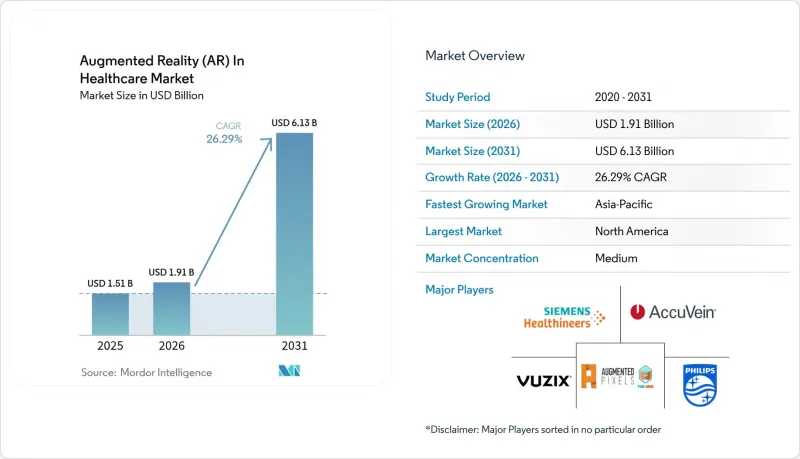
This report is Segmented by Component (Hardware, Software, Services), Technology (Head-Mounted Devices and Handheld Devices), Product (AR Displays, AR Sensors, and More), Application (Surgical Planning & Guidance, and More), End User (Hospitals & Clinics, and More), Geography (North America, Europe, Asia-Pacific, and More). The Market Forecasts are Provided in Terms of Value (USD).
Global Augmented Reality (AR) In Healthcare Market Trends and Insights
Growing Adoption of AR for Surgical Training & Guidance
Medical schools and major centers have adopted immersive simulators that combine high-resolution overlays with haptic feedback, cutting error rates and trimming the hours required to reach proficiency. Mayo Clinic reports lower procedural complications when residents practice on AR modules before entering the theatre. Recent prototypes add voice-controlled navigation that lets surgeons reposition virtual anatomy without touching screens, lowering infection risk and mental workload. These capabilities align with competency-based curricula that mandate objective performance tracking, something marker-based cameras and motion analytics supply natively. As reimbursement policies move toward outcomes, training directors view AR as a cost-effective path to faster credentialing. Medium-term momentum is therefore locked in; growth later accelerates when cloud-hosted libraries make updates available across entire residency networks.
Increasing Investments in AR Healthcare Start-Ups
Venture funding has pivoted from experimental prototypes to firms holding multiple FDA clearances and live hospital contracts. Augmedics drew USD 82.5 million in its 2024 Series D, bringing total backing to USD 149 million and supporting a 250-hospital roll-out of its xvision spine system. Strategic acquirers such as Stryker and Philips now value clinical data sets and integration know-how more than raw optics, prompting tuck-in deals that accelerate time-to-market. Capital inflows shorten the gap between concept and commercial production, which compresses product life cycles and raises competitive pressure. Over the next two years, boards will reward platforms that publish peer-reviewed outcomes and prove cost avoidance rather than those relying on general XR hype.
High Initial Cost of AR Hardware and Integration
Entry-level smart glasses start near USD 5 000, yet the fully loaded cost of an enterprise surgical suite surpasses USD 250 000 once software licenses, training, and IT build-outs are counted. Smaller regional hospitals hesitate because reimbursement codes for AR-assisted procedures are still limited, forcing them to shoulder capital expenses upfront. Custom links to PACS, EMR, and navigation stacks add further expense when vendors lack common interoperability standards. Early adopters counter these concerns with operating-lease models and evidence that procedure times can drop enough to free operating room capacity. Even so, near-term growth is capped where funding is tight or where CFOs demand three-year payback horizons.
Other drivers and restraints analyzed in the detailed report include:
- Rising Demand for Minimally Invasive Procedures Enhanced by Visualization
- Expanding Use of AR in Patient Education & Rehabilitation
- Data Privacy and Cybersecurity Concerns in Clinical Environments
For complete list of drivers and restraints, kindly check the Table Of Contents.
Segment Analysis
In 2025 hardware composed 54.72% of Augmented Reality in Healthcare market revenue, reflecting the up-front purchase of optical engines, sensors, and compute packs. The Augmented Reality in Healthcare market size for services is, however, expanding fastest at 27.90% CAGR through 2031 as hospitals demand turnkey workflow mapping, staff certification, and cybersecurity support alongside devices. Vendor contracts are moving to recurring subscription bundles, giving suppliers year-over-year revenue visibility while easing capital budgeting hurdles for providers. Hardware margins, in contrast, are slipping when generic waveguides and commodity processors lower differentiation; firms that pivot to managed services preserve profitability. Over the forecast period, custom analytics dashboards, remote calibration, and guaranteed uptime clauses will become standard, aligning AR procurement with broader digital-health sourcing models. This transition mirrors the path already traveled by radiology PACS and surgical robotics, where service revenue now exceeds hardware sales. Manufacturers who excel at clinical onboarding and cross-platform integration will secure higher renewal rates, cementing services as the primary engine of lifetime customer value.
Second-generation deployments demonstrate that robust services shorten learning curves and boost utilization. Hospitals that buy devices without structured support often stall below 40% usage after six months, while sites on full-service plans exceed 75% utilization within the first year. These metrics help CFOs justify subscription spending, creating a self-reinforcing cycle that channels budget growth toward service line items. As a result, investors increasingly assess competitive positioning by the scale of field-support teams and the depth of implementation playbooks rather than optical specifications alone. Services thus shift bargaining power away from component suppliers toward integrators that own the clinical relationship, reshaping competitive hierarchy across the Augmented Reality in Healthcare market.
Handheld tablets and phones delivered 38.12% of 2025 revenue because their familiar form factor lowered entry barriers for patient-education kiosks and bedside use. Head-mounted displays now post a 28.12% CAGR as operating-room teams value hands-free navigation and 3-D depth cues critical for intricate procedures. Apple Vision Pro's first documented shoulder-replacement case showed surgeons completing tasks 19% faster than those using 2-D screens, proving clinical viability. Lightweight optics and battery sleeves have trimmed headset weight below 220 grams, mitigating neck fatigue that previously hampered adoption. Future releases add myoelectric gesture sensors, enabling sterile interaction without voice commands that struggle in noisy theatres. Over the forecast window, hybrid architectures will appear: surgeons will reference patient-specific holograms through headsets while circulating nurses trigger medication reminders on handheld consoles. Vendors that synchronize annotations across both device classes stand to capture multi-department budgets and lock in cloud-rendering subscriptions.
Commercial momentum also reflects progress in regulatory pathways. The FDA's 510(k) panel cleared 16 head-mounted systems in 2024 alone, prompting group-purchasing organizations to negotiate framework agreements that pool demand across member hospitals. Such deals remove administrative friction, accelerating volume ramps. Long term, extended-reality chipsets built on 3-nanometer nodes will unlock 4K-per-eye resolution, positioning headsets to anchor even pathology and catheterization lab workflows. Consequently, research labs investing in next-generation optics are laying the foundation for a technology mix that tilts definitively toward head-mounted modalities by decade's end.
Complete Report Scope:
- By Component
- Hardware
- Software
- Services
- By Technology
- Head-Mounted Devices
- Handheld Devices
- By Product
- AR Displays
- AR Sensors
- AR Input Devices
- AR Semiconductor Components
- Other Products
- By Application
- Surgical Planning & Guidance
- Medical Training & Education
- Patient Monitoring & Rehabilitation
- Other Applications
- By End User
- Hospitals & Clinics
- Research Laboratories
- Academic & Training Institutes
- Other End Users
- Geography
- North America
- United States
- Canada
- Mexico
- Europe
- Germany
- United Kingdom
- France
- Italy
- Spain
- Rest of Europe
- Asia-Pacific
- China
- Japan
- India
- Australia
- South Korea
- Rest of Asia-Pacific
- Middle East & Africa
- GCC
- South Africa
- Rest of Middle East & Africa
- South America
- Brazil
- Argentina
- Rest of South America
- North America
Geography Analysis
North America retained 42.60% revenue in 2025, reflecting premium pricing power and a regulatory environment that has cleared 69 augmented-reality or virtual-reality devices to date. The United States dominates regional uptake as integrated-delivery networks bundle AR into digital theatre rebuilds, while Canada's publicly funded system channels grants toward rural tele-rehab pilots. Mexico shows budding demand tied to its medical-tourism corridor, where private hospitals promote AR-guided orthopedic packages for inbound patients. Cross-border collaborations allow U.S. academic surgeons to mentor Mexican procedures in real time, foreshadowing hemispheric service lines that could unlock fresh device shipments.
Asia-Pacific posts the highest 27.10% CAGR, giving it outsize influence on future Augmented Reality in Healthcare market growth. China funds provincial-level procurement of AR simulators for resident training, targeting doubled specialist numbers by 2030. India couples tele-mentoring headsets with government insurance that reimburses minimally invasive procedures, narrowing urban-rural outcome disparities. Japan pushes precision applications that converge with its robotics industry, while South Korea layers 5G slicing onto surgical feeds to prove remote cadaver dissections across islands. Australia's CSIRO anchors multi-center trials focusing on indigenous health, ensuring regional data diversity that shapes global algorithms. Collectively, Asia-Pacific buyers prize scalable, cost-efficient bundles, steering suppliers toward modular designs and aggressive price-performance road maps.
Europe delivers steady though slower expansion as health ministries require rigorous cost-benefit dossiers before acquisition. Germany leverages its optics supply chain to localise headset production, which satisfies EU sovereignty goals and trims import dependencies. The United Kingdom embeds AR evaluations inside NHS Clinical Entrepreneur programs that favor population-wide impact over boutique innovations. France and Italy host academic hubs where choreographed multi-discipline teams validate AR across cardiology, oncology, and orthopedics, driving ecosystem breadth. Middle East & Africa and South America remain nascent; Gulf hospitals import turnkey suites for medical-tourism clusters, while Brazil's research institutes explore public-sector tele-rehab to extend reach into the Amazon basin. Infrastructure gaps limit scale today, yet fast mobile-broadband rollouts position these regions for late-decade acceleration.
- Microsoft
- Siemens Healthineers
- Koninklijke Philips
- AccuVein
- EchoPixel
- Vuzix
- Augmented Pixels Inc.
- CAE Healthcare
- Intuitive Surgical
- Surgical Theater
- Orca Health Inc.
- Augmedix
- Medivis
- Magic Leap
- SentiAR
- XRHealth
- RealWear
- Brain Lab
- ImmersiveTouch
- SyncThink
- Medical Realities
- Pico Interactive
Additional Benefits:
- The market estimate (ME) sheet in Excel format
- 3 months of analyst support
TABLE OF CONTENTS
1 Introduction
- 1.1 Study Assumptions & Market Definition
- 1.2 Scope of the Study
2 Research Methodology
3 Executive Summary
4 Market Landscape
- 4.1 Market Overview
- 4.2 Market Drivers
- 4.2.1 Growing Adoption of Augmented Reality for Surgical Training and Guidance
- 4.2.2 Increasing Investments and Funding in Augmented Reality Healthcare Startups
- 4.2.3 Rising Demand for Minimally Invasive Procedures Enhanced by Visualization
- 4.2.4 Expanding Use of Augmented Reality In Patient Education and Rehabilitation
- 4.2.5 Integration of Augmented Reality with Medical Imaging Systems
- 4.2.6 Accelerating Digital Transformation and Telehealth Adoption Post-Covid
- 4.3 Market Restraints
- 4.3.1 High Initial Cost of Augmented Reality Hardware and Integration
- 4.3.2 Data Privacy and Cybersecurity Concerns in Clinical Environments
- 4.3.3 Lack of Standardized Regulatory and Reimbursement Frameworks
- 4.3.4 Limited Clinical Evidence and Validation of Long-Term Outcomes
- 4.4 Regulatory Landscape
- 4.5 Porter's Five Forces Analysis
- 4.5.1 Threat of New Entrants
- 4.5.2 Bargaining Power of Buyers
- 4.5.3 Bargaining Power of Suppliers
- 4.5.4 Threat of Substitutes
- 4.5.5 Competitive Rivalry
5 Market Size & Growth Forecasts (Value, USD)
- 5.1 By Component
- 5.1.1 Hardware
- 5.1.2 Software
- 5.1.3 Services
- 5.2 By Technology
- 5.2.1 Head-Mounted Devices
- 5.2.2 Handheld Devices
- 5.3 By Product
- 5.3.1 AR Displays
- 5.3.2 AR Sensors
- 5.3.3 AR Input Devices
- 5.3.4 AR Semiconductor Components
- 5.3.5 Other Products
- 5.4 By Application
- 5.4.1 Surgical Planning & Guidance
- 5.4.2 Medical Training & Education
- 5.4.3 Patient Monitoring & Rehabilitation
- 5.4.4 Other Applications
- 5.5 By End User
- 5.5.1 Hospitals & Clinics
- 5.5.2 Research Laboratories
- 5.5.3 Academic & Training Institutes
- 5.5.4 Other End Users
- 5.6 Geography
- 5.6.1 North America
- 5.6.1.1 United States
- 5.6.1.2 Canada
- 5.6.1.3 Mexico
- 5.6.2 Europe
- 5.6.2.1 Germany
- 5.6.2.2 United Kingdom
- 5.6.2.3 France
- 5.6.2.4 Italy
- 5.6.2.5 Spain
- 5.6.2.6 Rest of Europe
- 5.6.3 Asia-Pacific
- 5.6.3.1 China
- 5.6.3.2 Japan
- 5.6.3.3 India
- 5.6.3.4 Australia
- 5.6.3.5 South Korea
- 5.6.3.6 Rest of Asia-Pacific
- 5.6.4 Middle East & Africa
- 5.6.4.1 GCC
- 5.6.4.2 South Africa
- 5.6.4.3 Rest of Middle East & Africa
- 5.6.5 South America
- 5.6.5.1 Brazil
- 5.6.5.2 Argentina
- 5.6.5.3 Rest of South America
- 5.6.1 North America
6 Competitive Landscape
- 6.1 Market Concentration
- 6.2 Market Share Analysis
- 6.3 Company Profiles (includes Global level Overview, Market level overview, Core Business Segments, Financials, Headcount, Key Information, Market Rank, Market Share, Products and Services, and analysis of Recent Developments)
- 6.3.1 Microsoft
- 6.3.2 Siemens Healthineers
- 6.3.3 Koninklijke Philips N.V.
- 6.3.4 AccuVein Inc.
- 6.3.5 EchoPixel
- 6.3.6 Vuzix Corporation
- 6.3.7 Augmented Pixels Inc.
- 6.3.8 CAE Healthcare
- 6.3.9 Intuitive Surgical
- 6.3.10 Surgical Theater
- 6.3.11 Orca Health Inc.
- 6.3.12 Augmedix
- 6.3.13 Medivis
- 6.3.14 Magic Leap
- 6.3.15 SentiAR
- 6.3.16 XRHealth
- 6.3.17 RealWear
- 6.3.18 Brainlab
- 6.3.19 ImmersiveTouch
- 6.3.20 SyncThink
- 6.3.21 Medical Realities
- 6.3.22 Pico Interactive
7 Market Opportunities & Future Outlook
- 7.1 White-space & Unmet-Need Assessment

