PUBLISHER: Mordor Intelligence | PRODUCT CODE: 2116542

PUBLISHER: Mordor Intelligence | PRODUCT CODE: 2116542
Pharmaceutical Manufacturing Software - Market Share Analysis, Industry Trends & Statistics, Growth Forecasts (2026 - 2031)
According to Mordor Intelligence, pharmaceutical manufacturing software market size in 2026 is estimated at USD 4.01 billion, growing from 2025 value of USD 3.56 billion with 2031 projections showing USD 7.24 billion, growing at 12.55% CAGR over 2026-2031.
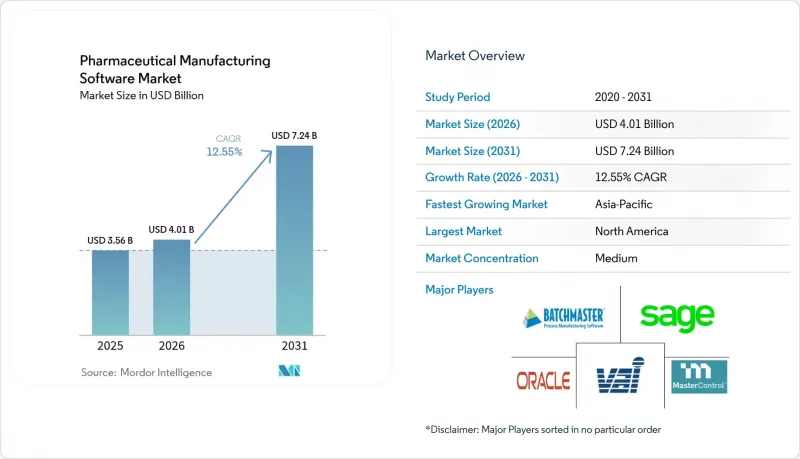
This report is Segmented by Deployment Model (On-Cloud, On-Premises), Enterprise Size (Large Enterprise, and Small and Medium-Sized Enterprises (SMEs)), End User (Pharmaceutical Manufacturers, and More), and Geography (North America, Europe, Asia-Pacific, Middle East and Africa, South America). The Market Forecasts are Provided in Terms of Value (USD).
Global Pharmaceutical Manufacturing Software Market Trends and Insights
Increasing Adoption of Automation
Manufacturers invest in robotics and integrated manufacturing execution systems (MES) to offset labor shortages and drive consistent quality. Predictive maintenance tools connected to MES cut unplanned downtime by up to 25% in validated facilities. Continuous manufacturing, which replaces static batch runs with dynamic flows, demands software that recalculates recipes in real time and reconciles streaming sensor data with electronic batch records. Japanese firms have piloted fully automated cell therapy suites that link robotics with MES to trim cycle times while preserving compliance. Automation also supports data-rich digital twins for process optimization, enabling faster scale-up when therapies advance from clinic to commercial production.
Rising Drug Production Costs
High-value biologics, complex formulations, and volatile raw-material prices heighten cost pressures. Advanced analytics platforms simulate multiple production scenarios, helping identify optimal run rates and ingredient yields. Plants using such models have reported 15-20% reductions in material waste after six months in operation. Energy-management modules integrated into MES monitor utilities in real time, cutting consumption without compromising Good Manufacturing Practice (GMP) standards. These savings offset rising specialty-ingredient costs and help facilities meet corporate sustainability pledges.
High Implementation Costs
Validation expenses can exceed initial licensing fees by as much as 300% because every code change demands documentation that satisfies GMP auditors. Smaller firms frequently outsource implementation and validation to specialist integrators, increasing total project budgets. Although long-term returns often exceed 25% through productivity gains and fewer compliance findings, near-term cash-flow constraints still deter some first-time buyers. Government tax incentives for digital-factory investments have begun to ease the barrier in select markets.
Other drivers and restraints analyzed in the detailed report include:
- Regulatory Compliance Requirements
- Advancements in Cloud-Based Solutions
- Complex Integration with Legacy Systems
For complete list of drivers and restraints, kindly check the Table Of Contents.
Segment Analysis
On-premise platforms retained 52.98% share of the pharmaceutical manufacturing software market in 2025 because large manufacturers prefer direct control of validated infrastructure. However, cloud solutions are forecast to grow at a 13.28% CAGR, reflecting enhanced cybersecurity certifications and regulator acceptance of virtual private cloud environments. Hybrid models dominate new projects, allowing master batch records to remain on-premise while analytics run in the cloud for burst compute requirements.
Cloud adoption also benefits SMEs that lack dedicated data-center resources. Subscription pricing reduces capital expenditure, and built-in validation templates shorten qualification timelines. Global enterprises adopt multi-tenant architectures to harmonize processes across product lines, driving demand for open application programming interface frameworks that integrate MES with enterprise resource planning (ERP) and laboratory information management systems. Vendors now embed machine-learning operations pipelines to refine predictive-quality models continuously, strengthening the value proposition of cloud MES.
Complete Report Scope:
- By Deployment Model
- On-Cloud
- On-Premise
- By Enterprise Size
- Large Enterprises
- Small & Medium-Sized Enterprises (SMEs)
- By End User
- Pharmaceutical Manufacturers
- Biopharmaceutical Manufacturers
- Contract Development & Manufacturing Organisations (CDMOs)
- By Geography
- North America
- United States
- Canada
- Mexico
- Europe
- Germany
- United Kingdom
- France
- Italy
- Spain
- Rest of Europe
- Asia-Pacific
- China
- Japan
- India
- Australia
- South Korea
- Rest of Asia-Pacific
- Middle East & Africa
- GCC
- South Africa
- Rest of Middle East & Africa
- South America
- Brazil
- Argentina
- Rest of South America
- North America
Geography Analysis
North America held 40.35% of pharmaceutical manufacturing software market revenue in 2025. Strict FDA enforcement of data-integrity guidance drives universal adoption of electronic batch records and audit-ready deviation management modules. Oracle's recent expansion of AI-enabled health applications in Canada exemplifies regional appetite for cloud infrastructures, with the firm forecasting a 70% rise in related sales for 2025. United States facilities leverage enterprise-wide MES rollouts to synchronise production across biologics and small-molecule plants, improving capacity utilisation and reducing lot-release times.
Asia-Pacific is the fastest-growing region, registering a 15.18% CAGR through 2031. China and India upgrade plants to meet global GMP standards, with local regulators aligning data-integrity frameworks to facilitate export licensing. Japanese manufacturers lead regional automation pilots; Chugai Pharmaceutical reports cycle-time reductions after implementing an integrated digital-factory program, while Astellas formed a joint venture with Yaskawa Electric to create a robotics-based cell-therapy manufacturing platform. Government subsidies targeting Industry 4.0 adoption and foreign direct investment in greenfield biologics facilities further propel regional software demand.
Europe maintains steady momentum as EMA guidance promotes quality-by-design and sustainability. German clusters attract fresh capital from multinational firms seeking advanced production ecosystems, and the regional market favours platforms that track carbon emissions in real time. Brexit-driven supply-chain complexities boost adoption of visibility solutions to manage cross-channel batch documentation. Cloud-native deployments gain traction as data-sovereignty concerns ease within the confines of European-based data centres.
The Middle East & Africa and South America remain nascent but exhibit rising adoption as domestic producers seek international quality certifications. Incentives in Saudi Arabia's National Industrial Strategy and Brazil's digital-health roadmap encourage investment in validated MES, yet capital constraints and limited skilled labour temper short-term uptake. Vendors offering modular, subscription-based solutions are well positioned to capture early adopters in these emerging markets.
- Oracle
- SAP
- Siemens Healthineers
- ABB Ltd
- Korber Pharma
- Rockwell Automation
- Honeywell International
- Emerson Electric
- Infor
- Dassault Systemes
- AspenTech
- MasterControl
- BatchMaster Software
- Sage Group plc
- Deskera
- Intellect
- Fishbowl
- Datacor Chempax
- Aquilon Software
- Logic ERP Solutions
- Vormittag Associates
Additional Benefits:
- The market estimate (ME) sheet in Excel format
- 3 months of analyst support
TABLE OF CONTENTS
1 Introduction
- 1.1 Study Assumptions & Market Definition
- 1.2 Scope of the Study
2 Research Methodology
3 Executive Summary
4 Market Landscape
- 4.1 Market Overview
- 4.2 Market Drivers
- 4.2.1 Increasing Adoption of Automation
- 4.2.2 Rising Drug Production Costs
- 4.2.3 Regulatory Compliance Requirements
- 4.2.4 Advancements in Cloud-Based Solutions
- 4.2.5 Growing Demand for Data-Driven Decision Making
- 4.2.6 Expansion of Pharmaceutical Supply Chains
- 4.3 Market Restraints
- 4.3.1 High Implementation Costs
- 4.3.2 Complex Integration with Legacy Systems
- 4.3.3 Data Security and Privacy Concerns
- 4.3.4 Lack of Standardization
- 4.4 Porter's Five Forces Analysis
- 4.4.1 Threat of New Entrants
- 4.4.2 Bargaining Power of Buyers
- 4.4.3 Bargaining Power of Suppliers
- 4.4.4 Threat of Substitutes
- 4.4.5 Intensity of Rivalry
5 Market Size & Growth Forecasts (Value in USD)
- 5.1 By Deployment Model
- 5.1.1 On-Cloud
- 5.1.2 On-Premise
- 5.2 By Enterprise Size
- 5.2.1 Large Enterprises
- 5.2.2 Small & Medium-Sized Enterprises (SMEs)
- 5.3 By End User
- 5.3.1 Pharmaceutical Manufacturers
- 5.3.2 Biopharmaceutical Manufacturers
- 5.3.3 Contract Development & Manufacturing Organisations (CDMOs)
- 5.4 By Geography
- 5.4.1 North America
- 5.4.1.1 United States
- 5.4.1.2 Canada
- 5.4.1.3 Mexico
- 5.4.2 Europe
- 5.4.2.1 Germany
- 5.4.2.2 United Kingdom
- 5.4.2.3 France
- 5.4.2.4 Italy
- 5.4.2.5 Spain
- 5.4.2.6 Rest of Europe
- 5.4.3 Asia-Pacific
- 5.4.3.1 China
- 5.4.3.2 Japan
- 5.4.3.3 India
- 5.4.3.4 Australia
- 5.4.3.5 South Korea
- 5.4.3.6 Rest of Asia-Pacific
- 5.4.4 Middle East & Africa
- 5.4.4.1 GCC
- 5.4.4.2 South Africa
- 5.4.4.3 Rest of Middle East & Africa
- 5.4.5 South America
- 5.4.5.1 Brazil
- 5.4.5.2 Argentina
- 5.4.5.3 Rest of South America
- 5.4.1 North America
6 Competitive Landscape
- 6.1 Market Concentration
- 6.2 Market Share Analysis
- 6.3 Company Profiles (includes Global level Overview, Market level overview, Core Segments, Financials as available, Strategic Information, Market Rank/Share for key companies, Products & Services, and Recent Developments)
- 6.3.1 Oracle
- 6.3.2 SAP SE
- 6.3.3 Siemens AG
- 6.3.4 ABB Ltd
- 6.3.5 Korber Pharma
- 6.3.6 Rockwell Automation
- 6.3.7 Honeywell International
- 6.3.8 Emerson Electric
- 6.3.9 Infor
- 6.3.10 Dassault Systemes
- 6.3.11 AspenTech
- 6.3.12 MasterControl
- 6.3.13 BatchMaster Software
- 6.3.14 Sage Group plc
- 6.3.15 Deskera
- 6.3.16 Intellect
- 6.3.17 Fishbowl
- 6.3.18 Datacor Chempax
- 6.3.19 Aquilon Software
- 6.3.20 Logic ERP Solutions
- 6.3.21 Vormittag Associates
7 Market Opportunities & Future Outlook
- 7.1 White-Space & Unmet-Need Assessment

