PUBLISHER: Mordor Intelligence | PRODUCT CODE: 2116544

PUBLISHER: Mordor Intelligence | PRODUCT CODE: 2116544
IVF Devices And Consumables - Market Share Analysis, Industry Trends & Statistics, Growth Forecasts (2026 - 2031)
According to Mordor Intelligence, the IVF devices and consumables market size was valued at USD 3.84 billion in 2025 and estimated to grow from USD 4.48 billion in 2026 to reach USD 9.62 billion by 2031, at a CAGR of 16.55% during the forecast period (2026-2031).
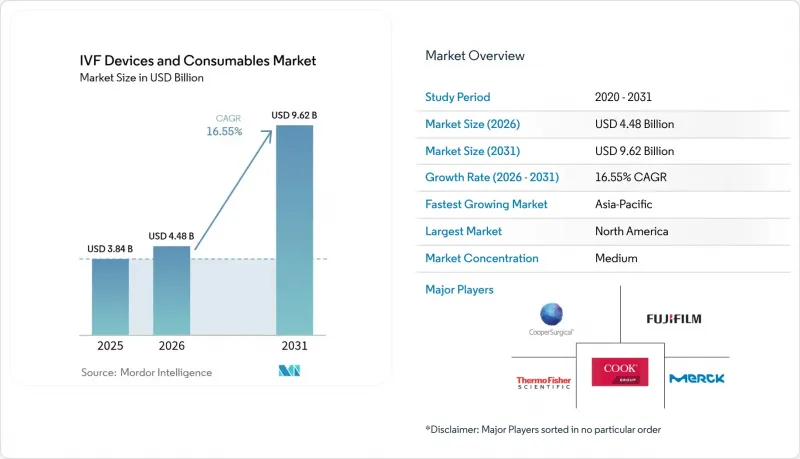
This report is Segmented by Type (Instruments, Reagents & Media, and Accessories & Disposables), Technology (Fresh Embryo IVF, Frozen Embryo IVF, and More), End User (Fertility Clinics, Hospitals, and More), Geography (North America, Europe, Asia-Pacific, The Middle East and Africa, and South America). The Market Forecasts are Provided in Terms of Value (USD).
Global IVF Devices And Consumables Market Trends and Insights
Rising Global Infertility Prevalence
The World Health Organization observes that 1 in 6 individuals face infertility at some point in life, a burden worsened by sexually transmitted infections and post-partum complications in low socio-demographic regions. Age-standardized infertility rates continue climbing even where absolute case counts stabilize, sustaining long-run demand for assisted reproduction. Asia-Pacific records notable growth in secondary infertility as lifestyle-related polycystic ovary syndrome gains prevalence. As natural conception declines, clinics invest in high-throughput intracytoplasmic sperm injection (ICSI) workstations and time-lapse incubators to meet rising caseloads. These conditions underpin a substantial portion of the expected CAGR in the IVF devices and consumables market.
Technological Advances in IVF Devices and Media
Laboratory automation marks the single largest efficiency leap in two decades. Conceivable Life Sciences achieved the first robot-controlled ICSI birth, demonstrating that a fully automated chain can complete 23 procedural steps without human intervention. AI-guided embryo classifiers reach 70-80% accuracy on ploidy prediction, letting clinics reduce invasive biopsies while improving implantation odds. Microfluidic vitrification chips now yield 86% oocyte survival, surpassing manual methods and lowering the per-cycle cost baseline. Continuous imaging incubators integrate analytics dashboards, allowing embryologists to review developmental trajectories remotely. These developments collectively add more than four percentage points to the forecast CAGR.
High Procedure and Device Costs
Single-cycle outlays range from USD 15,000-30,000 in developed markets, pushing many couples to attempt multiple rounds that can exceed USD 60,000. Public funding shortfalls worsen access; National Health Service support in the United Kingdom fell to 27% of treatments in 2022. Financing programs from specialist lenders emerge, yet interest rate premiums inflate the final expense, extending repayment well beyond the birth event. Capital equipment such as time-lapse incubators or integrated micromanipulation systems carry price tags in the mid-six-figure range, slowing adoption in mid-tier clinics. Rising medication prices compound the burden, narrowing the eligible patient pool and trimming potential unit volumes in the IVF devices and consumables market.
Other drivers and restraints analyzed in the detailed report include:
- Expanding Insurance Coverage and Government Support
- Growth of Cross-Border Fertility Tourism
- Supply-Chain Constraints for Specialized Consumables
For complete list of drivers and restraints, kindly check the Table Of Contents.
Segment Analysis
Instruments generated 35.10% of 2025 revenue, confirming their role as the backbone of embryology laboratories. Demand concentrates on incubators with integrated cameras, micromanipulators capable of sub-micron accuracy, and automated vitrification systems that standardize workflows and reduce operator variability. Robotic ICSI platforms improve precision while lowering training curves, encouraging new entrants to build capacity quickly. Continuous usage of these capital assets also drives steady aftermarket sales for calibration tools and single-use tips, expanding the serviceable portion of the IVF devices and consumables market. Clinics frequently align capital budgets with reimbursement schedules, creating multiyear replacement cycles that suppliers can forecast with confidence.
Reagents and culture media form the fastest-growing line, advancing at an 18.25% CAGR through 2031. Growth stems from specialized formulations optimized for extended culture to day-5 blastocyst stage and for AI-assisted imaging compatibility. Cryopreservation media leverage non-permeating cryoprotectants that dampen osmotic shock, raising post-thaw survival above 90% in many programs. Sperm preparation buffers adopt antioxidant additives that enhance motility under oxidative stress, supporting the wider shift toward single-sperm tracking algorithms. Personalized media that mimic a patient's follicular fluid profile are in early rollout, offering incremental revenue opportunities and higher margins. As a result, consumables suppliers secure recurring income streams that outpace the slower capital replacement pace, tilting overall growth dynamics in the IVF devices and consumables market.
Complete Report Scope:
- By Type
- Instruments
- Sperm Separation System
- Incubator
- Cryosystem
- Other Instruments
- Reagents & Media
- Cryopreservation Media
- Semen Processing Media
- Other Reagents and Media
- Accessories & Disposables
- Instruments
- By Technology
- Fresh Embryo IVF
- Frozen Embryo IVF
- Donor Egg IVF
- Intracytoplasmic Sperm Injection (ICSI)
- PGT-Assisted IVF
- By End User
- Fertility Clinics
- Hospitals
- Surgical Centers
- Clinical Research Institutes
- Cryobanks & Genetic Labs
- Geography
- North America
- United States
- Canada
- Mexico
- Europe
- Germany
- United Kingdom
- France
- Italy
- Spain
- Rest of Europe
- Asia-Pacific
- China
- Japan
- India
- Australia
- South Korea
- Rest of Asia-Pacific
- Middle East & Africa
- GCC
- South Africa
- Rest of Middle East & Africa
- South America
- Brazil
- Argentina
- Rest of South America
- North America
Geography Analysis
North America commanded 42.80% of 2025 revenue thanks to favorable reimbursement statutes, high procedural volumes, and a robust pipeline of automation startups. California's impending coverage mandate promises a meaningful step-change in addressable patients once enforcement begins in July 2025. Clinics in Boston, Houston, and the Bay Area pilot robot-assisted ICSI, creating lighthouse installations that influence purchasing trends across the continent. Federal initiatives that extend IVF benefits to veterans and federal employees expand procedural financing further and reinforce equipment refresh budgets. As a result, capital expenditure per clinic remains the highest globally, anchoring premium pricing within the IVF devices and consumables market.
Asia-Pacific delivers the fastest growth at 17.30% CAGR, spurred by shifting demographics, higher disposable incomes, and rapid capacity building. India opens dozens of clinics annually, while Chinese municipal governments subsidize local laboratories to raise national birth rates. Regional centers in Malaysia and Thailand position themselves as medical tourism hubs by offering bundled treatment, accommodation, and tourism services at a fraction of Western costs. These hubs rely heavily on imported class IIb and class III medical devices, supporting a vibrant distribution ecosystem. The progressive adoption curve sustains rising orders for flexible tubing sets, universal warming dishes, and programmable freezers, extending the revenue stream for suppliers active in the IVF devices and consumables market.
Europe posts steady single-digit growth, underpinned by advanced research infrastructure and harmonized regulatory frameworks. Extended transition timelines under the In Vitro Diagnostic Regulation give manufacturers more headroom to certify devices, preventing supply gaps in critical consumables. However, lower public funding in parts of the region dampens procedural uptake, especially in the United Kingdom where NHS coverage has fallen. Southern European countries compensate by courting international patients, driving cross-border flows that partially offset domestic funding constraints. Collectively, these dynamics ensure diversified geographic revenue sources for multinational vendors.
- Cook Group
- The Cooper Companies
- Esco Lifesciences
- FUJIFILM
- Genea Biomedx
- Hamilton Thorne
- Merck
- Nidacon International
- Thermo Fisher Scientific
- Vitrolife
- Memmert GmbH
- BioLife Solutions
- Oxford Gene Technology
- Cryo Bio System (IMV)
- IVFtech ApS
- Kitazato
- Eppendorf
- Rocket Medical
- Terumo
- Overture Life
- TMRW Life Sciences
Additional Benefits:
- The market estimate (ME) sheet in Excel format
- 3 months of analyst support
TABLE OF CONTENTS
1 Introduction
- 1.1 Study Assumptions & Market Definition
- 1.2 Scope of the Study
2 Research Methodology
3 Executive Summary
4 Market Landscape
- 4.1 Market Overview
- 4.2 Market Drivers
- 4.2.1 Rising Global Infertility Prevalence
- 4.2.2 Delayed Parenthood and Higher Maternal Age
- 4.2.3 Technological Advancements in IVF Devices And Media
- 4.2.4 Expanding Insurance Coverage and Government Support
- 4.2.5 Growth of Cross-Border Fertility Tourism
- 4.2.6 Increasing Success Rates Via AI and Genetic Screening
- 4.3 Market Restraints
- 4.3.1 High Procedure and Device Costs
- 4.3.2 Ethical and Regulatory Complexities
- 4.3.3 Variable Success Rates and Emotional Burden
- 4.3.4 Supply-Chain Constraints for Specialized Consumables
- 4.4 Regulatory Landscape
- 4.5 Porter's Five Forces Analysis
- 4.5.1 Threat Of New Entrants
- 4.5.2 Bargaining Power Of Buyers
- 4.5.3 Bargaining Power Of Suppliers
- 4.5.4 Threat Of Substitutes
- 4.5.5 Intensity Of Competitive Rivalry
5 Market Size & Growth Forecasts (Value, USD)
- 5.1 By Type
- 5.1.1 Instruments
- 5.1.1.1 Sperm Separation System
- 5.1.1.2 Incubator
- 5.1.1.3 Cryosystem
- 5.1.1.4 Other Instruments
- 5.1.2 Reagents & Media
- 5.1.2.1 Cryopreservation Media
- 5.1.2.2 Semen Processing Media
- 5.1.2.3 Other Reagents and Media
- 5.1.3 Accessories & Disposables
- 5.1.1 Instruments
- 5.2 By Technology
- 5.2.1 Fresh Embryo IVF
- 5.2.2 Frozen Embryo IVF
- 5.2.3 Donor Egg IVF
- 5.2.4 Intracytoplasmic Sperm Injection (ICSI)
- 5.2.5 PGT-Assisted IVF
- 5.3 By End User
- 5.3.1 Fertility Clinics
- 5.3.2 Hospitals
- 5.3.3 Surgical Centers
- 5.3.4 Clinical Research Institutes
- 5.3.5 Cryobanks & Genetic Labs
- 5.4 Geography
- 5.4.1 North America
- 5.4.1.1 United States
- 5.4.1.2 Canada
- 5.4.1.3 Mexico
- 5.4.2 Europe
- 5.4.2.1 Germany
- 5.4.2.2 United Kingdom
- 5.4.2.3 France
- 5.4.2.4 Italy
- 5.4.2.5 Spain
- 5.4.2.6 Rest of Europe
- 5.4.3 Asia-Pacific
- 5.4.3.1 China
- 5.4.3.2 Japan
- 5.4.3.3 India
- 5.4.3.4 Australia
- 5.4.3.5 South Korea
- 5.4.3.6 Rest of Asia-Pacific
- 5.4.4 Middle East & Africa
- 5.4.4.1 GCC
- 5.4.4.2 South Africa
- 5.4.4.3 Rest of Middle East & Africa
- 5.4.5 South America
- 5.4.5.1 Brazil
- 5.4.5.2 Argentina
- 5.4.5.3 Rest of South America
- 5.4.1 North America
6 Competitive Landscape
- 6.1 Market Concentration
- 6.2 Market Share Analysis
- 6.3 Company Profiles (includes Global level Overview, Market level overview, Core Business Segments, Financials, Headcount, Key Information, Market Rank, Market Share, Products and Services, and analysis of Recent Developments)
- 6.3.1 Cook Group
- 6.3.2 CooperSurgical
- 6.3.3 Esco Medical
- 6.3.4 FUJIFILM Holdings Corporation
- 6.3.5 Genea Biomedx
- 6.3.6 Hamilton Thorne Inc.
- 6.3.7 Merck KGaA (EMD Serono)
- 6.3.8 Nidacon International AB
- 6.3.9 Thermo Fisher Scientific, Inc.
- 6.3.10 Vitrolife AB
- 6.3.11 Memmert GmbH
- 6.3.12 BioLife Solutions
- 6.3.13 Oxford Gene Technology
- 6.3.14 Cryo Bio System (IMV)
- 6.3.15 IVFtech ApS
- 6.3.16 Kitazato Corporation
- 6.3.17 Eppendorf AG
- 6.3.18 Rocket Medical Plc
- 6.3.19 Terumo BCT
- 6.3.20 Overture Life
- 6.3.21 TMRW Life Sciences
7 Market Opportunities & Future Outlook
- 7.1 White-Space & Unmet-Need Assessment

