PUBLISHER: Mordor Intelligence | PRODUCT CODE: 2116546

PUBLISHER: Mordor Intelligence | PRODUCT CODE: 2116546
Speech Therapy Services - Market Share Analysis, Industry Trends & Statistics, Growth Forecasts (2026 - 2031)
According to Mordor Intelligence, the speech therapy services market size is expected to grow from USD 21.28 billion in 2025 to USD 22.47 billion in 2026 and is forecast to reach USD 29.53 billion by 2031 at 5.6% CAGR over 2026-2031.
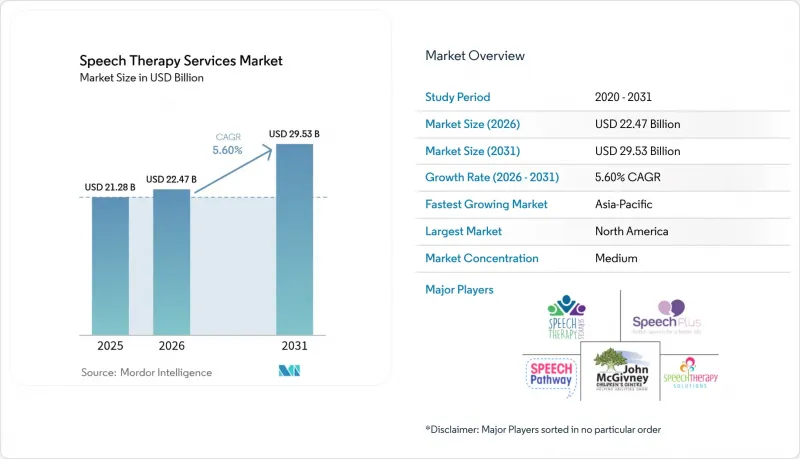
This report is Segmented by Indication (Speech Disorder, Language Disorder, and More), Age Group (Pediatric, Adult, Geriatric), Service Delivery Mode (In-Clinic, Home-Based, Virtual Care), End-User (Hospitals and Out-Patient Rehab Centers, and More), and Geography (North America, Europe, Asia-Pacific, Middle East and Africa, South America). The Market Forecasts are Provided in Terms of Value (USD).
Global Speech Therapy Services Market Trends and Insights
Increasing Screening for Speech & Hearing Impairment in Newborns
Mandatory universal newborn hearing screening laws in 44 countries are unlocking earlier referral pipelines for pediatric speech therapy, ensuring that children receive intervention when neuroplasticity is at its peak . Automated otoacoustic emission devices now incorporate AI voice-pattern modules that signal potential articulation delays inside the first six months of life. Longitudinal studies show that children enrolled in therapy before age 2 achieve 70-90% correction in speech sound disorders, far outpacing outcomes for those who start after preschool. Earlier detection also reduces downstream education spending, because timely therapy cuts the incidence of grade-retention and special-education placement. Providers therefore view neonatal screening as the most reliable top-of-funnel mechanism for steady, predictable utilization across the speech therapy services market. Government payers increasingly bundle newborn auditory screening with speech-language referral codes, ensuring reimbursement certainty that further propels provider participation.
Rapid Uptake of School-Based Tele-Speech Platforms
Sixty-four percent of U.S. school districts report unfilled speech-language pathology positions, a gap that tele-speech solutions are closing by streaming certified therapists directly into classrooms. Virtual platforms eliminate geographic hiring limits, letting rural districts comply with federal Individuals with Disabilities Education Act timelines even amid talent shortages. Since 2020, Medicaid and private payers have added new tele-speech billing codes, making school-based virtual sessions financially sustainable. Cloud-hosted therapy rooms also create high-quality data logs that track articulation gains, improving Individualized Education Program compliance and fostering outcome-based reimbursement pilots. The scalability of tele-speech allows providers to schedule back-to-back sessions across time zones, lifting clinician productivity by 20-25%-a critical efficiency gain in the speech therapy services market. Simultaneously, students become comfortable with video-mediated interactions, a skill transferable to future telehealth encounters across other disciplines.
Low Public Awareness in Emerging Markets
In many lower-middle-income economies, parents attribute delayed speech to cultural or spiritual factors rather than neurodevelopmental conditions, postponing intervention and shrinking therapeutic windows. Urban private hospitals offer high-quality services, yet rural districts seldom employ certified speech-language pathologists, forcing families to travel long distances for care. Governments are gradually integrating communication-screening modules into national child-wellness checklists, but resource constraints slow roll-out. Foreign aid agencies have begun sponsoring speech therapy diploma programs, though graduate output remains below minimum workforce density thresholds recommended by the World Health Organization. Until awareness, professional supply, and insurance coverage converge, the speech therapy services market in emerging regions will underperform its demographic potential.
Other drivers and restraints analyzed in the detailed report include:
- Growing Geriatric Population with Post-Stroke & Neuro-Degenerative Dysphagia
- AI-Enabled Early Voice Analytics for Parkinson's & ASD Detection
- Chronic Shortage & High Burnout of Certified SLP Workforce
For complete list of drivers and restraints, kindly check the Table Of Contents.
Segment Analysis
The autism spectrum disorder sub-segment is registering a 6.41% CAGR, the fastest within the speech therapy services market, propelled by earlier diagnosis protocols and near-universal U.S. insurance mandates that bundle speech therapy into Applied Behavior Analysis plans. Speech disorders, however, continued to contribute the largest 41.92% share of the speech therapy services market size in 2025, reaffirming their centrality to day-to-day clinical volume.
Digital therapeutics supplement traditional articulation drills by gamifying turn-taking and prosody training, broadening home practice adherence. Augmentative and alternative communication (AAC) apps further extend functional communication for minimally verbal individuals, expanding billable intervention hours. Interdisciplinary teams combining behavior analysts and speech-language pathologists yield holistic outcomes, strengthening clinical value propositions. With smartphone penetration exceeding 70% in most OECD markets, mobile-delivered ASD speech modules scale efficiently, making this indication a cornerstone of future growth in the speech therapy services market.
Pediatric clients dominate usage at 52.85% in 2025, yet the geriatric cohort is expanding at 6.45% CAGR, reshaping staffing mixes and clinical protocols. Speech therapists now receive dysphagia-specific credentialing to handle complex swallowing cases tied to stroke, Parkinson's disease, and frailty.
Because older adults often present with multiple comorbidities, speech therapy sessions are increasingly coordinated with dietitians and occupational therapists to ensure consistent care plans. Home-health agencies embed portable endoscopic devices that facilitate bedside swallowing assessments, reducing hospital readmissions-a key metric under value-based purchasing. Reimbursement agencies reward post-acute providers that demonstrate reduced aspiration-pneumonia incidence, encouraging more facilities to expand clinician rosters. This systemic incentive cycle feeds sustained volume expansion for geriatric speech services, thereby widening the speech therapy services market size attributable to senior care.
Complete Report Scope:
- By Indication
- Speech Disorder
- Language Disorder
- Autism Spectrum Disorder (ASD)
- Other Indications
- By Age Group
- Pediatric
- Adult
- Geriatric
- By Service Delivery Mode
- In-Clinic
- Home-Based
- Virtual Care
- By End-User
- Hospitals and Out-patient Rehab Centers
- Schools and Early-intervention Programs
- Long-term Care Facilities
- Home-Health
- Others
- By Geography
- North America
- United States
- Canada
- Mexico
- Europe
- Germany
- United Kingdom
- France
- Italy
- Spain
- Rest of Europe
- Asia-Pacific
- China
- Japan
- India
- Australia
- South Korea
- Rest of Asia-Pacific
- Middle East and Africa
- GCC
- South Africa
- Rest of Middle East and Africa
- South America
- Brazil
- Argentina
- Rest of South America
- North America
Geography Analysis
North America preserved its leadership with 41.98% of global revenue in 2025, buoyed by comprehensive insurance frameworks, state mandates for school-based services, and an entrenched culture of early intervention. The region also records one of the highest virtual-care uptakes, supported by reliable broadband penetration and favorable payer policies that underpin continual expansion of the speech therapy services market. Providers leverage robust electronic medical-record ecosystems that furnish outcome data essential for pay-for-performance contracts, consolidating North America's competitive advantage.
Europe forms a mature, quality-standardized arena where universal healthcare systems cover speech therapy as a core rehabilitation service. Rigorous professional certification under the European Speech and Language Therapy Association guarantees consistent care quality, stabilizing reimbursement trust. Despite slower macroeconomic growth, targeted investments in geriatric swallowing programs and refugee-language integration services help maintain steady volumes. Cross-border tele-speech initiatives further optimize resource allocation by routing patients to surplus therapist capacity across member states, reinforcing operational efficiency within the regional speech therapy services market.
Asia-Pacific is accelerating at a 6.62% CAGR and is positioned to become the principal incremental revenue engine by 2031. China's 14th Five-Year Plan prioritizes rehabilitation medicine, catalyzing public-hospital spending on speech laboratories and equipment. India's Ayushman Bharat scheme adds secondary and tertiary-care entitlements that indirectly reimburse speech therapy, extending access to lower-income groups. Japan faces rapid population aging, fostering demand for post-stroke dysphagia services, while Australia's National Disability Insurance Scheme continues to allocate flexible funding for ASD interventions. Tele-practice essentially leapfrogs infrastructure gaps, knitting together multilingual clinician networks that span the region and fueling heightened competition inside the speech therapy services market.
- Benchmark Therapies
- CHEO (Children's Hospital of Eastern Ontario)
- Humanus Corp.
- John McGivney Children's Centre
- Reliant Medical Group
- Smart Speech Therapy LLC
- Speech Plus Ltd.
- Speech Therapy Services London
- Speech Therapy Solutions Inc.
- Speech Therapy Services London
- SpeechPathway.net
- Talk About Speech Pathology
- Select Medical Corp.
- Genesis Rehab Services (Powerback)
- Ensign Group Inc.
- EBS Healthcare
- PresenceLearning Inc.
- TinyEYE Therapy Services
- Therapy Source Inc.
- Connect Teletherapy (Magpie SLP)
Additional Benefits:
- The market estimate (ME) sheet in Excel format
- 3 months of analyst support
TABLE OF CONTENTS
1 Introduction
- 1.1 Study Assumptions & Market Definition
- 1.2 Scope of the Study
2 Research Methodology
3 Executive Summary
4 Market Landscape
- 4.1 Market Overview
- 4.2 Market Drivers
- 4.2.1 Increasing screening for speech & hearing impairment in newborns
- 4.2.2 Rapid uptake of school-based tele-speech platforms
- 4.2.3 Growing geriatric population with post-stroke & neuro-degenerative dysphagia
- 4.2.4 AI-enabled early voice analytics for Parkinson's & ASD detection
- 4.2.5 Growing awareness about speech therapy
- 4.2.6 Value-based reimbursement pilots linking outcomes to payer bonuses
- 4.3 Market Restraints
- 4.3.1 Low public awareness in emerging markets
- 4.3.2 Chronic shortage & high burnout of certified SLP workforce
- 4.3.3 Inconsistency in service quality
- 4.3.4 Insurer session-caps & pre-auth hurdles for long-term therapy
- 4.4 Regulatory Landscape
- 4.5 Porters Five Forces Analysis
- 4.5.1 Threat of New Entrants
- 4.5.2 Bargaining Power of Buyers/Consumers
- 4.5.3 Bargaining Power of Suppliers
- 4.5.4 Threat of Substitute Products
- 4.5.5 Intensity of Competitive Rivalry
5 Market Size & Growth Forecasts (Value, USD)
- 5.1 By Indication
- 5.1.1 Speech Disorder
- 5.1.2 Language Disorder
- 5.1.3 Autism Spectrum Disorder (ASD)
- 5.1.4 Other Indications
- 5.2 By Age Group
- 5.2.1 Pediatric
- 5.2.2 Adult
- 5.2.3 Geriatric
- 5.3 By Service Delivery Mode
- 5.3.1 In-Clinic
- 5.3.2 Home-Based
- 5.3.3 Virtual Care
- 5.4 By End-User
- 5.4.1 Hospitals and Out-patient Rehab Centers
- 5.4.2 Schools and Early-intervention Programs
- 5.4.3 Long-term Care Facilities
- 5.4.4 Home-Health
- 5.4.5 Others
- 5.5 By Geography
- 5.5.1 North America
- 5.5.1.1 United States
- 5.5.1.2 Canada
- 5.5.1.3 Mexico
- 5.5.2 Europe
- 5.5.2.1 Germany
- 5.5.2.2 United Kingdom
- 5.5.2.3 France
- 5.5.2.4 Italy
- 5.5.2.5 Spain
- 5.5.2.6 Rest of Europe
- 5.5.3 Asia-Pacific
- 5.5.3.1 China
- 5.5.3.2 Japan
- 5.5.3.3 India
- 5.5.3.4 Australia
- 5.5.3.5 South Korea
- 5.5.3.6 Rest of Asia-Pacific
- 5.5.4 Middle East and Africa
- 5.5.4.1 GCC
- 5.5.4.2 South Africa
- 5.5.4.3 Rest of Middle East and Africa
- 5.5.5 South America
- 5.5.5.1 Brazil
- 5.5.5.2 Argentina
- 5.5.5.3 Rest of South America
- 5.5.1 North America
6 Competitive Landscape
- 6.1 Market Concentration
- 6.2 Market Share Analysis
- 6.3 Company Profiles (includes Global level Overview, Market level overview, Core Segments, Financials as available, Strategic Information, Market Rank/Share for key companies, Products & Services, and Recent Developments)
- 6.3.1 Benchmark Therapies Inc.
- 6.3.2 CHEO (Children's Hospital of Eastern Ontario)
- 6.3.3 Humanus Corp.
- 6.3.4 John McGivney Children's Centre
- 6.3.5 Reliant Medical Group
- 6.3.6 Smart Speech Therapy LLC
- 6.3.7 Speech Plus Ltd.
- 6.3.8 Speech Therapy Services London Ltd.
- 6.3.9 Speech Therapy Solutions Inc.
- 6.3.10 Speech Therapy Talk Services LLC
- 6.3.11 SpeechPathway.net
- 6.3.12 Talk About Speech Pathology
- 6.3.13 Select Medical Corp.
- 6.3.14 Genesis Rehab Services (Powerback)
- 6.3.15 Ensign Group Inc.
- 6.3.16 EBS Healthcare
- 6.3.17 PresenceLearning Inc.
- 6.3.18 TinyEYE Therapy Services
- 6.3.19 Therapy Source Inc.
- 6.3.20 Connect Teletherapy (Magpie SLP)
7 Market Opportunities & Future Outlook
- 7.1 White-space & Unmet-Need Assessment

