PUBLISHER: Mordor Intelligence | PRODUCT CODE: 2116551

PUBLISHER: Mordor Intelligence | PRODUCT CODE: 2116551
Postpartum Depression Drugs - Market Share Analysis, Industry Trends & Statistics, Growth Forecasts (2026 - 2031)
According to Mordor Intelligence, the postpartum depression drugs market size is expected to grow from USD 1.05 billion in 2025 to USD 1.15 billion in 2026 and is forecast to reach USD 1.79 billion by 2031 at 9.27% CAGR over 2026-2031.
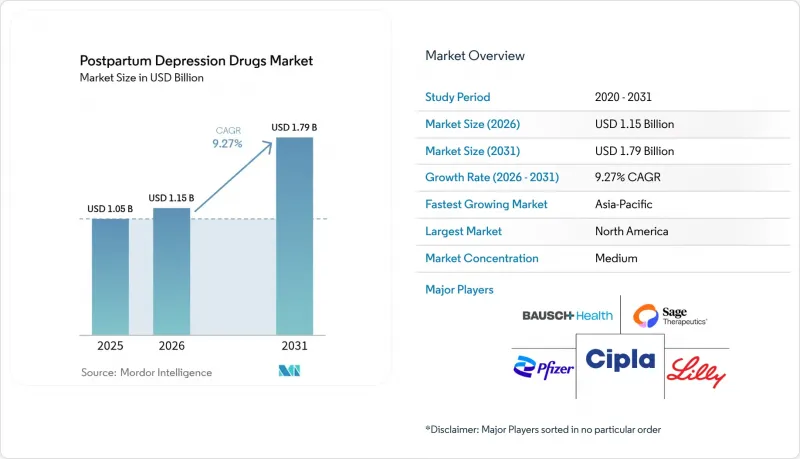
This report Segments the Industry Into by Drug Class (Neuroactive-Steroid Antidepressants, Selective Serotonin Re-Uptake Inhibitors and More), by Route of Administration (Oral, Intravenous and More), by End Users (Hospitals and Clinics, Specialty Centers, Others), and Geography (North America, Europe, Asia-Pacific, and More). The Market Forecasts are Provided in Terms of Value (USD).
Global Postpartum Depression Drugs Market Trends and Insights
Rapid FDA approvals of neuroactive-steroid antidepressants
Zuranolone gained breakthrough designation and priority review, compressing development by 18 to 24 months and signalling agency commitment to rapid-acting maternal therapies. Regulators accepted surrogate endpoints on Hamilton Depression Rating Scale improvements within 14 days, underpinning a more predictable pathway for follow-on compounds. Parallel guidance from the European Medicines Agency and Health Canada mirrors this stance, enlarging the addressable postpartum depression drugs market. Investor confidence has responded with heightened neurosteroid R&D budgets, and clinical pipelines now feature once-daily oral and sublingual candidates aiming for outpatient initiation.
Rising prevalence & screening of postpartum depression
Mandatory HEDIS reporting in 2025 requires US health plans to document screening rates, doubling detection versus a decade earlier. Adoption of the Edinburgh Postnatal Depression Scale in routine obstetric visits uncovers an estimated 50% formerly missed caseload, directly expanding therapy demand inside the postpartum depression drugs market. Smartphone-based assessments and AI blood tests extend reach into rural settings and normalize mental-health check-ups during pediatric appointments. Persistently higher diagnosis triggers payer recognition of unmet need, lending further support to formulary inclusions.
High cost & limited coverage of novel therapies
Although most US payers now list zuranolone, coverage criteria vary and pre-authorization delays blunt its rapid-acting promise. Middle-income families often straddle eligibility thresholds for assistance programs, shouldering burdensome copays. Outside high-income countries, reimbursement pathways for neurosteroids remain scarce, constraining global expansion of the postpartum depression drugs market. Health technology assessors also flag limited long-term efficacy data beyond 45 days, complicating cost-effectiveness decisions compared with generic SSRIs.
Other drivers and restraints analyzed in the detailed report include:
- Favorable reimbursement & maternal-mental-health parity laws
- Growing APAC healthcare spend on maternal mental health
- REMS & safety-monitoring burden for brexanolone
For complete list of drivers and restraints, kindly check the Table Of Contents.
Segment Analysis
Selective serotonin reuptake inhibitors retained 51.58% of postpartum depression drugs market share in 2025, underscoring their entrenched first-line status. The postpartum depression drugs market size for neuroactive-steroid antidepressants is forecast to expand at 9.88% CAGR to 2031, reflecting clinicians' preference for rapid-acting therapies. Neurosteroids modulate GABA-A receptors, addressing hormonal disruptions that follow childbirth more directly than monoamine-based agents, a distinction that resonates with payers and guideline committees. Trial data show symptom relief within 3 days and sustained benefit through 45 days, matching the critical period for maternal-infant bonding.
Traditional classes such as tricyclics continue to shrink amid breastfeeding safety concerns, while serotonin-norepinephrine reuptake inhibitors occupy a small but stable niche when comorbid anxiety prevails. Competitive pipelines now center on once-daily or single-dose neurosteroid candidates and psychedelic analogues, suggesting the postpartum depression drugs market will tilt further toward mechanistic interventions over symptom management.
Complete Report Scope:
- By Drug Class
- Neuroactive-Steroid Antidepressants
- Selective Serotonin Re-uptake Inhibitors
- Serotonin-Norepinephrine Re-uptake Inhibitors
- Tricyclic & Other Classes
- By Route of Administration
- Intravenous
- Oral
- Others
- By Distribution Channel
- Hospital Pharmacies
- Retail Pharmacies
- Online Pharmacies
- By Geography
- North America
- United States
- Canada
- Mexico
- Europe
- Germany
- United Kingdom
- France
- Italy
- Spain
- Rest of Europe
- Asia-Pacific
- China
- India
- Japan
- South Korea
- Australia
- Rest of Asis-Pacific
- South America
- Brazil
- Argentina
- Rest of South America
- Middle East and Africa
- GCC
- South Africa
- Rest of Middle East & Africa
- North America
Geography Analysis
North America dominated with 40.73% of the postpartum depression drugs market in 2025, underpinned by FDA leadership in neurosteroid approvals, expansive insurance parity laws, and high diagnostic rates exceeding 75% in major metropolitan areas. Canada mirrors US regulatory trends, while Mexico's social-security reforms widen maternal mental-health coverage. Ongoing cost-containment debates, especially in rural regions, may temper absolute volume growth, but value gains from rapid-acting therapies remain strong.
Asia-Pacific is the fastest-growing region, advancing at 11.21% CAGR to 2031. China's hospital-based screening mandates and Japan's government-funded postpartum care programs form a template for neighboring markets . Digital health adoption, including AI risk-prediction apps, enables scalable outreach across populous nations such as India and Indonesia. The postpartum depression drugs market size for APAC is expected to accelerate as regulators streamline neurosteroid approvals and private insurers extend maternal riders.
Europe shows steady, policy-driven expansion. Centralized EMA approvals facilitate entry, but national price negotiations cause staggered launches. Germany and the United Kingdom lead uptake owing to robust maternal-mental-health strategies, whereas Southern Europe moves at a measured pace. Long-term efficacy data requests from health technology assessment bodies shape reimbursement timelines yet, once listed, neurosteroids achieve sustained dispensing volumes. Eastern Europe's modernization programs add incremental demand, broadening the regional postpartum depression drugs market.
- Sage Therapeutics
- Biogen
- Pfizer
- Eli Lilly and Company
- GlaxoSmithKline
- Johnson & Johnson
- H. Lundbeck
- Teva Pharmaceutical Industries
- Abbvie
- Novartis
- AstraZeneca
- Sanofi
- Otsuka Pharma
- Mitsubishi Tanabe
- Cipla
- Dr Reddy's
- Sun Pharmaceuticals Industries
- Lupin
- Amneal Pharma
- Takeda Pharmaceuticals
Additional Benefits:
- The market estimate (ME) sheet in Excel format
- 3 months of analyst support
TABLE OF CONTENTS
1 Introduction
- 1.1 Study Assumptions & Market Definition
- 1.2 Scope of the Study
2 Research Methodology
3 Executive Summary
4 Market Landscape
- 4.1 Market Overview
- 4.2 Market Drivers
- 4.2.1 Rapid FDA approvals of neuroactive-steroid antidepressants
- 4.2.2 Rising prevalence & screening of postpartum depression
- 4.2.3 Favorable reimbursement & maternal-mental-health parity laws
- 4.2.4 Growing APAC healthcare spend on maternal mental health
- 4.2.5 Digital therapeutic companions boosting adherence
- 4.2.6 Shift toward outpatient-friendly oral regimens
- 4.3 Market Restraints
- 4.3.1 High cost & limited coverage of novel therapies
- 4.3.2 REMS & safety-monitoring burden for brexanolone
- 4.3.3 Limited long-term efficacy data for zuranolone
- 4.3.4 Neurosteroid API supply-chain bottlenecks
- 4.4 Value / Supply-Chain Analysis
- 4.5 Regulatory Landscape
- 4.6 Technological Outlook
- 4.7 Porter's Five Forces
- 4.7.1 Threat of New Entrants
- 4.7.2 Bargaining Power of Suppliers
- 4.7.3 Bargaining Power of Buyers
- 4.7.4 Threat of Substitutes
- 4.7.5 Competitive Rivalry
5 Market Size & Growth Forecasts (Value)
- 5.1 By Drug Class
- 5.1.1 Neuroactive-Steroid Antidepressants
- 5.1.2 Selective Serotonin Re-uptake Inhibitors
- 5.1.3 Serotonin-Norepinephrine Re-uptake Inhibitors
- 5.1.4 Tricyclic & Other Classes
- 5.2 By Route of Administration
- 5.2.1 Intravenous
- 5.2.2 Oral
- 5.2.3 Others
- 5.3 By Distribution Channel
- 5.3.1 Hospital Pharmacies
- 5.3.2 Retail Pharmacies
- 5.3.3 Online Pharmacies
- 5.4 By Geography
- 5.4.1 North America
- 5.4.1.1 United States
- 5.4.1.2 Canada
- 5.4.1.3 Mexico
- 5.4.2 Europe
- 5.4.2.1 Germany
- 5.4.2.2 United Kingdom
- 5.4.2.3 France
- 5.4.2.4 Italy
- 5.4.2.5 Spain
- 5.4.2.6 Rest of Europe
- 5.4.3 Asia-Pacific
- 5.4.3.1 China
- 5.4.3.2 India
- 5.4.3.3 Japan
- 5.4.3.4 South Korea
- 5.4.3.5 Australia
- 5.4.3.6 Rest of Asis-Pacific
- 5.4.4 South America
- 5.4.4.1 Brazil
- 5.4.4.2 Argentina
- 5.4.4.3 Rest of South America
- 5.4.5 Middle East and Africa
- 5.4.5.1 GCC
- 5.4.5.2 South Africa
- 5.4.5.3 Rest of Middle East & Africa
- 5.4.1 North America
6 Competitive Landscape
- 6.1 Market Concentration
- 6.2 Market Share Analysis
- 6.3 Company Profiles (includes Global level Overview, Market level overview, Core Segments, Financials as available, Strategic Information, Market Rank/Share for key companies, Products & Services, and Recent Developments)
- 6.3.1 Sage Therapeutics
- 6.3.2 Biogen
- 6.3.3 Pfizer
- 6.3.4 Eli Lilly
- 6.3.5 GlaxoSmithKline
- 6.3.6 Johnson & Johnson (Janssen)
- 6.3.7 H. Lundbeck
- 6.3.8 Teva Pharmaceutical
- 6.3.9 AbbVie
- 6.3.10 Novartis
- 6.3.11 AstraZeneca
- 6.3.12 Sanofi
- 6.3.13 Otsuka Pharma
- 6.3.14 Mitsubishi Tanabe
- 6.3.15 Cipla
- 6.3.16 Dr Reddy's
- 6.3.17 Sun Pharma
- 6.3.18 Lupin
- 6.3.19 Amneal Pharma
- 6.3.20 Takeda
7 Market Opportunities & Future Outlook
- 7.1 White-space & Unmet-need Assessment

