PUBLISHER: Mordor Intelligence | PRODUCT CODE: 2116556

PUBLISHER: Mordor Intelligence | PRODUCT CODE: 2116556
Global Surgical Booms - Market Share Analysis, Industry Trends & Statistics, Growth Forecasts (2026 - 2031)
According to Mordor Intelligence, the surgical booms market size is expected to grow from USD 507.80 million in 2025 to USD 531.26 million in 2026 and is forecast to reach USD 665.97 million by 2031 at 4.62% CAGR over 2026-2031.
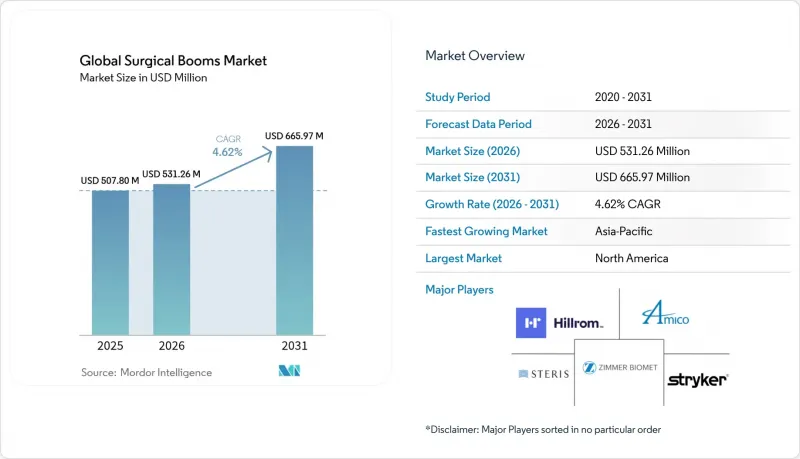
This report is Segmented by Product Type (Equipment Booms, Anesthesia Booms and More), by Arm (Single-Arm, Dual-Arm and More), by Power and Rotation Management (Mechanical, Electromagnetic Brake and More), and Geography (North America, Europe, Asia-Pacific and More). The Market Forecasts are Provided in Terms of Value (USD).
Global Surgical Booms Market Trends and Insights
Rapid Hybrid-OR Build-outs in Tertiary Hospitals
Tertiary hospitals are accelerating hybrid suite construction to merge open surgery and advanced imaging. Vancouver General Hospital's 2025 expansion added 15 rooms and upgraded a hybrid suite, lifting annual cases above 19,000. Virtua Health's USD 500 million project introduces 10 rooms, two of which are hybrid, specifically supporting high-acuity cardiovascular and gastrointestinal interventions. These spaces need booms that can bear heavier payloads, route complex utilities, and integrate seamlessly with imaging and robotics, driving premium demand across the Surgical Booms market.
Ambulatory Surgery Center Proliferation in OECD Nations
The United States hosted 11,555 ASCs by mid-2024, representing a USD 43.1 billion setting with 2.88 rooms per center. Medicare beneficiaries treated at ASCs climbed to 3.4 million in 2023. ASC owners prefer ceiling systems that shorten turnover, streamline visualization, and fit lower ceiling heights typical of outpatient builds, underpinning steady intake in the Surgical Booms market.
High Retrofit Cost for Brown-field ORs
Renovation consumes 35-55% of new-build budgets, with healthcare construction averaging USD 700-730 per sq ft. St. Francis Hospital's cardiac unit upgrade cost USD 2.2 million and required temporary closures. Such expense discourages some mature facilities from installing new ceiling platforms, muting a portion of near-term demand inside the Surgical Booms market.
Other drivers and restraints analyzed in the detailed report include:
- Post-COVID Backlog Driving Procedure-Room Expansion
- Rising Adoption of Integrated OR-IT & Video Routing Platforms
- Extended Procurement Cycles & Facility-Planner Shortages
For complete list of drivers and restraints, kindly check the Table Of Contents.
Segment Analysis
Equipment Booms retained 47.78% revenue in 2025 because they anchor anesthesia workstations, imaging displays, and surgical lights within compact footprints. Hybrid/Combination Booms, although smaller in base, exhibit a 4.98% CAGR thanks to rising universal-room strategies. Vancouver General Hospital's build underscores how versatile booms allow any procedure in any room. CleanSuite by Steris illustrates the trend by delivering ISO Class 5 sterility with 40% cost savings and six-fold faster installs. Integration pressure keeps Equipment Booms central to the Surgical Booms market, while combination units promise the headroom for future tech additions.
Complete Report Scope:
- By Product Type (Value)
- Equipment Booms
- Anesthesia Booms
- Utility / Service Booms
- Hybrid / Combination Booms
- By Arm Type (Value)
- Single-Arm
- Dual-Arm
- Multi-Arm
- By Power & Rotation Mechanism (Value)
- Mechanical Brake
- Electromagnetic Brake
- Electric Motorized
- By Geography (Value)
- North America
- United States
- Canada
- Mexico
- Europe
- Germany
- United Kingdom
- France
- Italy
- Spain
- Rest of Europe
- Asia-Pacific
- China
- India
- Japan
- South Korea
- Australia
- Rest of Asia-Pacific
- South America
- Brazil
- Argentina
- Rest of South America
- Middle East and Africa
- GCC
- South Africa
- Rest of Middle East and Africa
- North America
Geography Analysis
North America generated 41.88% of 2025 revenues, buoyed by well-funded capital budgets and early adoption of surgical robotics. Reimbursement stability allows hospitals to replace ceiling equipment on predictable cycles, and updated building codes mandate higher availability rates-trends that collectively sustain purchasing activity in the Surgical Booms market.
Europe shows mid-single-digit growth anchored by decarbonization directives. The EU's focus on energy-efficient infrastructure compels facilities to specify modular ceiling utilities compatible with smart HVAC, which raises demand for next-generation booms. Ageing populations further elevate procedure volumes, lending resilience to European contributions within the Surgical Booms market.
Asia-Pacific is advancing at 6.78% CAGR. China's hospital construction outlays exceed USD 75 billion for 2020-2025, while India's leading chains intend to add 17,800 beds via ₹14,600 crore programs. Getinge seeks to raise its Indian share from 30% to 45%, illustrating competitive heat. Multilateral funding from the Asian Infrastructure Investment Bank eases capital constraints for public builds, enlarging the addressable Surgical Booms market across emerging Asia.
- Stryker
- Steris plc
- Skytron
- Getinge AB (Maquet)
- Dragerwerk
- Trumpf Medical
- Amico Corporation
- Ondal Medical Systems
- Hillrom (Baxter)
- Mindray
- Olympus
- Shenzhen Keling Medical
- Karl Storz
- Mediland Enterprise Corp.
- BeaconMedaes (Atlas Copco)
- Starkstrom
- Hipac Healthcare
- Sigma-Medical
- Fuji Booms
- Pronk Technologies
Additional Benefits:
- The market estimate (ME) sheet in Excel format
- 3 months of analyst support
TABLE OF CONTENTS
1 Introduction
- 1.1 Study Assumptions & Market Definition
- 1.2 Scope of the Study
2 Research Methodology
3 Executive Summary
4 Market Landscape
- 4.1 Market Overview
- 4.2 Market Drivers
- 4.2.1 Rapid hybrid-OR build-outs in tertiary hospitals
- 4.2.2 Ambulatory Surgery Center (ASC) proliferation in OECD nations
- 4.2.3 Rising adoption of integrated OR-IT & video routing platforms
- 4.2.4 Post-COVID backlog driving procedure-room expansion
- 4.2.5 IoT-enabled predictive-maintenance contracts for booms
- 4.2.6 Hospital decarbonization targets favouring modular ceiling utilities
- 4.3 Market Restraints
- 4.3.1 High retrofit cost for brown-field ORs
- 4.3.2 Extended procurement cycles & facility-planner shortages
- 4.3.3 Supply-chain bottlenecks in medical-gas connectors & bearings
- 4.3.4 Limited reimbursement linkage for capital OR fixtures
- 4.4 Supply-Chain Analysis
- 4.5 Regulatory Landscape
- 4.6 Technological Outlook
- 4.7 Porter's Five Forces
- 4.7.1 Threat of New Entrants
- 4.7.2 Bargaining Power of Suppliers
- 4.7.3 Bargaining Power of Buyers
- 4.7.4 Threat of Substitutes
- 4.7.5 Competitive Rivalry
5 Market Size & Growth Forecasts
- 5.1 By Product Type (Value)
- 5.1.1 Equipment Booms
- 5.1.2 Anesthesia Booms
- 5.1.3 Utility / Service Booms
- 5.1.4 Hybrid / Combination Booms
- 5.2 By Arm Type (Value)
- 5.2.1 Single-Arm
- 5.2.2 Dual-Arm
- 5.2.3 Multi-Arm
- 5.3 By Power & Rotation Mechanism (Value)
- 5.3.1 Mechanical Brake
- 5.3.2 Electromagnetic Brake
- 5.3.3 Electric Motorized
- 5.4 By Geography (Value)
- 5.4.1 North America
- 5.4.1.1 United States
- 5.4.1.2 Canada
- 5.4.1.3 Mexico
- 5.4.2 Europe
- 5.4.2.1 Germany
- 5.4.2.2 United Kingdom
- 5.4.2.3 France
- 5.4.2.4 Italy
- 5.4.2.5 Spain
- 5.4.2.6 Rest of Europe
- 5.4.3 Asia-Pacific
- 5.4.3.1 China
- 5.4.3.2 India
- 5.4.3.3 Japan
- 5.4.3.4 South Korea
- 5.4.3.5 Australia
- 5.4.3.6 Rest of Asia-Pacific
- 5.4.4 South America
- 5.4.4.1 Brazil
- 5.4.4.2 Argentina
- 5.4.4.3 Rest of South America
- 5.4.5 Middle East and Africa
- 5.4.5.1 GCC
- 5.4.5.2 South Africa
- 5.4.5.3 Rest of Middle East and Africa
- 5.4.1 North America
6 Competitive Landscape
- 6.1 Market Concentration
- 6.2 Market Share Analysis
- 6.3 Company Profiles {(includes Global level Overview, Market level overview, Core Segments, Financials as available, Strategic Information, Market Rank/Share for key companies, Products & Services, and Recent Developments)}
- 6.3.1 Stryker Corporation
- 6.3.2 Steris plc
- 6.3.3 Skytron, LLC
- 6.3.4 Getinge AB (Maquet)
- 6.3.5 Dragerwerk AG & Co. KGaA
- 6.3.6 Trumpf Medical
- 6.3.7 Amico Corporation
- 6.3.8 Ondal Medical Systems GmbH
- 6.3.9 Hillrom (Baxter)
- 6.3.10 Mindray Medical International
- 6.3.11 Olympus Corporation
- 6.3.12 Shenzhen Keling Medical
- 6.3.13 KARL STORZ GmbH & Co. KG
- 6.3.14 Mediland Enterprise Corp.
- 6.3.15 BeaconMedaes (Atlas Copco)
- 6.3.16 Starkstrom
- 6.3.17 Hipac Healthcare
- 6.3.18 Sigma-Medical
- 6.3.19 Fuji Booms
- 6.3.20 Pronk Technologies
7 Market Opportunities & Future Outlook
- 7.1 White-space & Unmet-Need Assessment

