PUBLISHER: Mordor Intelligence | PRODUCT CODE: 2116558

PUBLISHER: Mordor Intelligence | PRODUCT CODE: 2116558
Global Barbiturate Drugs - Market Share Analysis, Industry Trends & Statistics, Growth Forecasts (2026 - 2031)
According to Mordor Intelligence, barbiturate market size in 2026 is estimated at USD 522.19 million, growing from 2025 value of USD 507.77 million with 2031 projections showing USD 600.98 million, growing at 2.84% CAGR over 2026-2031.
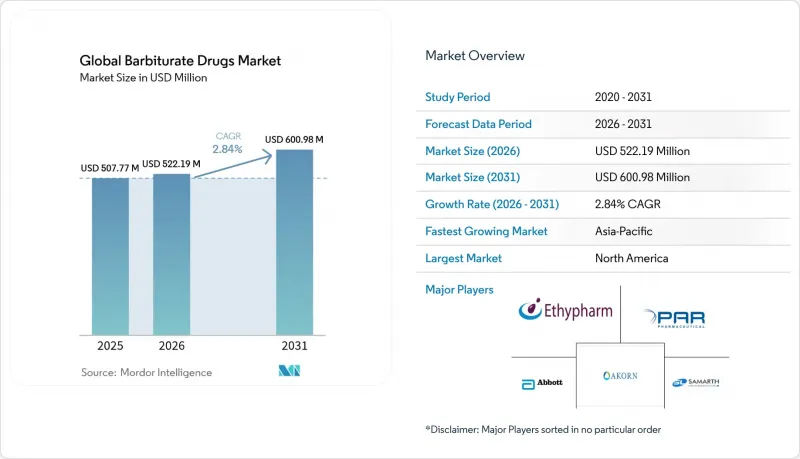
This report is Segmented by Drug Type (Ultra-Short-Acting, Short-Acting, Intermediate-Acting, Long-Acting), Application (Epilepsy, Insomnia, Pre-Operative and More), Route of Administration (Oral, Intravenous), Distribution Channel (Hospital Pharmacies, Retail Pharmacies, and More), and Geography (North America, Europe, Asia-Pacific, and More). The Market Forecasts are Provided in Terms of Value (USD).
Global Barbiturate Drugs Market Trends and Insights
Rising Prevalence of Drug-Resistant Epilepsy
Roughly 30% of patients with epilepsy remain refractory to first-line antiepileptic drugs, sustaining a dependable demand pool for phenobarbital and related compounds. The International League Against Epilepsy reinforces phenobarbital's role for refractory seizures, especially where cost containment steers formulary choices. Randomized trials show 24-hour seizure freedom in 80% of phenobarbital-treated refractory cases versus 28% for levetiracetam, sharpening clinicians' focus on time-tested GABA-ergic agents in critical episodes. Precision medicine also favors the barbiturate market as genetic sub-groups with preferable response profiles are increasingly identified through next-generation sequencing. As treatment algorithms mature, barbiturates retain a solid footing in resource-limited health systems and tertiary epilepsy centers alike.
Growing Use of Phenobarbital in Neonatal Care Protocols
The 2024 FDA approval of Sezaby marked the first neonatal-specific phenobarbital formulation, cementing its primacy in treating neonatal seizures. Comparative trials show superior seizure control relative to levetiracetam despite elevated respiratory-monitoring requirements, prompting NICUs to formalize phenobarbital-centric algorithms. Cost advantages of generic phenobarbital further bolster adoption in middle-income countries where neonatal intensive care is scaling rapidly. As protocol adherence improves, hospital purchase orders for injectable phenobarbital have risen, supporting predictable barbiturate market demand. Real-world data are now integrated into AI-driven dosing dashboards, refining therapeutic windows in vulnerable newborns.
Regulatory Push Toward Benzodiazepine Substitution
DEA scheduling places most barbiturates in Schedule II, subjecting clinicians to stricter log-keeping and inventory audits than for Schedule IV benzodiazepines. Major insurers require prior authorizations, adding administrative overhead that dissuades routine barbiturate prescribing. Updated guidelines from anesthesiology and psychiatry societies further cement benzodiazepines as first-line, squeezing short-term barbiturate volume. Despite recognized niche value, administrative drag and shifting formularies temper near-term adoption rates.
Other drivers and restraints analyzed in the detailed report include:
- Demand for Rapid-Onset Anesthetics in Emergent Surgeries
- Uptick in Medically-Induced Coma Procedures for TBI
- Narrow Therapeutic Index Driving Malpractice Premiums
For complete list of drivers and restraints, kindly check the Table Of Contents.
Segment Analysis
Long-acting compounds retained 38.75% share of the barbiturate market size in 2025, reflecting their cornerstone role in epilepsy and chronic sedation. Yet ultra-short-acting versions are charting a 4.12% CAGR owing to their utility in emergent anesthesia and rapid sequence intubation. Methohexital's swift onset and offset enable same-day discharge, reducing bed occupancy and improving cost metrics for ambulatory surgery centers. Growth is further lifted by process patents covering solubilizing excipients that improve stability and diminish pain on injection. Short-acting and intermediate-acting variants maintain mid-tier positions, servicing specific neurosurgical and psychiatric needs where duration balance matters.
Clinicians gravitate toward pharmacokinetic predictability, a trait amplified in ultra-short-acting iterations that dovetail with real-time anesthesia depth monitors. At the same time, the sustained demand for long-acting agents in refractory epilepsy ensures a resilient revenue base within the barbiturate market. Manufacturers therefore pursue portfolio breadth, producing both depot and flash-acting SKUs, hedging against therapeutic shifts while capturing emerging procedure-driven sales.
Epilepsy protocols anchored 46.15% of barbiturate market share in 2025, a testament to phenobarbital's longevity in seizure control. However, insomnia accounts are beginning to swell at a 4.86% CAGR as sleep specialists revisit barbiturate efficacy for therapy-resistant cases. Renewed clinical interest is fed by real-world reports of improved sleep architecture in psychiatric comorbidity populations versus non-barbiturate hypnotics. Pre-operative sedation remains a dependable mid-volume segment, with surgeons valuing titratable depth under hemodynamically fragile conditions. Medically induced comas, though comparatively niche, deliver consistent high-value demand tied to neurocritical care centers where lives hinge on strict intracranial pressure management.
This pluralistic demand profile fortifies the barbiturate market against abrupt downturns, ensuring that pressure on one indication does not derail overall revenue trajectories. Insomnia-related uptake also spurs formulation R&D, with micro-granulated oral dispersible tablets entering late-stage development.
Complete Report Scope:
- By Drug Type (Value)
- Ultra-short-acting
- Short-acting
- Intermediate-acting
- Long-acting
- By Application (Value)
- Epilepsy
- Insomnia
- Pre-operative Sedation
- Medically-Induced Coma
- By Route of Administration (Value)
- Oral
- Intravenous
- By Distribution Channel (Value)
- Hospital Pharmacies
- Retail Pharmacies
- Online Pharmacies
- By Geography (Value)
- North America
- United States
- Canada
- Mexico
- Europe
- Germany
- United Kingdom
- France
- Italy
- Spain
- Rest of Europe
- Asia-Pacific
- China
- India
- Japan
- South Korea
- Australia
- Rest of Asia-Pacific
- South America
- Brazil
- Argentina
- Rest of South America
- Middle East and Africa
- GCC
- South Africa
- Rest of Middle East and Africa
- North America
Geography Analysis
North America exerted 41.70% control of the global barbiturate market in 2025, bolstered by advanced neurotrauma centers, robust payer frameworks, and calibrated DEA production quotas that secure medicinal access while curtailing diversion. Hospitals routinely deploy barbiturate coma therapy in severe TBI, a practice embedded in Level I trauma guidelines. Canadian provinces similarly maintain phenobarbital on restricted formularies for cost-efficient epilepsy control, underpinning consistent regional procurement.
Asia-Pacific is slated for an 7.75% CAGR, driven by India's active pharmaceutical ingredient dominance and China's scale manufacturing prowess, both endorsed by successful USFDA audits that unlock Western market channels. Expanded health-insurance schemes across Southeast Asia further stimulate demand for economical seizure medication in rural clinics. Meanwhile, tertiary hospitals in Korea and Japan are incorporating ultra-short-acting barbiturates into anesthesia bundles, diversifying regional consumption drivers.
Europe shows measured expansion under unified EMA oversight that expedites mutual recognition of barbiturate dossiers, maintaining patient access within stringent pharmacovigilance frameworks. Germany and France display modest uptake in insomnia off-label uses under specialist supervision. South America and the Middle East & Africa trail but reveal upside as surgical capacity and neurocritical care capabilities mature; multilateral aid projects often include phenobarbital in essential-drug packages, laying foundations for broader barbiturate market penetration.
- Hikma Pharmaceuticals
- Pfizer
- Teva Pharmaceutical Industries
- Fresenius
- Bausch Health
- Sanofi
- Indoco Remedies Ltd.
- Senores Pharma Pvt Ltd.
- Aspen Pharmacare Holdings Ltd.
- Dr. Reddy's Laboratories Ltd.
- Viatris
- Sun Pharmaceuticals Industries
- Aurobindo Pharma Ltd.
- Mallinckrodt Pharmaceuticals
- Par Pharmaceutical (Endo)
- Accord Healthcare (Intas)
- Mayne Pharma Group Ltd.
Additional Benefits:
- The market estimate (ME) sheet in Excel format
- 3 months of analyst support
TABLE OF CONTENTS
1 Introduction
- 1.1 Study Assumptions & Market Definition
- 1.2 Scope of the Study
2 Research Methodology
3 Executive Summary
4 Market Landscape
- 4.1 Market Overview
- 4.2 Market Drivers
- 4.2.1 Rising prevalence of drug-resistant epilepsy
- 4.2.2 Growing use of phenobarbital in neonatal care protocols
- 4.2.3 Demand for rapid-onset anesthetics in emergent surgeries
- 4.2.4 Uptick in medically-induced coma procedures for TBI
- 4.2.5 Surging low-cost generic production in India & China
- 4.2.6 AI-guided drug-screening panels boosting phenobarbital demand
- 4.3 Market Restraints
- 4.3.1 Regulatory push toward benzodiazepine substitution
- 4.3.2 Narrow therapeutic index driving malpractice premiums
- 4.3.3 Global thiopental API shortages after GMP plant closures
- 4.3.4 Growing payor restrictions on Schedule II sedatives
- 4.4 Value / Supply-Chain Analysis
- 4.5 Regulatory Landscape
- 4.6 Technological Outlook
- 4.7 Porter's Five Forces
- 4.7.1 Threat of New Entrants
- 4.7.2 Bargaining Power - Suppliers
- 4.7.3 Bargaining Power - Buyers
- 4.7.4 Threat of Substitutes
- 4.7.5 Competitive Rivalry
5 Market Size & Growth Forecasts
- 5.1 By Drug Type (Value)
- 5.1.1 Ultra-short-acting
- 5.1.2 Short-acting
- 5.1.3 Intermediate-acting
- 5.1.4 Long-acting
- 5.2 By Application (Value)
- 5.2.1 Epilepsy
- 5.2.2 Insomnia
- 5.2.3 Pre-operative Sedation
- 5.2.4 Medically-Induced Coma
- 5.3 By Route of Administration (Value)
- 5.3.1 Oral
- 5.3.2 Intravenous
- 5.4 By Distribution Channel (Value)
- 5.4.1 Hospital Pharmacies
- 5.4.2 Retail Pharmacies
- 5.4.3 Online Pharmacies
- 5.5 By Geography (Value)
- 5.5.1 North America
- 5.5.1.1 United States
- 5.5.1.2 Canada
- 5.5.1.3 Mexico
- 5.5.2 Europe
- 5.5.2.1 Germany
- 5.5.2.2 United Kingdom
- 5.5.2.3 France
- 5.5.2.4 Italy
- 5.5.2.5 Spain
- 5.5.2.6 Rest of Europe
- 5.5.3 Asia-Pacific
- 5.5.3.1 China
- 5.5.3.2 India
- 5.5.3.3 Japan
- 5.5.3.4 South Korea
- 5.5.3.5 Australia
- 5.5.3.6 Rest of Asia-Pacific
- 5.5.4 South America
- 5.5.4.1 Brazil
- 5.5.4.2 Argentina
- 5.5.4.3 Rest of South America
- 5.5.5 Middle East and Africa
- 5.5.5.1 GCC
- 5.5.5.2 South Africa
- 5.5.5.3 Rest of Middle East and Africa
- 5.5.1 North America
6 Competitive Landscape
- 6.1 Market Concentration
- 6.2 Market Share Analysis
- 6.3 Company Profiles (includes Global level Overview, Market level overview, Core Segments, Financials as available, Strategic Information, Market Rank/Share for key companies, Products & Services, and Recent Developments)
- 6.3.1 Hikma Pharmaceuticals PLC
- 6.3.2 Pfizer Inc.
- 6.3.3 Teva Pharmaceutical Industries Ltd.
- 6.3.4 Fresenius Kabi AG
- 6.3.5 Bausch Health Companies Inc.
- 6.3.6 Sanofi SA
- 6.3.7 Indoco Remedies Ltd.
- 6.3.8 Senores Pharma Pvt Ltd.
- 6.3.9 Aspen Pharmacare Holdings Ltd.
- 6.3.10 Dr. Reddy's Laboratories Ltd.
- 6.3.11 Viatris Inc.
- 6.3.12 Sun Pharmaceutical Industries Ltd.
- 6.3.13 Aurobindo Pharma Ltd.
- 6.3.14 Mallinckrodt Pharmaceuticals
- 6.3.15 Par Pharmaceutical (Endo)
- 6.3.16 Accord Healthcare (Intas)
- 6.3.17 Mayne Pharma Group Ltd.
7 Market Opportunities & Future Outlook
- 7.1 White-space & Unmet-Need Assessment

