PUBLISHER: Mordor Intelligence | PRODUCT CODE: 2116566

PUBLISHER: Mordor Intelligence | PRODUCT CODE: 2116566
Europe Vascular Access Device - Market Share Analysis, Industry Trends & Statistics, Growth Forecasts (2026 - 2031)
According to Mordor Intelligence, the Europe vascular access devices market size is expected to grow from USD 1.64 billion in 2025 to USD 1.75 billion in 2026 and is forecast to reach USD 2.39 billion by 2031 at 6.47% CAGR over 2026-2031.
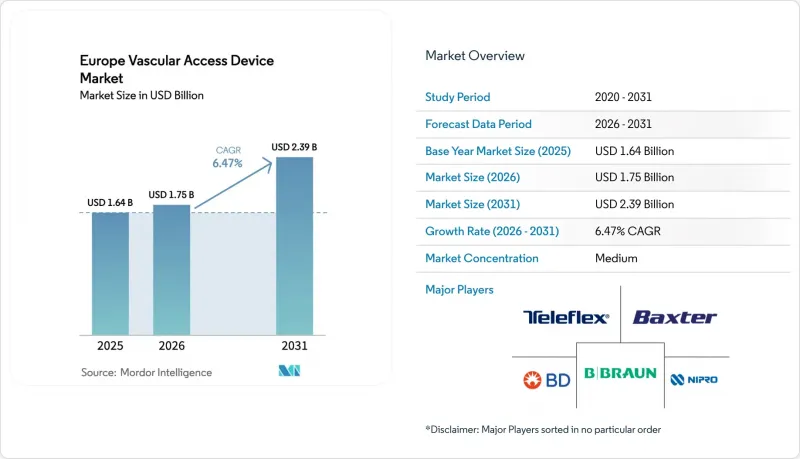
This report is Segmented by Device Type (Central Vascular Access Devices and Peripheral Vascular Access Devices), Application (Medication or Drug Administration, Fluid and Nutrition Administration, and More), End User (Hospitals & Clinics, and More), Material (Polyurethane, Silicone, and Others), and Geography (Germany, and More). The Market and Forecasts are Provided in Terms of Value (USD).
Europe Vascular Access Device Market Trends and Insights
Growing prevalence of chronic diseases
Europe's aging profile is increasing the incidence of cardiovascular, renal, and metabolic illnesses that require sustained venous access. By 2030, 22.9% of Europeans will be 65 years or older, and vascular procedures are projected to rise by 40.5%, underscoring the need for durable and low-complication catheters. Hospitals therefore favor antimicrobial-coated central lines, and peripheral midlines are gaining acceptance for outpatient follow-up. Device makers respond with hydrophilic biomaterials that resist thrombus formation, while clinicians expand ultrasound-guided insertion to minimize multiple punctures and unplanned replacements. Collectively, these trends reinforce steady demand across the Europe vascular access devices market as chronic-care pathways lengthen and readmission penalties tighten.
Rising number of chemotherapy procedures & high hospitalization
Oncology centers depend on reliable venous access to administer multidrug regimens that can last several months. Central venous ports show lower infection rates than tunneled catheters in pediatric cases, prompting wide adoption in children's hospitals. Adult oncology units also prefer implantable ports because fewer dressing changes reduce nursing burden and permit outpatient regimens. The result is heightened consumption of power-injectable ports and accessories, a key volume driver in the Europe vascular access devices market. Competition now centers on thin-walled designs that withstand high flow rates for contrast media while meeting new EU-MDR mechanical-integrity testing.
Risks & complications associated with catheter use
Central line infections remain a persistent obstacle . Greek intensive-care units record 8.6 bloodstream infections per 1,000 catheter-days, extending patient stays by nearly 19 days and adding mortality of 20.1%. Similar patterns in Polish ICUs show catheter-associated urinary infections affecting 8.83% of patients. Peripheral infiltration injuries occur in 5.4% of monitored infusions despite adherence to best-practice guidelines. These incidents elevate malpractice costs, slow device turnover, and oblige hospitals to favor proven brands, capping short-term volume uplift in the Europe vascular access devices market .
Other drivers and restraints analyzed in the detailed report include:
- Increasing pediatric utilization of VADs
- Shift toward home-infusion therapies in Europe
- Stringent regulations & product recalls
For complete list of drivers and restraints, kindly check the Table Of Contents.
Segment Analysis
Central lines continued to account for 54.86% of revenue in 2025 as oncologists and critical-care teams rely on ports and tunneled catheters for multidose regimens. At the same time, peripheral alternatives recorded the highest 7.29% CAGR, reflecting clinician preference for lower-risk insertion sites and growing ultrasound-guided competency. New hydrophilic midline formats reduce thrombus formation by 96%, and antimicrobial polyurethane hubs exhibit 99.998% lower bacterial adhesion than standard plastics. Vendors are integrating blood-draw valves into peripherally inserted central catheters to support lab sampling without additional sticks, a feature valued in pediatric wards.
Integrated short peripheral cannulas increasingly carry closed systems that limit exposure, extending dwell times beyond 96 hours. Mid-sized hospitals adopt device-agility protocols that graduate patients from short cannulas to midlines rather than directly to central lines, tightening the cycle time between admissions and discharge. As a result, purchasing committees reevaluate the optimal mix of catheter SKUs, buoying unit shipments of peripheral devices within the Europe vascular access devices market. However, central implants remain irreplaceable for power-injection imaging and vesicant therapy, ensuring sustained baseline demand.
Medication delivery absorbed 38.02% of the Europe vascular access devices market size in 2025, driven by continual antimicrobial and chemotherapy infusion. Diagnostics and testing, though smaller, accelerate at a 7.36% CAGR to 2031 as point-of-care protocols mandate repeat blood draws. Manufacturers therefore package needle-free connectors with sample-optimized flow paths, addressing contamination risks. Sensor-enabled cannulas detect occlusions in real time, improving sample integrity and curtailing repeat sticks that can inflate consumable costs.
Blood-product transfusion lines benefit from closed-loop identification systems that synchronize with hospital information technology, cutting mismatch errors. Nutrition-delivery applications remain steady amid an aging patient population requiring long-term parenteral support in nursing facilities. Many facilities now update flush policy every 12 hours, lifting saline and heparin lock solution sales. With wider adoption of dual-lumen catheters in oncology, the Europe vascular access devices market positions itself to capture both therapeutic and diagnostic revenues in a single procedure.
Complete Report Scope:
- By Device Type
- Central Vascular Access Devices
- Peripherally-Inserted Central Catheters (PICCs)
- Non-tunnelled Catheters
- Tunnelled Catheters
- Other Central Vascular Access Devices
- Peripheral Vascular Access Devices
- Peripheral IV Catheters (PIVC)
- Midline Catheters
- Other Peripheral Vascular Access Devices
- Central Vascular Access Devices
- By Application
- Medication or Drug Administration
- Fluid and Nutrition Administration
- Blood and Blood-Product Transfusion
- Diagnostics and Testing
- Other Applications
- By End User
- Hospitals & Clinics
- Ambulatory Surgery Centers
- Others
- By Material
- Polyurethane
- Silicone
- Others
- By Geography
- Germany
- United Kingdom
- France
- Italy
- Spain
- Rest of Europe
List of Companies Covered in this Report:
- Beckton Dickinson
- B. Braun
- Baxter
- ICU Medical
- Teleflex
- Edward Lifesciences
- AngioDynamics
- Terumo
- Nipro
- Medtronic
- Fresenius
- Vygon
- VascuLogic
- Access Scientific LLC
- Poly Medicure Ltd.
- Merit Medical Systems
- Penumbra
- Cook Group
- Vantex (Vascular Technology Inc.)
- GBUK Group
- VasoVet
Additional Benefits:
- The market estimate (ME) sheet in Excel format
- 3 months of analyst support
TABLE OF CONTENTS
1 Introduction
- 1.1 Study Assumptions & Market Definition
- 1.2 Scope of the Study
2 Research Methodology
3 Executive Summary
4 Market Landscape
- 4.1 Market Overview
- 4.2 Market Drivers
- 4.2.1 Growing prevalence of chronic diseases
- 4.2.2 Rising number of chemotherapy procedures & high hospitalization
- 4.2.3 Increasing pediatric utilization of VADs
- 4.2.4 Shift toward home-infusion therapies in Europe
- 4.2.5 EU-MDR-driven adoption of antimicrobial-coated catheters
- 4.2.6 Pilots of sensor-enabled catheters for IV infiltration alerts
- 4.3 Market Restraints
- 4.3.1 Risks & complications associated with catheter use
- 4.3.2 Stringent regulations & product recalls
- 4.3.3 Polyurethane supply-chain vulnerability
- 4.3.4 Growth of needle-free connectors cannibalising short PIVCs
- 4.4 Regulatory Landscape
- 4.5 Technological Outlook
- 4.6 Porters Five Forces Analysis
- 4.6.1 Threat of New Entrants
- 4.6.2 Bargaining Power of Buyers/Consumers
- 4.6.3 Bargaining Power of Suppliers
- 4.6.4 Threat of Substitute Products
- 4.6.5 Intensity of Competitive Rivalry
5 Market Size & Growth Forecasts (Value, USD)
- 5.1 By Device Type
- 5.1.1 Central Vascular Access Devices
- 5.1.1.1 Peripherally-Inserted Central Catheters (PICCs)
- 5.1.1.2 Non-tunnelled Catheters
- 5.1.1.3 Tunnelled Catheters
- 5.1.1.4 Other Central Vascular Access Devices
- 5.1.2 Peripheral Vascular Access Devices
- 5.1.2.1 Peripheral IV Catheters (PIVC)
- 5.1.2.2 Midline Catheters
- 5.1.2.3 Other Peripheral Vascular Access Devices
- 5.1.1 Central Vascular Access Devices
- 5.2 By Application
- 5.2.1 Medication or Drug Administration
- 5.2.2 Fluid and Nutrition Administration
- 5.2.3 Blood and Blood-Product Transfusion
- 5.2.4 Diagnostics and Testing
- 5.2.5 Other Applications
- 5.3 By End User
- 5.3.1 Hospitals & Clinics
- 5.3.2 Ambulatory Surgery Centers
- 5.3.3 Others
- 5.4 By Material
- 5.4.1 Polyurethane
- 5.4.2 Silicone
- 5.4.3 Others
- 5.5 By Geography
- 5.5.1 Germany
- 5.5.2 United Kingdom
- 5.5.3 France
- 5.5.4 Italy
- 5.5.5 Spain
- 5.5.6 Rest of Europe
6 Competitive Landscape
- 6.1 Market Concentration
- 6.2 Market Share Analysis
- 6.3 Company Profiles (includes Global level Overview, Market level Overview, Core Segments, Financials as available, Strategic Information, Market Rank/Share, Products & Services, Recent Developments)
- 6.3.1 Becton, Dickinson and Company
- 6.3.2 B. Braun SE
- 6.3.3 Baxter International
- 6.3.4 ICU Medical Inc.
- 6.3.5 Teleflex Incorporated
- 6.3.6 Edwards Lifesciences Corporation
- 6.3.7 AngioDynamics
- 6.3.8 Terumo Corporation
- 6.3.9 Nipro Corporation
- 6.3.10 Medtronic plc
- 6.3.11 Fresenius Medical Care AG & Co. KGaA
- 6.3.12 Vygon SA
- 6.3.13 VascuLogic
- 6.3.14 Access Scientific LLC
- 6.3.15 Poly Medicure Ltd.
- 6.3.16 Merit Medical Systems
- 6.3.17 Penumbra, Inc
- 6.3.18 Cook Medical
- 6.3.19 Vantex (Vascular Technology Inc.)
- 6.3.20 GBUK Group
- 6.3.21 VasoVet
7 Market Opportunities & Future Outlook
- 7.1 White-space & Unmet-need Assessment

