PUBLISHER: Mordor Intelligence | PRODUCT CODE: 2116568

PUBLISHER: Mordor Intelligence | PRODUCT CODE: 2116568
Restorative Dentistry - Market Share Analysis, Industry Trends & Statistics, Growth Forecasts (2026 - 2031)
According to Mordor Intelligence, the restorative dentistry market size in 2026 is estimated at USD 26.04 billion, growing from 2025 value of USD 24.18 billion with 2031 projections showing USD 37.75 billion, growing at 7.71% CAGR over 2026-2031.
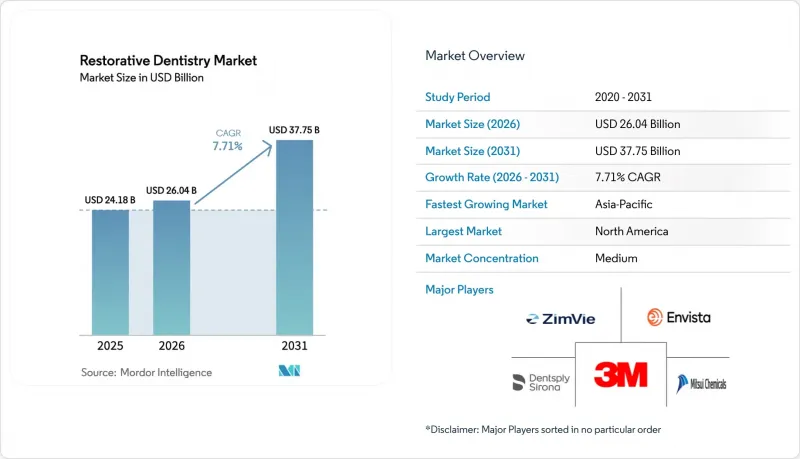
This report is Segmented by Product (Restorative Materials, Implants, Prosthetics, Restorative Equipment), End-User (Dental Hospitals & Clinics, Dental Labs, Other End-Users), and Geography (North America, Europe, Asia-Pacific, Middle East & Africa, South America). The Market Forecasts are Provided in Terms of Value (USD).
Global Restorative Dentistry Market Trends and Insights
Growing Prevalence of Dental Caries and Tooth Loss
Worldwide, 2.37 billion caries cases were recorded, and incidence is rising fastest among adolescents and young adults. Untreated periodontal disease costs the United States economy an estimated USD 154 billion each year. In West Africa, some Nigerian studies show caries prevalence as high as 96%, illustrating a sizeable pool of unmet restorative need. Older adults compound clinical complexity because cumulative tooth loss and systemic comorbidities require longer chairtime and multidisciplinary coordination. These epidemiological trends keep procedure volumes high and stimulate ongoing material development that can withstand heavier occlusal loads while preserving esthetics. As a result, the restorative dentistry market continues to widen its customer base across age groups and income segments.
Technological Advancements in CAD/CAM and 3D Printing
Computer-aided design and manufacture now underpin most indirect restorations, delivering finer marginal fit and superior fracture resistance compared with conventional waxing techniques. The arrival of cloud-native intraoral scanners, such as Dentsply Sirona's Primescan 2 introduced in 2024, enables hardware-independent data capture that suits single-chair as well as multi-location practices. Artificial-intelligence engines embedded in design software enhance margin detection and propose optimal reduction paths, cutting design time and reducing remakes. Robotic-assisted surgery is emerging, with pilot studies showing robots prepare teeth faster than human clinicians while employing imaging modalities that eliminate ionizing radiation. Collectively, these innovations reduce laboratory dependencies, shorten appointment cycles, and elevate patient acceptance-key levers for revenue growth in the restorative dentistry market.
High Cost of Restorative Dental Procedures
Advanced restorative workflows often involve premium materials, multi-visit protocols, and sophisticated capital equipment. U.S. practices absorbed 10% import tariffs on dental devices and consumables in April 2025, a policy that escalated equipment and implant prices and squeezed profit margins. Volatile supply chains for zirconia and titanium further inflate costs, prompting some providers to defer technology upgrades. For patients, high out-of-pocket expenses deter acceptance of full-arch implant therapy, particularly in emerging economies where public insurance rarely covers elective treatment. This price sensitivity narrows the addressable audience and tempers volume growth in the restorative dentistry market.
Other drivers and restraints analyzed in the detailed report include:
- Rising Geriatric Population Globally
- Increasing Demand for Cosmetic and Aesthetic Dentistry
- Limited Reimbursement for Elective Treatments
For complete list of drivers and restraints, kindly check the Table Of Contents.
Segment Analysis
Restorative materials contributed 42.12% to restorative dentistry market share in 2025, underscoring their irreplaceable role across direct fillings, inlays, onlays, and indirect prostheses. The restorative dentistry market size for materials stood near USD 10.2 billion in 2025 and is growing steadily as zirconia, resin-nanoceramic hybrids, and bioactive cements capture share from legacy amalgams. Multilayer zirconia blocks that sinter at optimized temperatures deliver esthetic translucency for anterior regions while retaining 1,000 MPa strength suitable for posterior bridges. Ongoing research into antimicrobial composites and ion-releasing liners promises to extend restoration longevity, keeping replacement cycles strong.
Restorative equipment, meanwhile, is set to register a 9.3% CAGR through 2031-outpacing all other categories-as clinics and laboratories replace standalone milling units with integrated cloud-based ecosystems. The restorative dentistry market size tied to equipment investments is projected to surpass USD 15.1 billion by 2031, driven by intraoral scanners, chairside mills, and 3D printers that shrink turnaround time from weeks to hours. Dentsply Sirona's Primescan 2 exemplifies the shift: its open architecture allows seamless data flow to any mill or printer, lowering hardware lock-in and broadening adoption. The spread of AI-driven quality assurance modules further shortens learning curves and curbs remake rates, reinforcing equipment-driven revenue gains.
Complete Report Scope:
- By Product
- Restorative Materials
- Direct Restorative Materials
- Indirect Restorative Materials
- Biomaterials
- Bonding Agents / Adhesives
- Impression Materials
- Implants
- Prosthetics
- Restorative Equipment
- CAD/CAM Systems
- Handpieces
- Rotary Instruments
- Casting Equipment
- Other Restorative Equipments
- Restorative Materials
- By End-User
- Dental Hospitals & Clinics
- Dental Labs
- Other End-Users
- Geography
- North America
- United States
- Canada
- Mexico
- Europe
- Germany
- United Kingdom
- France
- Italy
- Spain
- Rest of Europe
- Asia-Pacific
- China
- Japan
- India
- Australia
- South Korea
- Rest of Asia-Pacific
- Middle East & Africa
- GCC
- South Africa
- Rest of Middle East & Africa
- South America
- Brazil
- Argentina
- Rest of South America
- North America
Geography Analysis
North America delivered 39.92% of restorative dentistry market share in 2025, underpinned by robust insurance penetration and early adoption of digital workflows. FDA guidance issued in October 2024 under the Safety and Performance Based Pathway clarified performance criteria for endosseous implants and dental ceramics, accelerating product approvals. However, import tariffs enacted in April 2025 inflate acquisition costs for scanners and implants, challenging practice profitability. Leading suppliers such as Dentsply Sirona reported a 3.5% organic sales decline in 2024 yet continue to fund cloud-platform rollouts aimed at offsetting pricing pressure.
Asia-Pacific is the fastest-growing region, set to post an 8.29% CAGR as urban middle-income populations widen access to elective care. Straumann Group achieved 33.8% organic growth in Asia-Pacific during 2024 on the back of its AlliedStar intraoral scanner launch and localized implant production in China. Government dental-awareness campaigns and rising private insurance uptake boost procedural demand, while local manufacturers such as Osstem Implant advance acquisition strategies to cement regional leadership. Rapid digitalization allows clinics to leapfrog analog workflows, further enlarging the restorative dentistry market.
Europe maintains steady expansion, sustained by aging demographics and stringent product standards that favor premium solutions. Harmonized Medical Device Regulations, coupled with structured reimbursement schemes, encourage the diffusion of bioactive materials and AI-supported diagnostic platforms. Straumann's EMEA operations logged 11.4% organic growth in Q3 2024, driven by education initiatives that advance clinician competence in fully digital implant protocols. Workforce shortages resembling those in North America are accelerating investment in chairside CAD/CAM and robotic assistance, reinforcing efficiency gains across the region.
- 3M
- Dentsply Sirona
- Envista
- Mitsui Chemicals
- Straumann Group
- ZimVie
- Septodont
- Ivoclar Vivadent
- Coltene Holding
- GC Corporation
- Henry Schein
- Align Technology
- Planmeca
- Carestream Dental
- VOCO
- SHOFU Inc.
- Kavo Dental
- Kuraray Noritake Dental Inc.
- Bisco, Inc.
- SDI
- DMG Chem-Pharma-Fabrik GmbH
- Nobel Biocare Services
Additional Benefits:
- The market estimate (ME) sheet in Excel format
- 3 months of analyst support
TABLE OF CONTENTS
1 Introduction
- 1.1 Study Assumptions & Market Definition
- 1.2 Scope of the Study
2 Research Methodology
3 Executive Summary
4 Market Landscape
- 4.1 Market Overview
- 4.2 Market Drivers
- 4.2.1 Growing Prevalence of Dental Caries and Tooth Loss
- 4.2.2 Rising Geriatric Population Globally
- 4.2.3 Technological Advancements in CAD/CAM And 3D Printing
- 4.2.4 Increasing Demand for Cosmetic and Aesthetic Dentistry
- 4.2.5 Expansion of Value-Based Dental Insurance Models
- 4.2.6 Integration of Teledentistry for Postoperative Care
- 4.3 Market Restraints
- 4.3.1 High Cost of Restorative Dental Procedures
- 4.3.2 Limited Reimbursement for Elective Treatments
- 4.3.3 Shortage of Skilled Dental Technicians and Prosthodontists
- 4.3.4 Volatile Prices of Zirconia and Other Premium Materials
- 4.4 Regulatory Landscape
- 4.5 Porter's Five Forces Analysis
- 4.5.1 Threat of New Entrants
- 4.5.2 Bargaining Power of Buyers
- 4.5.3 Bargaining Power of Suppliers
- 4.5.4 Threat of Substitutes
- 4.5.5 Intensity of Competitive Rivalry
5 Market Size & Growth Forecasts (Value, USD)
- 5.1 By Product
- 5.1.1 Restorative Materials
- 5.1.1.1 Direct Restorative Materials
- 5.1.1.2 Indirect Restorative Materials
- 5.1.1.3 Biomaterials
- 5.1.1.4 Bonding Agents / Adhesives
- 5.1.1.5 Impression Materials
- 5.1.2 Implants
- 5.1.3 Prosthetics
- 5.1.4 Restorative Equipment
- 5.1.4.1 CAD/CAM Systems
- 5.1.4.2 Handpieces
- 5.1.4.3 Rotary Instruments
- 5.1.4.4 Casting Equipment
- 5.1.4.5 Other Restorative Equipments
- 5.1.1 Restorative Materials
- 5.2 By End-User
- 5.2.1 Dental Hospitals & Clinics
- 5.2.2 Dental Labs
- 5.2.3 Other End-Users
- 5.3 Geography
- 5.3.1 North America
- 5.3.1.1 United States
- 5.3.1.2 Canada
- 5.3.1.3 Mexico
- 5.3.2 Europe
- 5.3.2.1 Germany
- 5.3.2.2 United Kingdom
- 5.3.2.3 France
- 5.3.2.4 Italy
- 5.3.2.5 Spain
- 5.3.2.6 Rest of Europe
- 5.3.3 Asia-Pacific
- 5.3.3.1 China
- 5.3.3.2 Japan
- 5.3.3.3 India
- 5.3.3.4 Australia
- 5.3.3.5 South Korea
- 5.3.3.6 Rest of Asia-Pacific
- 5.3.4 Middle East & Africa
- 5.3.4.1 GCC
- 5.3.4.2 South Africa
- 5.3.4.3 Rest of Middle East & Africa
- 5.3.5 South America
- 5.3.5.1 Brazil
- 5.3.5.2 Argentina
- 5.3.5.3 Rest of South America
- 5.3.1 North America
6 Competitive Landscape
- 6.1 Market Concentration
- 6.2 Market Share Analysis
- 6.3 Company Profiles (includes Global level Overview, Market level overview, Core Business Segments, Financials, Headcount, Key Information, Market Rank, Market Share, Products and Services, and analysis of Recent Developments)
- 6.3.1 3M Company
- 6.3.2 Dentsply Sirona
- 6.3.3 Envista Holdings Corporation
- 6.3.4 Mitsui Chemicals, Inc.
- 6.3.5 Institut Straumann AG
- 6.3.6 ZimVie Inc.
- 6.3.7 Septodont Holding
- 6.3.8 Ivoclar Vivadent AG
- 6.3.9 COLTENE Holding AG
- 6.3.10 GC Corporation
- 6.3.11 Henry Schein, Inc.
- 6.3.12 Align Technology, Inc.
- 6.3.13 Planmeca Oy
- 6.3.14 Carestream Dental LLC
- 6.3.15 VOCO GmbH
- 6.3.16 SHOFU Inc.
- 6.3.17 KaVo Dental
- 6.3.18 Kuraray Noritake Dental Inc.
- 6.3.19 Bisco, Inc.
- 6.3.20 SDI Limited
- 6.3.21 DMG Chem-Pharma-Fabrik GmbH
- 6.3.22 Nobel Biocare Services AG
7 Market Opportunities & Future Outlook
- 7.1 White-space & Unmet-need Assessment

