PUBLISHER: Mordor Intelligence | PRODUCT CODE: 2116572

PUBLISHER: Mordor Intelligence | PRODUCT CODE: 2116572
Artificial Intelligence In Diagnostics - Market Share Analysis, Industry Trends & Statistics, Growth Forecasts (2026 - 2031)
According to Mordor Intelligence, the artificial intelligence in Diagnostics market size was valued at USD 1.77 billion in 2025 and estimated to grow from USD 2.33 billion in 2026 to reach USD 9.32 billion by 2031, at a CAGR of 31.88% during the forecast period (2026-2031).
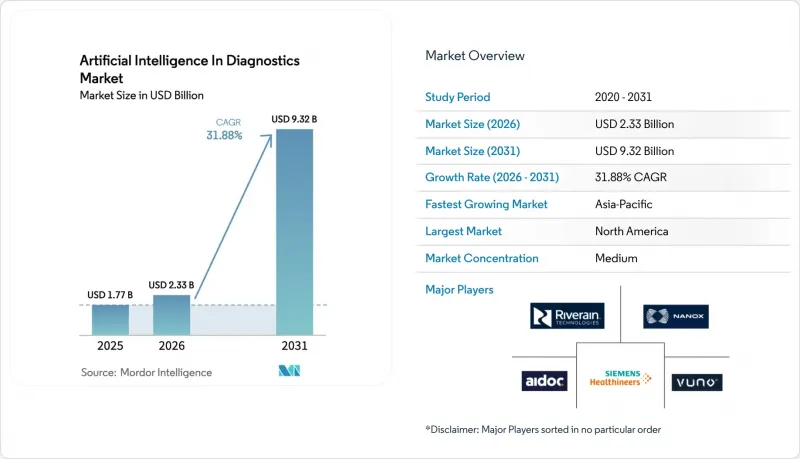
This report Segments the Industry Into by Type (In Vitro Diagnostics, Diagnostic Imaging, Other Types), by Application (Cardiology, Oncology, Neurology, Obstetrics/ Gynecology, Other Applications), by End-User (Hospitals, Diagnostic Imaging Centers, Diagnostic Laboratories, Other End-Users), and Geography (North America, Europe, Asia-Pacific, Middle East and Africa, South America).
Global Artificial Intelligence In Diagnostics Market Trends and Insights
Increasing demand for AI tools in medical imaging & workload reduction
Worldwide shortages of radiologists intensify interest in automation. Siemens Healthineers reports that its AI-Rad Companion Chest CT reduces report preparation time by up to 74%, freeing specialists for complex cases . Emergency departments see similar gains: RapidAI's stroke-triage model delivers 98% sensitivity, accelerating door-to-needle decisions. Imaging networks such as RadNet spent more than USD 54 million on AI acquisitions in 2024 alone to preserve turnaround speed and referral loyalty.
Administrators also cite reduced burnout and fewer repetitive stress injuries among sonographers after AI-guided scanning protocols. As imaging volumes keep rising faster than staff rosters, the Artificial Intelligence in Diagnostics market becomes core infrastructure rather than optional add-on.
Government incentives accelerating AI adoption
National policies now combine grants, standards and payment reform. The U.S. HHS AI Strategy earmarks funding for hospital pilots and codifies an HHS AI Council for ongoing governance. In Europe, the EU AI Act classifies diagnostic imaging algorithms as "high-risk," but offers regulatory sandboxes and harmonized conformity assessment, lowering multi-country launch costs. Legislatures in 34 U.S. states debated over 250 AI-related healthcare bills in 2025, many mandating coverage or setting liability shields for AI-guided diagnosis. In emerging Asian markets, public procurement programs subsidize cloud-hosted inference services so rural clinics can access city-grade image reading without on-site radiologists.
Reluctance among medical practitioners to adopt AI
Clinicians worry about loss of autonomy, liability exposure and algorithmic opacity. A 2024 survey of Polish physicians found that only 32% were fully comfortable delegating image interpretation to AI, despite 68% agreeing it improves throughput . Experienced radiologists voice concerns that atypical cases fall outside training data, requiring nuanced human judgment. Cost adds friction: department chairs identified procurement expense as the primary roadblock even when quality benefits were acknowledged. Finally, job-security fears linger; almost half of surveyed nurses expressed unease about AI replacing certain tasks, though structured training programs significantly improved acceptance rates.
Other drivers and restraints analyzed in the detailed report include:
- Surge in venture & strategic funding for AI-diagnostics start-ups
- FDA fast-track 510(k) clearances for AI diagnostic devices
- High procurement & lifecycle-maintenance costs
For complete list of drivers and restraints, kindly check the Table Of Contents.
Segment Analysis
Diagnostic imaging captured 57.64% of the Artificial Intelligence in Diagnostics market share in 2025, leveraging decades of archived DICOM files that enable supervised deep-learning at scale. Foundation models, pre-trained on millions of X-ray, CT and MRI slices, now deliver organ-agnostic workflows that read multiple pathologies in one pass. Vendors such as GE HealthCare pair these algorithms with edge processors embedded directly in detectors, cutting latency and reducing data-center fees. The Artificial Intelligence in Diagnostics market size for imaging is projected to expand steadily as autonomous acquisition protocols reduce retakes and standardize quality, making AI indispensable in resource-tight departments.
In vitro diagnostics (IVD) is the fastest-growing modality, set to scale at a 32.9% CAGR through 2031. Pattern-recognition networks classify genomic variants, metabolomic spectra and microbial signatures with higher specificity than rule-based analyzers. The Artificial Intelligence in Diagnostics market size for IVD will benefit from turnkey cloud APIs that deliver assay interpretation to small labs without dedicated data scientists. Digital pathology sits at the intersection of imaging and IVD; slide scanners feed whole-slide images into convolutional nets that mark tumor margins and grade inflammation, allowing pathologists to focus on complex differential diagnoses.
Complete Report Scope:
- By Diagnostic Modality
- In Vitro Diagnostics
- Molecular Diagnostics
- Immunoassays & Clinical Chemistry
- Point-of-Care Tests
- Diagnostic Imaging
- MRI
- CT
- X-ray
- Ultrasound
- PET/SPECT & Others
- Digital Pathology
- Other Modalities
- In Vitro Diagnostics
- By Application
- Oncology
- Cardiology
- Neurology
- Infectious Disease
- Obstetrics & Gynecology
- Respiratory & Pulmonology
- Other Applications
- By End-User
- Hospitals
- Diagnostic Laboratories
- Ambulatory Surgical Centers
- Other End-Users
- By Geography
- North America
- United States
- Canada
- Mexico
- Europe
- Germany
- United Kingdom
- France
- Italy
- Spain
- Rest of Europe
- Asia-Pacific
- China
- Japan
- India
- South Korea
- Australia
- Rest of Asia-Pacific
- Middle East
- GCC
- South Africa
- Rest of Middle East
- South America
- Brazil
- Argentina
- Rest of South America
- North America
Geography Analysis
North America remains the epicenter, accounting for 53.48% of global revenue in 2025. Early FDA clearances-129 radiology AI devices since 2015-established a precedent that de-risked pilot budgets, while new CMS codes ensure monetization for stroke detection, cardiac CTA analysis and breast-cancer triage. Strategic collaborations are a hallmark: GE HealthCare and NVIDIA co-develop autonomous imaging suites to offset staff shortages, and Siemens Healthineers inks decade-long "value partnerships" bundling scanners, AI software and managed service agreements.
Europe follows closely. The EU AI Act mandates risk-based classification, model transparency and bias testing but also provides common technical documentation templates, accelerating cross-border market entry. Vendors like ThinkSono obtained CE marking for point-of-care ultrasound AI that guides novice operators through DVT scans, broadening the sonographer pool. National health systems in Germany, France and the Nordics run reimbursement pilots that tie AI performance to outcome-based bonuses.
Asia-Pacific is the fastest-growing territory. Government-backed electronic medical-record rollouts in India, Japan and South Korea generate structured image archives ideal for machine-learning. The National Health Authority of India and IIT Kanpur launched open-access datasets under IndiaAI to spur domestic algorithm development. Regional leaders like Qure.ai deployed tuberculosis triage across more than 90 districts, reporting 15 million cumulative patient scans. In China, hospital groups bundle AI lung-nodule detection with annual physicals, illustrating consumer-direct monetization outside insurance frameworks.
- Siemens Healthineers
- GE Healthcare
- Koninklijke Philips
- Aidoc
- Nanox (Imaging/Zebra Medical)
- Riverain Technologies
- VUNO Inc.
- Digital Diagnostics
- AliveCor
- Enlitic
- InformAI
- IBM
- Lunit
- Arterys
- Qure.ai
- Paige AI
- Viz.ai
- HeartFlow
- RapidAI
- Tempus
- DeepMind Health
- Oxipit
Additional Benefits:
- The market estimate (ME) sheet in Excel format
- 3 months of analyst support
TABLE OF CONTENTS
1 Introduction
- 1.1 Study Assumptions & Market Definition
- 1.2 Scope of the Study
2 Research Methodology
3 Executive Summary
4 Market Landscape
- 4.1 Market Overview
- 4.2 Market Drivers
- 4.2.1 Increasing demand for AI tools in medical imaging & workload reduction
- 4.2.2 Government incentives accelerating AI adoption
- 4.2.3 Surge in venture & strategic funding for AI-diagnostics start-ups
- 4.2.4 FDA fast-track 510(k) clearances for AI diagnostic devices (post-2024)
- 4.2.5 Foundation-model integration enabling multimodal diagnostics
- 4.2.6 Emergence of CMS reimbursement codes for AI algorithms
- 4.3 Market Restraints
- 4.3.1 Reluctance among medical practitioners to adopt AI
- 4.3.2 High procurement & lifecycle-maintenance costs
- 4.3.3 Algorithmic bias triggering regulatory scrutiny
- 4.3.4 Fragmented data-interoperability standards
- 4.4 Value / Supply-Chain Analysis
- 4.5 Regulatory Landscape
- 4.6 Technological Outlook
- 4.7 Porter's Five Forces Analysis
- 4.7.1 Threat of New Entrants
- 4.7.2 Bargaining Power of Buyers
- 4.7.3 Bargaining Power of Suppliers
- 4.7.4 Threat of Substitutes
- 4.7.5 Competitive Rivalry
5 Market Size & Growth Forecasts (Value)
- 5.1 By Diagnostic Modality
- 5.1.1 In Vitro Diagnostics
- 5.1.1.1 Molecular Diagnostics
- 5.1.1.2 Immunoassays & Clinical Chemistry
- 5.1.1.3 Point-of-Care Tests
- 5.1.2 Diagnostic Imaging
- 5.1.2.1 MRI
- 5.1.2.2 CT
- 5.1.2.3 X-ray
- 5.1.2.4 Ultrasound
- 5.1.2.5 PET/SPECT & Others
- 5.1.3 Digital Pathology
- 5.1.4 Other Modalities
- 5.1.1 In Vitro Diagnostics
- 5.2 By Application
- 5.2.1 Oncology
- 5.2.2 Cardiology
- 5.2.3 Neurology
- 5.2.4 Infectious Disease
- 5.2.5 Obstetrics & Gynecology
- 5.2.6 Respiratory & Pulmonology
- 5.2.7 Other Applications
- 5.3 By End-User
- 5.3.1 Hospitals
- 5.3.2 Diagnostic Laboratories
- 5.3.3 Ambulatory Surgical Centers
- 5.3.4 Other End-Users
- 5.4 By Geography
- 5.4.1 North America
- 5.4.1.1 United States
- 5.4.1.2 Canada
- 5.4.1.3 Mexico
- 5.4.2 Europe
- 5.4.2.1 Germany
- 5.4.2.2 United Kingdom
- 5.4.2.3 France
- 5.4.2.4 Italy
- 5.4.2.5 Spain
- 5.4.2.6 Rest of Europe
- 5.4.3 Asia-Pacific
- 5.4.3.1 China
- 5.4.3.2 Japan
- 5.4.3.3 India
- 5.4.3.4 South Korea
- 5.4.3.5 Australia
- 5.4.3.6 Rest of Asia-Pacific
- 5.4.4 Middle East
- 5.4.4.1 GCC
- 5.4.4.2 South Africa
- 5.4.4.3 Rest of Middle East
- 5.4.5 South America
- 5.4.5.1 Brazil
- 5.4.5.2 Argentina
- 5.4.5.3 Rest of South America
- 5.4.1 North America
6 Competitive Landscape
- 6.1 Market Concentration
- 6.2 Market Share Analysis
- 6.3 Company Profiles (includes Global level Overview, Market level overview, Core Segments, Financials as available, Strategic Information, Market Rank/Share for key companies, Products & Services, and Recent Developments)
- 6.3.1 Siemens Healthineers
- 6.3.2 GE HealthCare
- 6.3.3 Philips Healthcare
- 6.3.4 Aidoc
- 6.3.5 Nanox (Imaging/Zebra Medical)
- 6.3.6 Riverain Technologies
- 6.3.7 VUNO Inc.
- 6.3.8 Digital Diagnostics
- 6.3.9 AliveCor
- 6.3.10 Enlitic
- 6.3.11 InformAI
- 6.3.12 IBM Watson Health
- 6.3.13 Lunit
- 6.3.14 Arterys
- 6.3.15 Qure.ai
- 6.3.16 Paige AI
- 6.3.17 Viz.ai
- 6.3.18 HeartFlow
- 6.3.19 RapidAI
- 6.3.20 Tempus
- 6.3.21 DeepMind Health
- 6.3.22 Oxipit
7 Market Opportunities & Future Outlook
- 7.1 White-space & Unmet-need Assessment

